Forest, Granite Bowl

Forest, Granite Bowl

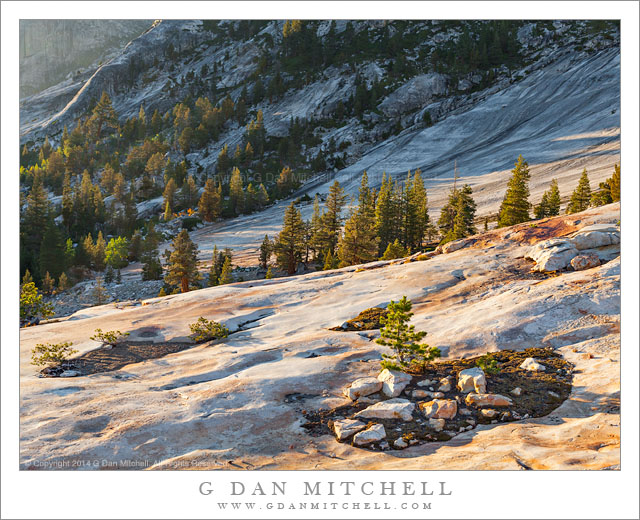
Forest, Granite Bowl. Yosemite National Park, California. September 8, 2014. © Copyright 2014 G Dan Mitchell – all rights reserved.

Evening light on forests and a glaciated granite bowl, Yosemite National Park

Large slabs of nearly unbroken granite, left behind in the wake of ancient glaciers, are a prominent and characteristic feature of the high country of Yosemite National Park. There is granite all of the Sierra, but this granite often seems to me to be more intact, and rather than encountering fields of broken rock it is common to come across these beautiful structures of exfoliating granite, often still with areas of smooth and reflective glacial polish. Scattered trees have taken hold in surprisingly thin cracks.

This bowl is in such a characteristic place, in the bottom of a great river canyon, just where it begins to become narrower and steeper. The area clearly shows the effects of glaciation, from the smooth rock in the canyon bottom to the sculpted domes and faces above. I have photographed in this bowl before on several occasions, and despite shooting there many times I continue to find new ways to see it every time I visit.


G Dan Mitchell is a California photographer and visual opportunist whose subjects include the Pacific coast, redwood forests, central California oak/grasslands, the Sierra Nevada, California deserts, urban landscapes, night photography, and more.
Blog | About | Flickr | Twitter | FacebookGoogle+ | 500px.com | LinkedIn | Email

Text, photographs, and other media are © Copyright G Dan Mitchell (or others when indicated) and are not in the public domain and may not be used on websites, blogs, or in other media without advance permission from G Dan Mitchell.
Autumn Morning, Fremont River Valley

Autumn Morning, Fremont River Valley

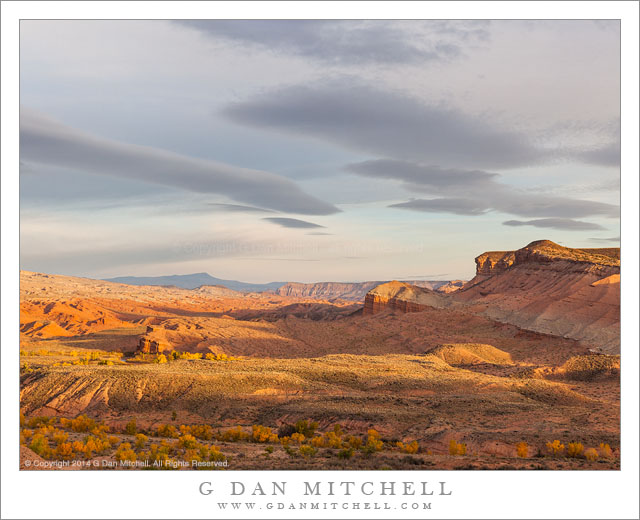
Autumn Morning, Fremont River Valley. Capitol Reef National Park, Utah. October 22, 2014. © Copyright 2014 G Dan Mitchell – all rights reserved.

Autumn morning light and clouds above the valley of the Fremont River

Technically this location is actually just outside of Capitol Reef National Park, but its close enough. The plan on this morning was to make a journey down the east side of the park to a somewhat more remote area, so we started out rather early. After passing through the park and starting the drive to our eventual destination we quickly realized that a fairly unusual and spectacular sunrise was underway, so we found the first available location from which to take advantage of the situation.

This was most definitely not a blah blue sky morning! A variety of clouds filled a good portion of the sky in several directions, though light was able to pass through gaps in the clouds to the east. Above the peaks of Capitol Reef to the west the sky was generally darkened by high clouds that briefly took on rosy dawn colors before fading. To the north were lenticular clouds, some lined up in formations that reminded me of California’s “Sierra wave” clouds. When I saw these clouds and this light, the obvious question was what to put in a photograph that included them — so I quickly wandered over the a high point above the valley of the Fremont River from which I could photograph across the sunlit valley to include the spectacular clouds and darker peaks in the distance.


G Dan Mitchell is a California photographer and visual opportunist whose subjects include the Pacific coast, redwood forests, central California oak/grasslands, the Sierra Nevada, California deserts, urban landscapes, night photography, and more.
Blog | About | Flickr | Twitter | FacebookGoogle+ | 500px.com | LinkedIn | Email

Text, photographs, and other media are © Copyright G Dan Mitchell (or others when indicated) and are not in the public domain and may not be used on websites, blogs, or in other media without advance permission from G Dan Mitchell.
Dry Mud and Sand

Dry Mud and Sand
Dry Mud and Sand

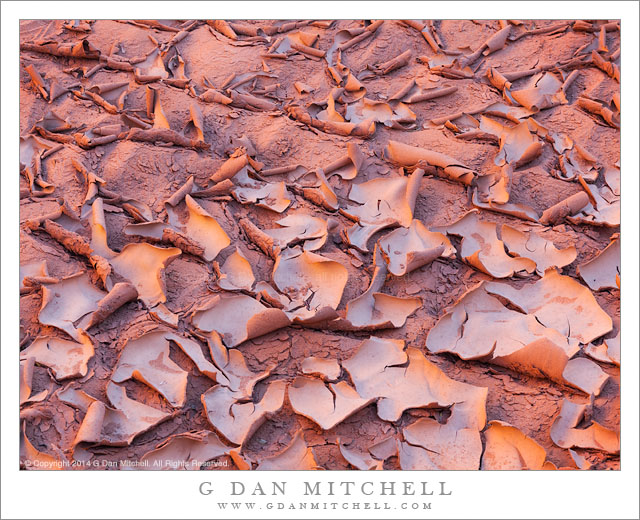
Dry Mud and Sand. Grand Staircase-Escalante National Monument, Utah. October 25, 2014.© Copyright 2014 G Dan Mitchell – all rights reserved.

A dry and curled layer of mud atop red sand in the bottom of a Utah canyon

It might be amusing for “normal people” to encounter a group of photographers in the bottom of a narrow Utah canyon, where the photographers might be found clustered attentively and enthusiastically around… dry mud. That was the case here, as a group of use suddenly halted our progress down a small (though much larger later on) canyon to set up tripods, fit just the right lenses, and spend about a half hour making photographs of mud.

However, as is often the case in landscape photography, it turns out that even dried mud may have a lot more going on than a casual glance would suggest. For people who are not particularly conscious of their “seeing,” it would be easy to walk past and think, “that curled mud is very interesting” and not pay much more attention to it. However, a bit of time spent in these narrow canyon walls teaches you to become alert to the possibility that you might be missing certain things. One bit of visual magic in these canyons happens during the middle part of the day, when the sun directly strikes the red rock canyon walls and reflects this red-saturated light down into the bottom of the canyon. Once you train yourself to see past what your visual system tells you it is seeing (brown mud) you can begin to see the intensely red coloration of this light and even begin to notice that there is a blue component where direct light from the open sky reflects off of some surfaces. And then, you may also find yourself intently focusing on making a photograph of a small patch of dry and cracked mud sitting atop red sand.


G Dan Mitchell is a California photographer and visual opportunist whose subjects include the Pacific coast, redwood forests, central California oak/grasslands, the Sierra Nevada, California deserts, urban landscapes, night photography, and more.
Blog | About | Flickr | Twitter | FacebookGoogle+ | 500px.com | LinkedIn | Email

Text, photographs, and other media are © Copyright G Dan Mitchell (or others when indicated) and are not in the public domain and may not be used on websites, blogs, or in other media without advance permission from G Dan Mitchell.
About Tripods (Morning Musings 11/4/14)

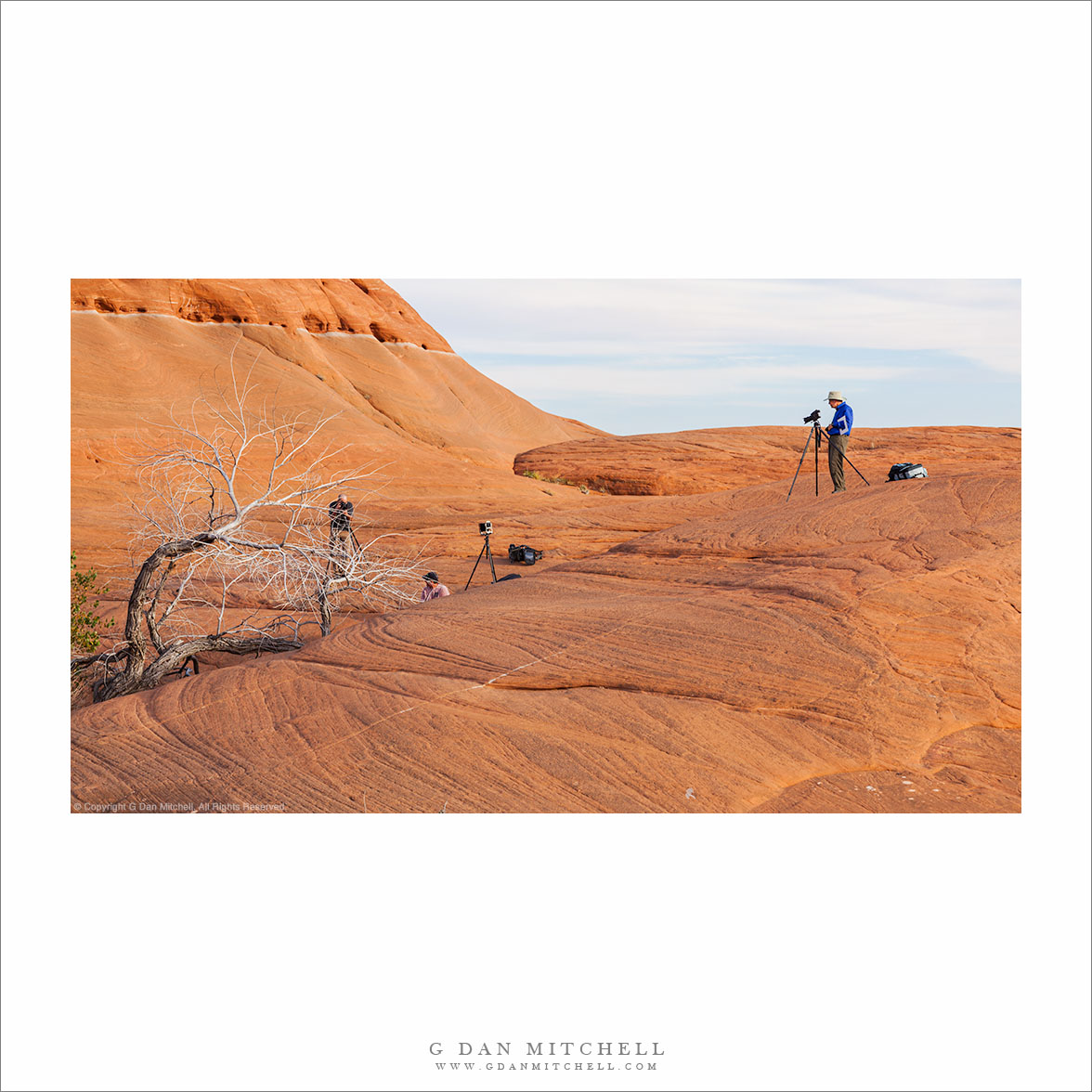
Working the Red Rock Landscape
“Working the Red Rock Landscape” — Photographers at work in Utah’s red rock country

Morning Musings are back! Today I have a few general thoughts about tripods — not aimed at those who are already confirmed tripod users, but rather at those who find it hard to bother using them.

To start, let’s admit that one does not always need a tripod. For certain types of photography in which quick response is required and being too obviously a photographer can interfere with photographs, it is usually better to not use one. There are exceptions to every rule, but you are unlikely to use a tripod for most street photography, for personal and family photography at home and on vacations, for certain kinds of portrait work, casual travel photography, and so on.

Let’s also agree that using a tripod is a burden, especially at first when you haven’t accepted the extra trouble and when you haven’t developed instincts that make tripod use a lot more automatic. I’ll readily admit to being less than thrilled on about the 50th time that I must remove my tripod from the car or pack, extend and lock the legs, level the thing, attach the camera, and only then make a photograph… after which I have to reverse the process: remove the camera, collapse the tripod legs, stow the thing once again. The slightly put-upon feeling diminishes as you get used to it, but it never goes away entirely. (The good news here is that the process of setting up and using the tripod does eventually become much quicker and much more automatic.)

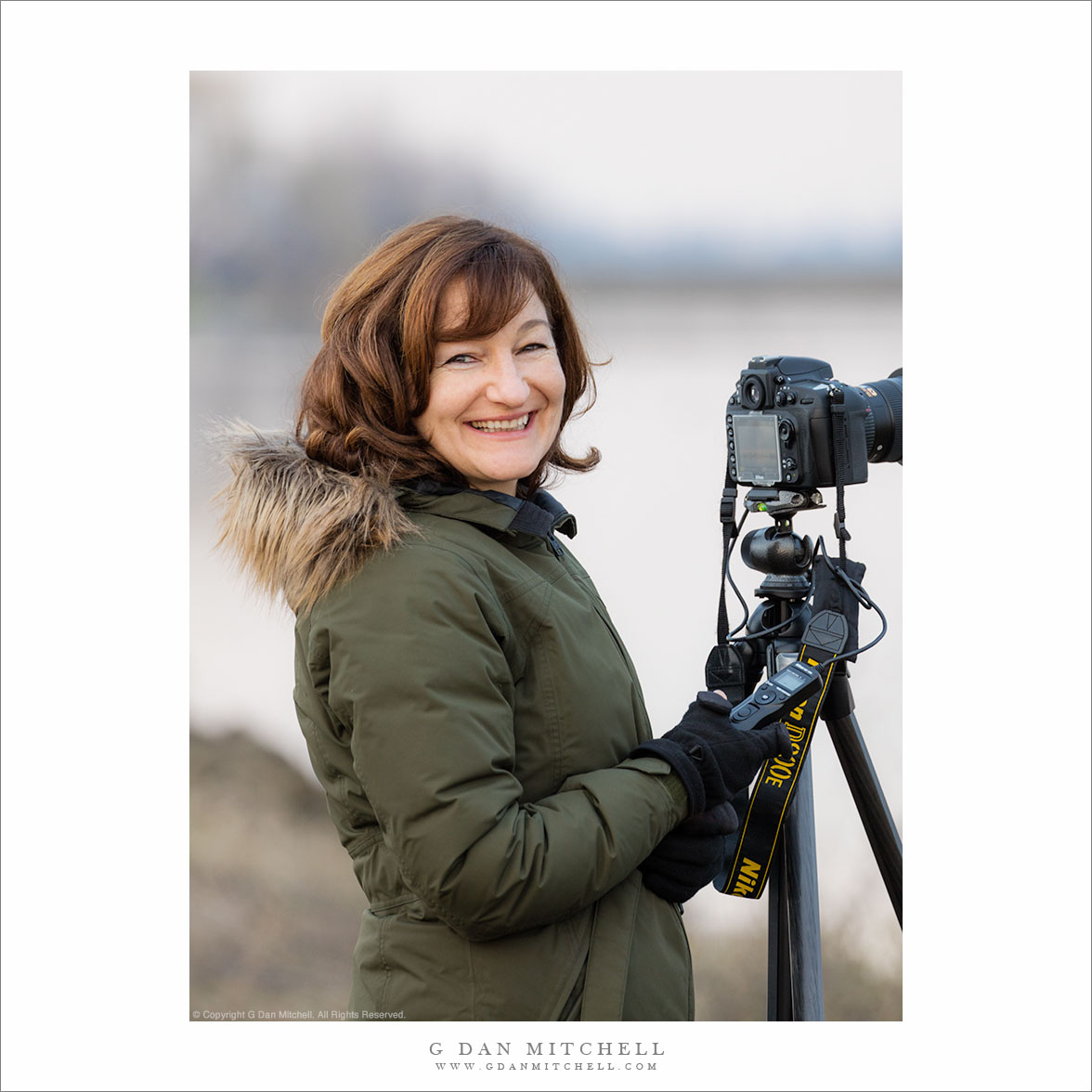
Photographer Franka M. Gabler
“Photographer Franka M. Gabler” — Franka M. Gabler in the field photographing in the San Joaquin Valley

So, why use it then? There are more reasons than you might imagine.

Stability is an obvious advantage of the tripod. While you can, with care and practice, often hold a camera quite steadily and produce very sharp images when shooting handheld, you simply cannot eliminate all of the blur that comes when you hold the camera in your hands. And if you do happen to have very steady hands, you still will make mistakes that produce blur — working a bit too fast you may introduce a bit of camera vibration in some shots and you will reduce the number of successful results. A good tripod used correctly can virtually eliminate camera motion and vibration. This is especially important when doing types of photography that intrinsically require longer shutter speeds. This obviously includes night photography. Low light, low ISO, long lenses, and small apertures often require landscape photographers to use rather long shutter speeds.

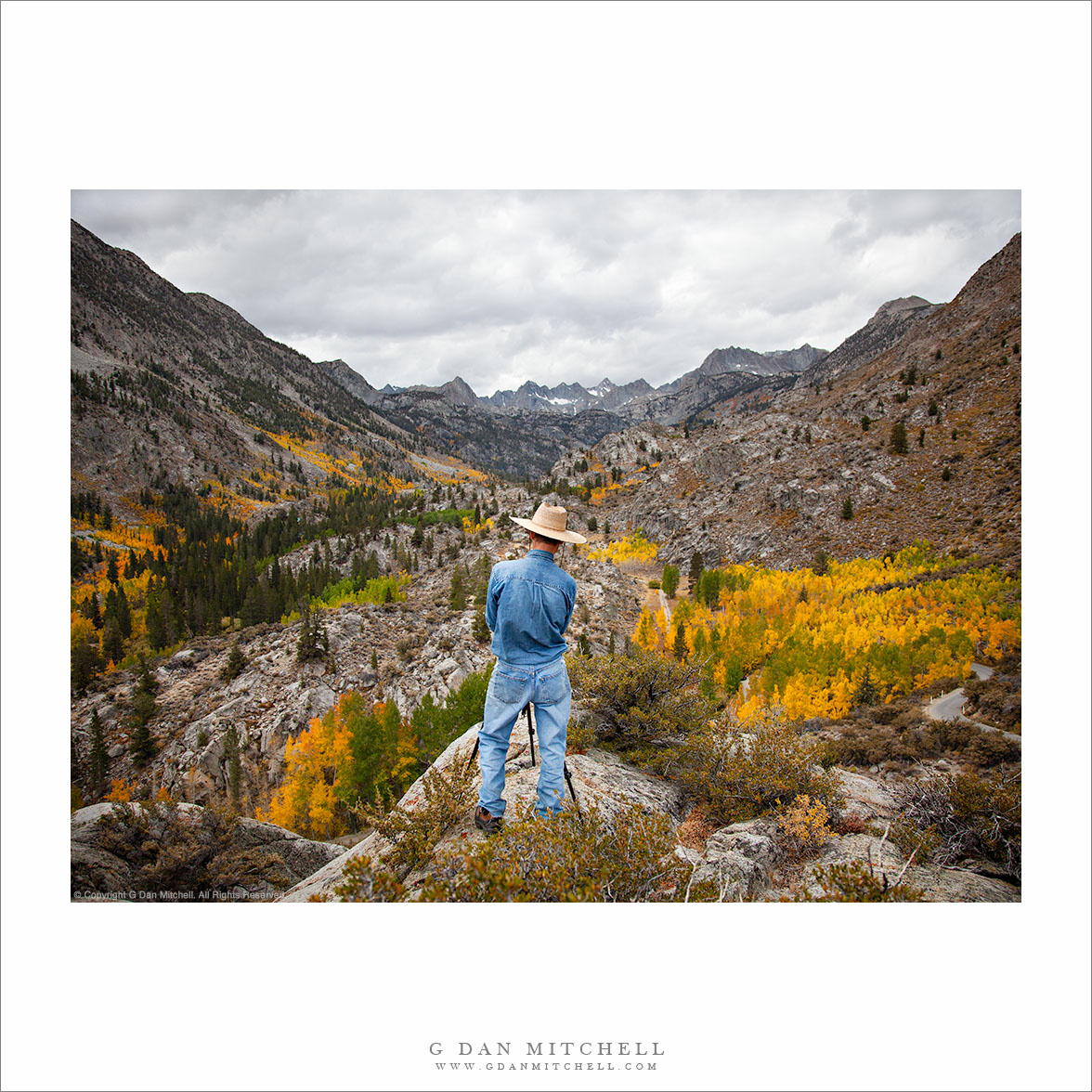
Photographer, Sabrina Basin
“Photographer, Sabrina Basin” — A photographer working the autumn colors from a ridgetop in Sabrina Basin, Sierra Nevada, as an early fall storm comes in.

High resolution cameras can capture images that may be reproduced at much larger sizes, and at those sizes the effects of minor camera stability issues become more visible. If you want to take advantage of such cameras’ potential for higher image resolution, the stability that comes with tripod use can be critical.

Continue reading About Tripods (Morning Musings 11/4/14)

Photographer and visual opportunist. Daily photos since 2005, plus articles, reviews, news, and ideas.