Reader Questions (April 2013)

Blog readers and others occasionally send me questions, and I like to reply publicly so that others who are interested in these topics can also see the answers. Here are a few from the past few weeks. (Some posts are edited slightly here.)

Dave writes:

“I recently was reading a thread here where you posted about the 24-105 vs the 24-70. First I wanted to say thanks for your perspective. I had every intention of selling the 24-105 after much of the hoopla I’ve read about it not being so great and ordering the 24-70 MKII. My first day out with the 5D3 was in a museum (No flash) and the IS on the 24-105 in combination with the ISO on the 5D3 gave me shots I never would have thought possible. In short I’m very happy with the 24-105 when I had zero expectation of keeping it.

The question I have is that my 24-105 does have a fair amount of distortion @ 24mm and I noticed you also use the 17-40. Do you find the 17-40 a better performer @ 24mm and do you like the 17-40 in general?”

There are several interesting questions here, so let me try to take them one at at time.

First, though, an article I wrote a while back that looked at the pluses of the 24-105mm lens: In Praise of the Canon EF 24-105mm f/4 IS L lens

Image stabilization (IS) versus larger apertures – The maximum aperture of the Canon 24-105mm f/4L IS is f/4. An f/2.8 maximum aperture is available on a Canon 24-70mm zoom and larger apertures come on a number of primes. This would seem to leave the f/4 zoom in the dust for low light photography – but maybe not. In situations where the limiting factor is camera stability (and the photographer’s ability to hold the camera steady at low shutter speeds), IS can provide several stops of additional low light performance if the subject is not moving too fast and/or if some subject motion blur is acceptable or even desired. In a situation like this one – photographing in a museum – the IS can work in light that would require a f/1.4 lens without IS. In addition, working at f/4 gives you slightly more depth of field. This can make focus just a bit less critical – important when working handheld with AF – let you keep more of the subject in focus.

Distortion at 24mm on the 24-105mm f/4L IS – One of the perceived negatives of this lens is that it shows more barrel distortion (a bowing outward of the image along the sides of the frame) at 24mm. It also exhibits more corner light fall off (or vignetting) at the largest apertures and especially at wide angles. In most cases you won’t notice either of these, but if you image contains lines parallel to the frame edges you may well see the barrel distortion when shooting at 24mm and you may well see the vignetting at f/4. (All lenses vignette to some extent – so it isn’t a question of whether a lens vignettes, but of how much. Most wide zooms will also show at least some barrel distortion.)

I rarely notice the barrel distortion. First, most of the time I shoot at focal lengths that don’t exhibit the issue. Second, when I do shoot at 24mm the issue is not visible with most subjects. But sometimes it will be visible at 24mm. However, most current raw conversion software auto-corrects for this. Some worry that this will diminish image resolution, but I’ve look for degradation and I cannot see it. Likewise, the software can automatically correct for vignetting and do so in ways that are essentially imperceptible. However, keep in mind that vignetting can be a beneficial effect in your photograph – in fact, it is not uncommon for photographers to add some in post! It serves to diminish the importance of peripheral parts of your image and can bring more attention to central elements.
Continue reading Reader Questions (April 2013)

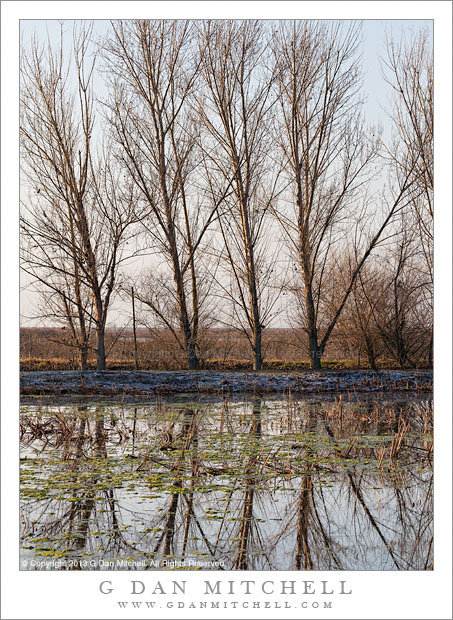
Trees and Pond, Winter Morning

Trees and Pond, Winter Morning

Trees and Pond, Winter Morning. San Joaquin Valley, California. January 21, 2013. © Copyright 2013 G Dan Mitchell – all rights reserved.

A row of winter trees stands along a frost-rimmed San Joaquin Valley pond

To me, this photograph looks deceptively warm, perhaps due to the warm color of some of the light and the distant fields beyond the trees. The truth is that it was freezing cold! The temperature was in the upper 20’s (cold for Californians!) and the air was damp as it always is this time of year in these marshy valley lowlands and there was thick frost on the ground.

We were here to photograph migratory birds once again. At this location, an official wildlife refuge, a perimeter road circles the place, and it is pretty much our routine to circle it more than once on our visits. The first pass is typically right around dawn, as was the case this time, and often seems to be in thick or – if we are lucky – clearing fog. Later circuits often reveal changing light, thinning fog, different birds, and warmer temperatures – until a final trip around the loop usually concludes with us shooting into the dusk period until there is no longer enough light for photography. Near one corner of the loop there is a parking area, an observation deck, and nearby short trail. (Hiking is not permitted in most of the refuge, as people hidden in cars are apparently perceived to be less threatening by the birds.) When we stop here I almost always do at least a momentary transition from wildlife photographer to landscape photographer and make a few photographs that don’t include birds at all. This pond and the row of bare trees on a levee along one side have attracted my attention almost every time I visit here, and seem to suggest to me something about the vast flat agricultural terrain of this part of the valley.

G Dan Mitchell is a California photographer and visual opportunist whose subjects include the Pacific coast, redwood forests, central California oak/grasslands, the Sierra Nevada, California deserts, urban landscapes, night photography, and more.
Blog | About | Flickr | Twitter | FacebookGoogle+ | 500px.com | LinkedIn | Email

Text, photographs, and other media are © Copyright G Dan Mitchell (or others when indicated) and are not in the public domain and may not be used on websites, blogs, or in other media without advance permission from G Dan Mitchell.

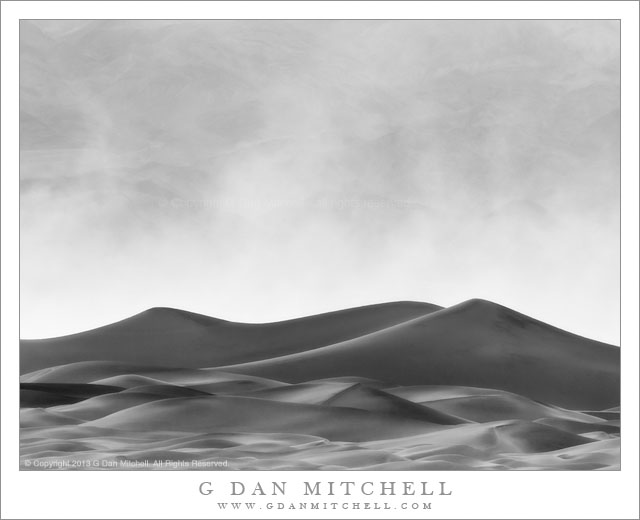
Sandstorm, Dunes

Sandstorm, Dunes
Sandstorm, Dunes

Sandstorm, Dunes. Death Valley National Park, California. April 4, 2013. © Copyright 2013 G Dan Mitchell – all rights reserved.

Strong winds lift clouds of sand high into the air above desert sand dunes, Death Valley National Park.

Sandstorms are common in Death Valley, especially when I visit, typically in the spring. I wasn’t totally surprised (nor totally pleased!) when one arose on the second day of this early April visit. After photographing all morning, I was back in camp to get something to eat and take care of camp business before heading back out in the mid-afternoon for the second shoot of the day. As I sat by my camp I saw a few pillars of dust out in the valley near dunes, and at that point I had a pretty good idea of what might be in store for me in the next few hours. It wasn’t long before the wind began to pick up, soon becoming strong enough to stir up a lot of dust and blow down any weak tents left by campers who had headed out for daytime activities elsewhere.

In objective terms, a sandstorm is an unpleasant thing. It is hot. It is dry. It is full of blowing sand and dust, and the fine dust gets into everything, no matter what you do to try to protect against it. In the worst cases, the blowing sand can damage the paint on vehicles. However, in visual terms, a sandstorm can be quite interesting – as long as you can find ways to shoot it that don’t risk destroying your photographic gear. It looked to me like the main storm was in the middle of the valley, so I figured I might be able to cross the valley, take road along the other side, and skirt the far edge of the storm, and photograph back into it with the light coming from behind. I drove across the valley and stopped right at the edge of the blowing sand and mostly shot from inside my vehicle so as to minimize the dust contamination. From this vantage point I could use a long lens to photograph the abstract shapes of sand dunes, backed by clouds of whirling and drifting sand that obscured the Cottonwood Mountains on the far side of the valley.

G Dan Mitchell is a California photographer and visual opportunist whose subjects include the Pacific coast, redwood forests, central California oak/grasslands, the Sierra Nevada, California deserts, urban landscapes, night photography, and more.
Blog | About | Flickr | Twitter | FacebookGoogle+ | 500px.com | LinkedIn | Email

Text, photographs, and other media are © Copyright G Dan Mitchell (or others when indicated) and are not in the public domain and may not be used on websites, blogs, or in other media without advance permission from G Dan Mitchell.

Abandoned Car, Desert Gully

Abandoned Car, Desert Gully

Abandoned Car, Desert Gully. Death Valley National Park, California. March 4, 2013. © Copyright 2013 G Dan Mitchell – all rights reserved.

An old and very weathered car abandoned to the elements in a desert mountain streambed.

There are many threads to the Death Vally story, and portions of these stories can be read by looking in the right places in the park. There is the geological story that involves seismic activity, a very old lake, and the surprising role of water in what is today a very dry place. Occasional remnants of their ancient presence tells the faint story of the people who lived here before Europeans arrived. And there is the story of extraction – prospecting and the mining of all sorts of materials, some of which has not ended even today. (There are a couple of inholdings within the larger boundaries of the park where mineral rights are maintained and mining work continues – a jarring sight the first time you encounter in while in a national park.)

Much of this work took place only a few decades ago, and the detritus of that period is still found throughout the park. A few examples are well-known, marked on maps, and even have directional signs and interpretive information displayed by the park. However, if you poke around even a little bit you’ll soon come across many other examples of old mines, tailings, buildings, automobiles, and more. (If you visit the park and see these things, please be very careful around them. They are deteriorating, and almost anything you do to disturb them will hasten that process and deprive future visitors of the experience that you are enjoying.) There is one such site that I have driven past many times, but where I have never stopped until this trip. Beyond the obvious artifacts that are visible from a passing road, the site continues. This time I stopped, got out of my car, and spent some time wandering up and old trail that heads up a gully and then switchbacks up a nearby hill. A ways up this hill, after passing some dilapidated buildings, I came to a gully that must have been the occupants’ automobile graveyard, since there were several very old, rusting vehicles in this gully, partially embedded in sand that must have washed down during rain.

G Dan Mitchell is a California photographer and visual opportunist whose subjects include the Pacific coast, redwood forests, central California oak/grasslands, the Sierra Nevada, California deserts, urban landscapes, night photography, and more.
Blog | About | Flickr | Twitter | FacebookGoogle+ | 500px.com | LinkedIn | Email

Text, photographs, and other media are © Copyright G Dan Mitchell (or others when indicated) and are not in the public domain and may not be used on websites, blogs, or in other media without advance permission from G Dan Mitchell.

Photographer and visual opportunist. Daily photos since 2005, plus articles, reviews, news, and ideas.