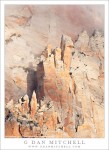
Juniper Tree and Sandstone Cliffs, Evening

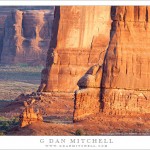
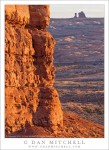
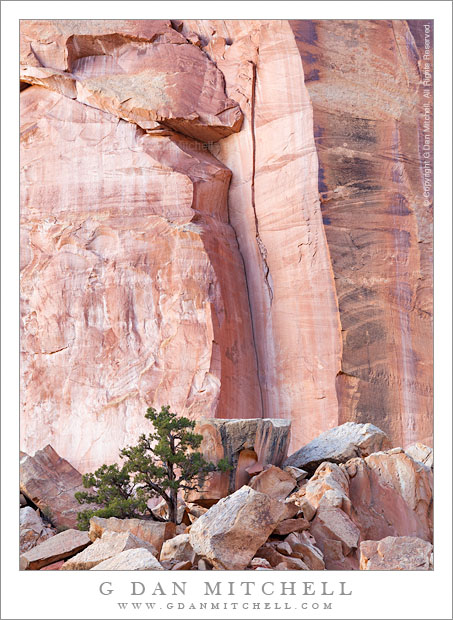
Juniper Tree and Sandstone Cliffs, Evening - Soft evening light on a single juniper tree among boulders at the base of tall sandstone cliffs, Capitol Reef National Park
Soft evening light on a single juniper tree among boulders at the base of tall sandstone cliffs, Capitol Reef National Park

Juniper Tree and Sandstone Cliffs, Evening. Capitol Reef National Park, Utah. October 26, 2012. © Copyright 2012 G Dan Mitchell – all rights reserved.

Soft evening light on a single juniper tree among boulders at the base of tall sandstone cliffs, Capitol Reef National Park

This photograph was a serendipitous one that resulted from going to a somewhat unlikely place, and going there without a whole lot of enthusiasm, having only modest success at that place, and then while leaving happening to look up at the right moment and spot some very interesting and somewhat unusual post-sunset light. The plot began with an evening last-minute decision to go shoot “somewhere” in Capitol Reef, but without a specific objective in mind. We perhaps had some thoughts about shooting along the descent from Torrey, Utah toward the park boundary, but this is tricky late in the day due to the way the terrain slants up to the west, causing the sun to drop below the elevated horizon rather early and stealing the light from the foreground terrain.

When we passed the park boundary we still didn’t have a clear idea of what the evening’s “target” might be, so we drove slowly into the park, looking at many things but not seeing quite the photographic opportunities that might have caused us to stop. We finally decided to investigate a large canyon and drove to its entrance, parked, and walked in a ways. Because of the orientation of this canyon, the light here also left us rather soon. We made some photographs – a few of which might even turn out to be interesting – and then headed back out of the canyon. The way passed along the base of a very tall sandstone cliff formed from one of the thicker layers of sedimentary rock. Typically the rock would appear darker and redder, but the soft post-sunset light changed the tones to an almost pastel effect – and we both quickly decided to stop and do some shooting. This lone juniper trees was growing improbably in the middle of a pile of very large boulders that had fallen from the cliffs, and those cliffs were catching the late and soft light from the west.

G Dan Mitchell is a California photographer whose subjects include the Pacific coast, redwood forests, central California oak/grasslands, the Sierra Nevada, California deserts, urban landscapes, night photography, and more.
Blog | About | Flickr | Twitter | FacebookGoogle+ | 500px.com | LinkedIn | Email

Text, photographs, and other media are © Copyright G Dan Mitchell (or others when indicated) and are not in the public domain and may not be used on websites, blogs, or in other media without advance permission from G Dan Mitchell.
2012 Favorite Photographs – Final Candidates Gallery

These are my current forty (!) final candidates for my “2012 Favorite Photographs” post that I hope to share later this week. This is still way too many, and my target is to try to get the number down to about half of this. I’m happy to hear your feedback in whatever form works best for you: identifying one or a few favorites, suggesting your “top X number” of them from within the group, your favorites of each of the various types, or even suggestions of photographs of mine that are not included in this list.

If you didn’t already know, this is a tough job!

Some of my criteria for the final selection include:

  • representing a range of genres – landscape (both large and small), night photography, wildlife, urban landscape, nature, and so forth.
  • incorporating both color and monochrome work.
  • balancing representational work with photographs that are a bit more conceptual, atmospheric, and so forth.
  • recognizing work that others tell me they like.
  • sharing photographs that are personal favorite of mine.

The gallery thumbnails show below are small and may omit portions of images, so click on an image to see a larger version. Once you click on that first image you can use the right/left arrows to navigate through the larger versions of the photographs throughout the entire gallery.

Thanks for looking and for whatever feedback you are willing to share. (Leaving a comment below is a great way to do this.)

Dan

G Dan Mitchell is a California photographer and visual opportunist whose subjects include the Pacific coast, redwood forests, central California oak/grasslands, the Sierra Nevada, California deserts, urban landscapes, night photography, and more.
Blog | About | Flickr | Twitter | FacebookGoogle+ | 500px.com | LinkedIn | Email

Text, photographs, and other media are © Copyright G Dan Mitchell (or others when indicated) and are not in the public domain and may not be used on websites, blogs, or in other media without advance permission from G Dan Mitchell.

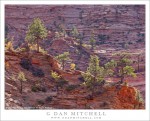
Trees and Receding Red Rock Hills

Trees and Receding Red Rock Hills - Sparse pines grow on low ledges in the high country red-rock sandstone, Zion National Park
Sparse pines grow on low ledges in the high country red-rock sandstone, Zion National Park

Trees and Receding Red Rock Hills. Zion National Park, Utah. October 22, 2012. © Copyright 2012 G Dan Mitchell – all rights reserved.

Sparse pines grow on low ledges in the high country red-rock sandstone, Zion National Park

Since I’ve posted several photograph of this particular terrain, there may not be a lot more to say about it beyond summarizing some of the basics. (And, yes, there will be more of this subject – though not too many more!) Out of the main park attraction of Zion Canyon and up in the high country, instead of being in a world of vertical cliffs that tower high above, it seems like we are more within than below the terrain. We can look down into washes and slot canyons, up to see sloping mountain sides, or straight across areas filled with slabs of curving sandstone on which various trees and bushes grow.

Here I lined up some backlit trees on a near ridge with those on a further ridge, with even more sloping ridges beyond. In the afternoon haze, the rocks combine their native red color with a bit of blue that comes from atmospheric haze, emphasized by backlight. And this same backlight lights up the needles of the trees, turning them almost white in places.

G Dan Mitchell is a California photographer whose subjects include the Pacific coast, redwood forests, central California oak/grasslands, the Sierra Nevada, California deserts, urban landscapes, night photography, and more.
Blog | About | Flickr | Twitter | FacebookGoogle+ | 500px.com | LinkedIn | Email

Text, photographs, and other media are © Copyright G Dan Mitchell (or others when indicated) and are not in the public domain and may not be used on websites, blogs, or in other media without advance permission from G Dan Mitchell.
Post-Processing: A Shadow Recovery Example

Note that this is an older article from 2012. While the concepts are largely the same with contemporary cameras and software, some aspects of the article are now a bit date.

(In another forum someone asked a question – actually, more like posed a challenge – related to how much usable detail and quality could be extracted from a raw file that contained areas of very low luminosity, as could happen with a badly underexposed image or with an image of a scene with a very large dynamic range. Since I went to the work of responding and illustrating my response, I figured that I might as well share it here, too. With minor revisions, here it is.)

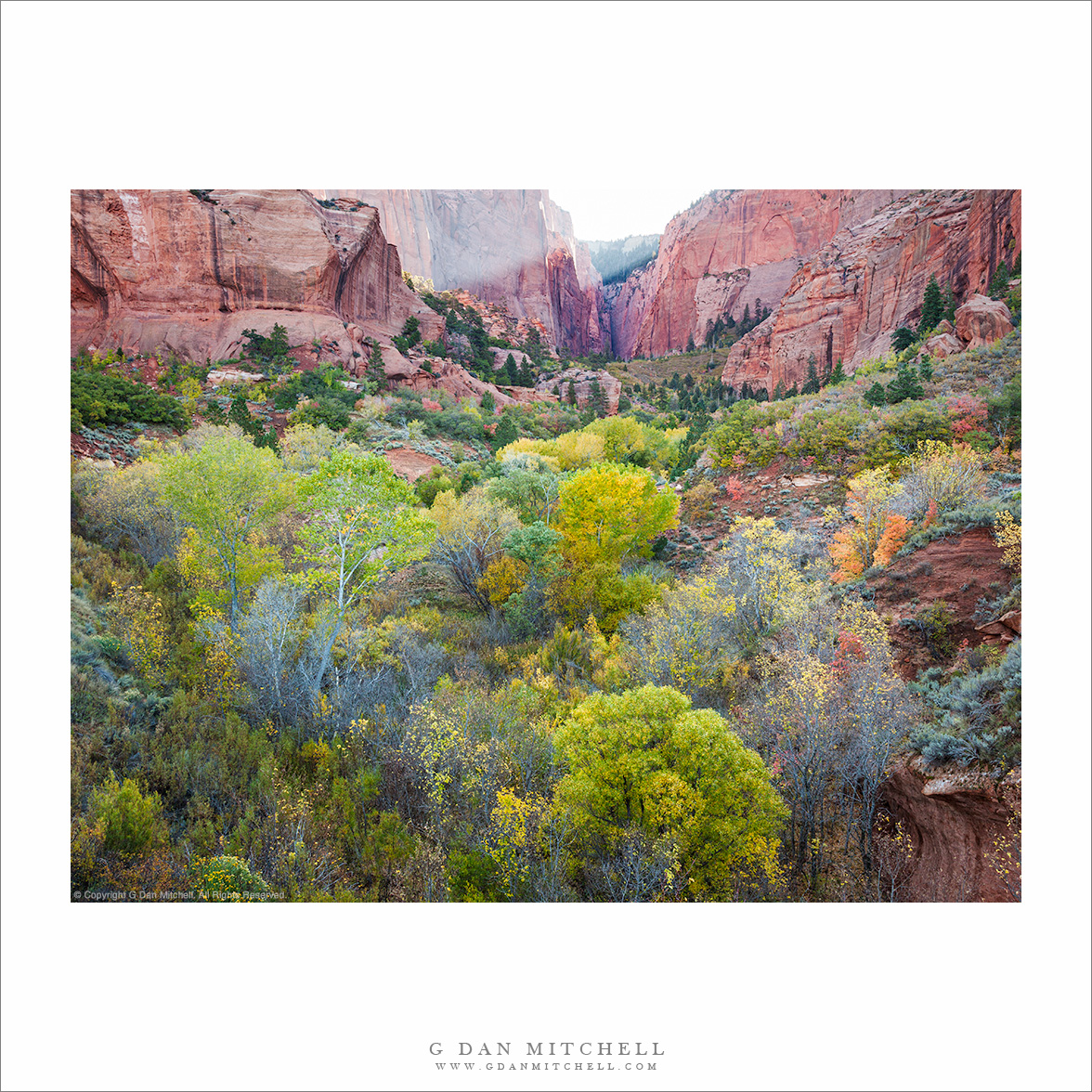
First, I actually have a “real” version of this photograph in which highlights were slightly blown, but which I preferred to use since I could bring them back in post and get a bit more shadow detail to start with. (It looks a bit bright to me as an on-screen jpg, but it makes a fine print.) That photograph ended up looking like this:

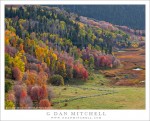
Morning light slants over the top of sandstone cliffs above early autumn foliage in Kolob Canyon, Zion National Park

This photograph and the other I’ll move to below were both shot from a tripod with a Canon EOS 5D Mark II at ISO 100 using the Canon EF 24-105mm f/4L IS at f/16. While the “keeper” used for the photograph above had a 1/4 second exposure, the example I’ll use below was shot at 1/30 second.

The exposure challenge in this scene was the very large dynamic range between the bright spot of sky at the head of the canyon and the much darker colorful foliage in relatively deep shadow in the foreground. Exposing for optimal quality in the foreground would completely blow out the sky, while exposing for the sky would necessarily grossly underexpose the foreground.

I originally thought that I might like to have four bracketed exposures in case that would let me produce a better final image via layer blending, but it turned out to be unnecessary and the final image (as shown above) has a single source file with no blending. However, this means that I still happen to have one very badly underexposed (by three stops) version at 1/30 second which I’ll use here as the starting point for what I plan to illustrate in this post. Follow along with me and see what I can do with the very underexposed version of the file…

Continue reading Post-Processing: A Shadow Recovery Example

Photographer and visual opportunist. Daily photos since 2005, plus articles, reviews, news, and ideas.