
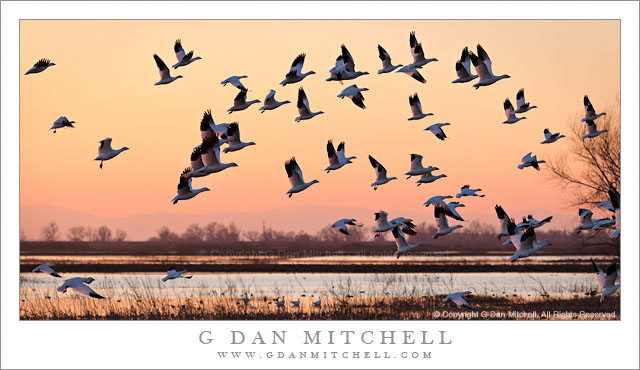
Ross’s Geese Take Flight, Dusk

Ross's Geese Take Flight, Dusk - A flock of Ross's geese take flight at dusk above a Central Valley pond, California.
A flock of Ross's geese take flight at dusk above a Central Valley pond, California.

Ross’s Geese Take Flight, Dusk. Central Valley, California. February 8, 2012. © Copyright 2012 G Dan Mitchell – all rights reserved.

A flock of Ross’s geese take flight at dusk above a Central Valley pond, California.

Yes, another photograph of geese taking flight above a California Central Valley pond. I can’t help myself! :-) After photographing the dwindling flock, as they left in large groups during the hour before sunset, at the point of most beautiful light there were only a few left. This group was among the very last to depart from this pond, and at this point it was dusk and the colors had gone from the crisp blues of an hour earlier to warm pinks and reds and purples. We were lucky enough to be very close to this large flock for at least an hour.

I’ll use this photograph to make another technical observation. I made what might seem like an odd choice regarding exposure for this shot. Here I wanted to try to stop the motion of the birds as they lifted off. (In other photographs of this subject I intentionally allow the motion to blur.) This meant that I needed a relatively short shutter speed. Even after raising the ISO to 400 and opening up the largest aperture on this long lens, the result was still going to be underexposure. for what I had in mind for this sequence of shots, I wanted to avoid using an ultra-high ISO with the attendant increase in noise. So I chose to deliberately underexpose these shots by perhaps a couple of stops, trusting that I’d be able to compensate for this in post since I shoot in raw mode. In other words, if you are the sort who scans EXIF data for exposure information and then tries to make sense out of it or even use it yourself… you have been warned! :-)

G Dan Mitchell is a California photographer whose subjects include the Pacific coast, redwood forests, central California oak/grasslands, the Sierra Nevada, California deserts, urban landscapes, night photography, and more.
Blog | About | Flickr | Twitter | FacebookGoogle+ | 500px.com | LinkedIn | Email

Text, photographs, and other media are © Copyright G Dan Mitchell (or others when indicated) and are not in the public domain and may not be used on websites, blogs, or in other media without advance permission from G Dan Mitchell.
Canon EOS 5D Mark III Digital Camera – First Thoughts

As a photographer who uses the previous Canon EOS 5D II, I have been watching the news leading up to this week’s announcement of the Canon EOS 5D Mark III. The 5D series has been notable for providing top-notch image quality by means of a full frame sensor at a price point that, when the 5D was first introduced, was  a major breakthrough. Since that time, the 5D cameras have continued to provide excellent value and, more important, great image quality for Canon photographers doing work that benefits from the full frame sensors.

I won’t recount the whole list of camera specifications here, but I would like to comment on some highlights and their implications:

  • 22.3 megapixel full frame sensor – In light of Nikon’s recent announcement of the 36MP D800 at about $3000, some who are interested in the greatest possibly sensor resolution were hoping for something comparable in the 5D3, so let me deal with the sensor right off the bat. While the 5D3 increases the MP count by roughly 1MP, this difference is essentially negligible when it comes to image resolution, so for all intents and purposes the 5D3 supplies the same resolution as the 5D2. Time will tell whether or not there are other significant differences in the quality of images captured at this resolution, but those who were waiting for a 5D3 primarily because they wanted to upgrade from a 5D2 to a camera with greater resolution may be disappointed. It appears that Canon focused its efforts elsewhere with the 5D3. To be fair, that “elsewhere” includes some pretty compelling improvements in other areas, and the fact is that 22MP produces truly excellent resolution – for example, making making excellent 20″ x 30″ prints.
  • ISO 100-25600 (extended range to ISO 50 and ISO 102400) – The continual improvement in the performance of DSLRs at higher ISO values is, in many ways, revolutionizing SLR photography. It was only a decade or less ago when the idea of shooting with any level of quality at an ISO above 100,000 would have been thought ludicrous – yet, here we are! You are not going to shoot at that ISO for typical photography, but this camera does continue to push the boundaries of high ISO that you can use. This makes it possible do do things that were extremely difficult or even impossible a few years ago: doing nighttime street photography, shooting action subjects like wildlife and sports in very low light, shooting indoors without flash, relying less on expensive large-aperture primes, and so forth.
  • 61-point autofocus system with 41 cross-type points and 5 dual diagonal AF points – As fine as the 5D2 is as a photograph producing system, its AF system was never anything to crow about. It was (and is) functional and effective, but hardly state of the art. However, in the 5D3, Canon seems to have addressed this concern, giving the camera a much improved set of AF features that should please those who want to use it for photographing moving subjects, and make the camera significantly more capable for photographing in low light and for shooting wildlife, sports, and similar.
  • Optimized metering system – The description sounds interesting… but, in my view, the metering system of the 5D2 was not particularly weak. I’ll chalk this one up to useful and interesting increment improvement until I hear otherwise.
  • Up to 6 frames-per-second continuous shooting (“burst mode”) – The improvements here are two-fold. First, the continuous shooting rate has been increase from slightly less than 4 fps on the 5D2 (not much different from the older 5D) to 6 fps. While some may point out that even faster frame rates are available on cameras optimized for such shooting, 6fps is actually pretty darn fast and will be quite good for almost all users. Second, and perhaps at least as important, the buffer depth has been improved. If I read the specifications correctly, the 5D3 can capture up to 18 raw format frames  at 6 fps. That is really, really great news from my perspective. The older versions not only worked more slowly but their buffers filled much more quickly, at which point the continuous mode frame rate dropped to an almost unusable rate. For this reason, we might have chosen to switch to the jpg mode in the past – but with the ability to shoot 18 frames of raw quality in burst mode… I would be a very happy photographer, indeed!
  • High Dynamic Range (HDR) and multiple exposure modes – I’ll put these in the category of “may be interesting or even compelling” to some photographers. The inclusion of features designed for capturing HDR images is not unexpected, since there are many situations in which HDR techniques can be used to either produce the trademark “HDR effect” or for more subtle effects that improve photographs of scenes with extremely large dynamic range. The multiple exposure mode is an interesting thing in a few ways. For one, it returns a capability to SLR cameras that was lost for the most part when we left film behind.
  • Improved HD video – I’m not a “video guy,” so I don’t have a lot to say about this one. However, people I know who are focused on using DSLRs to produce video tell me that the improvements to the video specifications are significant and welcome. A simple bottom line might be that if you are among those who were excited by the ability to use your SLR lenses and the larger sensor of the 5D2 to make video, then you will likely be very pleased by the 5D3.
  • Dual CF/SD card – We have previously seen the inclusion of dual CF and SD memory card slots in high-end DSLR bodies, and it is good to see this feature added to the 5D3. There are several reasons to like this. Many DSLR photographers already own quantities of CF cards and don’t want to give up the ability to use them – who wants to have to use different card formats for different cameras? So a photographer using two bodies – not that uncommon – will be able to move cards between them with less worry about format compatibility. In addition, the smaller SD cards are becoming much more common. For example, a number of laptops now come with built-in SD card slots, eliminating the need for an external card reader. On top of that, if you use both types of cards in the camera you can record different formats on each card, make an in-camera backup copy of your photographs for safekeeping, or have the camera automatically switch from one card to another when the first card is full.
I’ll end by considering a few basic questions that various photographers might be asking:
  • “I have a 5D. Should I upgrade?” Unless the cost of the newer camera is an impediment, I think that the 5D3 is a very worthy upgrade from the original 5D. The difference between 12MP and 22MP is significant if you are producing large, high quality prints. Even more than that, the functional improvements are significant. They are not limited to those listed above but include a number of features missing from the older 5D: live view mode, video, better high ISO performance, the improved AF system, and more.
  • “I have a cropped sensor camera. Should I upgrade? The answer here is a bit trickier and it depends a lot on your needs and your circumstances. If you are mostly sharing your photographs electronically, you are getting fine quality images from your current camera, and it is a recent enough model that it includes most of the newer features, there may not be a great reason for you to upgrade. On the other hand, if you are the sort of shooter who will benefit from the full frame sensor, this could be a great time to make your move to a 5D3.
  • “I have a 5D2. Should I upgrade?”  This is a tough one, and I think it depends on why you want to upgrade and what benefits you are looking for in a newer camera. If you mostly shoot from the tripod and are largely happy with the overall performance of your 5D2, then upgrading to the 5D3 may or may not be worth it. There are situations in which it might be a more attractive idea. For example, if you tend to move to the newest model and keep the previous model as your backup/second camera, you might end up with a 5D2 and a 5D3, both with very similar image quality – and that could be a good thing. Or if you have a 5D2 and like it, but really feel that you need the improved burst mode and AF features of the 5D3, the upgrade could be more attractive to you.
  • “I wanted a higher MP count 5D-series camera!” – OK, that’s not a question. But I certainly have heard the concern among photographers who had been anticipating a camera with a 30+MP sensor, especially after Nikon introduced the 36MP D800. This is a bigger topic than I’ll take on in its entirety right here, but I do have a few initial thoughts. First, do you really need more than 22 MP? If you think so mainly because “more is always better,” you may not. As I mentioned earlier, I can reliably produce really excellent 20″ x 30″ prints from the 21MP 5D2. Are your needs greater than mine? Second, while I have no inside information, I’m pretty certain that the 5D3 will not be the last camera that Canon produces nor will 22MP be the highest MP sensor that they produce…

So, final verdict? Well, it may be too soon for a final verdict since we don’t actually have the camera yet! But a few generalizations seem possible. The camera will produce excellent image quality – more than enough for virtually all DSLR photographers. The improvements in ISO, burst mode, AF, video, and more seem to be significant and compelling. I think it is going to be a very successful camera.

Please feel free to leave a comment with your thoughts or questions.

(If you find my reviews useful in making your purchase decisions, please consider purchasing via links on this site from site-sponsor B&H Photo. The following links go to a pre-order page at B&H.)

Preorder the 5D3 from site affiliate B&H:
Canon EOS 5D Mark III Digital Camera (Body Only)
Canon EOS 5D Mark III Digital Camera Kit with Canon 24-105mm f/4L IS USM AF Lens 

G Dan Mitchell is a California photographer whose subjects include the Pacific coast, redwood forests, central California oak/grasslands, the Sierra Nevada, California deserts, urban landscapes, night photography, and more.
Blog | About | Flickr | Twitter | FacebookGoogle+ | 500px.com | LinkedIn | Email

Text, photographs, and other media are © Copyright G Dan Mitchell (or others when indicated) and are not in the public domain and may not be used on websites, blogs, or in other media without advance permission from G Dan Mitchell.

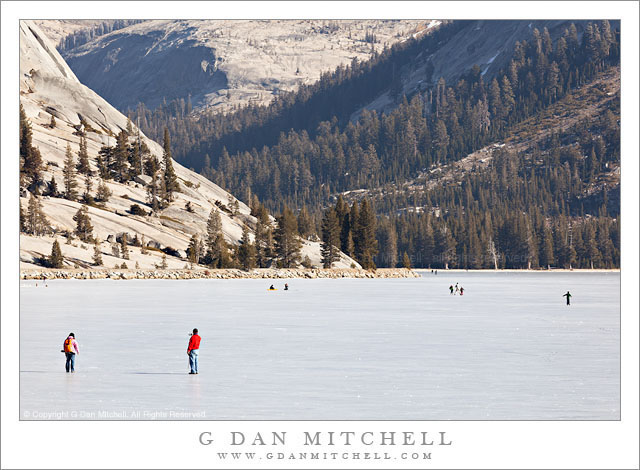
Tenaya Lake, January 2012

Tenaya Lake, January 2012 - Skaters and walkers on frozen Tenaya Lake, accessible via the still-open Tioga Pass Road on January 16, 2012.
Skaters and walkers on frozen Tenaya Lake, accessible via the still-open Tioga Pass Road on January 16, 2012.

Tenaya Lake, January 2012. Yosemite National Park, California. January 16, 2012. © Copyright 2012 G Dan Mitchell – all rights reserved.

Skaters and walkers on frozen Tenaya Lake, accessible via the still-open Tioga Pass Road on January 16, 2012.

I have been meaning to post this photograph since I made it last month, on January 16, 2012. The serious California drought (or so it seems) of 2012 created very unusual conditions in the Sierra this winter. The Tioga Pass Road (highway 120) through Yosemite National Park usually closes by some time in November, and has been known to close as early as October. The early season this year made it appear that we might have a normal or even heavier than normal winter – early storms near the beginning of October brought a lot of snow to the range and temporarily closed the road more than once. But by December it became clear that this was not going to be a normal year at all, and by the end of the month there was almost no snow anywhere in the range.

A week before this visit I had crossed and re-crossed the pass on a trip to Death Valley. While I appreciated the convenience and shorter drive, I found the odd conditions unnerving. Aside from a few patches here and there, I saw no snow at all, though the seasonal cold had frozen the high country lakes. A week later it looked like a storm or two might finally arrive, so we decided to make the trip up to the Tuolumne area to see the high country in a state that we probably (hopefully!) won’t see again. During the week before this visit, local news stations around California had made this story well known, and they almost all mentioned that people were visiting Tenaya Lake. And, indeed, there were tons of people at the lake when we arrived. There were about as many cars as you might see on an August afternoon. People were clustered along the frozen edge of the lake, were walking along its borders, even setting up tables for picnics on the ice. A few people thought to bring ice skates and they were skating great distances. (Fortunately for us, most people went no farther than Tenaya, and the crowds decreased rapidly after that point.)

G Dan Mitchell is a California photographer whose subjects include the Pacific coast, redwood forests, central California oak/grasslands, the Sierra Nevada, California deserts, urban landscapes, night photography, and more.
Blog | About | Flickr | Twitter | FacebookGoogle+ | 500px.com | LinkedIn | Email

Text, photographs, and other media are © Copyright G Dan Mitchell (or others when indicated) and are not in the public domain and may not be used on websites, blogs, or in other media without advance permission from G Dan Mitchell.

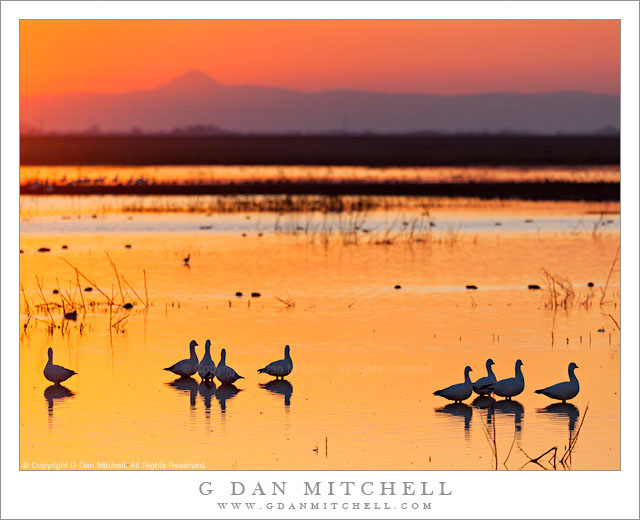
Ross’s Geese, Sunset, Central Valley

Ross's Geese, Sunset, Central Valley - Ross's geese in a Central Valley pond, sunset.
Ross's geese in a Central Valley pond, sunset.

Ross’s Geese, Sunset, Central Valley. Merced NWR, California. February 8, 2012. © Copyright 2012 G Dan Mitchell – all rights reserved.

Ross’s geese in a Central Valley pond, sunset.

Here I’m going to go with the slightly guilty pleasure of sharing a photograph with colors so intense they almost don’t fit in the color space of online jpg images! This was almost, but not quite, a last second “grab shot” as I looked up and saw a few geese remaining in this pond as the sun was slipping behind the ridge of the coast range. Not long before there had been thousands and thousands of these geese in the pond, but group by group they had all departed for wherever it is that the go at night… except for a very few stragglers, including this group. I like to think that they perhaps share my fondness for beautiful sunset light and had thus chosen to stick around a bit longer. ;-)

This isn’t a photograph that you can really quite plan. Because of the subjects that I had been shooting right before this, it happened that the sun was setting to the left of that compositionally-significant peak along the distant mountains. And fortunately everything was placed so that I could just barely keep the sun itself out of the frame on the left edge. And then I found myself looking at a small number of straggler geese still in the pond. I think I exposed perhaps three frames, and luckily for me they cooperated and assumed such interesting relative positions! One lone bird at the far left looking out of the frame; four of them near the opposite edge and lined up facing right; a group of three closely spaced and facing toward a central point; and one slightly separate from them and facing the opposite way from the bird at the far left. Wow. Talk about good fortune – or well-trained geese!

G Dan Mitchell is a California photographer whose subjects include the Pacific coast, redwood forests, central California oak/grasslands, the Sierra Nevada, California deserts, urban landscapes, night photography, and more.
Blog | About | Flickr | Twitter | FacebookGoogle+ | 500px.com | LinkedIn | Email

Text, photographs, and other media are © Copyright G Dan Mitchell (or others when indicated) and are not in the public domain and may not be used on websites, blogs, or in other media without advance permission from G Dan Mitchell.

Photographer and visual opportunist. Daily photos since 2005, plus articles, reviews, news, and ideas.