
Pasture, Estero, and Drakes Bay

Pasture, Estero, and Drakes Bay
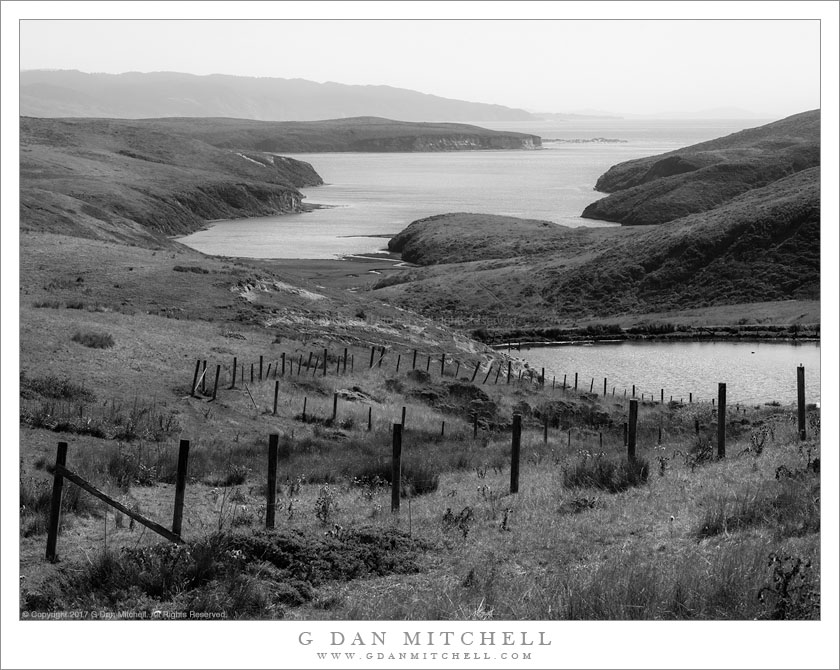
Looking across pastureland and Drakes Estero toward Drakes Bay and the California coast

Pasture, Estero, and Drakes Bay. Point Reyes National Seashore, California. October 15, 2017. © Copyright 2017 G Dan Mitchell – all rights reserved.

Looking across pastureland and Drakes Estero toward Drakes Bay and the California coast

I have a confession to make regarding Point Reyes. Although it is, relatively speaking, “in my local neighborhood” and I’ve gone there a lot, I have yet to fully wrap my mind around the place to the extent that I feel that I have fully photographed it or fully understand its character. I do have some photographs of the place that I like quite a bit, but when I go there I often find it more difficult to photograph than places like the Sierra, the Big Sur coast, California’s deserts, and similar. I love photographing the ocean, but here the features of the coast are perhaps more subtle, tending more toward beaches and bluffs and bay than to dramatic and rocky coastline. There are hills, but many are rather short, tend to be covered almost completely in forest in many cases, and tend to lack rocky outcroppings. The light can be very interesting, but there is often a fine line between too much and too little sun.

To summarize, I’m still working to figure out my vision of the place. Our most recent visit, in the middle of October during the northern California wildfires, was provided no exceptions to the challenge. There was no fog and the sky was almost clear… except that wildfire smoke often tended to blanket the terrain, producing a sort of yellow quality to the light. Because it is October, most of the green of meadows is long gone, and instead open areas are a kind of muted brown. Yet, I still want to photograph the place, and I know I’ll eventually “get it.” We did spend some time looking for photographs in the park this time, and this lovely inlet from Drakes Estero caught my attention as we traveled out toward the location of the Point Reyes Lighthouse. After we stopped and I looked more closely, I found the old stock fence to be an interesting addition to the photograph.


G Dan Mitchell is a California photographer and visual opportunist. His book, “California’s Fall Color: A Photographer’s Guide to Autumn in the Sierra” is available from Heyday Books and Amazon.
Blog | About | Flickr | Twitter | FacebookGoogle+ | LinkedIn | Email


All media © Copyright G Dan Mitchell and others as indicated. Any use requires advance permission from G Dan Mitchell.
Aspen Groves, Early Evening

Aspen Groves, Early Evening
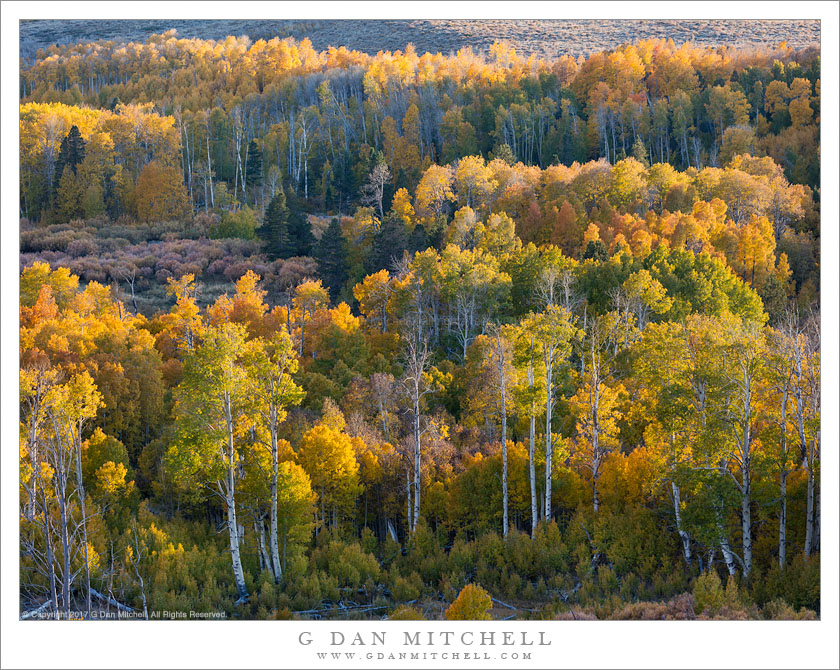
Early evening light on aspen groves with fall color, Eastern Sierra Nevada

Aspen Groves, Early Evening. Eastern Sierra Nevada, California. October 9, 2017. © Copyright 2017 G Dan Mitchell – all rights reserved.

Early evening light on aspen groves with fall color, Eastern Sierra Nevada

As with virtually all locations with fall color, especially the fall color of aspen trees, timing (and/or good luck about timing!) is everything. There are so many variables that can make or break a photograph of autumn color, and some of them are beyond our control. Precisely when does the color peak in a specific location? What are the effects of the preceding months of weather, from winter snows and summer rains to the temperature patterns? What about preceding days of weather — has it snowed, how cold has it been, have there been strong winds? On the day of the photograph, what are the clouds doing? Are you there at the ideal time of day — perhaps a time when there is some backlight on the trees and other distracting elements are perhaps less well-lit?

Sometimes it all comes together — or close enough — and you find a scene with beautiful color, few trees that have completely lost their leaves, perhaps a bit of green remaining, the light in the right place, and more. For what I was after I had a window of only a few minutes to make this photograph. You may have noticed that the evening shadow has already reached the very bottom of the frame, but that the light has softened and warmed enough to bring out the color in the trees. But what you cannot see in the photograph is that I came to this same location two prior times over the period of a week, one of them the previous night. On those visits it did not work quite right — clouds covered the sky, it was hazy, too many trees were green, near gale force winds were blowing, and more. A rule of landscape photography is that the more chances you give yourself, the greater the odds that you’ll be there when the elements all happen to fall together.


G Dan Mitchell is a California photographer and visual opportunist. His book, “California’s Fall Color: A Photographer’s Guide to Autumn in the Sierra” is available from Heyday Books and Amazon.
Blog | About | Flickr | Twitter | FacebookGoogle+ | LinkedIn | Email


All media © Copyright G Dan Mitchell and others as indicated. Any use requires advance permission from G Dan Mitchell.
Photographic Myths And Platitudes — Diffraction Limited Aperture

It has been a while since I posted an article in my “Photographic Myths And Platitudes” series — so here is a new one! It is a bit different than some of the previous posts in that it is based on something I wrote elsewhere in response to a lengthy (and long-winded!) discussion that suggested hyper-awareness of the so-called diffraction-limited aperture

What is the diffraction-limited aperture, you ask? It is a real thing — not a myth — though it is sometimes over-emphasized by overzealous techno-photographers.  In simple terms, as you stop down a lens its potential maximum resolution declines as a result of diffraction blur. (Keep in mind that other factors affect sharpness, too. Also, this happens to every lens, from the cheapest to the most expensive — it is a universal optical phenomenon.) At some aperture, the increase in blur becomes significant enough, in a technical sense, to be more of a “limitation” on image sharpness than the ability of the sensor to record detail — e.g. the “number of megapixels” of the sensor. A simplistic interpretation of the concept suggests that a photographer should avoid other apertures in order to “get the sharpest image.”

As with many things in photography, it isn’t that clear-cut.

Now on to my original post. It is a bit technical, though I think most photographers should be able to follow it — and I will conclude with some simple, straightforward practical advice. (And here I remind readers that sharpness is not the most important, much less the only important thing in photography. Far from it!)


Sharpness, or at least the perception of sharpness, is a more complex thing than choosing the aperture the provides (to the extent that this can be determined) the highest optical resolution at the sensor plane, measured at either a) the best performing point in the frame, or b) the average across the frame.

(Speaking of “the extent that this can be determined,” I wonder how folks would answer the following question: Which is “sharper,” the image with the best center resolution but slightly lower corner resolution or the image with slightly less center resolution but better overall resolution across the frame?)

While we might consider whether f/16 will be softer than f/8 on some lens/camera combination — it almost certainly will be softer — it isn’t irrelevant to ask: “How much softer, and will this affect my print?” In quite a few cases the difference in maximum resolution in the print will be essentially invisible. In other words, while you will get optimal resolution at some particular aperture, you will actually still get extremely good print resolution at a smaller (or larger) aperture, too.

If there is no particular photographic reason to choose a smaller (or larger!) aperture, you might as well use whatever aperture you think will produce the highest resolution. That best resolution aperture will vary based on the lens you are using, the camera format, and arguably the photo site density of the sensor. To generalize, if you are shooting full frame it will probably be somewhere in the f/5.6-f/8 range with many lenses. (Other things can affect that — for example, what the maximum aperture of the lens is.) On a cropped sensor camera you could, in many cases, use either the same aperture or guess at one stop larger or so — while realizing that there could be resolution downsides to going larger with some lenses. Trade-offs abound! (I’ll spare you the technical discussion of all of the variables. You can think me later.)

But, seriously, if you are calculating the “sharpest” aperture to the closest 1/3-stop for each lens and using that aperture in the field and avoiding others that are slightly different, you probably aren’t really gaining anything significant from your efforts, and you may be sacrificing things that could make your photographs better.

That said, if we know that some mid-range aperture can provide the highest resolution, why use other apertures? And if we do use other apertures, won’t we end up with a softer print? Continue reading Photographic Myths And Platitudes — Diffraction Limited Aperture

Bluff, Tidal Flats, Tomales Bay

Bluff, Tidal Flats, Tomales Bay
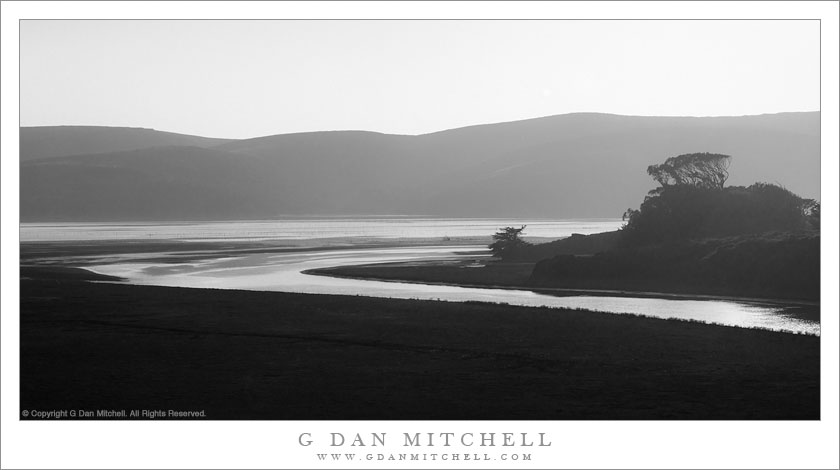
Evening along the shoreline of Tomales Bay

Bluff, Tidal Flats, Tomales Bay. Near Point Reyes National Seashore, California. October 15, 2017. © Copyright 2017 G Dan Mitchell – all rights reserved.

Evening along the shoreline of Tomales Bay

This is another photograph from our very recent visit to areas of California just north of San Francisco. If you follow the news, that description perhaps calls to mind the recent (and current, as I write this) major wildfires burning in California, including the disastrous fire in the Santa Rosa area that killed dozens of people and destroyed thousands of homes and other structures. In fact, we were very close to that area on this trip. We might not have gone at all, except that one of the reasons for going there was to participate in a wedding — and since the wedding went on despite the first, we went. We had planned a few days after that for photography, and we decided to stick to that plan, too.

The effects of the fires were obvious in many ways: signs in shops and elsewhere about people needing a place to stay or raising funds for fire relief, the traffic heading to the coast to try to find relief from the smoke, and the constant presence of that smoke in the air. We ended up doing much less photography than we usually would, but on one day we did manage to make a few photographs. We had driven north up that coast a ways, turning around just north of Jenner where the smoke became quite severe, and we were returning to the area around Point Reyes National Seashore. We arrived alongside upper Tomales Bay, which separates Point Reyes from the rest of California, not long before sunset. Here the smoke thinned a bit, mostly just producing some atmospheric haze, and the scene was quiet and still in the early evening light.


G Dan Mitchell is a California photographer and visual opportunist. His book, “California’s Fall Color: A Photographer’s Guide to Autumn in the Sierra” is available from Heyday Books and Amazon.
Blog | About | Flickr | Twitter | FacebookGoogle+ | LinkedIn | Email


All media © Copyright G Dan Mitchell and others as indicated. Any use requires advance permission from G Dan Mitchell.

Photographer and visual opportunist. Daily photos since 2005, plus articles, reviews, news, and ideas.