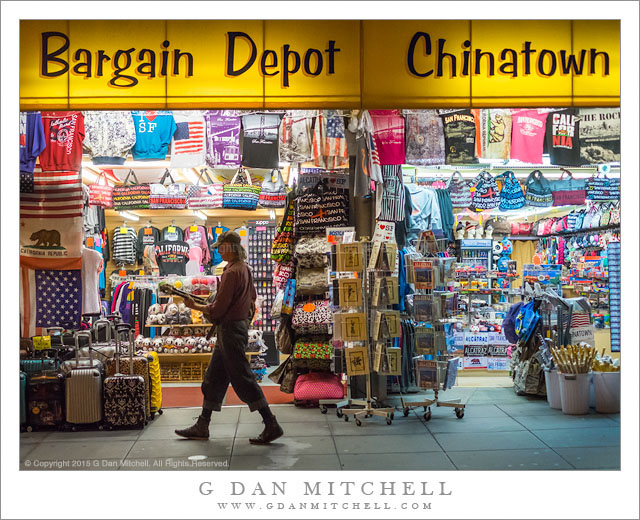
Man with guitar walks past a Chinatown souvenir shop at night.
When photographing in the “street” you never quite know what will show up, when it will happen, or how quickly it will appear and disappear. And you have very, very little control over the elements that might make a photograph — you can sometimes pick your point of view, perhaps create a composition out of the static elements, watch a person approaching who might put a point of focus in the scene… but they you simply have to work with whatever happens. I think this can be even a bit trickier at night, since not all of the interesting things take place in light that can easily be photographed.
Here the first focus for me was the gaudy, colorful, and well-lit interior of this open front store in San Francisco’s Chinatown district. There is some interest in that subject alone, but frankly it can be a pretty static thing when not populated by people. As I looked at this storefront and pondered how to make a photograph out of it I noticed a man wandering up the sidewalk with a guitar, a literal strolling minstrel. At that point, he became the important element, and as he passed I attempted to time several exposures that placed him in interesting places in the composition.
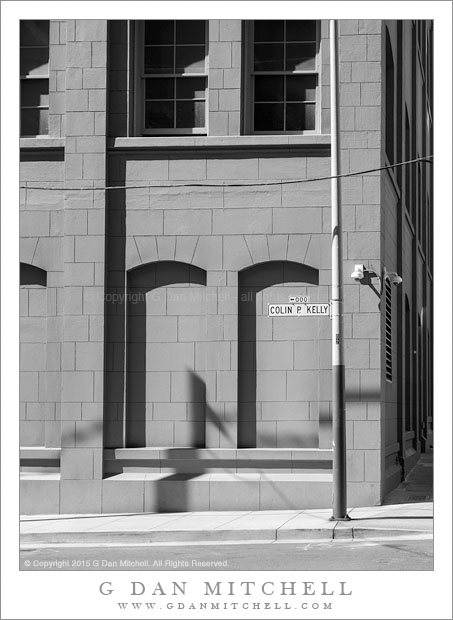
Stark light on an old building on Colin P. Kelly Street, San Francisco
Most often when I go out to make photographs I do not have extremely specific ideas about my subject or even about how I will photograph the subjects I encounter. Usually, and especially with street photography, it is more a matter of tuning in to my surroundings and essentially hunting, conspiring to be in places where I think I might find interesting things, paying attention, and being ready to take advantage of whatever opportunities arise. On the other hand, I often do have some general ideas about the sorts of things that might interest me, and on my way to this morning on San Francisco streets I had specifically thought about a sort of image that might be black and white and which might use rather stark light a bit later in the morning — so when I saw this building on a corner near the train station I didn’t hesitate to photograph it.
What about the name of this photograph? It was simply a practical matter. I usually do not like to name photographs in ways that tell the viewer how to think of the photograph — most often I feel that if the photograph has anything to say to the viewer, the viewer should be allowed to figure that out from the visual content. (Yes, there are some exceptions.) So in this case the choice to use the words on the street sign near the right side of the frame was simply a practical decision… especially since I forgot to look for any other name on the building! However, I did wonder who Colin P. Kelley is/was. Most likely the street is named after a man known for being “one of the first American heroes of the war [who sacrificed] his own life to save his crew” in World War II. (There are lots of interesting little San Francisco streets with unusual and surprising naming histories like this.)
I have so many photographs in the queue right now that I have decided to do something a bit different and post some of them in collections. This first group features night photography from the historic Mare Island Naval Ship Yard, a location where I have been doing night photography for about a decade now. As is often the case, this visit was with my friends from The Nocturnes, the San Francisco Bay Area night photography group.
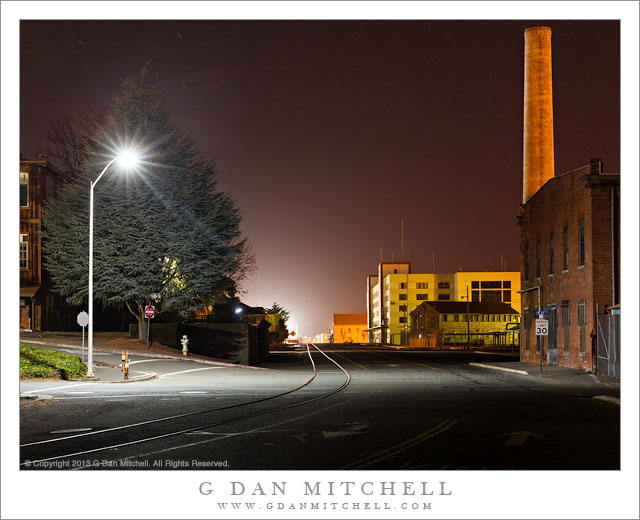
A street light illuminates tracks running down Railroad Avenue at historic Mare Island Naval Ship Yard
This is probably one of the iconic views of the nighttime environment at Mare Island, as it was made in a location where many night photographers start, whether it is their first visit or their fiftieth time there. The spot is near the Mare Island Museum, which holds many objects and photographs from the long history of the place as the first important west coast naval ship yard. The tracks – obviously! – given this street its name. The tower is the chimney of the old power plant, and off in the distance more of the old ship yard buildings are visible.
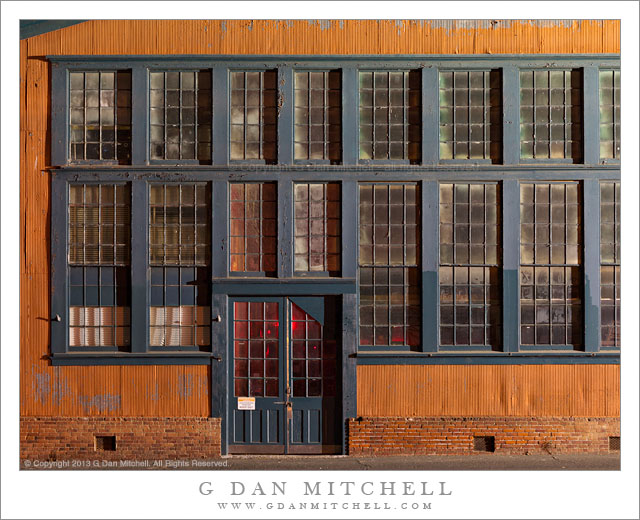
Red light behind the door of an industrial building at the historic Mare Island Naval Ship Yard
I was interested in the windows, doorway, and wall of this building for several reasons on this visit. First – and night photographers will understand – Mare Island has recently started to see an update of its lighting. As newer and presumably more energy-efficient types of lighting become available, the older lighting gets replaced. Some years ago the move was to the intensely yellow sodium vapor lights (which you can see in other images in this set), but today it is to what I understand are LED systems. Since the ambient light is tremendously important to night photographers, we notice that this produces a significant change in the mood of photographs made here since the LED light seems to have a much more subtle coloration that is closer to what we might regard as daylight. The new lighting has been installed by this building, so I wanted to see how I could use it to make a photograph that still captured the feeling of the night. In addition, I noticed some subtle red interior lights behind the doorway that seem to suggest something a bit mysterious in this scene.
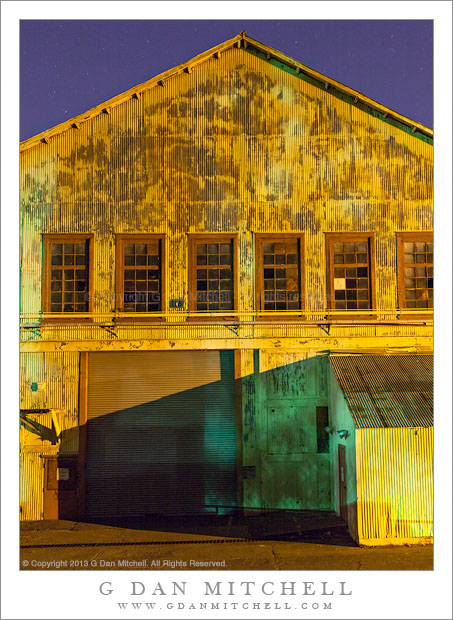
A green tinted shadow falls across the front of a yellow building, Mare Island Naval Ship Yard
There are several things I like about this photograph of the side of a tall building and a lower section casting an odd green shadow. In much night photography we create photographs of things that we actually cannot see – essentially we are making photographs of what the camera sees. Standing in front of this scene it was very, very dark and the details of the building wall was barely visible at all. However, after shooting this stuff for some time I can recognize what might happen with an exposure long enough to make this scene visible. The old sodium vapor lamps are still installed along this street, and I knew that their yellow light would have a powerful effect on the colors of the scene. I also know that where there is a shadow that is not illuminated by sodium vapor light, the shadow will take on the colors of other kinds of ambient lighting – in this case a relatively green type of light coming from a nearby open area. In the end, without actually doing any light painting (the process of using colored lights and gels to illuminate the subject) I was able to make a photograph that is “naturally” just as wildly colorful.
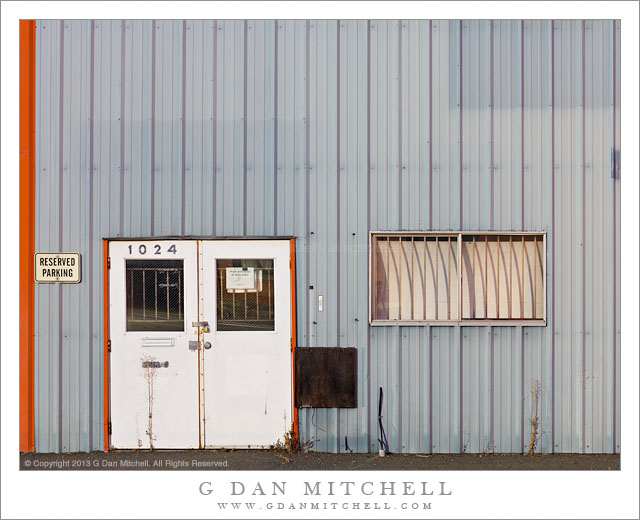
Metal wall with white doors, window, and Reserved Parking sign
The plain and simple geometry of this building and its front wall has attracted me for several years, with its vertical lines, square forms of the door and the shadows, and the surprising orange highlights – and I have photographed it before. This building is now also lit by the newer lighting, so I had to see what I could do with this new coloration. I made two photographs of it. This one is a simple, straight-on view that is “about” the angular and square forms and the thin lines of orange paint and asphalt, with the only curves coming from the shadows in the window and a bit of broken-off pipe near the bottom center.
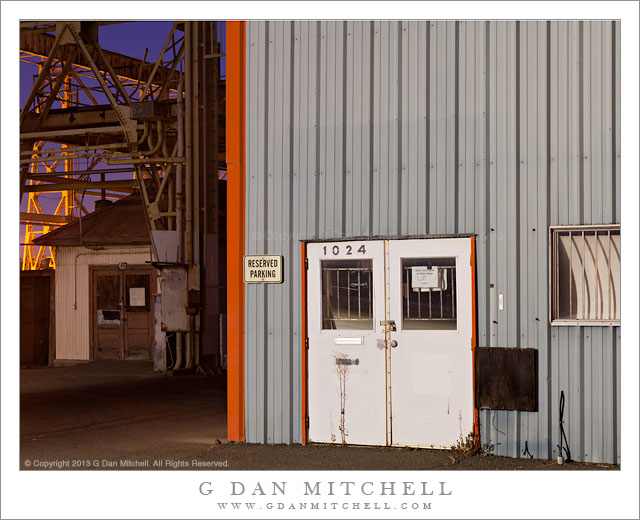
White door on a metal building with industrial structures of Mare Island Naval Ship Yard in the distance
This is a different take on the same wall, here composed off-center so that some of the darker ship yard machinery and structures can be seen.
G Dan Mitchell is a California photographer and visual opportunist whose subjects include the Pacific coast, redwood forests, central California oak/grasslands, the Sierra Nevada, California deserts, urban landscapes, night photography, and more. Blog | About | Flickr | Twitter | Facebook | Google+ | 500px.com | LinkedIn | Email
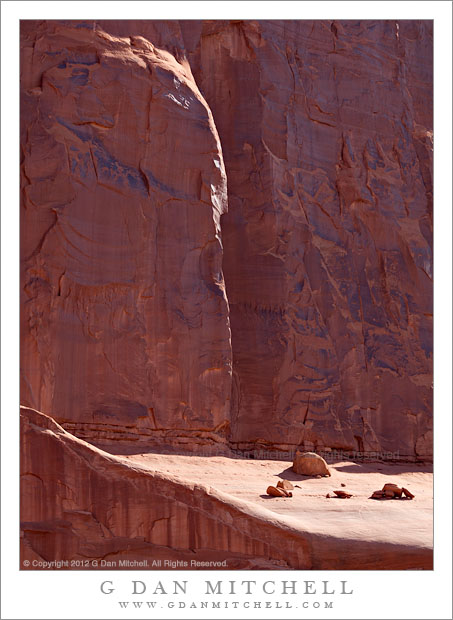
Red cliffs and rocks on a ledge at Park Avenue, Arches National Park.
I made this photograph fairly early in the morning at the Park Avenue area of Arches National Park. While morning might was hitting the walls behind my camera position, the walls in front of me were still in fairly deep shade. However, as the sun rose, its light began to come over the tops of these tall sandstone walls and spill down into the canyon. As the morning wore on, the light/shadow line began to move back closer to this wall, first illuminating the ledge and the fallen rocks in holds and then beginning to highlight edges of some of the cracks in the wall itself.
The Park Avenue area seems like one of the most accessible areas of this park being only a short distance inside the park boundaries and being very close to the roadway. The area is essentially a canyon between two nearly parallel walls of sandstone, often topped with remarkable towers and other features as the canyon descends toward where it opens up into sage brush country below. At this particular hour of this particular morning, as wonderful as that scene was, the light shooting down the canyon was only so-so, so I looked around, put on a long lens, and photographed smaller vignettes of the landscape such as this one.
G Dan Mitchell is a California photographer whose subjects include the Pacific coast, redwood forests, central California oak/grasslands, the Sierra Nevada, California deserts, urban landscapes, night photography, and more. Blog | About | Flickr | Twitter | Facebook | Google+ | 500px.com | LinkedIn | Email
Photographer and visual opportunist. Daily photos since 2005, plus articles, reviews, news, and ideas.
Manage Consent
To provide the best experiences, we use technologies like cookies to store and/or access device information. Consenting to these technologies will allow us to process data such as browsing behavior or unique IDs on this site. Not consenting or withdrawing consent, may adversely affect certain features and functions.
Functional
Always active
The technical storage or access is strictly necessary for the legitimate purpose of enabling the use of a specific service explicitly requested by the subscriber or user, or for the sole purpose of carrying out the transmission of a communication over an electronic communications network.
Preferences
The technical storage or access is necessary for the legitimate purpose of storing preferences that are not requested by the subscriber or user.
Statistics
The technical storage or access that is used exclusively for statistical purposes.The technical storage or access that is used exclusively for anonymous statistical purposes. Without a subpoena, voluntary compliance on the part of your Internet Service Provider, or additional records from a third party, information stored or retrieved for this purpose alone cannot usually be used to identify you.
Marketing
The technical storage or access is required to create user profiles to send advertising, or to track the user on a website or across several websites for similar marketing purposes.

 G Dan Mitchell is a California photographer and visual opportunist. His book, “California’s Fall Color: A Photographer’s Guide to Autumn in the Sierra” is available from Heyday Books and Amazon.