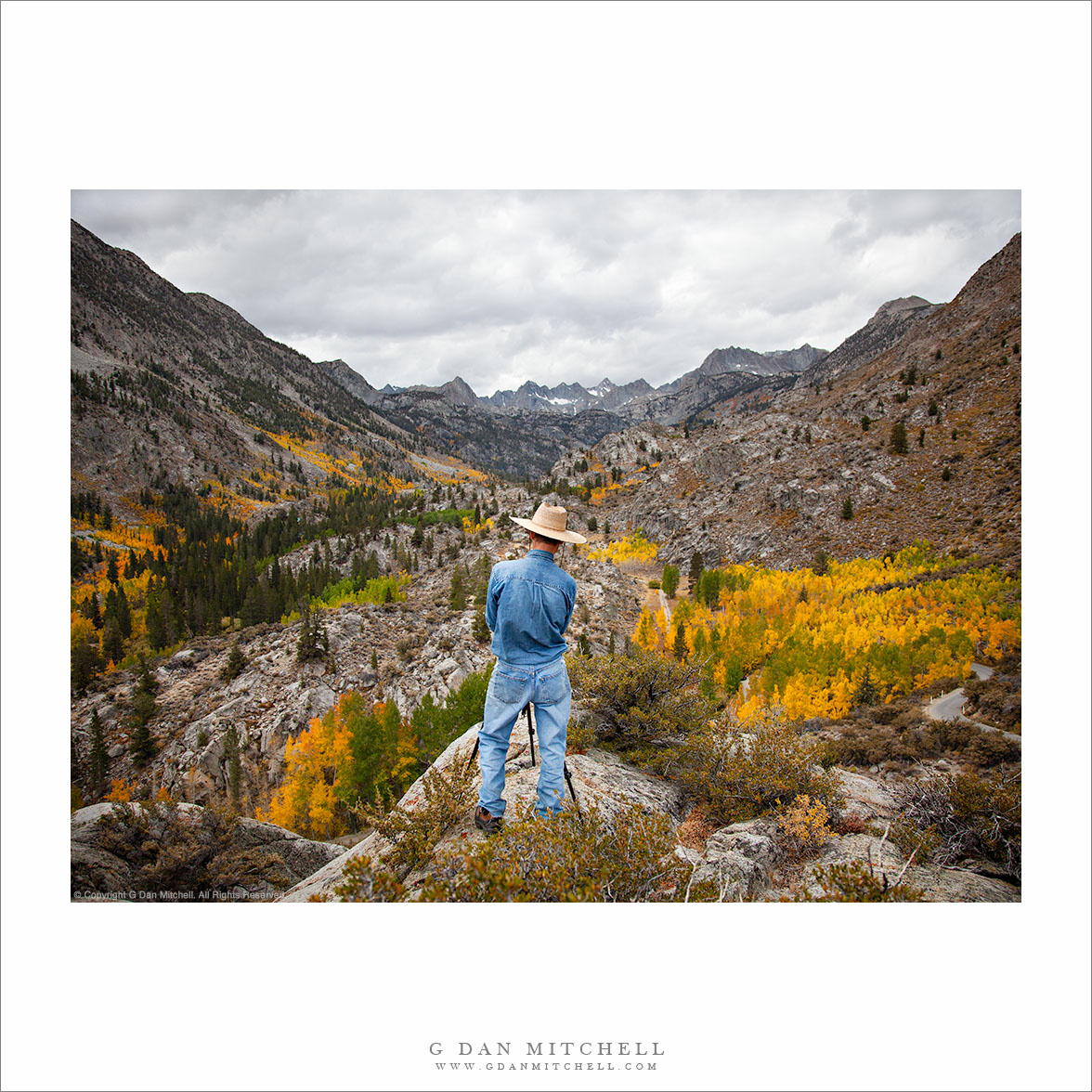
“Photographer, Sabrina Basin” — A photographer working the autumn colors from a ridge in Sabrina Basin, Sierra Nevada, as an early fall storm comes in.
I wandered out onto this ridge above Sabrina Basin, a spot that I know for its unobstructed view of the valley and the peaks of the Sierra crest above Sabrina Lake, far up the canyon. I had my eyes on some rocky benches that run along the top of the ridge As I approached I saw that I wasn’t the only photographer with this idea. As I crossed the rocks toward the overlook, he was working my intended camera position, so I decided to sit back and let him finish. (The ridge wasn’t wide enough for both of us to work together there.)
As I waited, I thought there was something interesting about his position above the valley, his concentration on shooting, his all-blue outfit (shirt and jeans, on a cold and rainy day!), and that wide brimmed hat. So I decided to make a few photographs of him. We barely talked at all. I hoped to get his name, but that didn’t happen. The best I was able to do was give him a card, and offer him a copy of the photo if he contacted me. Never heard from him…
G Dan Mitchell is a California photographer and visual opportunist. His book, “California’s Fall Color: A Photographer’s Guide to Autumn in the Sierra” (Heyday Books) is available directly from him.
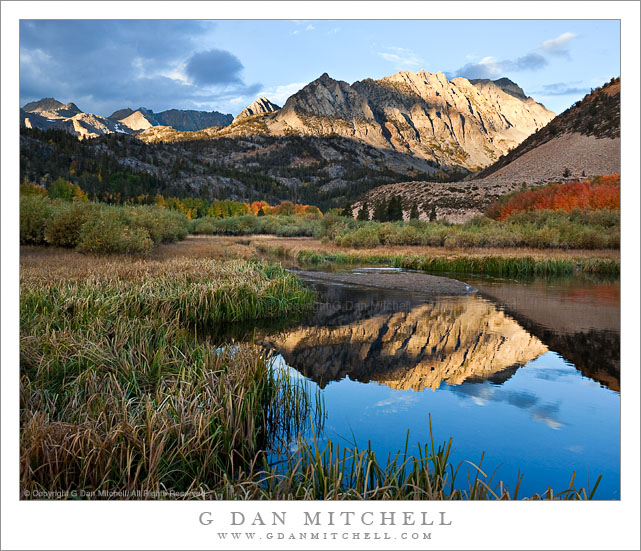
Autumn morning light on Piute Crags, reflected in the shoreline waters of a Sierra Nevada lake.
I made a lot of photographs during the past few months, traveling to the Sierra and a number of other places frequently. I often go through the photographs from the most recent shoot and post images soon after, but when I’m on to the next adventure fairly quickly I don’t always have time to get to everything in one batch before I shoot the next one. Inevitably, some images get “left behind.” Things have slowed down just a bit, and now I’m finding time to go back through some of that earlier work and pull out a few more images that I like. This is one of them.
Folks who photograph in the eastern Sierra will likely recognize this location. The long, rugged ridge of Piute Crags is striking, especially in the morning light, more so in the fall when the aspens change color, and double-especially on such a fall morning when clouds are moving in and out of the scene. I’m not going to say much more about the location beyond telling a little story. As I made this photograph there were perhaps 50 photographers set up more or less tripod-to-tripod a ways away shooting the same general subject from the place where almost everyone shoots. Their location is, indeed, a beautiful spot and I’ve shot there myself. (Heck, I shot there later on this same trip, though at a time of day when the workshops had gone elsewhere.) But there is more than one way to photograph a scene, and with a bit of thought and some wandering around it is usually possible to find a perspective that isn’t quite the same as the familiar one.
(If you know where I stood, please resist the temptation to say too much. This precise spot could not withstand the stress of dozens of photographers. Thanks!)
This photograph is not in the public domain and may not be used on websites, blogs, or in other media without advance permission from G Dan Mitchell.
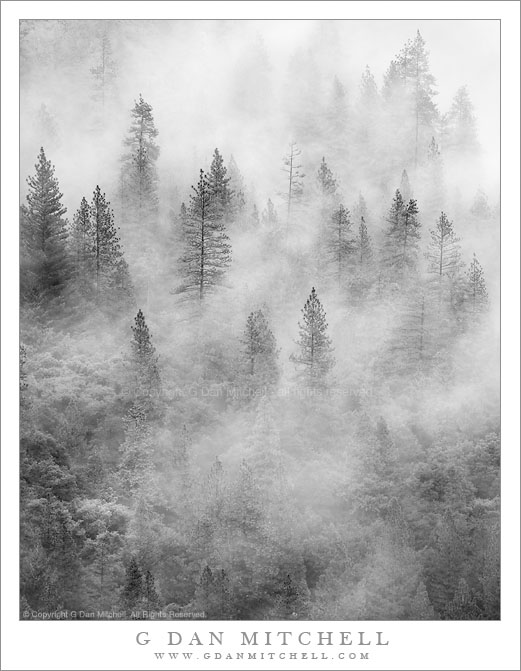
Evening fog drifts among forest trees on the floor of Yosemite Valley.
One more “misty Yosemite Valley” photograph – though perhaps not quite the final one just yet. This is similar to a photograph I posted earlier – another black and white image of evening fog floating among the trees of Yosemite Valley as seen from Wawona Tunnel View. The traditional and iconic scene from Tunnel View is impressive even in bland conditions, but photographing “that view” in such conditions is not a promising activity. But that wasn’t my plan. Noting that it had just rained for a day and was beginning to clear, I was pretty confident that this evening fog would form and begin to drift over and through the forest. My plan was to be at Tunnel View not to photograph El Capitan, Bridalveil Fall, and Half Dome – which didn’t cooperate in the end anyway – but to point a very long lens downward toward the mist.
This photograph is not in the public domain and may not be used on websites, blogs, or in other media without advance permission from G Dan Mitchell.
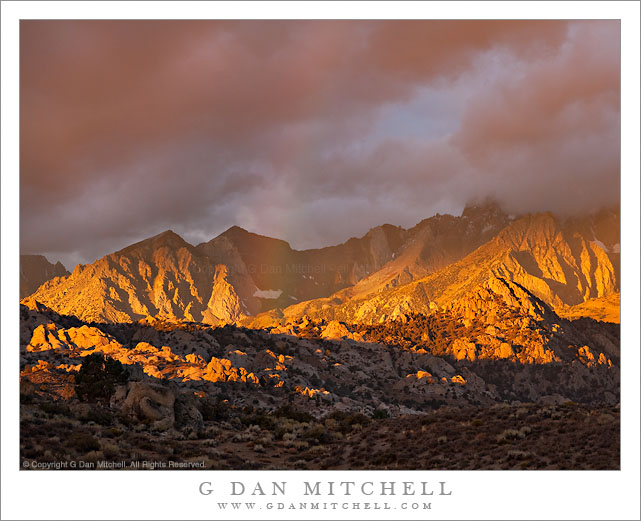
A faint rainbow briefly glows in dawn light on the eastern escarpment of the Sierra Nevada above the Buttermilks as an autumn storm builds.
Since I wrote previously about acting on a hunch to be in this spot in time to catch a few minutes of dawn light, I won’t recount the whole thing here – though I would like to describe the phenomenon a bit more and perhaps make a point or two about light and opportunities.
The photograph is of the eastern escarpment of the Sierra Nevada above Bishop, California and was made on an early autumn morning of a day that brought one of the first winter-like storms of the season. I found myself in this spot (as described at the link) for the very few minutes during which this light was present – and afterwards the light was simply gone and the rest of the day was overcast and rainy. The circumstances have me thinking about a few things about light and “being there” at the right moment.
Sometimes, even on a “poor light day” – though I like overcast conditions! – there can be a few brief moments of exceptional light. Catching them involves some combination of anticipating that these moments might occur, being there, and – let’s admit it! – dumb luck. In this case, all three were at work. I did not know that this light would occur, but I knew that the conditions offered a possibility. A clearing in the clouds along the eastern horizon allowed a horizontal beam of light to briefly hit the mountains right at dawn. It began by striking the clouds above the Sierra crest, soon hit the highest peaks, moved across the face of the range, and within minutes the show ended with light on the high desert. The band was so narrow that only one of these subjects was generally illuminated at a time – and the whole thing couldn’t have lasted more than five or ten minutes.
That description might make it sound like I’m saying that I’m just plain great at predicting such things and planning to be there. Not quite! If you had asked me a few minutes earlier, when I made the spontaneous decision to abandon my previous plans and high-tail it out to this spot, what the odds were that I’d see light like this I might have estimated them at perhaps 10% or less. In other words, if I repeated this little adventure 10 times, I’d guess that I’d fail to see light like this nine out of ten times. However, if I only go for “sure bets” (which I’ll take when I can get them!) I know that I’ll miss lots of special conditions that are not subject to prediction.
Which brings up the subject of luck. I often read that one should be able to know in advance what the photograph will look like, and that careful and full preparation will lead to good photographs. Well, sort of, but maybe not quite in the way that some imply. (There is an element of “preparation” in all of this that I’ll write about eventually, but that is a different thing.) Frankly, these subjects are too complex and too fleeting and too unpredictable to be subject to that sort of careful and precise planning in any sort of consistently useful way. The photographer cannot make that small band of open sky appear along the horizon on an autumn morning when a storm is building along the crest – but if everything goes right a photographer might be there at the right moment, prepared to make a photograph of it.
This photograph is not in the public domain and may not be used on websites, blogs, or in other media without advance permission from G Dan Mitchell.