
Tag Archives: dawn

Eastside Dawn

Eastside Dawn
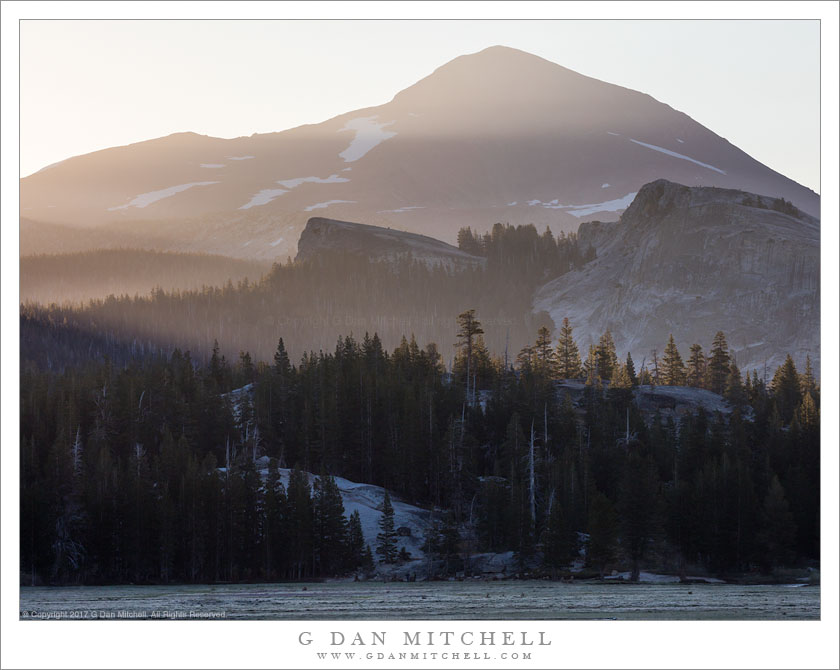
Dawn light on the eastern escarpment of the Sierra Nevada near Long Valley

Eastside Dawn. Sierra Nevada, California. October 10, 2015. © Copyright 2015 G Dan Mitchell – all rights reserved.

Dawn light on the eastern escarpment of the Sierra Nevada near Long Valley

I regard myself as a bit of a sunrise connoisseur, having arisen well before dawn on many, many mornings — almost every morning, actually — and often gone out to observe and photograph at first light. Trust me, I do understand how hard it is to get out of a warm bed (or warm sleeping bag) in darkness, dress, and head out into the still-dark world. But if you can start to make it a habit there is a good chance that you’ll become addicted — and what better kind of addiction is there than to need to see the first light?

I photographed this on an autumn morning when I headed out into the valley to the east of the escarpment of the Sierra. It was, as it usually is in mid-October, very cold when we arrived. But it was also very quiet and still, and steam was rising from nearby springs and creeks as the sky began to listen and the first light touched the peaks of the Sierra. It worked its way down the face of the range, across fluted alpine faces, into deep mountain valleys, and eventually to the rounded, tree-covered hills at the foot of the range.


G Dan Mitchell is a California photographer and visual opportunist. His book, “California’s Fall Color: A Photographer’s Guide to Autumn in the Sierra” is available from Heyday Books and Amazon.
Blog | About | Flickr | Twitter | FacebookGoogle+ | LinkedIn | Email


All media © Copyright G Dan Mitchell and others as indicated. Any use requires advance permission from G Dan Mitchell.
Lenticular Clouds, Death Valley

Lenticular Clouds, Death Valley
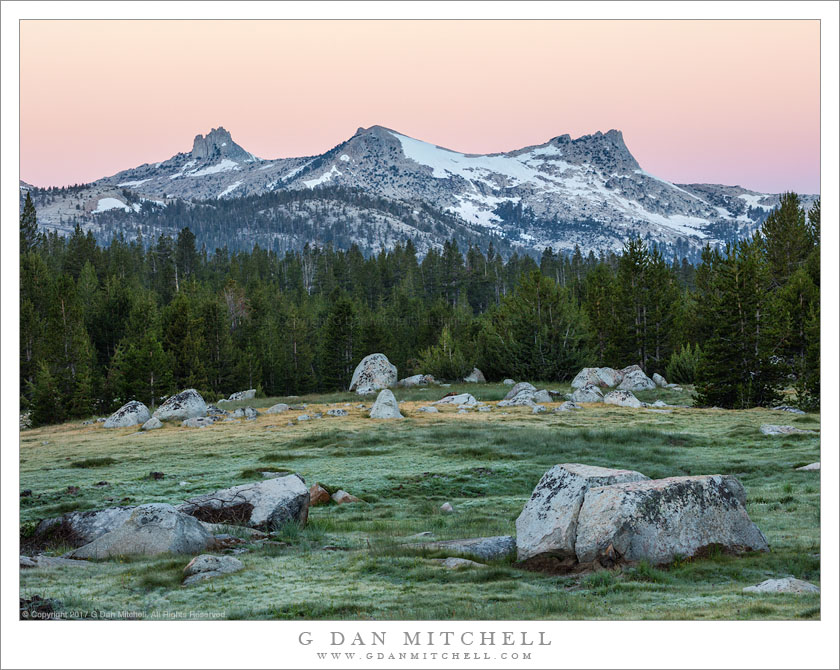
Dawn lenticular clouds from above the Black Mountains and Death Valley

Lenticular Clouds, Death Valley. Death Valley National Park, California. April 7, 2017. © Copyright 2017 G Dan Mitchell – all rights reserved.

Dawn lenticular clouds from above the Black Mountains and Death Valley

After a cold and windy final night camping in the Panamint Mountains of Death Valley National Park this spring, I woke up early and headed to an overlook along the summit ridge for the range before dawn. The most typical experience here is to watch the sun rise into clear skies above the desert landscape, but this time a weather system was approaching. It was cold, extremely windy, and the sky was filled with dark clouds. The only sunrise color I saw was along a distant band of light at the horizon, produced by clearer skies far to the southeast.

I had seen the giant lenticular cloud forming the previous afternoon. These clouds are almost a part of the landscape at times, arising in predictable locations and formed by interactions between the atmosphere and features such as mountain ridges. Unlike other clouds, the lenticular can remain almost stationary for long periods of time — but this is the first time I’ve awakened to see clouds from the previous day still there. The choice to use a monochrome interpretation allowed me greater interpretative latitude in the final image, and this let me draw attention to certain shapes mirrored by the clouds and the geology in the scene.


G Dan Mitchell is a California photographer and visual opportunist. His book, “California’s Fall Color: A Photographer’s Guide to Autumn in the Sierra” is available from Heyday Books and Amazon.
Blog | About | Flickr | Twitter | FacebookGoogle+ | LinkedIn | Email


All media © Copyright G Dan Mitchell and others as indicated. Any use requires advance permission from G Dan Mitchell.
Sunrise Wave Cloud

Sunrise Wave Cloud
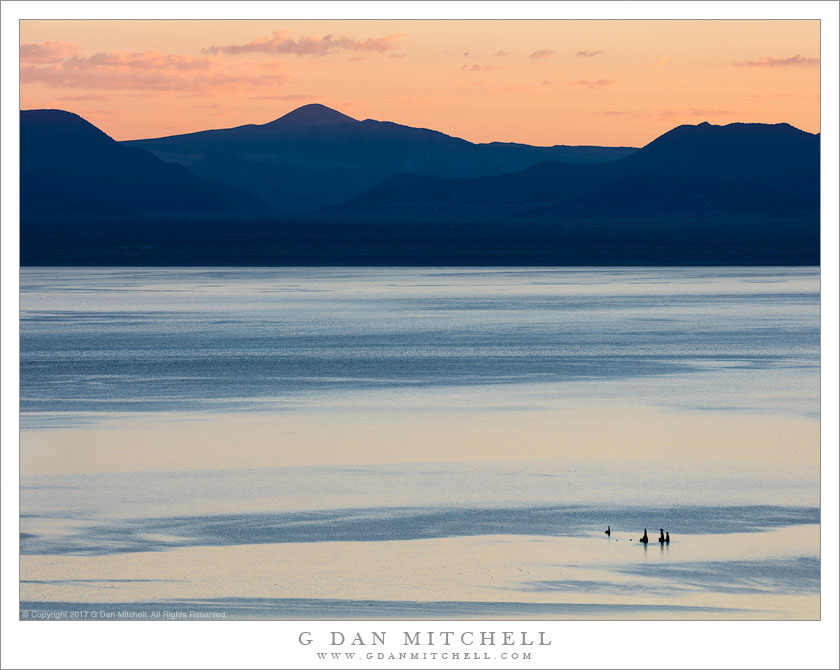
A wave cloud develops above Death Valley mountains at sunrise

Sunrise Wave Cloud. Death Valley National Park, California. April 6, 2017. © Copyright 2017 G Dan Mitchell – all rights reserved.

A wave cloud develops above Death Valley mountains at sunrise

When it comes to desert skies, it can be hard to find just-right conditions. Often the skies at Death Valley are simply clear, with few or no clouds aside from contrails from passing jets. And when there are clouds during the dawn and dusk hours when color potential is at its greatest, more distant clouds can block the light that would create the bright colors. This is especially true in the evening in Death Valley, where it is not uncommon for there to be thicker clouds in the moister regions to the west at sunset.

The latter situation was in play on this morning. In fact, I had originally planned to photograph south of this location. I had driven there and started to set up in the near darkness, only to realize that a fairly thick cloud deck was not going to clear and that it was going to block the morning light. I had a backup plan, and when I arrived at this spot a good distance to the north there was a break in the clouds. This color comes quickly and doesn’t last long — you more or less have to be ready for it before it is visible, though you may get a hint of developing color from clouds far off and near the horizon. Here a wave cloud is forming over Tucki Mountain, with a few more lenticular clouds out over the Cottonwood Range and beyond.


G Dan Mitchell is a California photographer and visual opportunist. His book, “California’s Fall Color: A Photographer’s Guide to Autumn in the Sierra” is available from Heyday Books and Amazon.
Blog | About | Flickr | Twitter | FacebookGoogle+ | LinkedIn | Email


All media © Copyright G Dan Mitchell and others as indicated. Any use requires advance permission from G Dan Mitchell.
Predawn Clouds Above The Black Mountains

Predawn Clouds Above The Black Mountains
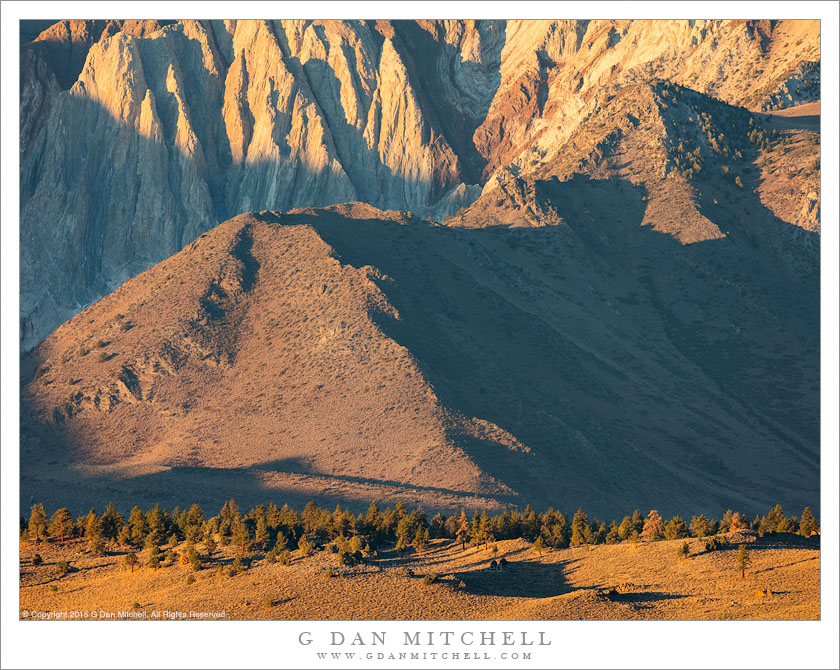
Lenticular clouds build over the Black Mountains before dawn, Death Valley National Park

Predawn Clouds Above The Black Mountains. Death Valley National Park, California. April 7, 2017. © Copyright 2017 G Dan Mitchell – all rights reserved.

Lenticular clouds build over the Black Mountains before dawn, Death Valley National Park

Death Valley can be a tough place in general and a tough place for photography in particular. My recent trip in April of this year might be a case in point. The photography was not easy, and I faced different sorts of challenges almost every day. During the morning and evening hours when I typically look for “golden light” subjects, I had rather thick clouds on almost each day. Wind is often a challenge in the park, and this trip was no exception. And with the wind comes dust — yes, I dealt with dust storms on multiple days. On one morning I arrived at what I thought was my location in pre-dawn murky light, loaded up a pack, and wandered out into the landscape… only to realize once the light came that I was in the wrong place! While this sort of thing can make the photography edge a bit more difficult, I know that it comes with the territory, so I’m philosophical about it. If you are out there enough to encounter astonishing conditions, it is not a surprise when you find yourself at the opposite end of the bell curve on occasion. And when this does happen, if I just open myself to the terrain and look more carefully I can almost always find something.

On my second-to-last day of photography in the park I packed up my camp and left one of the popular campgrounds, with a plan of putting myself in a more isolated location, one of several that I had in mind. However, as I drove up the Valley a storm wind began to rise from the south, and soon clouds of dust and sand were filling the air and blowing north towards the places I thought I would visit. I wasn’t in the mood for camping in a dust storm so I switched gears and decided to head up into the Panamint Range where I thought the terrain might give me some protection. I arrived and set up my “camp” (which, in this case, was mostly my vehicle, in which I would roll out a sleeping bag), and almost immediately clouds filled the sky and a strong wind raced through the campsite. I hunkered down, at some dinner, and realized that this was not going to be a photography evening. The next morning, my final in the park on this trip, I was up and out of the campground at around 5:00, heading out on a gravel road to a high place with a grand panorama. As the first light appeared it became clear that the clouds had not gone away, and my hopes of a colorful sunrise were not going to be rewarded. I arrived at the destination to find that gale-force winds were raking the summit ridge. But I was there, I had my camera, I figured something might happen, so I got out and watched the sky lighten. Soon I saw this remarkable lenticular cloud formation to the southwest above the Black Mountains.


G Dan Mitchell is a California photographer and visual opportunist. His book, “California’s Fall Color: A Photographer’s Guide to Autumn in the Sierra” is available from Heyday Books and Amazon.
Blog | About | Flickr | Twitter | FacebookGoogle+ | LinkedIn | Email


All media © Copyright G Dan Mitchell and others as indicated. Any use requires advance permission from G Dan Mitchell.