
Tag Archives: desert

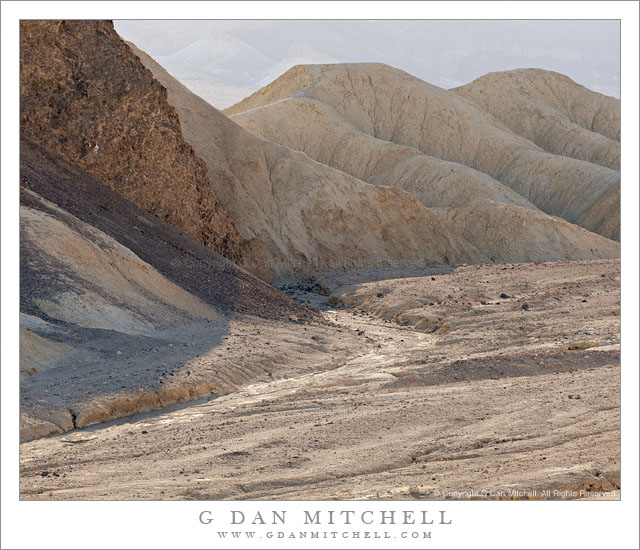
Buttermilk Range, Morning

Buttermilk Range, Morning

Buttermilk Range, Morning. Near Bishop, California. October 15, 2011. © Copyright 2011 G Dan Mitchell – all rights reserved.

Early morning light strikes a ridge in the Buttermilk Range, with the eastern escarpment of the Sierra Nevada in the background.

While in the eastern Sierra last week to photograph aspen color again, I detoured away from the trees at sunrise one morning to photograph the first light striking these hills in the Buttermilk Range above Bishop, California, with a steep section of the Sierra’s east escarpment beyond. The light in this area is often spectacular in the early morning, but it can be especially so when there are some clouds in the sky as was the case on this morning. While it was almost completely clear to the west over the Sierra crest, the sky to the east held some broken clouds which cast alternating patterns of light and shadow across the landscape. Here, while the light on the foreground rocky ridge was very intense and saturated, some haze muted the more distant ridge and the shadow from those clouds slightly obscured the lower slopes.

The Buttermilks are yet another example of the range to subjects to be found in the eastern Sierra. Sometimes I head to these mountains with a plan of shooting a particular subject or even a particular place, but this doesn’t always work out. The weather may change or my schedule may change. Fortunately, if the original subject doesn’t work, there are almost always other choices! This small range tucked up against the Sierra above Bishop – like many other similar places along the “east side” – contains a wealth of photographic subjects to explore.

G Dan Mitchell Photography
About | Flickr | Twitter | FacebookGoogle+ | 500px.com | LinkedIn | Email

Text, photographs, and other media are © Copyright G Dan Mitchell (or others when indicated) and are not in the public domain and may not be used on websites, blogs, or in other media without advance permission from G Dan Mitchell.

(Basic EXIF data may be available by “mousing over” large images in posts when this page is viewed on the web. Leave a comment if you want to know more.)

Sierra Wave Clouds Above Owens Valley, Dawn

“Sierra Wave Clouds Above Owens Valley, Dawn”— Sierra wave clouds building at dawn are reflected in the waters of an Owens Valley lake.

On this morning I was up well before dawn – I checked out of my motel in Bishop, California and was on the road while it was still dark, with a semi-plan of photographing aspen trees around dawn up in the northern portion of the June Lakes Loop. As I headed north out of Bishop and through Round Valley, the very first light arrived and I saw the dim outlines of Sierra wave clouds forming over and just east of the crest. Now, this was an interesting development!

As I continued north and the light increased, the clouds began to interest me more than the possibility of photographing more aspens – I could do that later, but such clouds are unpredictable and transitory. I could see that subtle color was beginning to appear along the edges of the clouds even though it was not yet sunrise, and I decided that I needed to find some landscape feature – almost any would do! – that could serve as a foil to these clouds so that I could photograph them as they began to pick up sunrise color.

A week earlier I had photographed at some small lakes out in Owens Valley, and it occurred to me that if I could get there in time that they might reflect the clouds nicely, though I was a bit concerned about how the lake and the mountains and the clouds would actually align. But not having any better ideas and having very little time, I decided to make the lake my goal and without much further thought took the turnoff, parked my car near the largest lake, grabbed my gear, and headed across the sage brush landscape to the shore of the lake. My initial thought that I might be able to include the Sierra range in the image with the clouds clearly wasn’t going to work due to their relative positions, so I circled a bit further around the shore of the lake and instead composed a scene that excluded all but the tiniest bit of the peaks of the Sierra.

G Dan Mitchell Photography
About | Flickr | Twitter | FacebookGoogle+ | 500px.com | LinkedIn | Email

Text, photographs, and other media are © Copyright G Dan Mitchell (or others when indicated) and are not in the public domain and may not be used on websites, blogs, or in other media without advance permission from G Dan Mitchell.
(Basic EXIF data may be available by “mousing over” large images in posts when this page is viewed on the web. Leave a comment if you want to know more.)

Hills and Gullies, Twenty Mule Team Canyon

Hills and Gullies, Twenty Mule Team Canyon

Hills and Gullies, Twenty Mule Team Canyon. Death Valley National Park, California. April 2, 2009 © Copyright 2009 G Dan Mitchell – all rights reserved.

Morning light across the shapes of hills and gullies, Twenty Mule Team Canyon, Death Valley National Park.

This is a photograph I made back in 2009 when I managed to get to Twenty Mule Team Canyon before sunrise and then continued to shoot for several hours. Though this area is very close to one of the most popular and oft-photographed locations in Death Valley National Park, it gets relatively few visitors from what I’ve seen. While it doesn’t generally present the huge and expansive vistas of some of the more famous areas, it is a great playground for those of us who enjoy the eroded and rounded landforms and the seemingly infinite variations of color and texture.

Here I tried to fill the frame completely with these shapes that have been produced by water eroding the relatively soft earth. The light was very interesting and a bit complex. Some diffused light was coming straight down from the sky, hence the bits of blue shadow in some of the gullies. At the same time, slightly diffused sunlight was directly striking the earth in a few spots. And in some of the foreground areas additional illumination was being reflected into the scene from nearby formations.

G Dan Mitchell Photography
About | Flickr | Twitter | FacebookGoogle+ | 500px.com | LinkedIn | Email

Text, photographs, and other media are © Copyright G Dan Mitchell (or others when indicated) and are not in the public domain and may not be used on websites, blogs, or in other media without advance permission from G Dan Mitchell.

(Basic EXIF data may be available by “mousing over” large images in posts when this page is viewed on the web. Leave a comment if you want to know more.)

Schoolhouse Ruins, Rhyolite

Schoolhouse Ruins, Rhyolite

Schoolhouse Ruins, Rhyolite. Rhyolite, Nevada. April 1, 2009 © Copyright 2009 G Dan Mitchell – all rights reserved.

Morning sunlight shine through the window frames of the ruins of the abandoned schoolhouse in the ghost town of Rhyolite Nevada, near Death Valley National Park.

The ghost town of Rhyolite, Nevada is located just east of the boundary of Death Valley National Park, along the edge of the Amargosa Valley, and not far from Beatty, Nevada, which itself is close to the Nevada Test Site. Put all of that together and you have the potential for a bit of a spooky place!

Rhyolite was a short-lived mining town in the early 1900s, when it apparently was home to thousands of people who streamed to this forsaken landscape to find silver. The town was eventually abandoned – although some mining still takes place in the area – but a good number of the larger buildings are still there, in various states of decay. An old train station that looks pretty fancy is fenced off to keep us out, but you can walk (respectfully and carefully!) among many other old structures including the old school house that is the subject of this photograph.

I’ve been out here a number of times and dawn is my favorite time to photograph here. The light makes it to many of the old ruins very shortly after actual sunrise, and there is a moment of often beautiful light at this time. From Rhyolite the hills inside Death Valley National Park are visible to the west and above the nearer hills you can see Telescope Peak, the highest point in the park at over 11,000′ elevation.

The school (like a few of the other ruins) looks like it must have been a very large and robust structure. Even though the roof and the second floor are gone, almost all of the exterior walls still stand and don’t show any immediate signs of incipient collapse. On this morning I made a series of photographs from just inside one of the “doorways” of the school with a wide-angle lens. I selected and shared a few of them back in 2009, but I recently went back to my original raw files and decided to try this one in black and white.

G Dan Mitchell Photography
About | Flickr | Twitter | FacebookGoogle+ | 500px.com | LinkedIn | Email

Text, photographs, and other media are © Copyright G Dan Mitchell (or others when indicated) and are not in the public domain and may not be used on websites, blogs, or in other media without advance permission from G Dan Mitchell.

(Basic EXIF data may be available by “mousing over” large images in posts when this page is viewed on the web. Leave a comment if you want to know more.)