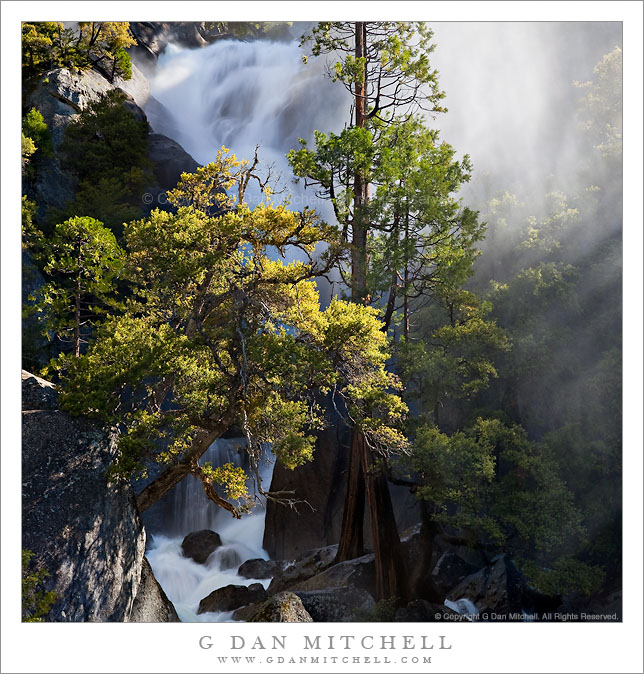
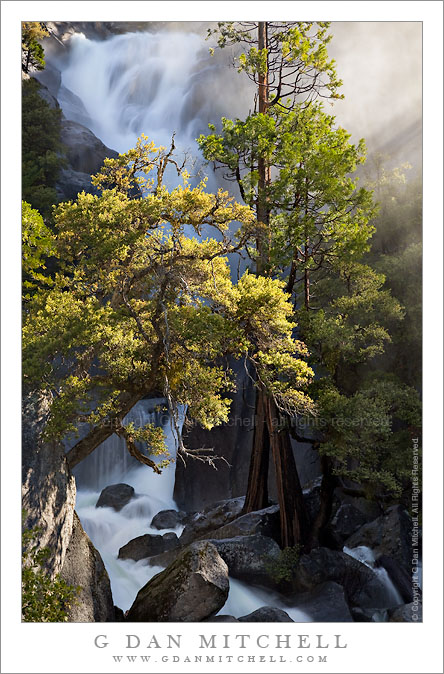
The spring torrent of cascade creek fills its narrow canyon with mist behind trees growing among the rocks.
I’ve been sitting on this second photograph of Cascade Creek, shot back near the beginning of June, trying to make some decisions about cropping and so forth. I finally have decided that I think I like this somewhat unusual (for me, at least) square format for this image.
Cascade Creek crosses beneath Big Oak Flat Road as it descends toward the Merced River and Yosemite Valley. For a few weeks during the spring snow melt season it can turn into a powerfully flowing stream, whose power is amplified by the steep descent and narrowness of the rock channel it follows.
The spring torrent of Cascade Creek descends past Big Oak Flat Road on its way to the Merced River, Yosemite National Park, California.
Every year, but especially in years of above average precipitation, this cascade flows strongly in the early season as low elevation snow melts above Crane Flat Road. The creek, swollen with runoff, drops down a narrow slot above the road, passes under the bridge, and continues its descent to join the Merced. This year the cascade was very full during my first-week-of-June visit, and even though I’ve photographed it before I had to stop again.
Lighting can be tricky here. The water is deep in the cleft in the rocks, so it is much darker and the light is fairly blue. The direct sun was lighting the foreground trees, which are much brighter and warmer in color than the background. I was lucky in that the waterfall and some morning breezes were raising a good deal of mist, which alternately obstructed the view of the fall and cleared away to show some of the trees. At the moment I made this exposure the shadows of trees outside the frame were creating shadows in the cloud of mist.
This photograph is not in the public domain and may not be used on websites, blogs, or in other media without advance permission from G Dan Mitchell.
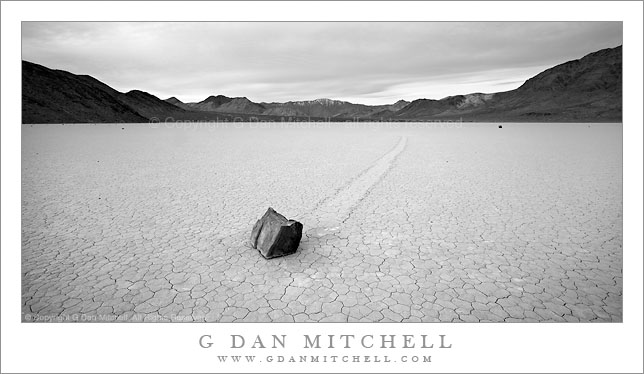
Black and white panoramic format photograph of a moving rock at Racetrack Playa, Death Valley National Park, California.
This photograph probably belongs in the “trying to turn lemons into lemonade” file. I’ve had wonderful luck with great light on all of my previous visits to the remote Racetrack Playa in Death Valley, the site of the “moving rocks” that have left tracks in their wake across the playa surface. However, my string luck seemed to run out on this late March visit. Earlier in the day as I contemplated whether or not to head out there I noticed some budding lenticular clouds to the north and made the decision to go. My preference is to have some clouds at the Racetrack, as perfectly clear sky isn’t as interesting in my view. Plus I always have in mind a particular previous visit when I photographed the playa at dawn with beautiful lenticulars building over the mountains to the north of the playa, and I think I’m always hoping for similar conditions again.
The plan on this visit was to arrive in the mid-afternoon to shoot the Grandstand, a formation near where the road first arrives at the playa, and to then photograph the beautiful evening light, the full moon (in the evening and then again before dawn) and finally the dawn light. The conditions continued to look great as I did the long washboard drive to the playa, and I arrived and photographed the Grandstand as planned. However, as I finished up here a high band of clouds moved across the sky and flattened out the light. As evening came on I was out on the playa, but the clouds remained and the light was not remarkable. I finally wandered back off the playa after dark, hoping that the clouds would clear and allow full moon photography. This never happened, and when I returned to the playa early in the morning the overcast was still present, with only a thin area of blue sky far to the west.
But I photographed anyway. Softer, overcast light has its potential, and since I was there I was certainly not going to waste the opportunity. In the end, I wasn’t thrilled with what I brought back for the most part, though I do like the effect of the overcast and the softer light on this black and white photograph of one of the more recognizable rocks. (By the way, the rest of my Death Valley visit went much better than this one night!)
This photograph is not in the public domain and may not be used on websites, blogs, or in other media without advance permission from G Dan Mitchell.
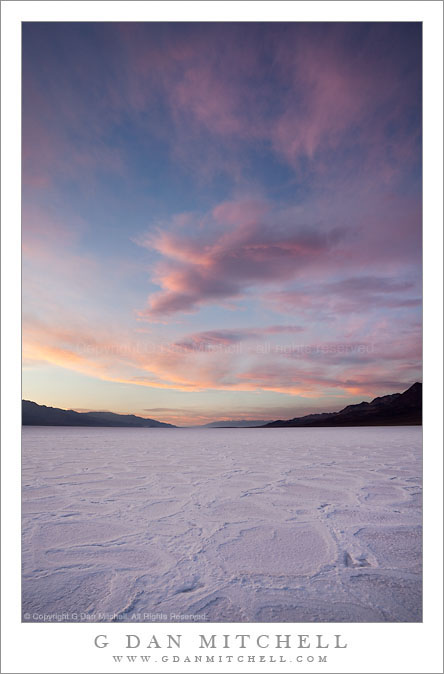
Late light illuminates dusk clouds above the salt flats of Badwater Basin, Death Valley National Park, California.
First, my disclaimer: I really am getting very near the end of the photographs of Badwater Basin shot on this late March evening. Really, I am. I’ve posted a number already, but I don’t see how there could be possibly be more than two additional images at this point. :-)
To recap, for anyone who didn’t catch the earlier posts, I visited this spot near Badwater Basin on an evening that turned out to have a wonderful combination of somewhat unusual salt flat conditions and interesting evening clouds. The “unusual conditions” were due to recent heavy rains in Death Valley that had flooded this section of the the salt flats a few weeks earlier. The flooding had subsided – at this point there was some water below the salt crust but the surface was mostly dry – but the character of the salt “polygons” had been “reset to zero” by the water. What had been very jagged and worn and cracked material had been flattened and smoothed. While the joints between the sections of the salt are clearly still visible, they were almost flush with the surface of the flat at this time.
On top of this somewhat rare condition, I was very fortunate to be there on an evening when there were clouds and, in addition, the cloud conditions evolved beautifully as the evening progressed. I saw this possibility earlier in the afternoon, which was one reason that I chose to shoot here, but you can never really know for sure what will happen… until it happens. The clouds started out thicker than what is seen in this photograph but as the day came to an end they began to thin and separate – enough that the colorful light from the evening sun began to light the clouds during the last moments of the day.
This photograph is not in the public domain and may not be used on websites, blogs, or in other media without advance permission from G Dan Mitchell.
Technical Data:
Canon EOS 5D Mark II
Canon EF 17-40mm f/4 L USM at 17mm
ISO 100, f/16, composite of two photographs at .4 and .8 second exposure time
keywords: late, evening, sunset, dusk, clouds, sky, light, orange, blue, pink, badwater, basin, salt, flat, polygon, white, death valley, national, park, california, usa, north america, landscape, nature, scenic, travel, mountain, amargosa, panamint, range, horizon, stock
Photographer and visual opportunist. Daily photos since 2005, plus articles, reviews, news, and ideas.
Manage Consent
To provide the best experiences, we use technologies like cookies to store and/or access device information. Consenting to these technologies will allow us to process data such as browsing behavior or unique IDs on this site. Not consenting or withdrawing consent, may adversely affect certain features and functions.
Functional
Always active
The technical storage or access is strictly necessary for the legitimate purpose of enabling the use of a specific service explicitly requested by the subscriber or user, or for the sole purpose of carrying out the transmission of a communication over an electronic communications network.
Preferences
The technical storage or access is necessary for the legitimate purpose of storing preferences that are not requested by the subscriber or user.
Statistics
The technical storage or access that is used exclusively for statistical purposes.The technical storage or access that is used exclusively for anonymous statistical purposes. Without a subpoena, voluntary compliance on the part of your Internet Service Provider, or additional records from a third party, information stored or retrieved for this purpose alone cannot usually be used to identify you.
Marketing
The technical storage or access is required to create user profiles to send advertising, or to track the user on a website or across several websites for similar marketing purposes.