Exfoliated and fractured granite ledges form patterns in late afternoon light, Yosemite National Park.
While this particular spot happens to be in the neighborhood of Tenaya Creek, similar features may be found throughout Yosemite and in many other parts of the Sierra. These rocks have probably been eroded in just about every way possible. They have been broken away from the underlying rock via exfoliation. The area was obviously glaciated. No doubt freezing water helped to widen the patterns of cracks and break up the rocks.
I made the photograph in late afternoon light when the sun was just barely above a low ridge beyond the upper edge of the photograph. The zoom was cranked out as wide as it goes in order to capture a good width and density of these wonderfully broken up rocks and the trees and other plants that somehow manage to live on and among them.
Morning light on trees and glaciated ridges, Yosemite National Park.
It is now 11:23 p.m. PDT on Friday, August 12… and I just realized a few moments ago that I neglected to schedule the posting of a new photograph today! Before I left for Yosemite on this past Wednesday I thought I had placed a photograph in the queue for automatic posting today, but apparently not. As long as I complete this post in the next half hour or so, I won’t miss posting my daily photograph!
I made this photograph early today (Friday, August 12) as the first light was striking the glaciated ridges near Olmsted Point. I had arrived early enough to climb far up on the granite slopes above the famous overlook before the sun came up – I had a plan to photograph some of the solitary trees high on these granite slabs as the first light struck them. I accomplished that, and as I began to descend from this area I decided to make a few more photographs while I was up there. Across the nearby canyon is another ridge that is topped by the glacial erratics, the solitary boulders sitting on top of the rounded ridges and just about anywhere else in this part of Yosemite. The early light was coming across from the left and striking the tops of these ridges, but it had not yet struck the huge face of Clouds Rest, seen behind them.
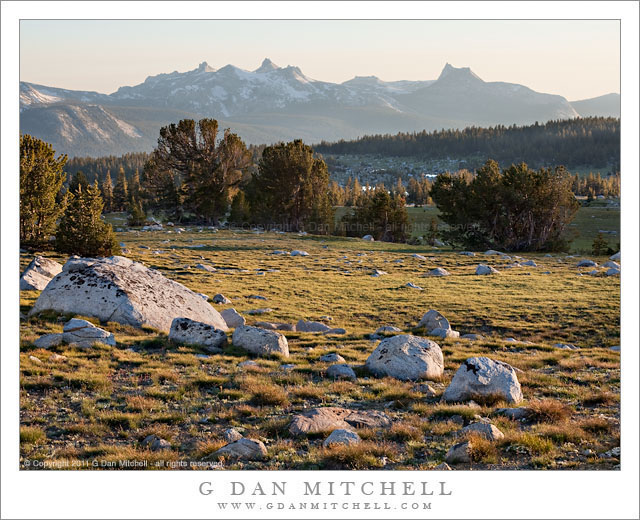
Evening shadows stretch across the boulder-filled meadows and forests of Gaylor Basin with the peaks of the Cathedral Range on the skyline, Yosemite National Park.
On the first evening of my late-July four-day visit to Yosemite’s high country along Tioga Pass Road I decided to visit this favorite location of mine. It is a short (but steep!) hike from near Tioga Pass over a nearby ridge to reach this quiet basin with its many lakes, long distance views of the Cathedral Range, and the treeline terrain of rocks and trees that I believe is my very favorite in the Sierra.
I started out after my mid-afternoon “dinner” and the drive to the trailhead from my camp at Porcupine Flat. Probably because it was so late in the day, I met a fair number of people hiking back out but only saw two others in the entire basin once I arrived. I suppose this is one of the advantages of keeping odd “photographer’s hours” – while most people are heading back to camp to fix dinner, I’m heading out to catch the evening light.
In the end, I didn’t make many photographs on this evening. I mostly wandered, something I love to do in these high open basins. I walked around the first lake, passing over some still-unmelted snow, and crossed the very full outlet stream, trying to skirt the wettest portions of the meadow by looking for rocky terrain. I finally settled on an area just below the lake and made a few photographs of trees and rocks and the long, shallow valley leading toward the main trunk of the Tuolumne River and the mountains beyond. I finished just after dusk, climbed back up the ridge as darkness came on, and finished the hike back to my car with the help of the light from my headlamp.
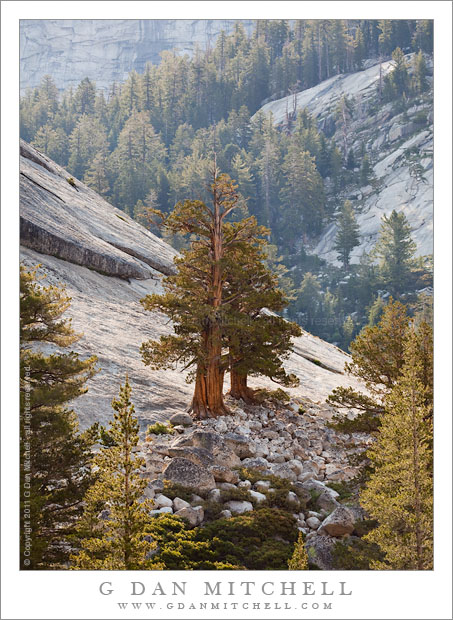
Two juniper trees in morning light at the base of Pywiack Dome, Yosemite National Park.
This strong and straight juniper and the smaller twin hiding behind it grow at the top of the rocky debris field at the base of this dome not far from Tenaya Lake in the Yosemite National Park high country. A bit later than the “golden hour” time, the morning light begins to spill around the side of the dome and illuminate these trees from behind, creating a glow in their branches and the branches of trees and brush around them.
Last night someone asked me if I choose when to go to the Sierra to photograph based on the weather conditions. I wish I had that luxury! To some extent I make general decisions about where and what to shoot based on the season – The Valley around the end the start of November, the east side in early October, etc. – but for the most part I go where I can go when I can go there. However, I do alter the focus of my shooting based on the current conditions. This late-July trip is a good example.
I associate certain types of light with different seasons, and I tend to look for clear and crisp light in late July along, accented by snow fields and lots of new growth. I was a bit surprised by the amount of haze in the atmosphere. In fact, in some ways it almost reminded me of very late summer and early fall when Sierra wildfires often create a smokey haze over the range. With this in mind, I figured out that crystal clear photographs of mountain peaks against sky were not going to be in the cards. Instead I focused more on closer subjects, and when I shot more distant subjects I thought a lot about how to use the haze, embracing its effect rather than regretting that I had to deal with it. This photograph is perhaps an example of both of those approaches. The main subject here, the central pair of trees, cannot be more than a couple hundred feet away, if that. Behind the trees and the slab are more distant granite domes and cliffs and forest winding up the mountainside. Shooting almost straight into the sun accentuated the hazy quality of the more distant elements of the scene and enhanced the sense of front to back distance, and separated the foreground trees from the background it a way that would not have been possible in “better” lighting conditions.
Photographer and visual opportunist. Daily photos since 2005, plus articles, reviews, news, and ideas.
Manage Consent
To provide the best experiences, we use technologies like cookies to store and/or access device information. Consenting to these technologies will allow us to process data such as browsing behavior or unique IDs on this site. Not consenting or withdrawing consent, may adversely affect certain features and functions.
Functional
Always active
The technical storage or access is strictly necessary for the legitimate purpose of enabling the use of a specific service explicitly requested by the subscriber or user, or for the sole purpose of carrying out the transmission of a communication over an electronic communications network.
Preferences
The technical storage or access is necessary for the legitimate purpose of storing preferences that are not requested by the subscriber or user.
Statistics
The technical storage or access that is used exclusively for statistical purposes.The technical storage or access that is used exclusively for anonymous statistical purposes. Without a subpoena, voluntary compliance on the part of your Internet Service Provider, or additional records from a third party, information stored or retrieved for this purpose alone cannot usually be used to identify you.
Marketing
The technical storage or access is required to create user profiles to send advertising, or to track the user on a website or across several websites for similar marketing purposes.