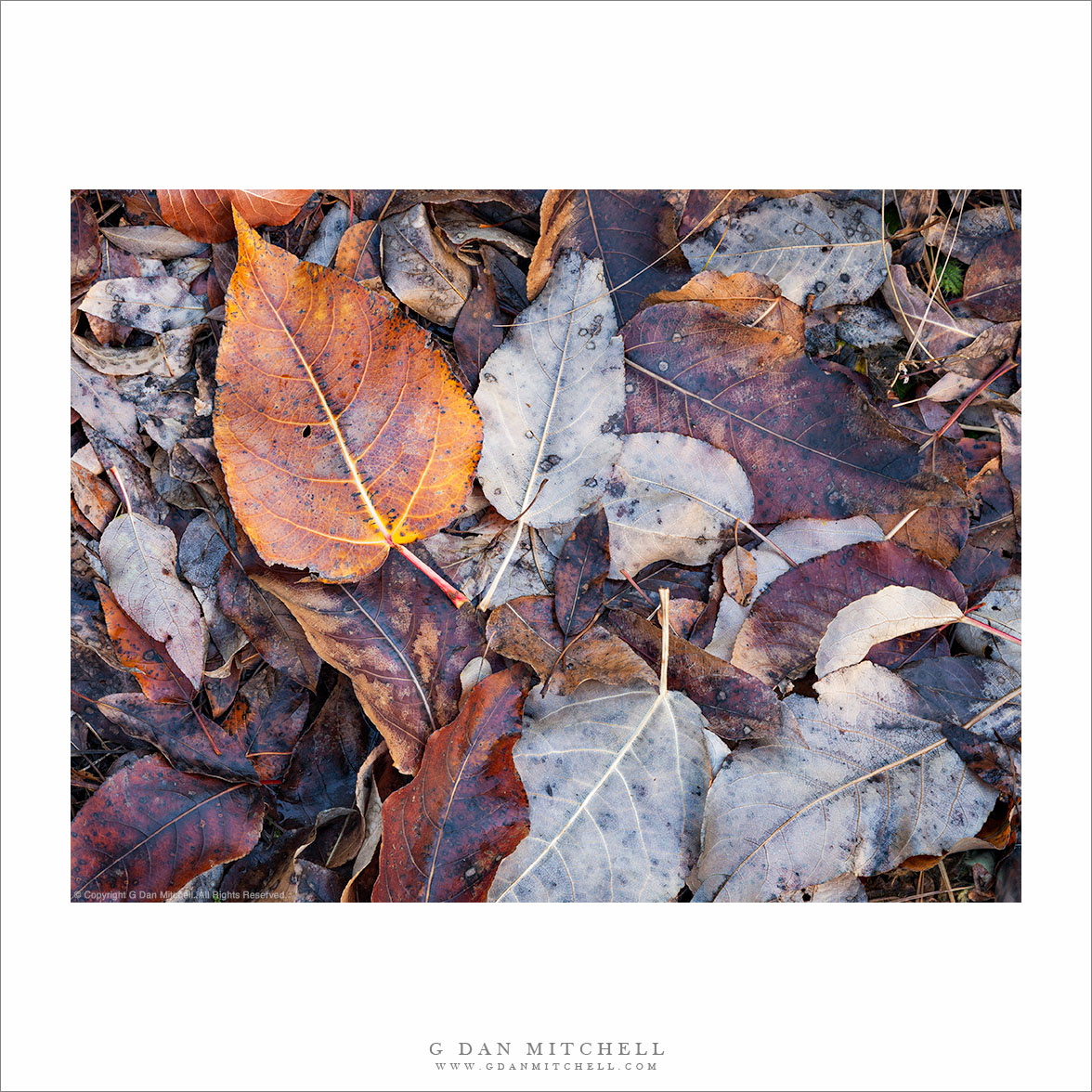
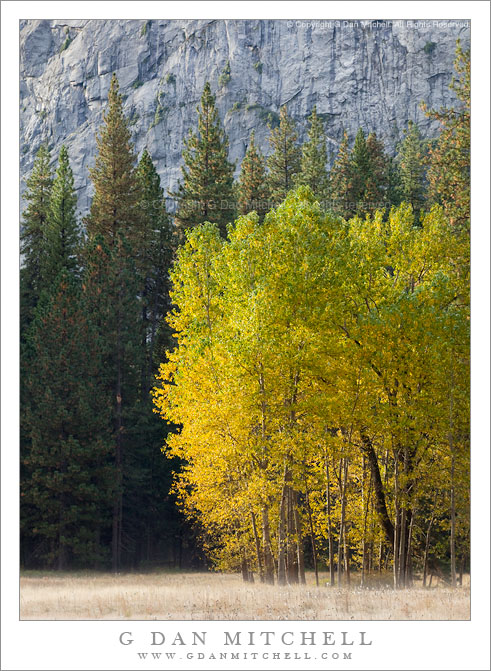
During my recent visit to Yosemite Valley to photograph autumn subjects, I kept seeing a particular stand of very small cottonwood trees growing densely close together near the Merced River. They were in a spot with somewhat tricky lighting, and the first few times I saw them the light was not ideal, so I filed the subject away mentally and figured I would come back and shoot them in the right light. Eventually, I returned, and although the light was still not ideal for the photograph I had in mind – and did not make yet on this trip – I decided to walk out to the trees and take a look and perhaps make a few close-up photographs.
None of the trees are taller than perhaps fifteen feet and some are only a couple of feet tall, but they grow together densely. (My hunch is that in some future decade when they mature only a few of them will survive.) I began by photographing groups of their vertical trunks from outside the grove, looking for interesting relationships among the forms of their trunks and for a few spots where a solitary leaf was still stuck in the branches of a tree. Then I walked into the grove, looking at the trees themselves and at the ground below, which was some combination of dew-soaked and flattened grass mixed with the leave that had fallen from the trees.
COMMENT OR QUESTION? Scroll down to the comment form.
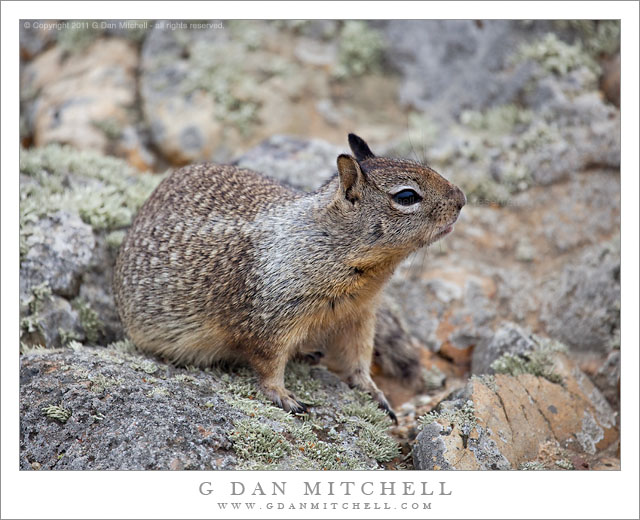
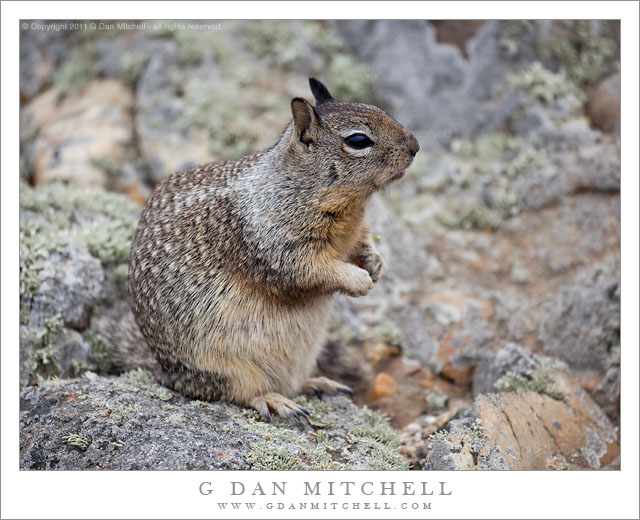
Three photographs of a ground squirrel along a shoreline trail at Point Lobos State Reserve, California.
Since I don’t quite think these photographs warrant separate posts, consider this to be my first three-for-one offer on the blog – three photographs in one post! I had taken a break from seascape photography on my recent visit to Point Lobos State Reserve south of Carmel and at the upper limit of what we might think of as the Big Sur coast. I was at the top of a bluff overlooking the “point of the sea wolves,” the actual spot that gives this park its name, and was trying to photograph the rather small number of pelicans that were coming past from time to time. (This was an odd day for photographing pelicans – fortunately that wasn’t the main reason I was at Point Lobos. Ten or fifteen minutes would go by with no pelicans at all… and then a giant flock or 30 or more would cruise by and be gone.)
So, I was parked at a spot along this trail on top of the bluff, waiting for interesting birds to come by when a couple stopped to look, too. As they stood there, this squirrel emerged from the brush and came right up to them – obviously not the wildest wild animal around. (Later I had to chase it off the bench that my camera bag was sitting on.) Since there weren’t any bird in photography range and there was a very close squirrel, and since I was standing there with a 100-400mm zoom on my camera, I figured I might as well get some close up shots for my gallery. This seemingly well-trained squirrel (is there a squirrel modeling school somewhere?) went quickly through a delightful sequence of poses: first all fours on the ground and looking quizzically to my right; then up on hind feet to eat a seed; and finally lowering the paws holding the seed to look ever so cutely at something to the right.)
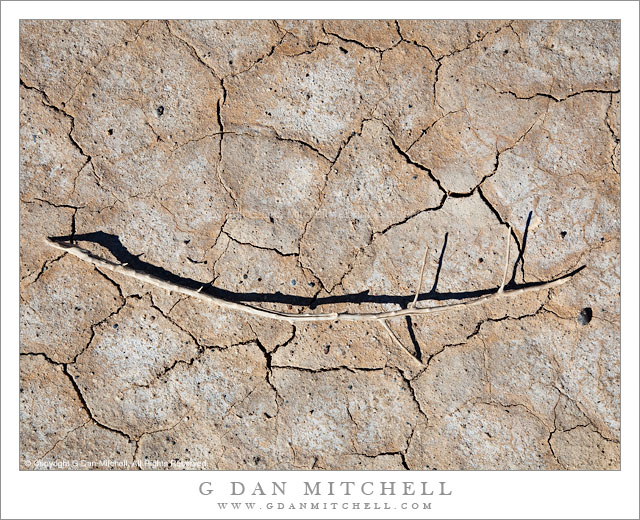
A lone branch lies across dried mud on the playa of Panamint Valley, Death Valley National Park.
First, a story about the location. My first visit to Death Valley was sometime in the late 1990s, when the “hiking and biking” club at my kids’ middle and high school did a trip there. The club is a long and interesting story that I don’t have time or space to describe here fully. Suffice it to say that the teacher, “Mr. Hodges,” had for decades taken kids on amazing outdoor adventures throughout the western United States every year, and that the trip that year was to involve visits to several places in the park and then a backpacking trip down to the Valley from up in the Teakettle Junction vicinity. This may sound like a crazy thing to do with a bunch of school kids, but the group had a record of success. I was along as a parent chaperone since my oldest son was a participant in the trip.
The “readers digest” version of the story of the trip is that, as is often the case near the beginning of April, we encountered an astonishing range of weather conditions. Early on it snowed and the wind blew at gale force levels. This forced us to abandon our initial backpacking plans after we had already camped overnight near Teakettle Junction, and to head back down to the Valley. We readjusted our plans and decided that we might still be able to do an overnight hike down the length of the upper Valley and (leaving out a bunch of intervening adventures in this narrative) we arrived at Stovepipe Wells and set up camp… just in time for a tremendous dust storm to blow in. The next morning the “bus” arrived that was to take the kids and a few of the chaperones home (the rest of us were in a truck carrying tons – literally – of gear on the roof rack and in a trailer) and we headed up to cross Towne Pass. It turned out that the “bus” (which was more or less a large airport shuttle-type van) was ill-equipped for these conditions and after struggling up the pass and then racing down the other side, the transmission blew out at the bottom of the descent into Panamint Valley. Those of us in the truck pulling the trailer arrived a few minutes later to find a group of scared kids and parents who had just experienced more excitement than they wanted.
I have a strong visual memory of “Mary,” one of the parents, who had just had a bit too much excitement walking quietly north away from the road and across this playa. Ever since that time, this place that most people would probably blow right past, has almost always warranted a stop as I passed by on my way out of the Valley. This trip was no exception. I left my camera gear in the car and just walked a ways out onto the playa. As I walked, even though I had been certain that my photography for this trip was finished, I started noticing some of the small details on the playa… and I went back to my car to get my camera, then returned and made a few hand-held exposures of some of these small subjects.
Morning sun light illuminates autumn trees at Ahwahnee Meadow and dissolves the last remnants of morning ground fog, Yosemite Valley.
This was just about the very last exposure I made in this series. As I wrote earlier, I had started shooting in Ahwahnee Meadow before sunrise, on a very cold morning (frost on the grass!) when ground fog obscured the trees. I continued to photograph here for perhaps an hour and a half as the sun light began to touch the highest cliffs and peaks and slight breezes began to move the ground fog. Finally the light began to make its way down to the valley floor, hitting the trees along the west edge of the meadow. At this point I figured it wouldn’t be long before the trees that I was shooting would be touched by the first bit of light. This photograph was made at just about that moment when, fortuitously, some thin clouds moved overhead and muted the fist light to strike the yellow leaves of this grove of trees, standing above the very last remnants of the ground fog.
This photograph is not in the public domain and may not be used on websites, blogs, or in other media without advance permission from G Dan Mitchell.
Photographer and visual opportunist. Daily photos since 2005, plus articles, reviews, news, and ideas.
Manage Consent
To provide the best experiences, we use technologies like cookies to store and/or access device information. Consenting to these technologies will allow us to process data such as browsing behavior or unique IDs on this site. Not consenting or withdrawing consent, may adversely affect certain features and functions.
Functional
Always active
The technical storage or access is strictly necessary for the legitimate purpose of enabling the use of a specific service explicitly requested by the subscriber or user, or for the sole purpose of carrying out the transmission of a communication over an electronic communications network.
Preferences
The technical storage or access is necessary for the legitimate purpose of storing preferences that are not requested by the subscriber or user.
Statistics
The technical storage or access that is used exclusively for statistical purposes.The technical storage or access that is used exclusively for anonymous statistical purposes. Without a subpoena, voluntary compliance on the part of your Internet Service Provider, or additional records from a third party, information stored or retrieved for this purpose alone cannot usually be used to identify you.
Marketing
The technical storage or access is required to create user profiles to send advertising, or to track the user on a website or across several websites for similar marketing purposes.