
Tag Archives: high

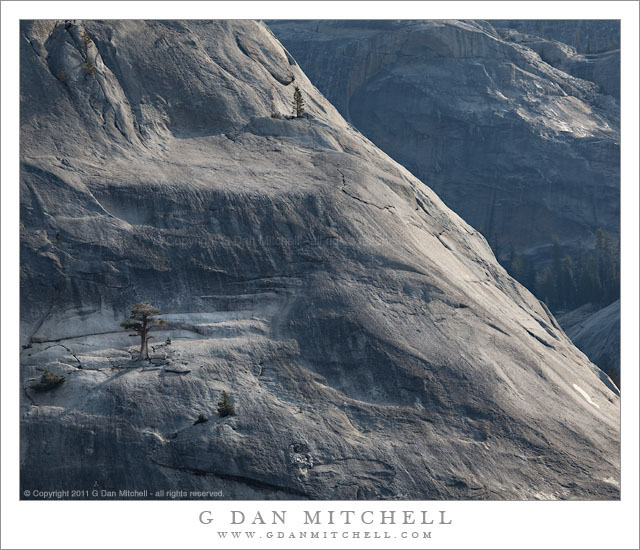
Trees and Granite, Morning

Trees and Granite, Morning

Trees and Granite, Morning. Yosemite National Park, California. July 27, 2011. © Copyright 2011 G Dan Mitchell – all rights reserved.

Morning light shines on the trees clinging to massive granite domes in the high country of Yosemite National Park.

This photograph was the result of an odd little sequence of events. While driving along Tioga Pass Road in the afternoon I looked more closely at an area that I have passed by many times and noticed that it was filled with glacial erratics, “loose” boulders left behind when glaciers retreated. It seemed like these boulders might be an interesting subject and since they were in a position where morning light seemed likely, I made a mental note to return in the morning over the next couple of days and see what I could photograph here.

The next morning, after photographing at dawn nearby, I decided to go to this spot and see what I could come up with. I arrived without a specific idea in mind beyond the plan to look around and see what I could find. My first idea was to photograph the boulders themselves, and I did make a few mediocre exposures of individual boulders and groups of boulders. As I played around with this idea I noticed that the light slanting across granite slabs a bit to the north of me looked interesting, especially since this light was also side- and back-lighting some of the trees. So I turned my attention to this potential subject.

Working with this idea I gradually became less interested in the boulders and more interested in the trees of the lodgepole forest that extended beyond the slabs, so I found a somewhat higher spot to shoot from and made a series of exposures that included layers of backlit trees extending beyond the granite. Beyond the trees was the base of Pywiack Dome, a subject that I have worked with a number of times in the past. Now I looked a bit higher than the forest that led my eye to the dome, and I photographed the boundary between the forest and the base of the dome. (Producing, I might add, a really, really boring photograph!) Looking a bit higher I saw the solitary tree near the lower left of this photograph, and I made a vertical exposure that included mostly just the tree and the expanse of granite above and around it. (This photograph will be here in a few days.) They I thought I would try a landscape orientation photograph, and as I worked with this I got the idea to include the right face of the closer granite dome against the darker shape of a more distant cliff. And, finally, I found this photograph.

(There is also a black and white version of this photograph. The text accompanying that version talks a bit about the black and white versus color issue.)

G Dan Mitchell Photography
About | Flickr | Twitter | FacebookGoogle+ | 500px.com | LinkedIn | Email

Text, photographs, and other media are © Copyright G Dan Mitchell (or others when indicated) and are not in the public domain and may not be used on websites, blogs, or in other media without advance permission from G Dan Mitchell.

(Basic EXIF data may be available by “mousing over” large images in posts. Leave a comment if you want to know more.)
Exposure Blending – A Quick Overview

(This is a slightly modified version of something I wrote as part of a discussion on Google+)

The author of the post that I read before writing this mentions two alternatives for dealing with dynamic range issues in landscape scenes – the use of graduated neutral density (GND) filters or the use of a similarly-named post process technique in Lightroom. (Similar processes are available in other software including Photoshop/ACR.) Another alternative is to use HDR (High Dynamic Range) techniques that allow computer algorithms to combine source images in ways that are not the same as what I describe in this post. I almost always use a different approach, exposure blending, and I’d like to share a few ideas on this topic.

When the scene contains an extremely large dynamic range – a common situation in landscape photography – it is possible to end up with shadow areas that are nearly black and devoid of detail, along with bright areas that are blown out and also completely lack detail. (The latter is especially an issue with digital capture in which overexposed areas can simply become pure white. Film failed more gracefully in this situation.)

One traditional method for dealing with such scenes is to attach various types of graduated neutral density (GND) filters to the front of the lens. These filters include a clear area and an area darkened by a few stops. A typical use might be to position the dark portion over the sky and the clear section over a darker foreground, effectively reducing the dynamic range of the light reaching the sensor by reducing only the brightness of the sky. With film, especially positive transparency film, this was just about the only realistic way to handle the situation in many cases.

A second method is to make a single exposure and use features in Photoshop/ACR, Lightroom, or other software to simulate the effect of the GND, lightening (or darkening) a portion of the photograph. This can often help quite a bit when it comes to balancing out dark and light areas in the image, and the fact is that most savvy landscape photographers do this sort of thing and more in post. But it has its limits. For example, darkening a bright area cannot put detail back in blown out areas, and lightening underexposed shadows can lead to problems with noise and posterization. The bottom line is that this technique works well when the overall range 0f brightness in the scene does not exceed the dynamic range of the camera – here it may be used to adjust the relative levels of the areas – but it does not work well when the dynamic range is actually too great for a single normal exposure.

There is a third method, sometimes called exposure blending, that can often be used when making the exposure. The idea is to make more than one exposure, with each exposure optimized for different parts of the scene by varying shutter speed, and then selectively blend the two exposures during post-production.* Two exposures are sufficient in almost all cases, with one for the shadow detail and the other for highlight detail – though in very complex or wide dynamic range situations more exposures can be used.

Continue reading Exposure Blending – A Quick Overview

Yosemite High Country – A Brief Late July Report

Carefully timing my visit to miss the weekend crowds, I spent the better part of the last week of July (2011) in the Yosemite National Park high country along and around Tioga Pass Road. I posted the first photograph from this visit earlier today, and more will appear here soon. But while the visit is still fresh in my mind, I thought I’d share a few observations and comments that might be useful to others heading there or to other parts of the high Sierra soon.

In a typical late July, all of the snow is melted out at “campground elevations” (generally 8000′ – 9000′ or so – Tuolumne Meadows is at 8600′), essentially all of the usual high country areas are accessible by trail or cross-country travel, wildflowers are at or near their peak, mosquito populations have reached their peak, and visitors are starting to arrive en masse for day use, camping, and backpacking. With the exception of the influx of visitors, this is not quite a typical season, however.

Snow – As I drove up Tioga Pass Road on July 26, the first surprise was finding that there were still large snow patches in some forested areas as low as 8000′ or so. I don’t recall seeing this much snow so low so late in the season in the past. (My memory may not include the lower elevations at this time of year in 1996, the last year with such impressive snow fall.) I stayed at the Porcupine Flat campground, and at least one site there still had enough snow as to make it pretty unusable. Continue reading Yosemite High Country – A Brief Late July Report

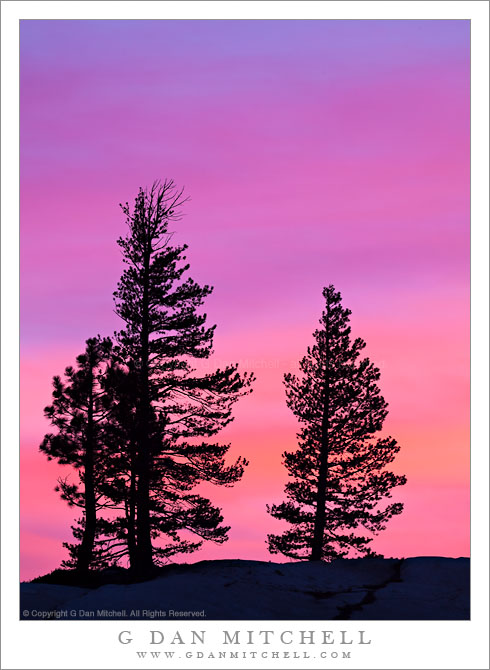
Trees in Silhouette, Olmsted Point, Sunset

Trees in Silhouette, Olmsted Point, Sunset

Trees in Silhouette, Olmsted Point, Sunset. Yosemite National Park, California. June 18, 2011. © Copyright G Dan Mitchell – all rights reserved.

Trees at Olmsted Point are silhouetted against a brilliantly colorful spring sunset sky, Yosemite National Park.

I think everyone should occasionally get to post a just plain gaudy color sunset – and this is mine. While photographing Mount Conness from Olmsted Point was my primary goal on this evening, I also had some opportunities to swing the tripod around and point at other things from time to time. This is about as close as I can come to capturing the nearly hallucinogenic color of the sky as the brightest cloud illumination was centered directly overhead and beginning to move off to the west.

The color saturation was so intense that I had to under expose this by at least a stop in order to avoid blowing out the red channel and in order to retain some differentiation among the various shadings of color as they transitioned from very pink/red through orange and purple and on towards blue.

G Dan Mitchell Photography | Flickr | Twitter (follow me) | Facebook (“Like” my page) | LinkedIn | Email
Text, photographs, and other media are © Copyright G Dan Mitchell (or others when indicated) and are not in the public domain and may not be used on websites, blogs, or in other media without advance permission from G Dan Mitchell.