
Tag Archives: license

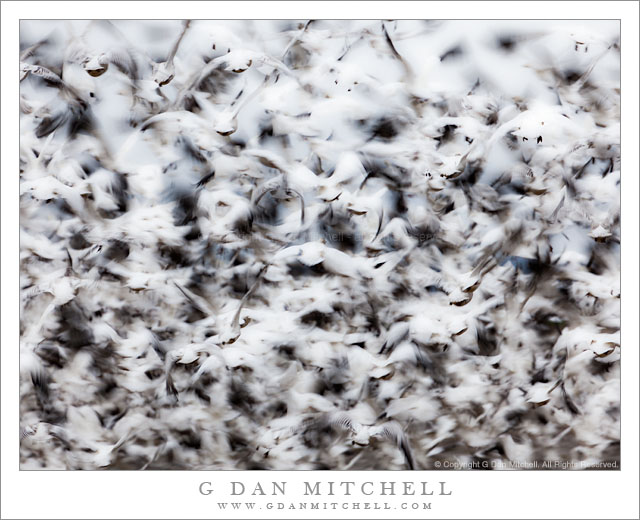
Snow Goose Maelstrom

Snow Goose Maelstrom - A swirling mass of snow geese taking flight above Skagit Valley, Washington.
A swirling mass of snow geese taking flight above Skagit Valley, Washington.

Snow Goose Maelstrom. Skagit Valley, Washington. February 19, 2012. © Copyright 2012 G Dan Mitchell – all rights reserved.

A swirling mass of snow geese taking flight above Skagit Valley, Washington.

(You may need to look at this one for a moment in order to understand what is going on.) I photographed these birds in what I believe Washingtonians might refer to as the “Lower Skagit River Valley” area of Washington. I visited the Seattle Area in mid-February, and managed to get one full day to drive up to Skagit Valley and look for the famous birds that are found there: snow geese, trumpeter swans, bald eagles, and more. I arrived there just before dawn on a cloudy and drizzly morning. Not really knowing the area, at first I wasn’t exactly certain where to look. I started just outside of the town of Conway, where fresh green fields occasionally held groups of trumpeter swans, though they all turned out to be a bit too far away for effective photography. Soon I decided to continue on the road out of Conway, driving in the general direction of Laconner and Anacortes. About half way between Conway and Anacortes, the road crosses a large bridge over the river through a forested area. Just before this bridge, I found my geese! As I approached I caught (thrilling) sight of airborne birds heading toward and landing in a field, so I pulled over and began photographing them. There were many thousands of snow geese, mixed in with some trumpeter swans and a few odd ducks.

As I have photographed the migratory birds this season, mostly in California’s Central Valley, one of the ideas that I got in my head was to photograph the massive flocks as they take off, using longer shutter speeds to create some motion blur and long focal lengths to compress the flocks. So, after making a few photographs at more normal and reliable shutter speeds, I switched to an unusually low shutter speed for a hand held 400mm lens and prepared for the inevitable lift off of the flock. I didn’t have to wait long. As the flock, with its edge barely more than 50 feet away from me, lifted off all at once, I used the long lens to crop closely and tracked the flock as it rose and expanded. While the initial impression of the resulting photograph might be “lots of blurry stuff!,” a closer look begins to reveal some detail and order in the madness, and individual birds can be isolated from the background blur. For the interpretation I had in mind, additional work was needed in the post-processing phase, including some work to control the blur and find edges, and some overall adjustments to dynamic range and color.

G Dan Mitchell is a California photographer whose subjects include the Pacific coast, redwood forests, central California oak/grasslands, the Sierra Nevada, California deserts, urban landscapes, night photography, and more.
Blog | About | Flickr | Twitter | FacebookGoogle+ | 500px.com | LinkedIn | Email

Text, photographs, and other media are © Copyright G Dan Mitchell (or others when indicated) and are not in the public domain and may not be used on websites, blogs, or in other media without advance permission from G Dan Mitchell.
Snow Geese in Motion

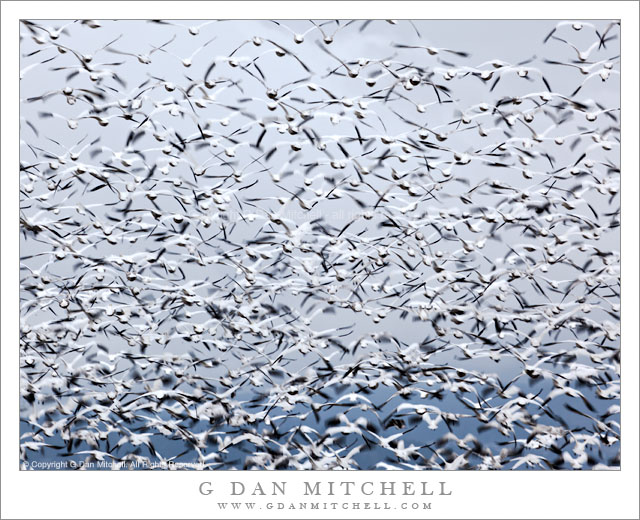
Snow Geese in Motion - A subtle abstraction of motion-blurred snow geese in the sky over Skagit Valley, Washington.
A subtle abstraction of motion-blurred snow geese in the sky over Skagit Valley, Washington.

Snow Geese in Motion. Skagit Valley, Washington. February 19, 2012. © Copyright 2012 G Dan Mitchell – all rights reserved.

A subtle abstraction of motion-blurred snow geese in the sky over Skagit Valley, Washington.

In the second half of February I had the opportunity to spend four days in the Pacific Northwest, in and around the Seattle area. It seemed that there were two wildlife events taking place – both involving birds. The one that was getting the most attention was the snowy owls up in, if I understood correctly, the Vancouver, BC area. For a variety of reasons that subject was not going to be on my itinerary for this trip. The other was the trumpeter swans and snow geese that were settling in the lower Skagit Valley, roughly between Conley and Laconner. I did manage to spend the better part of an entire day there photographing these birds, along with a few others including bald eagles.

I arrived in the area very early, at just about the time of what would have been sunrise had it not been raining lightly. As I drove out of Conley I began to see the trumpeter swans here and there on the bright green winter fields. But despite some serious wandering about on rural side roads, I was not able to get close enough to them to make photographs. So I moved on, soon coming to a closed produce market alongside the road near fields and just before the road crossed the nearby river on a bridge through the woods. Here, at a curve in the road, I spotted many thousands of snow geese just across a drainage ditch and not far from the roadway. I pulled over and set up and watched as even more birds began to arrive, until the largest flock of geese that I have even seen was assembled in this empty field. Then, for some reason I could not discern, the entire group of thousands and thousands of geese spontaneously and en masse rose up into the air. Fortunately, I had been thinking about this possibility and an idea I had to photograph them with a long lens and at slow shutter speeds, and I was already at the right shutter speed and had the long lens on the camera. It was mostly a matter of aiming straight into the thickest part of the flock and trying to keep some eye on the background patterns as the geese rose into the air. I took this photograph from the set since it was almost entirely filled with geese and used it as a starting point to do a bit of additional post-processing to produce the interpretation of the photograph that you see here.

G Dan Mitchell is a California photographer whose subjects include the Pacific coast, redwood forests, central California oak/grasslands, the Sierra Nevada, California deserts, urban landscapes, night photography, and more.
Blog | About | Flickr | Twitter | FacebookGoogle+ | 500px.com | LinkedIn | Email

Text, photographs, and other media are © Copyright G Dan Mitchell (or others when indicated) and are not in the public domain and may not be used on websites, blogs, or in other media without advance permission from G Dan Mitchell.

Thinking About Yosemite’s Horsetail Fall

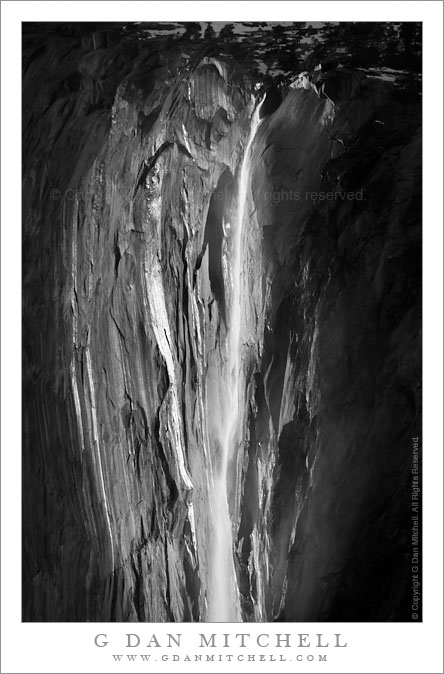
Horsetail Fall
Horsetail Fall

Horsetail Fall. Yosemite National Park, California. February 15, 2010. © Copyright 2010 G Dan Mitchell – all rights reserved. *

UPDATE: As of 2020 I am no longer posting annual updates concerning this subject — and I am editing older posts on the subject in light of the need to be more responsible about not encouraging the onslaught. I also no longer recommend going to the Valley to see it. Unfortunately, too much exposure (yes, I played a part in it, unfortunately) has led to absurd crowds, traffic jams, littering, destruction of areas in the Valley where too many people go to see it… and the park has increasingly — and appropriately — cracked down. Parking options have been eliminated, at least one viewing location has been closed. Good news! The rest of Yosemite Valley is still there and often exceptionally beautiful at this time of year.

The silver strand of Horsetail Fall and water reflecting on surrounding cliffs in late afternoon light, Yosemite Valley.

This being February, it seems that Horsetail Fall has again (and more every year) become a hot topic. Horsetail Fall, sometimes referred to as the “Natural Firefall” has been popularized to an absurd and, frankly, dangerous level on social media and in the press. To be honest, I now recommend that you not go.

The conjunction of elements required to produce the most spectacular Horsetail Fall “event” is complex. First, it depends on the geological coincidences of the placement of the fall in a spot hight on the face of El Capitan that receives a narrow beam of sunset light during two brief periods each year. Second, the fall must be running – in roughly the middle of winter. The area supplying water to the fall is high enough to be snow-covered in a typical winter, but low enough that snow can melt and start the fall flowing even in the cold season – but this is not a sure thing. Essentially, there must be snow and then some warmth to melt it, or else some significant warm rain. Third, a series of meteorological events must play out just right. Obviously, the upper face of El Capitan must be clear of clouds. (Yosemite Valley fog and clouds ringing the cliffs are rather common in the winter season.) The sky west of the Valley must also be clear all the way to the horizon since the best color occurs just before the sun hits the horizon.

Most often the requirements do not align. Many of us can tell stories of light getting better and better, leading toward a brilliant finale… and then the “lights going out” just at the peak of color as the sun dropped behind clouds far to the west.

Hundreds and hundreds Thousands of photographers now show up to try to photograph the thing. I’ve done it in the past, though I’m no longer interested these days – partly because of the absurd crowds and partly because I’m often busy photographing other interesting things!

My best memory of photographing Horsetail was years ago when the park service was doing major road work on Northside Drive, the road along that side of the Valley. The road was completely closed as were the cross-valley roads that travel between Southside and Northside Drives. It had snowed and there was perhaps a foot or more of snow along this section of the Valley floor. I wanted to photograph the fall from a location on the north side of the Valley, so my only option was to put on lots of warm clothes, load up a pack of camera and other gear, and walk across the Valley in the snow. I arrived long before sunset, so I first walked west to El Capitan Meadow where I photographed in rare quiet and solitude on this car-free and carefree late afternoon. Later, I quietly walked back along the road to my shooting location and found perhaps three or four other people there. This quiet, peaceful, and relatively uncrowded experience became my touchstone for photographing Horsetail.

If you go today, there is no way that your experience will be even close, unfortunately.

In recent years, as more people have acquired digital cameras and become more serious about their photography and as the renown of the fall has increased, the crowds have also increased to the point that they have become unmanageable and are damaging the park. As I revise this article in 2020, the problem has become so acute that the park service has wisely put severe restrictions on access — there is no stopping allowed along large sections of nearby Valley roads and one of the popular locations has been completely closed due to damage to forest, meadows, and the river.

* Note: In a wonderful video about Horsetail Fall, Ansel Adams’ son Michael Adams speaks eloquently about his father’s early photographs of the phenomenon. I was intrigued by his comment that Ansel might not have photographed the fall the way we do now because he couldn’t – since he worked with black and white photography. Thinking of this, and being full of myself today, I thought that I’d post a black and white photograph of Horsetail Fall! :-)

G Dan Mitchell is a California photographer whose subjects include the Pacific coast, redwood forests, central California oak/grasslands, the Sierra Nevada, California deserts, urban landscapes, night photography, and more.
Blog | About | Flickr | Twitter | FacebookGoogle+ | 500px.com | LinkedIn | Email

Text, photographs, and other media are © Copyright G Dan Mitchell (or others when indicated) and are not in the public domain and may not be used on websites, blogs, or in other media without advance permission from G Dan Mitchell.

Trees, Pond, and Birds in Twilight Sky

Trees, Pond, and Birds in Twilight Sky - Migratory birds fly through twilight skies above trees and ponds at the Merced National Wildlife Refuge.
Migratory birds fly through twilight skies above trees and ponds at the Merced National Wildlife Refuge.

Trees, Pond, and Birds in Twilight Sky. Merced National Wildlife Refuge, California. February 4, 2012. © Copyright 2012 G Dan Mitchell – all rights reserved.

Migratory birds fly through twilight skies above trees and ponds at the Merced National Wildlife Refuge.

On an early February Saturday evening, four of us converged on the Merced National Wildlife Refuge from far-flung locations – two from the San Francisco Bay Area and two from the Sierra Foothills – to photograph the evening fly-in of migratory birds. We arrived well before the golden light of evening and had plenty of time to get settled in and find birds and other things to photograph. The first “target” was a large, no make that huge, flock of geese that were in a pond of the far side of the road around the refuge. We photographed these birds, both in the water and as groups of them took off and flow (sometimes) over our position.

As the evening wore on the bird “action” began to slow down. Some of us wandered off to shoot other subject including the interesting trees and brush along the levees that separate the ponds. I can’t speak for the others, but I had decided that “the show was over,” and that we had probably seen as many of the large migratory birds as we would see that night. You can’t completely predict where and when they’ll show, so one has to be a bit philosophical about this. Then, without warning, we began to hear the calls of large numbers of birds from the south and moments later flock after flock began to fly right over us and then circle above the pond in front of us in huge groups. There was a bit of light still, and I managed a few photographs in this beautiful but marginal light before we pretty much stopped photographing and simply marveled at the spectacle.

G Dan Mitchell is a California photographer whose subjects include the Pacific coast, redwood forests, central California oak/grasslands, the Sierra Nevada, California deserts, urban landscapes, night photography, and more.
Blog | About | Flickr | Twitter | FacebookGoogle+ | 500px.com | LinkedIn | Email

Text, photographs, and other media are © Copyright G Dan Mitchell (or others when indicated) and are not in the public domain and may not be used on websites, blogs, or in other media without advance permission from G Dan Mitchell.