
Tag Archives: Mountain

Manly Beacon, First Light

Manly Beacon, First Light

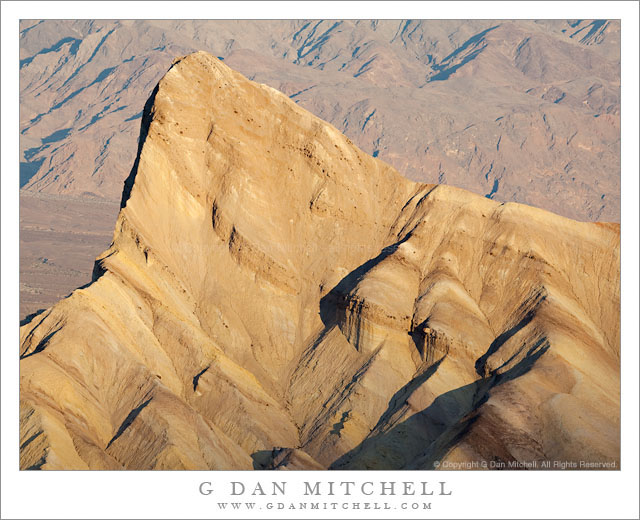
Manly Beacon, First Light. Death Valley National Park, California. March 30, 2011. © Copyright G Dan Mitchell – all rights reserved.

The first morning light strikes Manly Beacon at Zabriskie Point, Death Valley National Park.

Icon alert!

I had more or less promised myself that I would not photograph at Zabriskie Point on this trip – been there, done that – unless the conditions were really special. But I miscalculated my morning start on this day and discovered that I wasn’t going to make it to my intended destination in time. As I passed Zabriskie on my way to the “other place,” telling myself that I still had a half hour before I needed to be in place for the early light… I noticed that clouds above this area were already starting to pick up the pink color of dawn light. I hesitated for a moment – I really wanted to photograph that other subject – but quickly realized that it would make a lot more sense to the shoot the subject that was here in the light that was developing than to drive further and miss out entirely on the first light.

So I turned into that familiar parking lot with its familiar fleet of photographers’ cars and quickly loaded up my gear. I was a bit surprised that I saw so few people up above at the official overlook, but it was quite windy and I figured that perhaps they had just dropped down on the other side of the wall below this spot. In any case, I had a different spot in mind, one further to the right, so I headed over that way and quickly discovered that the wind was blowing almost too strongly to make photographs. I made a couple of shots from a small gap there and then headed up toward the overlook. At the top of the little trail from the parking lot I dropped onto the small use trail to the side of the wall and was again surprised to see almost no other photographers. I walked a few feet farther and discovered that the “usual crowd” was huddled in a small area in the lee of the wall, trying desperately to find protection from the wind.

These days, my main project when I stop at Zabriskie is to find and photograph small, isolated elements of the landscape with a long lens. For the most part – unless truly magical conditions are present, and they weren’t on this morning – I don’t really spend much time on the classic views of Gower Gulch, the Valley, and the Panamint Range. However, since I’m there and know the progression of the light fairly well at this point, I’m not about to pass up the opportunity to get a better image of one of these iconic subjects. So as the first light was about to hit the summit of Manly Beacon I turned my rig that direction and spent a couple of minutes photographing it as the line between shadow and morning light traveled down its face.

G Dan Mitchell Photography | Flickr | Twitter (follow me) | Facebook (“Like” my page) | LinkedIn | Email
Text, photographs, and other media are © Copyright G Dan Mitchell (or others when indicated) and are not in the public domain and may not be used on websites, blogs, or in other media without advance permission from G Dan Mitchell.
Desert Wash at Base of Tucki Mountain, Dusk

Desert Wash at Base of Tucki Mountain, Dusk

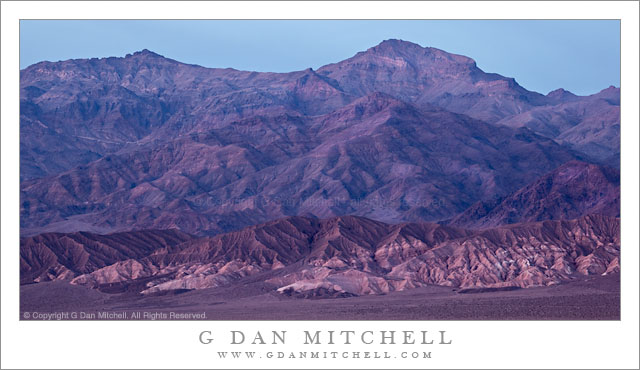
Desert Wash at Base of Tucki Mountain, Dusk. Death Valley National Park, California. March 29, 2011. © Copyright G Dan Mitchell – all rights reserved.

Soft rose-colored dusk light illuminates an alluvial fan below a canyon at the base of Tucki Mountain, Death Valley National Park.

This is one of several photographs from the recent Death Valley trip that beg the question, “Is that color real?!”*

Yes, this really is the color of the light from this scene.

I learned quite a while ago that the interesting light most definitely does not end at sunset – often the best and most interesting light comes after the sun has set. Sunset on this evening had been quite interesting, but a few minutes after the sun set the last brilliant red light struck high clouds overhead and lit up the entire scene with this lurid and intense wash of color.

The scene is a large desert gravel wash where a drainage canyon spills out into Death Valley at the base of Tucki Mountain and forms a huge alluvial fan. I had climbed to the top of a low hill to shoot late afternoon and sunset light, so I had a good vantage point to view this wash beyond intervening hills. Tucki Mountain itself is a massive lump of a mountain that rises above Stovepipe Wells – what it lacks in terms of an impressive and jagged summit peak in makes up for by means of its sheer bulk. It constitutes a large spur off of the Panamint Range and almost seems like a small sub-range all by itself.

*After I originally wrote the text to this post I made a 12″ x 16″ test print of this photograph. As I often do, I put the print out on a table in our living room so that I can see it in a context other than that of my small studio. My wife, who is a very perceptive viewer and who has seen the results of, uh, printer errors (for real fun, print on the back side of your paper by accident some time…) looked at these colors and said, “Is something wrong with your printer?” Ah, I love critics! ;-)

G Dan Mitchell Photography | Flickr | Twitter | Facebook | Email
Text, photographs, and other media are © Copyright G Dan Mitchell (or others when indicated) and are not in the public domain and may not be used on websites, blogs, or in other media without advance permission from G Dan Mitchell.
Red Rock and Desert Hills

Red Rock and Desert Hills

Red Rock and Desert Hills. Death Valley National Park, California. March 29, 2011. © Copyright G Dan Mitchell – all rights reserved.

A red rock gully among the desert hills of the Panamint Range, Death Valley National Park.

This is anything but an iconic image, but I think that it is emblematic of a certain type of scene that is often seen in Death Valley National Park once you get out of the main Valley and up into the hills, especially during the brief spring season when the light can be a bit softer and the plants a bit (relatively speaking!) greener.

The photograph looks up a broad valley that is visible from along the road that rises from the main road through the Valley and climbs toward the Wildrose Canyon area. Here the elevation is high enough that the dry, sun-baked flat land of the Valley is nowhere to be found. Instead this is a country of large valleys and plateaus, cut in places (mostly at the bottom of canyons) but rocky outcroppings and gullies. This red rock gully is easily visible from the road, though the odds are that most people just drive right by. I had seen it on several drives past this spot before I thought to stop and photograph it, and I was fortunate to be there when the light seemed just right.

G Dan Mitchell Photography | Flickr | Twitter | Facebook | Email
Text, photographs, and other media are © Copyright G Dan Mitchell (or others when indicated) and are not in the public domain and may not be used on websites, blogs, or in other media without advance permission from G Dan Mitchell.

Mesquite Dunes and Cottonwood Mountains

Mesquite Dunes and Cottonwood Mountains

Mesquite Dunes and Cottonwood Mountains. Death Valley National Park, California. March 29, 2011. © Copyright G Dan Mitchell – all rights reserved.

Soft and hazy late-afternoon light on Mesquite Dunes and lower Cottonwood Mountains, Death Valley National Park.

The color of the sand dunes of Death Valley changes radically at different times of the day, in different weather conditions, and even seasonally. Many of the photographs of these dunes – the “Mesquite Dunes” in the middle Valley near Stovepipe Wells – are made in the early morning or in the evening. At those times the dunes take on the colors of sunrise/sunset light (generally very warm yellow to golden colors) or the pre-dawn or (better yet) post-sunset light of the sky, which can include a range of colors from blues to pinks to purples and so on. Judging by photographs you might think that the dunes are brightly and intensely colorful. (Or black and white, but that’s a different story.)

Most of the time the coloration is quite different from what we see at the early and late “edges” of the day. The less saturated colors at other times of day can be a bit more complicated to shoot, but they can also create some wonderful subtle effects if you happen to look in the right place at the right time. Late in the afternoon on this early spring day, there was some haze in the atmosphere – perhaps from some blowing dust and/or some clouds and moisture that had been around earlier. As the sun drops at Mesquite Dunes, it goes behind mountains to the west well before actual sunset. When this happens, the dunes are gently back-lit by soft light from the western sky, and the backlit haze mutes the colors of the dunes and, even more, the distant slopes of the rugged Cottonwood Mountains.

My idea here was to isolate the undulating shapes of the softly lit dunes in front of the background of the very, very muted colors and shapes of the lower Cottonwood Mountains, which are obscured by haze. There is some color in this scene, but it is subdued and edges quite a ways towards pastels.

G Dan Mitchell Photography | Flickr | Twitter | Facebook | Email
Text, photographs, and other media are © Copyright G Dan Mitchell (or others when indicated) and are not in the public domain and may not be used on websites, blogs, or in other media without advance permission from G Dan Mitchell.