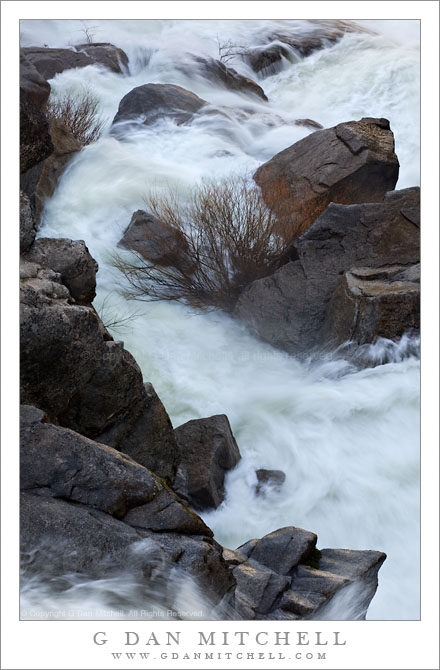
A torrent of water from melting spring snow rushed through a rocky section of Cascade Creek, Yosemite National Park.
During the early part of the seasonal spring snowmelt runoff, Cascade Creek is transformed into a wild and raging torrent as the lower elevation snow in the upper portion of its drainage begins to melt quickly. Contributing to the spectacular effect is the very steep path the creek follows down the walls of the Merced Canyon before it makes one final leap over a waterfall and then joins with the main Merced River.
This bit of creek is another of those places in the Sierra that I have come to know very well. There are certain places where I like to say that I know individual rocks and trees, and this is one of them. I photograph here several times each year during all seasons and in all kinds of light. But my favorite is the early morning spring light, before the sun rises high enough to directly illuminate the creek bed, when the creek is flowing madly and twisting and turning around and over boulders.
An early dogwood blossom and leaves in Yosemite Valley, California.
This is another plant that I’m on a first name basis with. I know this particular dogwood rather well, having first been attracted to it one fall while walking along the north side of Yosemite Valley looking for leaves against rock. At that time the fall-color leaves of this dogwood tree were draped across the top of a low, flat boulder. When I’m in this part of the Valley, I often walk past this tree to see what it is doing. On this first weekend of May, the tree was just getting its first blossoms of the spring season, and I was able to clamber up on top of the boulder, set up my tripod, and make a few close-up photographs of the flowers.
I originally figured it would be a color photograph but as I worked on it I started to think it might be interesting in black and white, too. (You’ll get to decide – the color version will appear tomorrow.) Besides having to wait for the slight breeze to pause so that I could make a 1/8 second exposure, another challenge was the dynamic range between the bloom and the rather dark background. I tend to slightly underexpose the highlights, since digital capture is not kind to over-exposed whites. Then I work in post to bright the brightest parts back up to where I think they should be, but without letting anything blow out.
For dogwood fans, the “word on the street” had been that these flowers were coming along a bit later than usual this year. But on this day it seemed like they were suddenly starting to appear in many of the usual places in the Valley. I’m expecting them to peak between now and perhaps a week or so from now, and later on at higher elevations. One potential wrinkle is the possibility of snow in the Valley on Sunday!
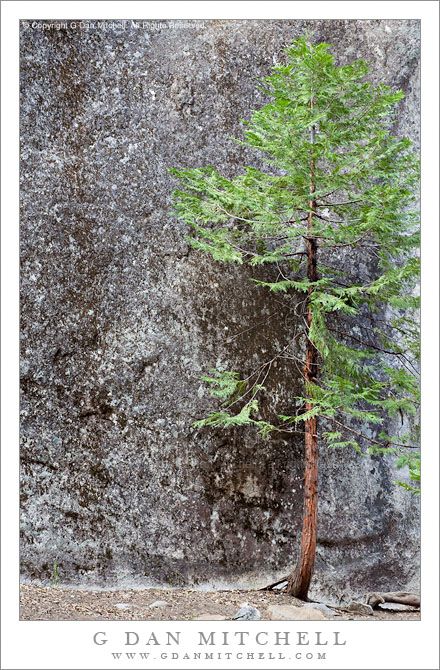
A young tree grows against a granite wall along the north side of Yosemite Valley.
This tree (and its nearby oak partner) and I have become good friends over the past few years. I first photographed it in the fall some years back, though the oak made a better shot at that time given its fall color leaves. But every time I walk along a certain area under the cliffs on the north side of Yosemite Valley I check in here to see what the light is doing.
During the first weekend of May I was in the Valley for photography and to visit the reception for Michael Frye’s exhibit at the Ansel Adams Galley. After spending an enjoyable hour and a half or so viewing Michael’s prints and meeting and talking with a wonderful group of photographers and photography enthusiasts at the Gallery I left to go wander a bit and make some photographs. When I came to this spot, clouds were starting to appear in the late afternoon sky above the Valley. This is a kind of ideal light since these conditions soften but don’t completely destroy the sunlight, and diffused light gets down into the forest and fills out the shadows.
I love the texture of these huge blocks of flat granite, covered with lichen. I like the visual quality of this rock, but I also like the physical quality of it; this probably dates back to a time some years ago when I was a rock climber for a few years. So while the tree seems like the main subject here, the rock surface is for me just as important.
Black and white photograph of the ruins of an abandoned mining cabin high in the Panamint Mountain Range of Death Valley National Park.
There are a number of things that make Death Valley National Park, to the best of my knowledge, rather unique. One is the extensive history of human habitation inside the park boundaries, quite a bit of which is visible – though some takes a bit more effort and attention to spot. The history of mining in the park is well-known, and many of the icons of the park have connections to this history. If you visit Furnace Creek, for example, you cannot miss the displays of old wagons and so forth used to move ore out of the Valley. It doesn’t take a lot of careful study to figure out that many park roads originated in an era of prospecting and mining. There are several well-known examples of structures left over from that era in and around the park, too.
It is largely because of this history that many areas of this national park are (or have been – some are now reverting to wilderness status) accessible by gravel road or four-wheel-drive routes. I would argue that you can’t really get to know this park if you just stick to the paved roads and the points of interest that they access. If you drive any of these other routes and keep your eyes open you will often be surprised by the left overs from relatively recent mining and prospecting, much of which isn’t really written about or described in the usual guides to the park. (And I’m not going to offer specific details about where to find such places here, since I don’t want to be even a little bit responsible for damage to them. If you do visit, treat them with care and respect.)
As I drove along a gravel road in one of the many mountain ranges of the park, returning from a site that is somewhat well-known, I began to notice evidence of fairly recent mining and prospecting. Faint tracks depart from the main “road” and cross valleys and hills, here and there tailing piles and mine entrances are visible, and sometimes you come across old structures such as cabins, storage bunkers, or wooden towers above mine entrances. I spotted the ruins of this old cabin above the road at one point and decided to walk up and investigate.
I’m almost always surprised at how “modern” many of the traces found at these places seem to be. I guess I am expecting something from the 1800s, but quite a few of these places look like they were build and occupied much later than that. I find modern things like linoleum flooring or modern-looking nails or electrical wire in many of them. There obviously isn’t much left of this cabin now, but from the detritus lying around near it and the form and materials found here, it must have been a reasonably comfortable place to live. As I walk around such places I often try to imagine what it must have been like to wake up every morning in this silent desert and head out for another day of physical labor.
Photographer and visual opportunist. Daily photos since 2005, plus articles, reviews, news, and ideas.
Manage Consent
To provide the best experiences, we use technologies like cookies to store and/or access device information. Consenting to these technologies will allow us to process data such as browsing behavior or unique IDs on this site. Not consenting or withdrawing consent, may adversely affect certain features and functions.
Functional
Always active
The technical storage or access is strictly necessary for the legitimate purpose of enabling the use of a specific service explicitly requested by the subscriber or user, or for the sole purpose of carrying out the transmission of a communication over an electronic communications network.
Preferences
The technical storage or access is necessary for the legitimate purpose of storing preferences that are not requested by the subscriber or user.
Statistics
The technical storage or access that is used exclusively for statistical purposes.The technical storage or access that is used exclusively for anonymous statistical purposes. Without a subpoena, voluntary compliance on the part of your Internet Service Provider, or additional records from a third party, information stored or retrieved for this purpose alone cannot usually be used to identify you.
Marketing
The technical storage or access is required to create user profiles to send advertising, or to track the user on a website or across several websites for similar marketing purposes.