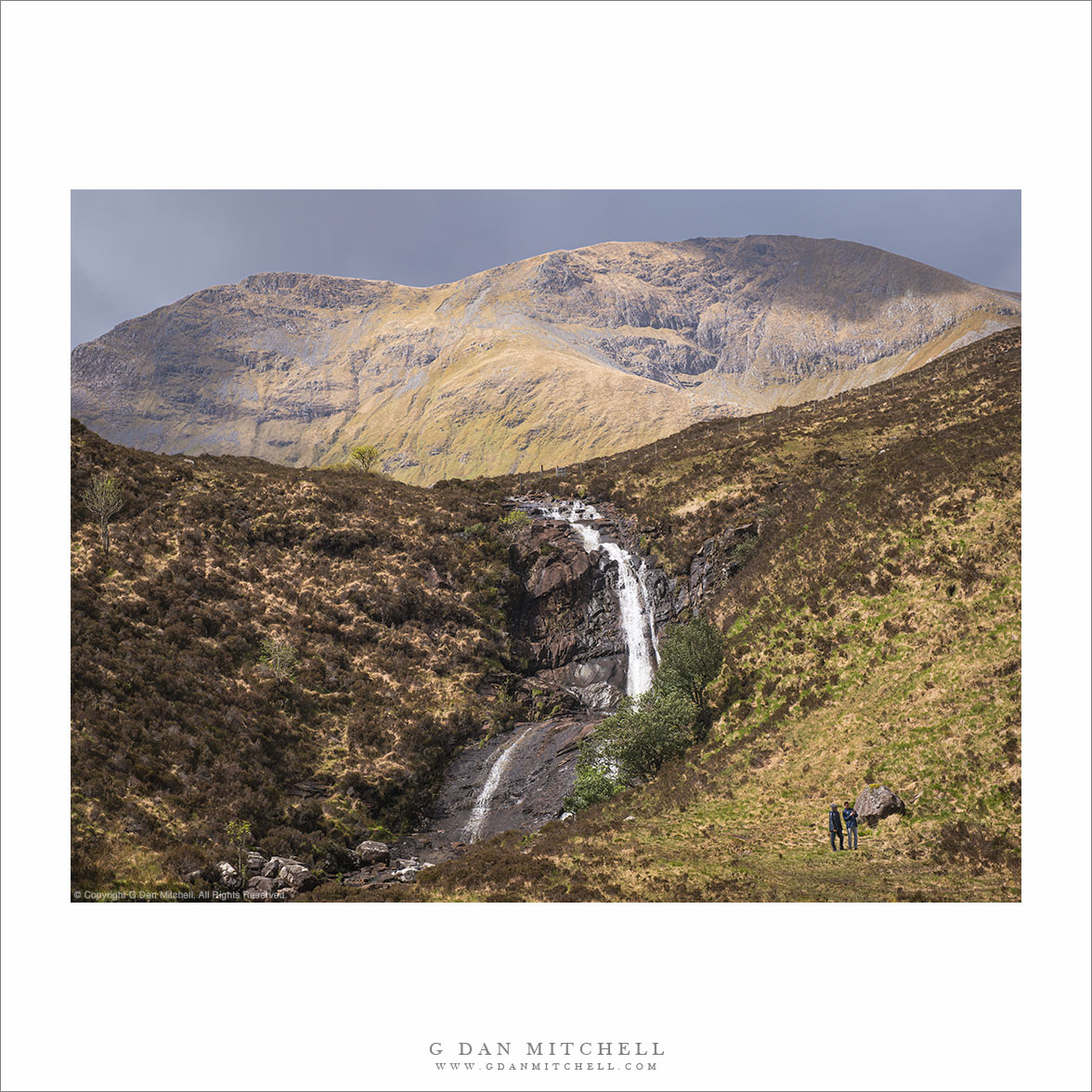
“Marsco and Waterfall” — The peak of Marsco towers over a waterfall, Eas a’ Bhradain, Isle of Skye.
In case you haven’t heard, it is wet in Scotland. I knew this, having been there before, but coming from the relatively dry California climate, it is still quite a contrast. One thing that still takes me by surprise at first is the size of the streams and rivers that rise over short distances — and that they are everywhere. We stopped and photographed this roadside cascade as we were departing Skye to head north.
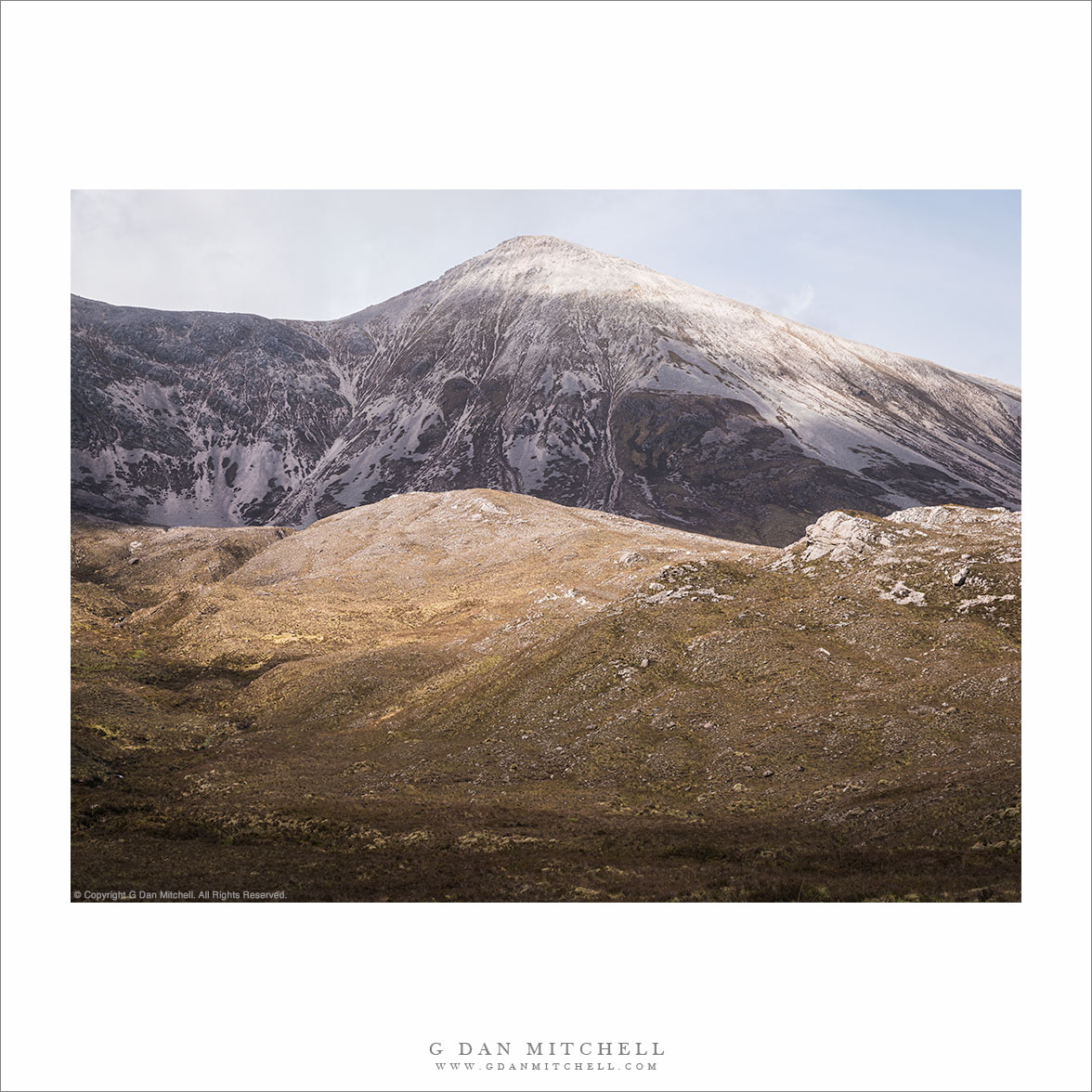
“Snow-dusted Highlands Peak” — A highlands summit rises above a sun-dappled hill.
After six weeks of travel, almost two weeks of it in beautiful Scotland, some location memories begin to blur together. I cannot say precisely where I made this photograph. It was on the day we left Skye and made our way north to Ullapool. My recollection is that we had perhaps passed through some rain at a high point on the route, and we came to this peak and its foreground hill as the weather was beginning to clear, allowing a bit of sunlight into the scene. (It is hard to identify these Scottish peaks after returning back to the US, but this one may be Spidean Coire nan Clach.)
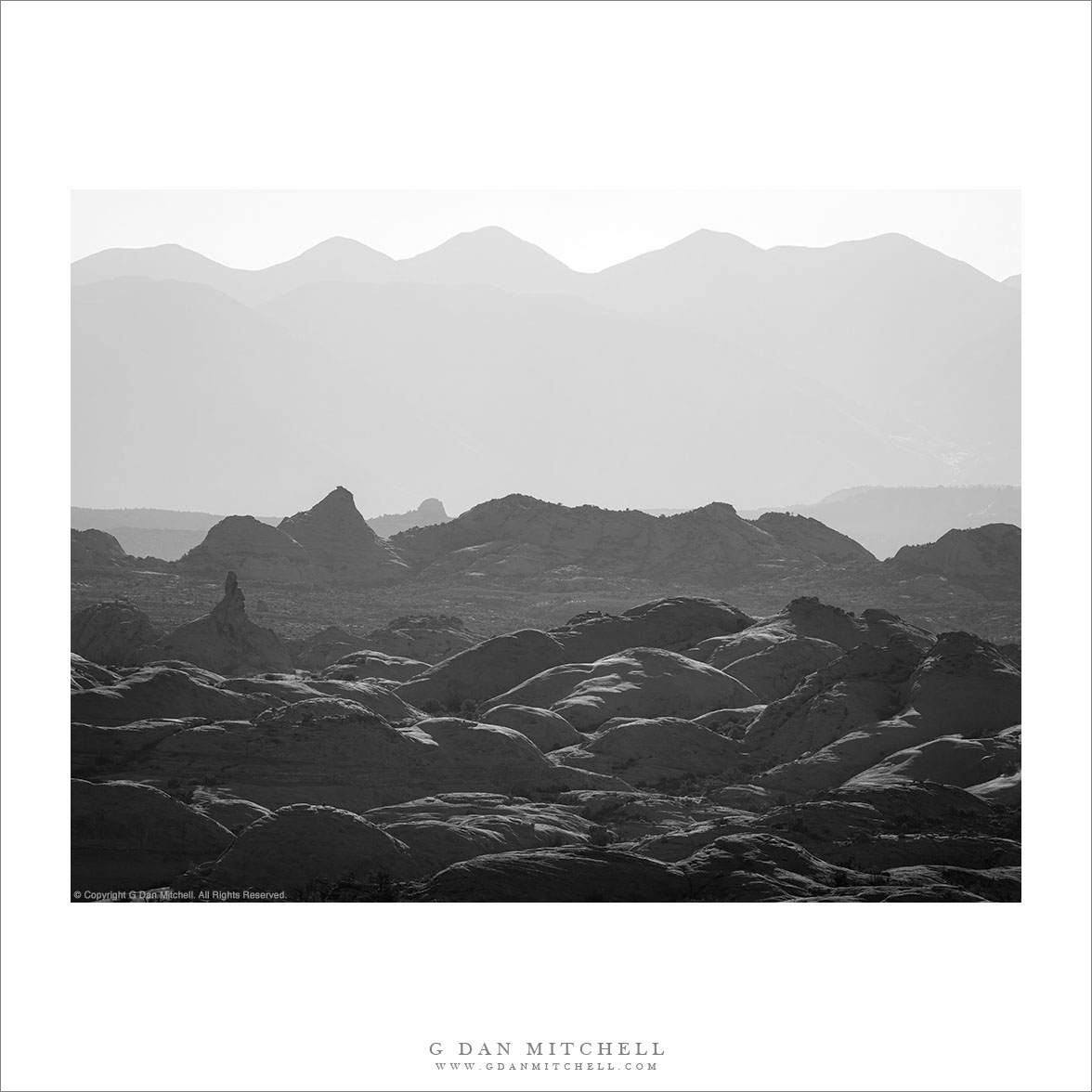
“Sandstone Terrain and Mountains” — Morning haze and backlight obscures distant mountains and sandstone terrain, Arches National Park.
Arches National Park is red rock country, a landscape dominated by the colors of Southwest sandstone. Almost all of my photographs of the area are in color, for that obvious reason. It is not just the rocks themselves — the complementary greens of vegetation and the blue of the sky feature strongly, too. But this particular view, a veritable moonscape, seems to call for a monochrome interpretation.
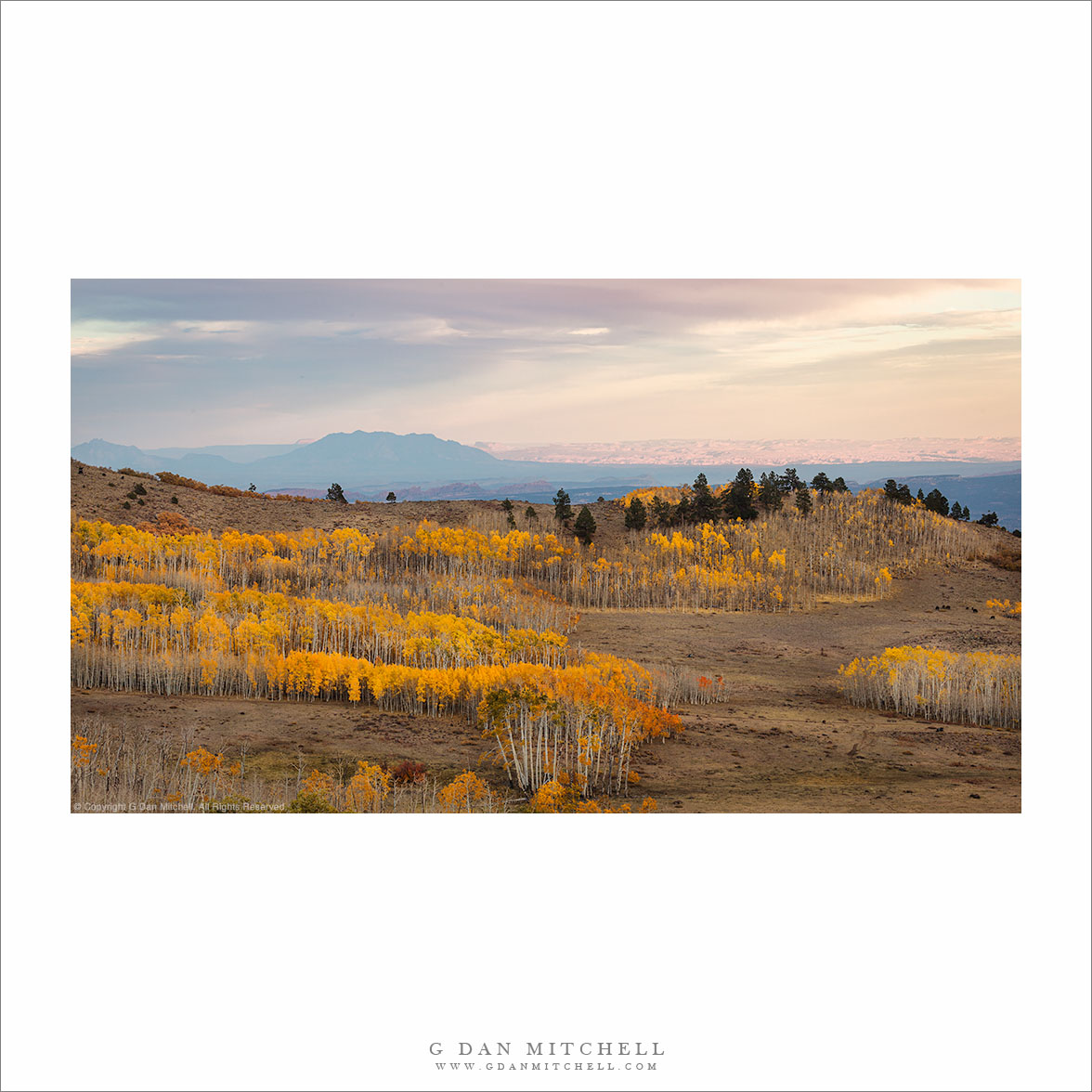
“Boulder Mountain Aspens, Evening” — Autumn aspen trees near Boulder Mountain, Utah.
I took me a while to figure out this location in Utah, along the edge of Boulder Mountain. Years ago we drove through here in the spring, and I was astonished by the huge aspen groves. I resolved to return in the autumn, and a few years later we did —timing our visit to synchronize with peak of California’s Eastern Sierra aspen color. It turns out that the color change earlier in Utah, and by the time we arrived the groves were past their peak.
Photographer and visual opportunist. Daily photos since 2005, plus articles, reviews, news, and ideas.
Manage Consent
To provide the best experiences, we use technologies like cookies to store and/or access device information. Consenting to these technologies will allow us to process data such as browsing behavior or unique IDs on this site. Not consenting or withdrawing consent, may adversely affect certain features and functions.
Functional
Always active
The technical storage or access is strictly necessary for the legitimate purpose of enabling the use of a specific service explicitly requested by the subscriber or user, or for the sole purpose of carrying out the transmission of a communication over an electronic communications network.
Preferences
The technical storage or access is necessary for the legitimate purpose of storing preferences that are not requested by the subscriber or user.
Statistics
The technical storage or access that is used exclusively for statistical purposes.The technical storage or access that is used exclusively for anonymous statistical purposes. Without a subpoena, voluntary compliance on the part of your Internet Service Provider, or additional records from a third party, information stored or retrieved for this purpose alone cannot usually be used to identify you.
Marketing
The technical storage or access is required to create user profiles to send advertising, or to track the user on a website or across several websites for similar marketing purposes.