Tag Archives: national

The best laid plans…

… sometimes fail. :-)

A number of things needed to fall into place today so that I could arrive at Cathedral Lakes in the Yosemite back-country this evening to meet a group of photographers. Reading the previous sentence you might think that I’m somehow posting from my tent after enjoying a nice backpacker dinner.

Not quite.

I teach. Classes started this week. Today I met my Friday-only class for the first time. My plan was to have everything packed for the weekend last night – check rather late by headlamp – check. To get up at the slightly-later hour and load the car for the trip – check. To leave for the college with enough time to stop for gas, get ready for my class, etc. – oops!

When I went to the car – after loading it, of course – I discovered a flat tire. By this time it was too late to deal with a repair and still make it to the college on time – I didn’t even have time to unload the car – so I simply had to take the other car, teach my class, and then come home to unpack and get the tire repaired. So, I’m not at Cathedral Lake tonight… where I’m sure it is quite beautiful and my friends are now enjoying the post-evening photography conversation.

At least I’m reasonably confident that the Sierra will still be there when I do make it up to Cathedral… soon.

Eastern Sierra Aspen Color Reports Starting (9/24/09)

If you are really trying to follow the evolution of eastern Sierra fall color – most aspens – your best bet is to find some of the primary sources yourself and start following them. However, I’m going to continue to post a few here from time to time – and before long I should be able to start posting some of my own reports.

  • Inge Fernau posted an extensive description of her one-day marathon trip to Bishop Creek, including some photographs that will help those who know the areas already extrapolate a bit. Inge’s site is always worth a visit, and few post more thoroughly on the aspens.
  • The calphoto site is typically a great source of current information about the fall color in the eastern Sierra… but this season there doesn’t seem to be much info there yet. I’m hopeful that this many change in the next few days.
  • The Eastern Sierra Fall Color group at Flickr has a lot of information, both in the form of text and in images that will give you some answers to the “where?” and “when?” questions.
  • Greg Boyer’s One Horse Studio site is featuring frequent updates including one from the middle of the current week that sounds somewhat optimistic.

Remember a few things about finding and shooting aspens:

  • Conditions can vary a lot as you travel north/south and low/high. If you hear a poor report about one spot, you cannot necessarily extrapolate that to the whole range. Be prepared to move if your “perfect spot” isn’t in condition.
  • How you shoot the trees matters a lot. Sometimes a grove that seems to be almost green will appear to be quite yellow/gold if you go around to the other side for some backlight.
  • Time of day matters a lot #1. It is really tough to shoot them effectively in harsh, midday sun on a cloudless day. Early and late are often better, and shooting on the sun/shade boundary is often very interesting – though you’ll have to be prepared and work quickly.
  • Time of day matters a lot #2. A spot that is flat and boring in the morning may shine in the evening, and vice versa.
  • Time of day matters a lot #3. Shooting in shady conditions is sometimes very effective. You can get past the problems with black shadows and blown highlights and get a very wonderful soft effect – though you’ll likely have to do some color balancing in post.
  • If you show up and there is a crowd in the spot you were heading towards – yes, it happens! – look around. There is often something slightly different nearby and shooting something other than “the obvious thing” often leads to more interesting shots. (One morning I arrived at North Lake intending to do the iconic “across the lake towards Piute Peak” shot only to find a few dozen photographers lined up tripod to tripod in “the spot.” I went a few hundred yards away… and came back with one of my very favorite aspen photos.
  • Think small. Big groves are spectacular, but sometimes one perfect leaf can make a better photograph.
  • Think beyond the trees. Part of the experience includes other trees, rocks, moving or still water, clouds, grass, etc.

Happy aspen hunting!

UPDATE: 9:00 p.m. – Sierra Impressions points out that there is a probability of a change in the weather pattern next week – in the direction of true fall-like weather. That could mean cooler temperatures (a possible hard freeze is mentioned), perhaps wind, and (outside chance) some precipitation. It is always good to keep an eye on this stuff, for a whole bunch or reasons:

  • light snow can create some really wonderful photographic opportunities, but
  • it can also temporarily close passes, and
  • challenge your adaptability to and knowledge of more challenging conditions.
  • wind can quickly bring down some aspen leaves. (One morning I arrived before dawn at North Lake to find beautiful leaves. A squall swept in and it blew and snowed lightly for about an hour. At the end of that hour the large grove across the lake had lost half of its leaves!)

Besides following the official weather service reports – I like to read the “weather discussion” pages for more details – it also can be fun and informative to follow the Mammoth Dweeb Report. Not only does this site include some interesting local information and a lot of background stuff, but you can have fun following the speculation about longer term patterns.


G Dan Mitchell is a California photographer and visual opportunist. His book, “California’s Fall Color: A Photographer’s Guide to Autumn in the Sierra” (Heyday Books) is available directly from him.

G Dan Mitchell: Blog | Bluesky | Mastodon | Substack Notes | Flickr | Email


All media © Copyright G Dan Mitchell and others as indicated. Any use requires advance permission from G Dan Mitchell.
Michael Frye at the Ansel Adams Gallery

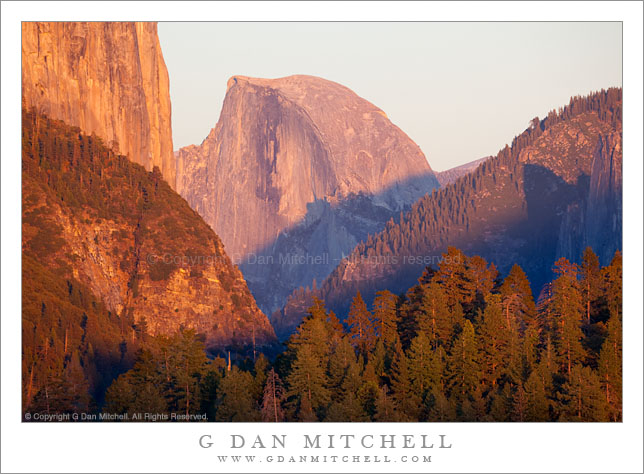
You have about a week and a half to catch Michael Frye’s “Color, Light, and Form” exhibit at the Ansel Adams Gallery in Yosemite Valley. If you are up that way, check it out!


G Dan Mitchell is a California photographer and visual opportunist. His book, “California’s Fall Color: A Photographer’s Guide to Autumn in the Sierra” (Heyday Books) is available directly from him.

G Dan Mitchell: Blog | Bluesky | Mastodon | Substack Notes | Flickr | Email


All media © Copyright G Dan Mitchell and others as indicated. Any use requires advance permission from G Dan Mitchell.
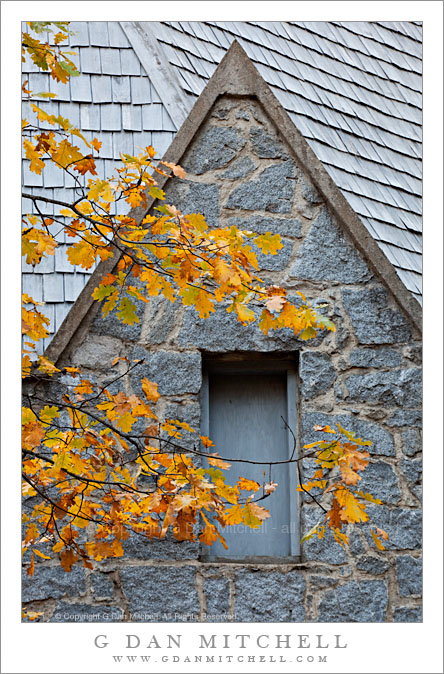
Late-Season Corn Lilies and White Flowers

Late-Season Corn Lilies

Late-Season Corn Lilies and White Flowers. Yosemite National Park, California. August 24, 2009. © Copyright G Dan Mitchell – all rights reserved.

Golden late-season corn lily plants at Half Moon Meadow, Yosemite National Park, California.

The summer goes so quickly in the High Sierra! It was barely a month ago that I was in the Young Lakes region for a few days and the wildflowers were just starting to come into form, and only a couple weeks ago when I encountered peak condition wildflowers above 10,000′ in the upper Sabrina Basin. While you can still find wildflowers – including in this photograph! – if you know where to look in the Sierra, the signs of the coming autumn are beginning to appear throughout the high country, as they do every year at about this time.

Every year, there seems to be a day during the second half of August when I’m in the Sierra and I get a very clear and distinct impression of a change. In many cases I’m hard pressed to identify exactly what it is, but I know it is there. It might be something about the changing angle and quality of the light. Sometimes I think changing air movement and wind patterns may play a part. Perhaps it is the end of the lush moisture from melting snow. In other cases it is more obvious – like when I begin to see these late-season corn lily plants begin their transition: first they are thick and green; then a bit of  brown begins to appear at the tips of the leaves; soon the veined pattern of the leaves begins to pick up brown and yellow streaks; before long some of the plants turn wild yellow and gold colors and their stems begin to weaken; and in a short time they fall over and taken on the texture and color of old corn stalks.

I photographed these brightly colored leaves at the edge of Half Moon Meadow in Yosemite during the last week of August while on a three-day pack trip into the Ten Lakes Basin.

(If anyone can identify the small white flowers in this photo I would be very grateful. And, no, the flowers are not growing from the bright yellow corn lily plants! 10/11/09 – I think we have  a winner. It looks like it might be a plant called gray’s lovage.)


G Dan Mitchell is a California photographer and visual opportunist. His book, “California’s Fall Color: A Photographer’s Guide to Autumn in the Sierra” (Heyday Books) is available directly from him.

G Dan Mitchell: Blog | Bluesky | Mastodon | Substack Notes | Flickr | Email


All media © Copyright G Dan Mitchell and others as indicated. Any use requires advance permission from G Dan Mitchell.