
Tag Archives: panamint

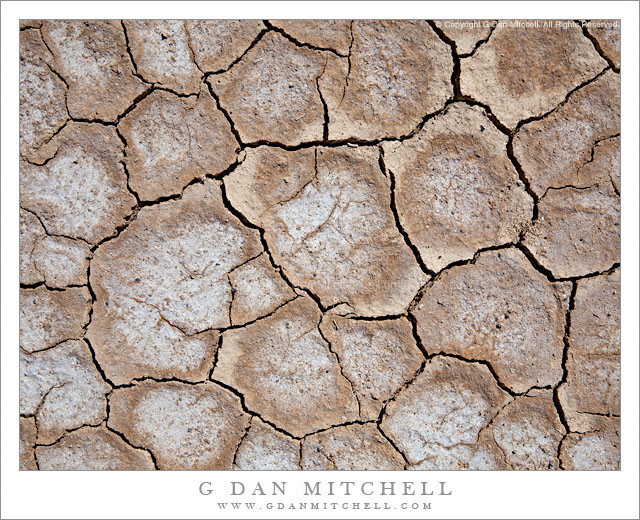
Playa Surface, Panamint Valley

Playa Surface, Panamint Valley

Playa Surface, Panamint Valley. Death Valley National Park, California. March 31, 2011. © Copyright G Dan Mitchell – all rights reserved.

Cracked and dry surface of the playa in Panament Valley, Death Valley National Park.

This micro-scene could be found in many locations in Death Valley and, for that matter, in many places in the USA and around the rest of the planet. But my little rectangle of the patterns of drying and cracked mud comes from the surface of the Playa (sometimes called “Panamint Lake?”) in upper Panamint Valley in Death Valley National Park. I wrote previously that it was the last day of my late-March photographic visit to Death Valley – I had finished my photography in the main Valley and had started the long drive back to the Bay Area. After crossing Towne Pass the road descends into Panamint Valley to a junction where I most often go south towards Trona and Ridgecrest and beyond.

Just before this junction the road crosses the playa, an extraordinarily flat surface formed when silt washed down from the surrounding mountains occasionally pools and gradually dries, forming what may be the flattest surfaces on the planet. As the moisture evaporates the mud cracks and splits into these interesting semi-geometrical patterns.

For no particular reason other than that this is a spot where I often make one final stop before leaving the park, I pulled over and wandered out onto the playa. I enjoy walking on these often-immense flat surfaces, but there is something very odd about the experience, too. Perhaps it is the slightly odd feeling of walking on such a large floor-flat surface in the natural world, or it might be the deep silence and stillness. In any case, as I wandered around not too far from the road I started looking a bit more closely at the patterns of cracks and soon decided that my photography was not quite finished yet – so I went back to the car to get my camera and made a small series of hand-held photographs with the camera pointing straight down. (The “straight down” shooting raises a question: How should the photograph be oriented? The horizontal orientation shown here is what I saw as I made the photograph… but I also wonder about rotating it 90″ clockwise.)

G Dan Mitchell Photography | Flickr | Twitter (follow me) | Facebook (“Like” my page) | LinkedIn | Email
Text, photographs, and other media are © Copyright G Dan Mitchell (or others when indicated) and are not in the public domain and may not be used on websites, blogs, or in other media without advance permission from G Dan Mitchell.
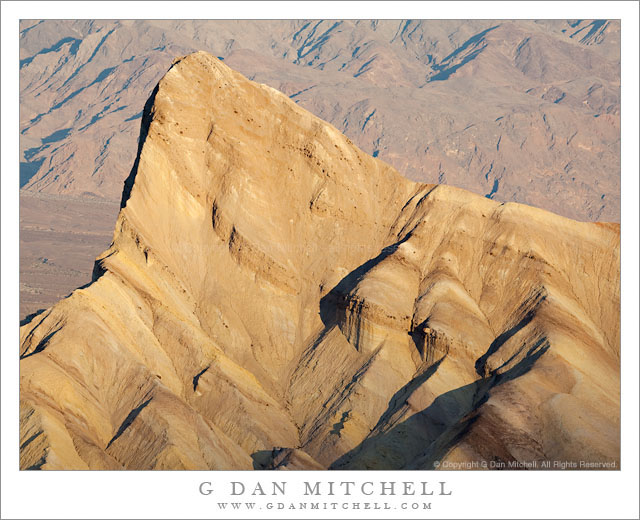
Manly Beacon, First Light

Manly Beacon, First Light

Manly Beacon, First Light. Death Valley National Park, California. March 30, 2011. © Copyright G Dan Mitchell – all rights reserved.

The first morning light strikes Manly Beacon at Zabriskie Point, Death Valley National Park.

Icon alert!

I had more or less promised myself that I would not photograph at Zabriskie Point on this trip – been there, done that – unless the conditions were really special. But I miscalculated my morning start on this day and discovered that I wasn’t going to make it to my intended destination in time. As I passed Zabriskie on my way to the “other place,” telling myself that I still had a half hour before I needed to be in place for the early light… I noticed that clouds above this area were already starting to pick up the pink color of dawn light. I hesitated for a moment – I really wanted to photograph that other subject – but quickly realized that it would make a lot more sense to the shoot the subject that was here in the light that was developing than to drive further and miss out entirely on the first light.

So I turned into that familiar parking lot with its familiar fleet of photographers’ cars and quickly loaded up my gear. I was a bit surprised that I saw so few people up above at the official overlook, but it was quite windy and I figured that perhaps they had just dropped down on the other side of the wall below this spot. In any case, I had a different spot in mind, one further to the right, so I headed over that way and quickly discovered that the wind was blowing almost too strongly to make photographs. I made a couple of shots from a small gap there and then headed up toward the overlook. At the top of the little trail from the parking lot I dropped onto the small use trail to the side of the wall and was again surprised to see almost no other photographers. I walked a few feet farther and discovered that the “usual crowd” was huddled in a small area in the lee of the wall, trying desperately to find protection from the wind.

These days, my main project when I stop at Zabriskie is to find and photograph small, isolated elements of the landscape with a long lens. For the most part – unless truly magical conditions are present, and they weren’t on this morning – I don’t really spend much time on the classic views of Gower Gulch, the Valley, and the Panamint Range. However, since I’m there and know the progression of the light fairly well at this point, I’m not about to pass up the opportunity to get a better image of one of these iconic subjects. So as the first light was about to hit the summit of Manly Beacon I turned my rig that direction and spent a couple of minutes photographing it as the line between shadow and morning light traveled down its face.

G Dan Mitchell Photography | Flickr | Twitter (follow me) | Facebook (“Like” my page) | LinkedIn | Email
Text, photographs, and other media are © Copyright G Dan Mitchell (or others when indicated) and are not in the public domain and may not be used on websites, blogs, or in other media without advance permission from G Dan Mitchell.
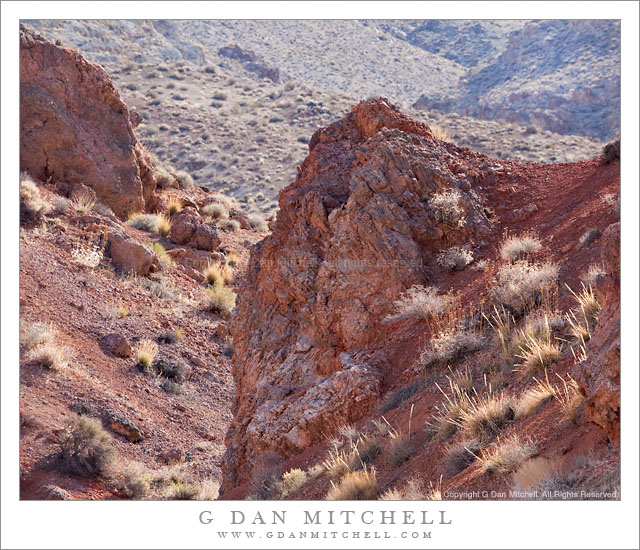
Red Rock and Desert Hills

Red Rock and Desert Hills

Red Rock and Desert Hills. Death Valley National Park, California. March 29, 2011. © Copyright G Dan Mitchell – all rights reserved.

A red rock gully among the desert hills of the Panamint Range, Death Valley National Park.

This is anything but an iconic image, but I think that it is emblematic of a certain type of scene that is often seen in Death Valley National Park once you get out of the main Valley and up into the hills, especially during the brief spring season when the light can be a bit softer and the plants a bit (relatively speaking!) greener.

The photograph looks up a broad valley that is visible from along the road that rises from the main road through the Valley and climbs toward the Wildrose Canyon area. Here the elevation is high enough that the dry, sun-baked flat land of the Valley is nowhere to be found. Instead this is a country of large valleys and plateaus, cut in places (mostly at the bottom of canyons) but rocky outcroppings and gullies. This red rock gully is easily visible from the road, though the odds are that most people just drive right by. I had seen it on several drives past this spot before I thought to stop and photograph it, and I was fortunate to be there when the light seemed just right.

G Dan Mitchell Photography | Flickr | Twitter | Facebook | Email
Text, photographs, and other media are © Copyright G Dan Mitchell (or others when indicated) and are not in the public domain and may not be used on websites, blogs, or in other media without advance permission from G Dan Mitchell.

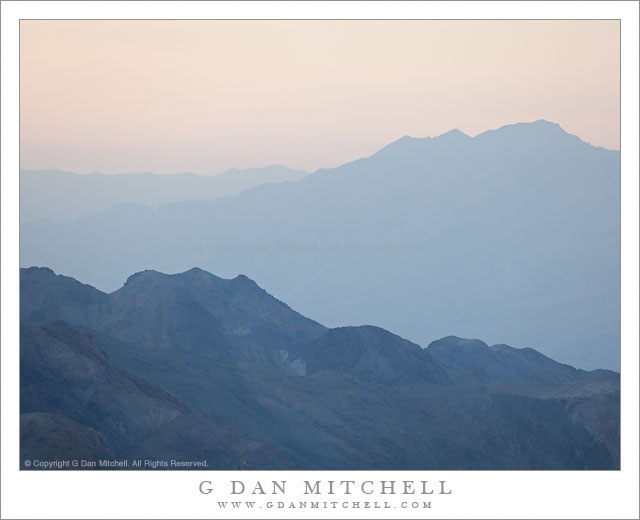
Dusk, Death Valley Ridges

Dusk, Death Valley Ridges

Dusk, Death Valley Ridges. Death Valley National Park, California. March 30, 2011. © Copyright G Dan Mitchell – all rights reserved.

Dusk light on ridges above Death Valley, California.

This photograph was made in the evening from Aguereberry Point, high in the Panamint Mountain Range along the west side of Death Valley. The point is a spectacular overlook with panoramic views in all directions. The number of visitors is relatively low since it is at the end of a gravel road and is a good long drive from most of the places where people tend to stay when they visit the park. It is also windy!

(Those who read the brief technical information about the photographs might wonder at my use of ISO 400 for a landscape photograph – but when shooting at 400mm in windy conditions, a lower ISO makes it darn near impossible to deal with camera vibrations.)

The range of lighting conditions and effects as the day comes to an end at Aguereberry Point is tremendous. To the west (roughly behind me and over my left shoulder as I shot this photograph) the sky is very bright as the sun drops towards the distant Sierra Nevada. Below the Valley and the canyons along the mountains on either side gradually dim and become hazy. As the sun drops and is blocked by intervening peaks and mountain ranges, even the higher peaks and ridges take on these subtle and pastel shadings. It probably isn’t too important to identify the specific ridges in this image, but they are to the northeast of the point. The nearer ridge is along the west side of the Valley (probably part of the Tucki Mountain complex) and the further ridges are a much greater distance to the northeast across the upper Valley.

G Dan Mitchell Photography | Flickr | Twitter | Facebook | Email
Text, photographs, and other media are © Copyright G Dan Mitchell (or others when indicated) and are not in the public domain and may not be used on websites, blogs, or in other media without advance permission from G Dan Mitchell.