
Tag Archives: park

Whitewater, Tenaya Creek

Whitewater, Tenaya Creek

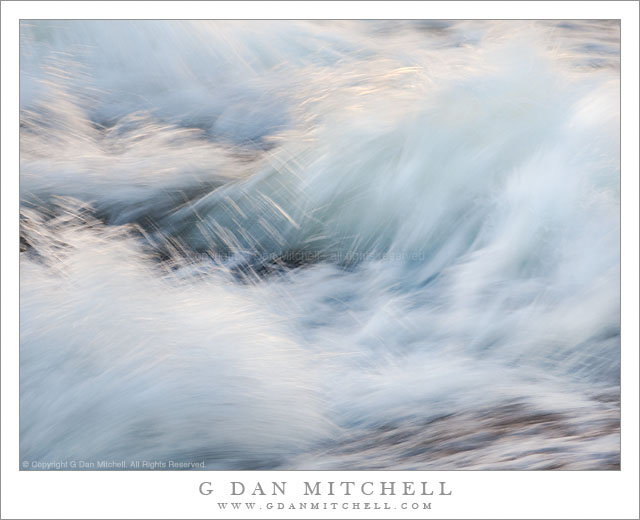
Whitewater, Tenaya Creek. Yosemite National Park, California.June 28, 2010. © Copyright G Dan Mitchell – all rights reserved.

Turbulent whitewater flows through an area of steep granite along Tenaya Creek, Yosemite National Park.

You can, of course, find a place to shoot subjects like this one all over the Sierra and no doubt in many other places as well. This photograph was made during a period of relatively high water early in the season and in a spot where the water flowed over some rocks in shade. Sunlight on the other side of the stream reflected into the water and revealed highlights, especially the flying spray that I allowed to blur with a somewhat slow shutter speed.

The moving water in Sierra streams and rivers seems to be an almost irresistible subject for many photographers, and I confess that I count myself among them. In some ways it is almost too easy to make these photographs, and one basic requirement is a willingness to make quite a few exposures. The instantaneous motion of the water and the reflections of light simply cannot be controlled or predicted, so one almost has to make many, many exposures. Of course, there is a bit more to it than pointing the camera at water and then repeatedly pressing the shutter release. It is important to find some sort of compositional interest first – it could be where water flows around or over a rock, a place where the light catches the water, or possibly just the twisting forms of turbulent water. Light is extra important in these photographs I think – most often the colors come from a combination of the blue-green shades of water full of foam and from reflected light from things that are out of the frame. (In this photograph, the light mostly comes from sunlight reflected off of granite on the far side of the stream.) Shutter speed is an important consideration, as a short exposure will stop or nearly stop the water and freeze the motion, a somewhat longer exposure can hold some detail but still allow blur along the direction of the flow, and very long exposures can create a misty and diffuse effect.

G Dan Mitchell Photography | Flickr | Twitter | Facebook | Email
Text, photographs, and other media are © Copyright G Dan Mitchell (or others when indicated) and are not in the public domain and may not be used on websites, blogs, or in other media without advance permission from G Dan Mitchell.
Glacial Erratics and Trees, Lembert Dome

Glacial Erratics and Trees, Lembert Dome

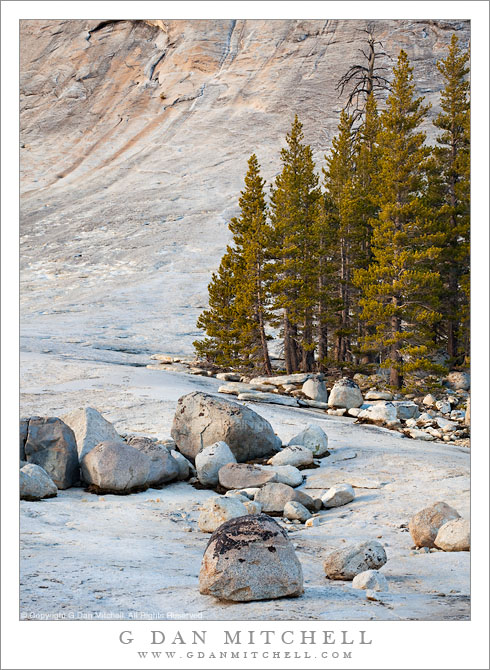
Glacial Erratics and Trees, Lembert Dome. Yosemite National Park, California. June 5, 2010. a© Copyright G Dan Mitchell – all rights reserved.

Glacial erratics and trees at the base of Lembert Dome, Tuolumne Meadows, Yosemite National Park.

This photograph was made last spring in early June, when I drove over Tioga Pass on a quick one-day jaunt right around the time that the road was re-opened for the season after its annual winter closure. The road opened a bit later than usual in 2010 due to above average and late snow fall, and when I crossed there was as much or more snow than I recall seeing up there.

This was one of my marathon drive days. I started well before dawn in the San Francisco Bay Area and arrived in Yosemite in the very early morning and without any concrete plan – except that the ideas of visiting waterfalls and possibly getting up to Tioga Pass were on my mind. I did stop near the Valley first, where I made a series of photographs of Cascade Creek in virtually full flow. After doing this and making a very brief visit to the Valley, I decided to visit the high country along Tioga Pass road. I went just over the pass before turning back. There was so much snow still around that in most places it still looked much more like winter than like early June.

I finally started heading back to the west, as my plan was to return late to the SF Bay Area. As I left the pass and started down toward Tuolumne Meadows the light began to get “interesting” as the sun dropped lower in the west and some high clouds occasionally softened the light. As I drove past Lembert Dome I thought of photographing these glacial erratics that sit on the apron at the bottom of the dome before making one last stop to photograph snow-covered Tuolumne Meadow in the day’s last light.

G Dan Mitchell Photography | Flickr | Twitter | Facebook | Email
Text, photographs, and other media are © Copyright G Dan Mitchell (or others when indicated) and are not in the public domain and may not be used on websites, blogs, or in other media without advance permission from G Dan Mitchell.
Trees Atop the Rostrum

Trees Atop the Rostrum

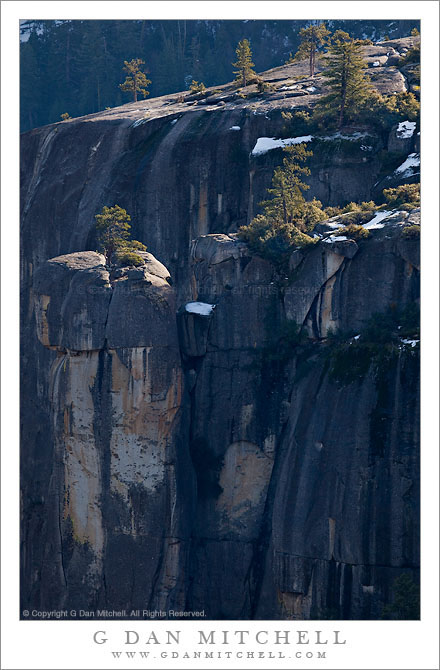
Trees Atop the Rostrum. Yosemite National Park, California. January 15, 2011. © Copyright G Dan Mitchell – all rights reserved.

Sparse trees grow in granite slabs above steep granite cliffs in Lower Yosemite Valley.

(Note: After receiving some advice from a helpful reader – which was much appreciated! – I now know that this feature has a name. It is called “the Rostrum,” and I have retitled the photograph accordingly.)

I’ve seen these tree-topped columns and the granite slabs beyond many times when I’ve taken Crane Flat Road into the Valley. On my recent visit to Yosemite, photographing these trees in both early and late light was on my agenda, and I got myself into position to shoot them on two or three occasions.

At the right times of day – and there are at least two when this can work – the light slants across the top of the granite slabs and ledges at the top of these cliffs and catches the trees with side or back light. Below these upper slopes the vertical fluted forms of the cliffs drop nearly vertically to the Merced River canyon below. The cliffs themselves are in what I might describe as lower Yosemite Valley – think of Crane Flat Road above Cascade Creek or the area well beyond the upper end of Wawona Tunnel. There is a lot of very interesting and imposing rock in this part of the Valley, though I think it may get overlooked a bit by comparison to the truly astonishing faces and domes and peaks of the Valley proper.

Since the light changes throughout the year, and especially because the point at which the sun sets moves north as the years moves from winter to summer, I want to come back and photograph this area again a bit later in the year when I think the potential for light later in the day might improve.  From my point of view, the ideal conditions might combine “golden hour” side light with shadows that reduce the detail on the forest covered slopes beyond – and without the bright snow patches that appear here. Of course, a fresh snowfall here might also be interesting…

I got a bit of a laugh out of one thing that happened when I made this photograph, though it is similar to similar situations I’ve had in the past. It is not at all unusual for lots of tourists to stop when they see a photographer with a big tripod and large lens at a pull-out along the road. I assume they think that if the photographer with the Fancy Equipment is stopping that there must be something there worth photographing. But sometime the photographer is pointing the camera in direction that must only confuse them. On this occasion I was in a spot with a classic and stunning view of distant Bridalveil Fall, and I’ll bet that many of those stopping thought they might try to duplicate my “shot of the falls.” But as they stopped and looked they may have wondered about me if they noticed that my lens was aimed at some seemingly nondescript spot perhaps 30% to the right of the fall…

G Dan Mitchell Photography | Flickr | Twitter | Facebook | Email
Text, photographs, and other media are © Copyright G Dan Mitchell (or others when indicated) and are not in the public domain and may not be used on websites, blogs, or in other media without advance permission from G Dan Mitchell.

Tree and Pond, Fog

Tree and Pond, Fog
Tree and Pond, Fog

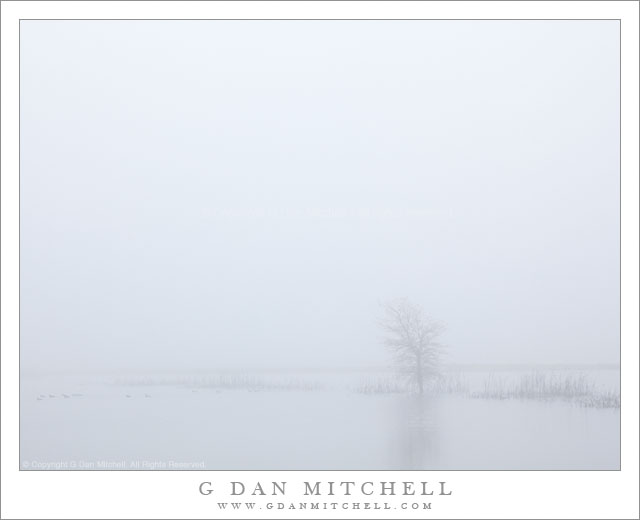
Tree and Pond, Fog. Cosumnes River Wildlife Preserve, California. January 23, 2011. © Copyright G Dan Mitchell – all rights reserved.

A solitary tree and a winter pond on a very foggy Central Valley morning, Cosumnes River Wildlife Preserve.

On my first visit to this wildlife preserve in California’s Central Valley (located between Stockton and Sacramento) I was thinking that I might have a chance to photograph wildlife, namely that incredible number of migrating birds that spend their winters in the rich, wet areas of this part of California. I knew it would be foggy, but I like that. (If you have followed my blog for even a short time you have perhaps seen some of my “barely there” photographs in which most details are nearly entirely obscured by clouds, rain, mist, or fog. )

I was not disappointed by a lack of fog! When I arrived it was so thick that I couldn’t see more than perhaps 100 or 200 feet! The Central Valley fog us tule fog which rises from the wet ground rather than blowing in from somewhere else. (The latter is the type of fog in, say, San Francisco, where it often blows in off the ocean.) Since tule fog starts at ground level, it often is not that thick. On a number of occasions I’ve been driving (slowly!) though terribly thick tule fog in the Central Valley, so thick that it seemed risky to drive at even 25 mph, only to look up and see stars in the sky overhead! On my way past Tracy on this morning, as I entered the fog I noted that it was perhaps only 30-50 feet deep. Because of this, the fog has a special quality that is not found as often in the ocean fog that is more common in the San Francisco Bay Area. The tule fog seems often to me to have a luminous quality that I attribute to the light that comes down from above even in the thickest fog.

That was somewhat the case here. I walked into the slough area across the road from the visitor center at the Preserve, and into an area that is mostly open fields in the summer, but mostly a giant pond in the winter. Everywhere around me I could hear the hundreds or thousands of waterfowl – ducks, geese, and who knows what else, and I later saw egrets and sandhill cranes – but I could see almost nothing. Eventually I could just barely make out his small tree standing on a shallow area where some grasses grew. I wondered if the photograph would have enough contrast to even be usable, but in the end there was just enough detail. (It is hard to see in the small jpg, but it is certainly there in the 12 x 18 test print I made.) At first I thought it would end up being a monochrome photograph, and I spent a lot of time taking it through my workflow with that in mind. But something just wasn’t quite working for me, so I decided to reconsider and try a color rendition. In the print, I think that this ends up looking better in color in several ways. First, the soft blue cast that I thought I’d want to avoid, more strongly evokes for me the feeling of actually being there, especially through that luminous quality of the tule fog light that I mentioned earlier. In addition, I think that some of the very subtle color variations turn out to be important.

G Dan Mitchell Photography | Flickr | Twitter | Facebook | Email
Text, photographs, and other media are © Copyright G Dan Mitchell (or others when indicated) and are not in the public domain and may not be used on websites, blogs, or in other media without advance permission from G Dan Mitchell.