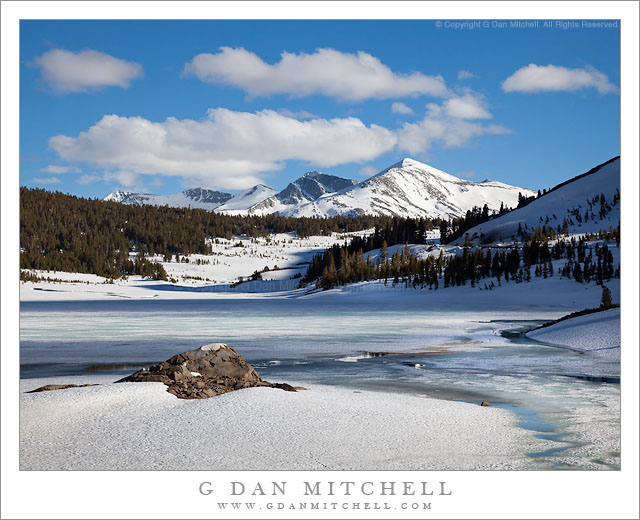
Late spring at icebound Tioga Lake below Tioga Pass with Mammoth Peak and the Kuna Crest beyond in afternoon light.
I made and shared a slightly different photograph of this scene last summer, but when I did my annual end-of-year traverse of the year’s raw files I returned to the original set of images and wondered how I missed this one. In a lot of ways it is similar to the one I selected earlier, though the foreground light and shadow patterns are a bit different and, more importantly, I like the position of the clouds in this one more than what I had in the original. So, there are now two versions of this scene floating around…
After several fairly dry years in California, the winter of 2009-10 produced much more precipitation, as rain in the lowlands and as snowpack in the Sierra. Because of the heavier snow, Tioga Pass opened just a bit later than average, and when it opened there was still a lot of snow in the high country. Since this afforded a rare chance to cross the Yosemite Sierra in conditions not usually seen by drivers I made it a point to get up there as soon as the road opened.
On the drive there was snow along almost the entire length of Tioga Pass Road, and in many places it looked more like winter than like spring. At the same time, it was spring, and the melting of the snowpack was fully underway. While lakes like Tioga Lake, as seen in this photograph, were still ice-covered… the ice was thinning quickly, and everywhere the melting snow was creating creeks and cascades. The high country, especially at the elevation of the road, was filling with water – water in ponds, water in overflowing lakes, water in rivers, water in cascades and waterfalls. I was waterfalls along the road in places where I had not even suspected that there were creeks!
This photograph shows Tioga Lake, just east of and below Tioga Pass, the eastern entrance to Yosemite. The pass itself is in the low saddle just above the meadow ascending the hill at the end of the lake. Beyond, and inside the park, is massive Kuna Crest with white, snow-capped Mammoth Peak in full sun at the right end of the ridge.
UPDATE: As of 2020 I am no longer posting annual updates concerning this subject — and I am editing older posts on the subject in light of the need to be more responsible about not encouraging the onslaught. I also no longer recommend going to the Valley to see it. Unfortunately, too much exposure (yes, I played a part in it, unfortunately) has led to absurd crowds, traffic jams, littering, destruction of areas in the Valley where too many people go to see it… and the park has increasingly — and appropriately — cracked down. Parking options have been eliminated, at least one viewing location has been closed. Good news! The rest of Yosemite Valley is still there and often exceptionally beautiful at this time of year.
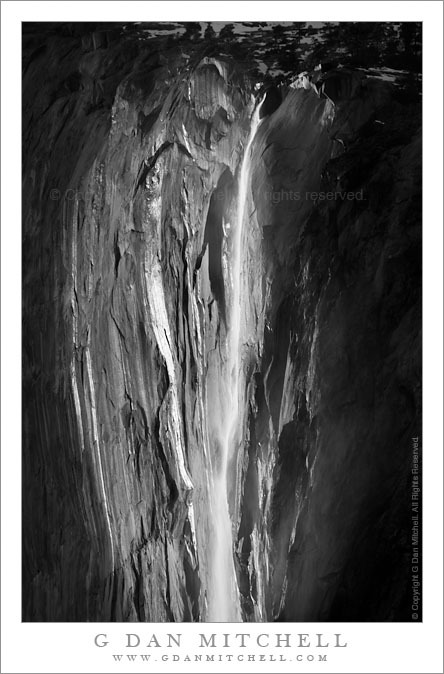
As more and more people now seem to know, late February is the prime time for the appearance of the “natural fire fall” in Yosemite Valley, when the setting sun may strike Horsetail Fall near the east end of the face of El Capitan, and when viewed from the right angle create a striking light show. I do not plan to be there to photograph the event this year since I’ll likely be shooting somewhere else during the prime time for the fall… and I no longer encourage others to attempt it. I’ll explain below.
The spectacle of Horsetail Fall is now quite well known. The initial renown came after Galen Rowell produced a striking and now-famous photograph of it several decades ago. Eventually others began to photograph it as well. (I read somewhere that several other well-known photographers made images of Horsetail decades earlier, but apparently no one “discovered” the special annual sunset light until Rowell shot it.) Since that time, and especially in the past few years, news of the phenomenon and information about when, where, and how to shoot it has become widespread – especially now that information travels so fast on the Internet. As of this article revision, a plethora of articles (newspapers, magazines, the web) and social media posts have built the thing up beyond all reason, with predictable and unfortunate results.
Twice each year, the setting sun lines up just right so that it casts its final light directly on this waterfall for a few weeks. The phenomenon is ephemeral and dependent on a series of conditions that must all occur at the right time. First, it must be during that short window of time when the setting sun strikes the location of the fall on a high cliff. Second, the waterfall must be flowing. Typically this means that there has been a good amount of snow followed by a warm-up that melts enough of it to get the fall going, though a warm winter rain could accomplish the same thing. Third, the western horizon must be clear so that the sun’s light will not be obstructed as it sets. (Those who have tried to shoot the fall a few times may have experienced disappointment when a crescendo of light potential occurs late in the day… only to be suddenly switched off as the sun drops behind low clouds to the west. To be honest, this happens more often than not.)
The photographer wants where light hits the fall more or less from behind. The number of suitable locations is quite limited and — no surprise — they end up being hugely crowded.
Having said all of this, be aware that it is going to be extremely difficult to get a photograph of Horsetail that hasn’t already been done. I’ve seen a few, but most essentially duplicate existing images. In some ways, I think that contemplating the fact that such a thing actually happens in a place that already contains as many marvels as we see in the Valley may be more rewarding than making another photograph of it.
A downside to the experience is that the popularity of “bagging this shot” has taken off remarkably in the past few years. Yosemite Valley is obviously already a place where it is tempting to run from well known spot to well known spot trying to recreate the well known photographic images that others have produced there. (Ironically, those who take this approach often miss many, many less known subjects in the Valley that can be every bit as beautiful and rewarding.) With Horsetail, the rush of photographers is compressed into a very short time period and focused on a few (mostly only two!) very popular shooting locations. Those who shoot from them on prime evenings may arrive in the morning to reserve a spot… to find a crowd of photographers is already set up.
As of the date of this revision in 2020 the situation has become quite insane, and the park service has had to take serious steps to control the mess. Literally thousands of photographers and others have been arriving in places that used to handle a dozen or two folks. Traffic jams ensued, the experience has been significantly degraded, parking is a mess, and the crowds are damaging park features. As of this year large sections of park roads are now off-limits to parking and one of the two popular locations has been completely closed.
I strongly urge you to NOT go.
I was fortunate a few years ago to have a nearly solitary experience photographing the fall. That winter Northside Drive was closed and all traffic was routed in and out of the Valley along Southside Drive. It had snowed, and one of the locations for photographing the fall was only accessible by hiking across the Valley in snow to Northside Drive and then walking a bit further in the snow to the place from which I shot. I walked over early and spent an hour or more shooting alone in the silent and snow-covered El Capitan meadow! Then, as sunset approached, I walked quietly to a place where I could see the fall and joined a small handful of fellow photographers waiting for the event. We weren’t disappointed.
That is the way I want to remember photographing Horsetail Fall.
(Some of my Horsetail photographs are found here.)
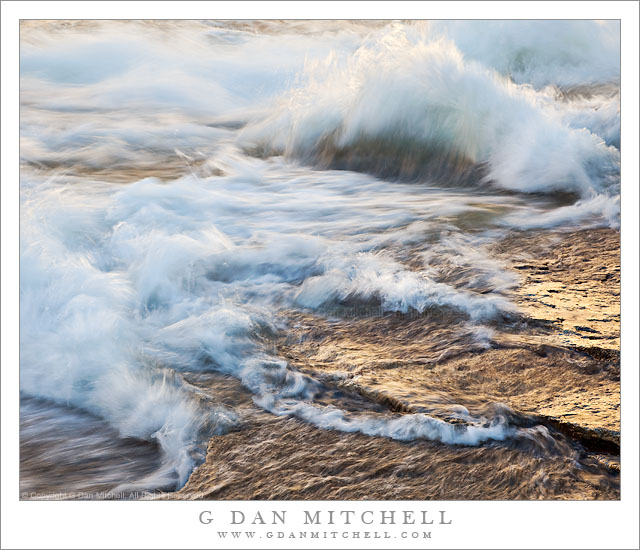
Sunlight reflects on granite ledges next to cascades on Tenaya Creek.
In this iteration of the “blurry-fast-moving-water-in-Sierra-creek” photograph, I was looking to cram a variety of elements into the frame – as you can see, the entire photograph is not filled with water. There is a transition from white water with flashes of sunlit light at the tops of the waves, through the water with smaller areas of foam, to water reflecting the golden late afternoon light from a cliff face on the other side of the creek, to some bits of streamside granite slabs along the lower right edge of the frame. To me, these areas of shallow water and wet rock reflecting more distant light almost have a molten quality.
One of the trickiest things about this photograph for me was dealing with the strong contrast between very blue tones in the shaded parts of the water and the very warm tones of the reflections. As every photographer knows, the light in shade can be very blue, especially when the subject is supposed to be white and is lit almost entirely by the blue sky, as is the case in parts of the turbulent water. Adjustments are necessary in order to make it look realistic and conform with the colors that our eyes tell are are there. (Our vision system is remarkable… but it is not objectively accurate!) But adjustments to the blue water, if applied to the warm tones of the reflecting granite, can end up looking bizarre and overdone in the opposite direction!
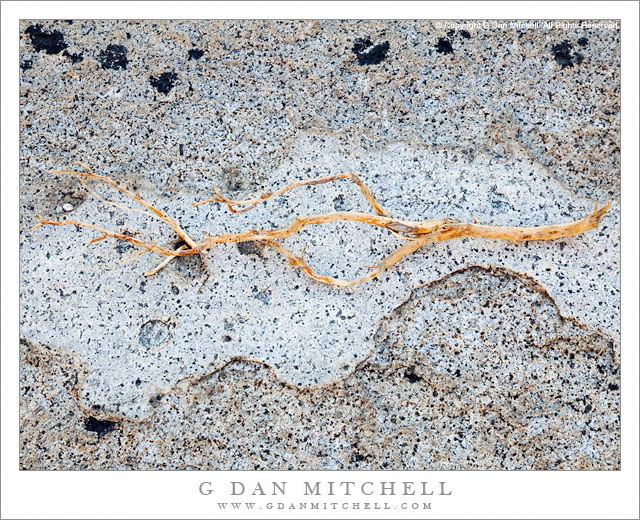
A dead branch lies on glacially-polished granite in the Yosemite National Park back-country.
I made a promise to someone to not say where this photograph was made – I’ll just say it is in Yosemite National Park. But the exact location really doesn’t matter too much, as these large expanses of glaciated granite slab are a common feature throughout the park, and you could find similarly interesting geology in thousands of locations.
I was a little surprised to find this weathered branch in this location, since it was a good distance from any trees and also not near any flowing water. Besides its location, a few other things about it caught my attention. First, its curving shapes lined up in a way tht seems to tie in with the bit of glacially-polished granite that lies beneath it. (And, yes, this is exactly where the branch was when I found it.) In a way, the larger shape of the lighter area of granite winding across the photograph from side to side almost seems like a much thicker echo of the curving shape of the branch. In addition, the warm brown tones of the branch seem to stand out a bit – though perhaps more in a larger print – against the relatively drab color of the rock.
Photographer and visual opportunist. Daily photos since 2005, plus articles, reviews, news, and ideas.
Manage Consent
To provide the best experiences, we use technologies like cookies to store and/or access device information. Consenting to these technologies will allow us to process data such as browsing behavior or unique IDs on this site. Not consenting or withdrawing consent, may adversely affect certain features and functions.
Functional
Always active
The technical storage or access is strictly necessary for the legitimate purpose of enabling the use of a specific service explicitly requested by the subscriber or user, or for the sole purpose of carrying out the transmission of a communication over an electronic communications network.
Preferences
The technical storage or access is necessary for the legitimate purpose of storing preferences that are not requested by the subscriber or user.
Statistics
The technical storage or access that is used exclusively for statistical purposes.The technical storage or access that is used exclusively for anonymous statistical purposes. Without a subpoena, voluntary compliance on the part of your Internet Service Provider, or additional records from a third party, information stored or retrieved for this purpose alone cannot usually be used to identify you.
Marketing
The technical storage or access is required to create user profiles to send advertising, or to track the user on a website or across several websites for similar marketing purposes.