Tag Archives: photography

Bar Martinez 1942

Bar Martinez 1942
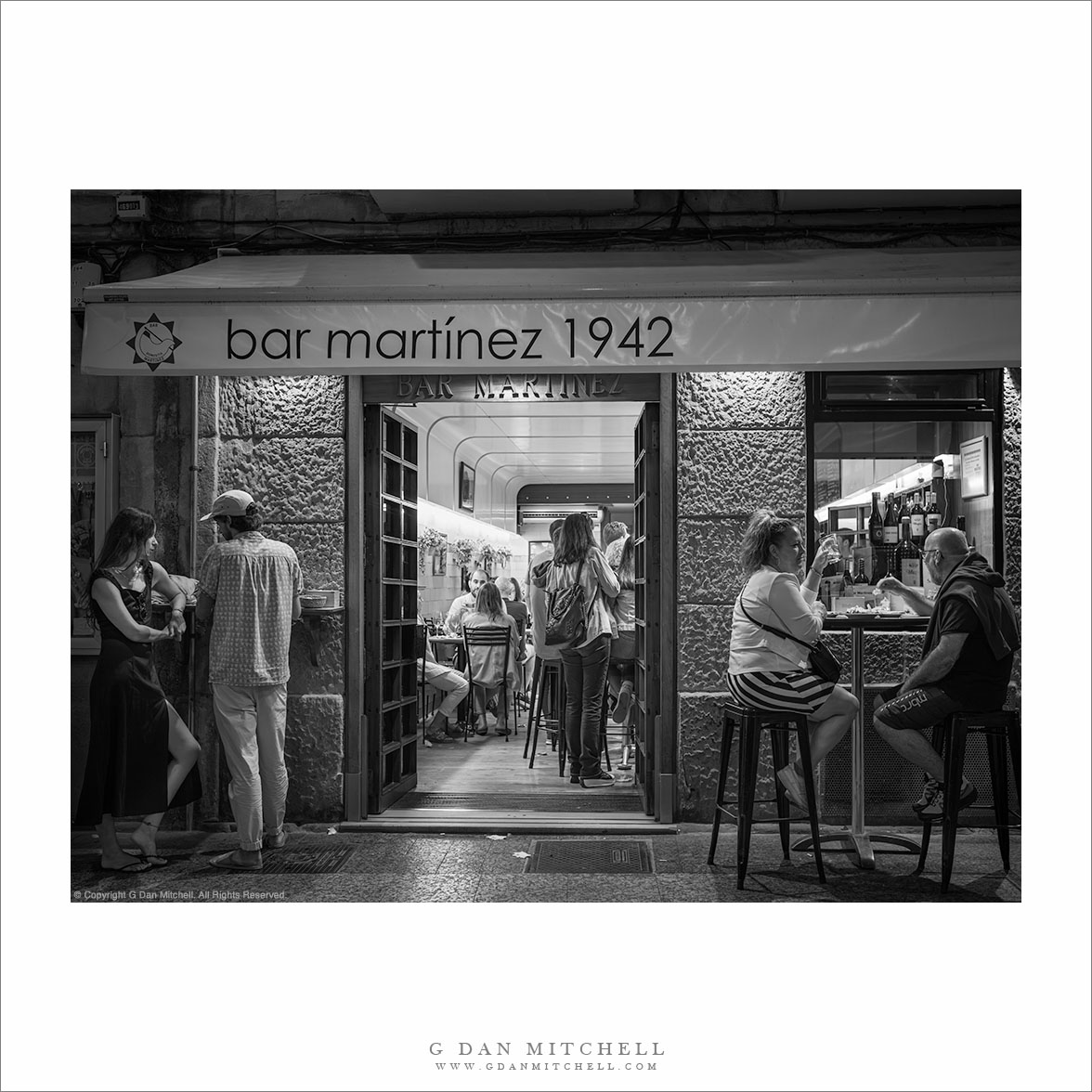
“Bar Martinez 1942” — The evening crowd at Bar Martínez 1942 in Donostia/San Sebastian, Spain.

In a sense, it felt like this summer’s big European adventure (ten weeks of travel!) really began in Donostia/San Sebastián Spain. Our arrival felt different from much of the rest of the trip, where mostly it was just the two of us, traveling light and sometimes a bit randomly. But several things were different at this first stop in Spain. We met a couple of “our (adult) kids” here. Within about an hour of our arrival, a stage of the Tour de France also arrived a short distance from where we stayed. And we did something else a bit unusual for us — we took a “pinxtos tour” on our first night.

If you don’t already know, pinxtos are essentially the tapas of this Basque region of Spain — wonderful, varied, “small plate” foods, and Donostia/San Sebastián is known for this culinary style. We usually plunge into such things on our own, but the “kids” had arranged for a tour with a local guide. She took us to a series of pinxtos bars, and it was a lot of fun. The photograph comes from the area of town where these businesses are found, and I snapped it as we wandered about in the evening.


Leave a comment or question using the form. (If you are reading this on the home page, click the article title to see the full article and the comment form.

G Dan Mitchell is a California photographer and visual opportunist. His book, “California’s Fall Color: A Photographer’s Guide to Autumn in the Sierra” (Heyday Books) is available directly from him. Blog | Bluesky | Mastodon | Substack Notes | Flickr | Email

All media © Copyright G Dan Mitchell and others.
Porto Street, Night

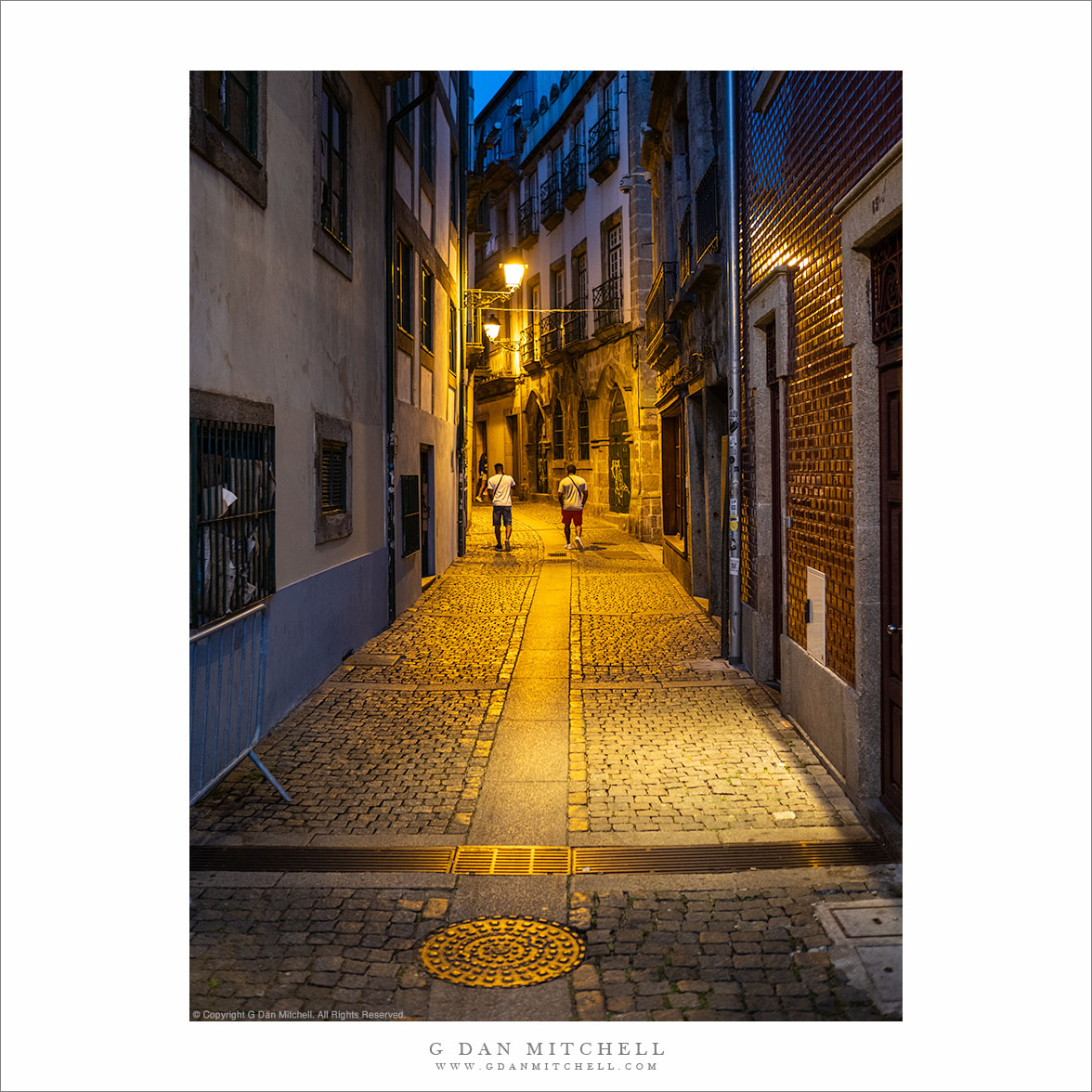
“Porto Street, Night” — Two men walk down a narrow Porto street at night.

Porto is a fascinating and complex city and there is a lot to see there. But I think that we found the Ribeira District to be the most interesting part. This is the area of narrow, winding streets on the steep hillside above the Duoro River. It is, of course, popular with tourists, especially right above the shoreline of the river. But a short walk from the most busy areas, especially at the right hour of the day, and the crowds can diminish and the ambiance of the district takes over.

We walk a lot when we visit cities, and on this day we made a big loop that took us up this narrow, cobblestone street. We passed through at what seems like an ideal time in terms of light — it was dark enough that the artificial light illuminated and colored the scene, but there was still a bit of ambient light to reveal details outside the light and produce blue-tinted shadows.


Leave a comment or question using the form. (Click the title to see the full article and to comment if you are viewing it on the home page.)

G Dan Mitchell is a California photographer and visual opportunist. His book, “California’s Fall Color: A Photographer’s Guide to Autumn in the Sierra” (Heyday Books) is available directly from him. Blog | Bluesky | Mastodon | Substack Notes | Flickr | Email

All media © Copyright G Dan Mitchell and others.
Accept Or Join The Fight

Accept Or Join
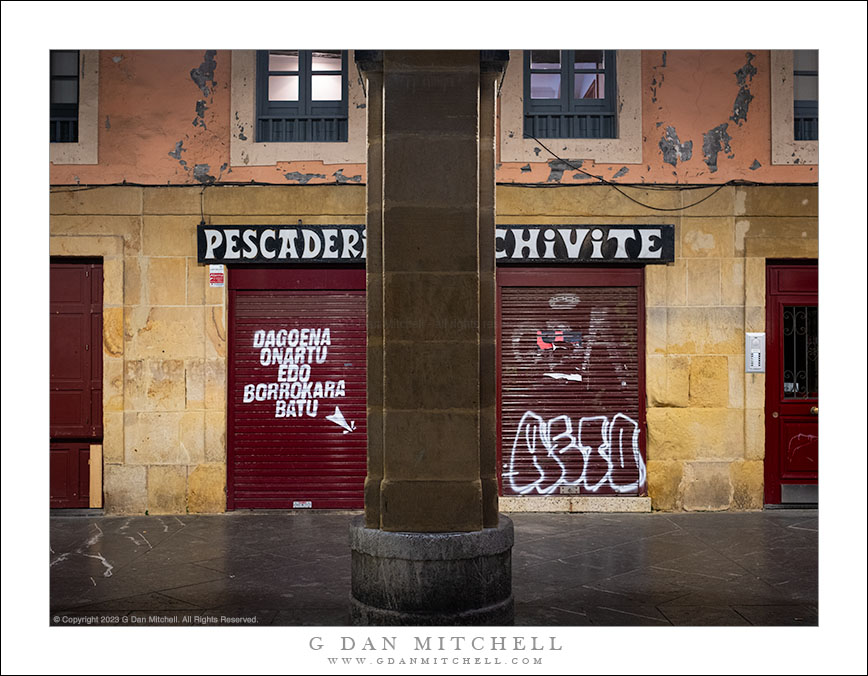
A wall with graffiti and politcal slogans at night in San Sebastian, Spain

Accept Or Join The Fight. © Copyright 2023 G Dan Mitchell.

A wall with graffiti and politcal slogans at night in San Sebastian, Spain

This photograph is from Donostia San Sebastián, Spain — made during a nighttime walk through a lively district of popular bars, pintxos places, and more. (We are now great fans of the pintxos scene.) Having said that, this particular spot obviously wasn’t the most lively, being in a small square mostly lacking such businesses, but having plenty of interesting forms, lighting, colors and textures.

Back home I often avoid including graffiti in my urban photographs, but here it was hard to avoid and it seemed like an aspect of the place. I think that it was the light, colors, and forms that initially caught my attention, and it wasn’t until we got home and I began to work on these photographs that I looked up a translation of the Basque language slogan on the left door: “Accept what is there or join the fight.”


G Dan Mitchell is a California photographer and visual opportunist. His book, “California’s Fall Color: A Photographer’s Guide to Autumn in the Sierra” is available from Heyday Books, Amazon, and directly from G Dan Mitchell.

Blog | About | Twitter | Flickr | FacebookEmail

Links to Articles, Sales and Licensing, my Sierra Nevada Fall Color book, Contact Information.

Scroll down to leave a comment or question. (Click this post’s title first if you are viewing on the home page.)


All media © Copyright G Dan Mitchell and others as indicated. Any use requires advance permission from G Dan Mitchell.

Moving On: Fujifilm XPro2 to XT5

The XPro is dead! Long live the XPro! That’s not the main subject of this essay, but based on tea-leaf reading and my own experience with the XT5 I think that’s where we are headed. I’ll get to why I think so near the end of this article.

This article is primarily aimed at Fujifilm users (and potential users) considering the retro XPro design versus the recently released (DSLR-style) mirrorless XT5. It is partly about techie camera stuff, but it is also a story about letting go of preconceptions and adapting to something new.

Since some readers may be unfamiliar with the cameras, here’s a quick summary.

XPro2 — The XPro2 is one of three Fujifilm “XPro” bodies — originally the XPro1 , the subsequent XPro2, and the most recent XPro3. These are rangefinder-style cameras with retro appeal due to their similarity to classic rangefinder film cameras and the inclusion of full manual controls. A key feature is the hybrid viewfinder system combining an old-school optical viewfinder (OVF) and a modern electronic viewfinder (EVF). The XPro2 has a 24MP APS-C sensor, while the newer XPro3 has a 26MP sensor.

XT5 — The XT5 is the most recent (as of this writing) in Fujifilm’s series of XT cameras that combine a small DSLR-like mirrorless body with a full set of manual controls, similar to what is found on the XPro bodies. This new camera uses an updated 40MP sensor — previous models (XT1-4) used 16MP, 24MP, and most recently 26MP sensors.

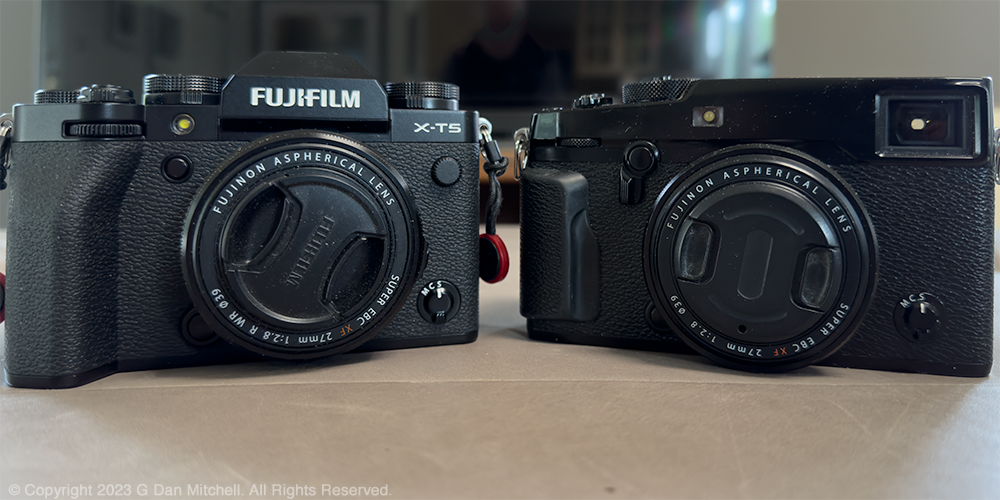
Fujifilm XT5 (l) and XPro2 (r) with Fujifilm 27mm f/2.8 lenses.

Because virtually all models in a generation of Fujifilm cameras use the same sensor, Fujfilm owners are more attentive to other functional differences between them. That is why I’ll focus on those things and say little about the sensor.

Continue reading Moving On: Fujifilm XPro2 to XT5