Tag Archives: photography

Porch and Shadows

Porch and Shadows
Porch and Shadows

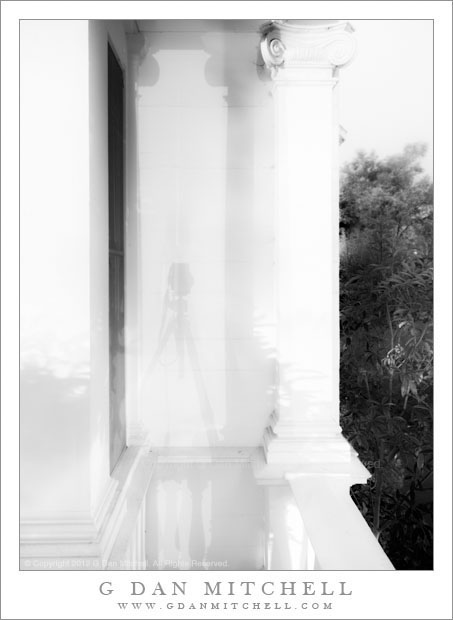
Porch and Shadows. Mare Island Naval Ship Yard, California. November 17, 2012. © Copyright 2012 G Dan Mitchell – all rights reserved.

Ambient light, shadows, architecture and vegetation on a night photography shoot.

In November 2012 I joined my friends from The Nocturnes, the San Francisco Bay Area night photography group, for a get-together and shoot at the historic Mare Island Naval Ship Yard. Since this was an “alumni night” event, there was a certain ritual to be followed. Folks who were new to Mare Island arrived early to tour the site – the first west coast naval ship yard, with history going back well over 150 years. A bit later, the “veterans” arrived to join everyone else for events that began with sharing of photographs, continued with pizza, and then led to a night of, well, night photography nearby.

The weather was not promising. We knew that a weather front was on its way, and we hoped – though we probably knew better – that it might hold off long enough to complete some photography. (Those of us with smartphones, checking the weather radar updates, knew better.) The tell-tale south wind was rising as we headed out, and within moments of starting to photograph an old wooden building the rain began. At first I continued to shoot under my umbrella, but soon it was just plain too wet to stay out. Fortunately, we had arranged for access to one of the historic officer’s quarters buildings and photographing inside and around this building quickly became the fall-back plan. I ended up on the front porch with Mark Citret and Tim Baskerville where we intermittently talked photography and made a few shots of things that didn’t require us to stand in the rain. At one point I parked myself near an end of the old porch and made this photograph of the shadow of my rig falling the wall of the building.

G Dan Mitchell is a California photographer and visual opportunist whose subjects include the Pacific coast, redwood forests, central California oak/grasslands, the Sierra Nevada, California deserts, urban landscapes, night photography, and more.
Blog | About | Flickr | Twitter | FacebookGoogle+ | 500px.com | LinkedIn | Email

Text, photographs, and other media are © Copyright G Dan Mitchell (or others when indicated) and are not in the public domain and may not be used on websites, blogs, or in other media without advance permission from G Dan Mitchell.

Building 106, Night

Building 106, Night
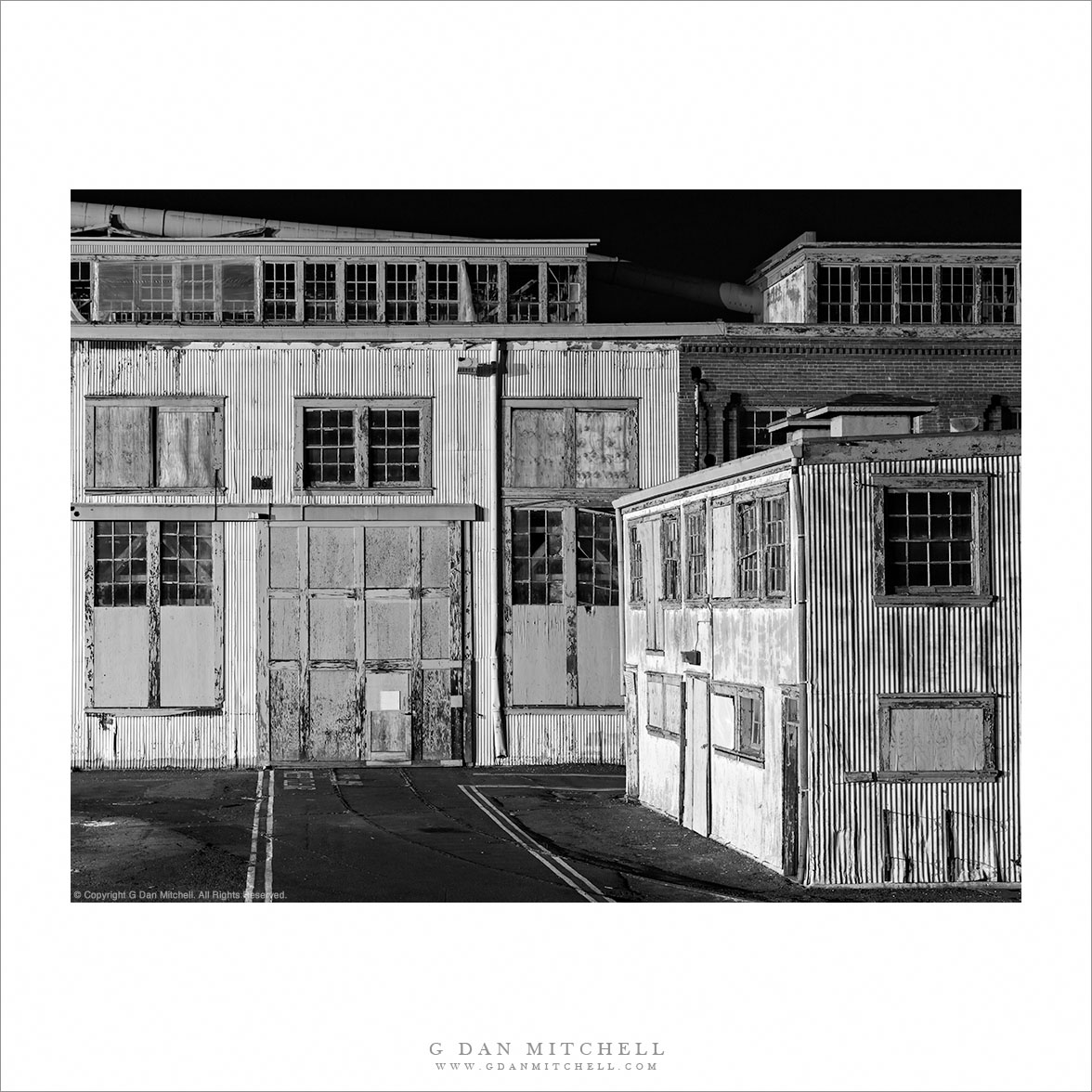
“Building 106, Night” — Black and white night photograph of Building 106 and surroundings, Mare Island Naval Ship Yard

It has been a while since I have posted new night photography, much less work from this location. I’ve photograph this area extensively over a period of years, often working with my friends from The Nocturnes, the San Francisco Bay Area night photography group. In fact, I was there with them once again on this mid-March night.

Atypically, some of us had begun the evening’s work by shooting in the daylight! Shortly before sunset someone came up with the novel idea, among night photographers anyway, of going out before it became dark to photograph in the golden hour light. So, I started early and gradually worked my way back to the familiar central core of old ship yard buildings. Some years ago when I first visited I was entranced by the most obvious subjects, mostly very large and impressive industrial structures. I still find them impressive and continue to photograph them, but as I returned many more times I began to push out the boundaries of what I know of the place. Eventually I looked for less obvious subjects, sometimes small and out-of-the-way things I had first overlooked, and I began to move beyond the familiar core area to look a bit more far afield. While the location in this photograph isn’t that far from where I started shooting, it is a bit less visited and it was probably the first time that I had explored this particular spot. I was first attracted by some nearby tall structures that look like they might be some sort of hoppers or collection equipment. Then I continued walking and turned up this side alley where nearby artificial lights illuminated the terribly weathered metal walls of old factory buildings, rising from the small one at right, past the taller building just beyond, and culminating that the much taller building near the upper portion of the frame, with its large pipe that must have carried smoke or gas away from its room.


G Dan Mitchell is a California photographer and visual opportunist. His book, “California’s Fall Color: A Photographer’s Guide to Autumn in the Sierra” (Heyday Books) is available directly from him.

G Dan Mitchell: Blog | Bluesky | Mastodon | Substack Notes | Flickr | Email


All media © Copyright G Dan Mitchell and others as indicated. Any use requires advance permission from G Dan Mitchell.

Reader Question: One Lens for Landscape and Wildflowers on Hikes?

From time to time blog readers email me questions about photography subjects. When possible I like to answer them here so that I can share the answer with others who might be interested. Here is a recent question:

“If you were going on a hike to capture landscape and wildflowers, and you could only take one lens, which one and why?”

In some ways that is  a very simple question, but it other ways the answer can be quite involved. Since the question did begin with, “If you were…”, let me start out by literally saying a bit about my own photography – but reminding readers that my approach is individual and idiosyncratic and may not match up with your preferences at all.

If the goal was to cover as much ground as possible in a single lens, and accept some photographic limitations in exchange for carrying less gear, with my Canon full-frame DSLR system I would most likely use my Canon EF 24-105mm f/4 L. On full-frame, the 24mm focal length covers a pretty decent wide angle range, and 105mm is long enough for many subjects. The lens also focuses reasonably close – though not macro-close – and the image stabilization feature is useful in situations where I might want to hand-hold the camera. On a week-long backpacking trip through a high and remote section of the Sierra a few years ago, I used only this lens (and tripod, remote release, a few filters, etc) and came back with good results. To extend the usefulness of the lens for close-up flower photography I sometimes carry an extension tube, though others might just bring along a close-up “filter” or two.

There are things that I would miss with this single-lens setup. A personal preference in my shooting is to work with longer focal lengths, so for me having nothing longer than 105mm would seem like a bit of a restriction. And while this lens plus the extension tube works pretty well, it won’t be as good as a dedicated macro lens.

Another alternative that I’ve thought about but have not yet tried (since I haven’t had the gear long enough just yet) would be to use my small Fujifilm X-E1 (seen”Fujifilm X-E1: From DSLR to Mirrorless“) with the 60mm macro and perhaps the fine little 18-55mm zoom. I know that is more than one lens, but the total kit size is smaller/lighter than my full-frame DSLR. You could go with just the excellent little zoom plus a close up filter or two as an alternative. I use this particular brand/model and like it a lot, but there are alternatives from other manufacturers that also have a lot of fans.

Moving on from what I might use, let’s briefly consider some other options that might appeal to other photographers.

If you are primarily interested in the wildflowers and are a very serious photographer, you might prefer to simply carry a dedicated macro lens of whatever focal length seems best for you. This will be your best bet for close-up wildflower photography and, accepting the limitations of having only a single focal length, will produce excellent image quality for non-macro subjects as well.

Another option that would work well for a lot of people is one of the entry-level DSLRs (like the Canon t1i-t5i series or alternatives) with the “kit” lens in the 18-55mm range plus one or more close-up filters. These can produce quite decent image quality and the package is small, light, versatile, and not too costly.

This begins to lead to the question of what your primary goals are in your hiking photography. Are you a very serious photographer who regularly produces large and high quality prints? Or, at the opposite end of the spectrum, are you a much more casual photographer who wants to bring back some beautiful records of your experience and share them with friends and family, perhaps mostly online? More than likely, you might have to determine where you fit between the extreme ends of this spectrum. How important is the weight/bulk of the equipment? Are you going to grab shots handheld or stop and use a tripod?

For some who are more concerned with the weight/bulk issues and perhaps not likely to make 20″ x 30″ prints, there are lots of smaller, lighter and often less expensive options that can be very good choices. These include some of the smaller and lighter mirrorless cameras such as the Fujifilm model I mentioned above (at the high end), and also some of the point and shoot cameras, many of which can produce excellent photographs.

Good luck with your choice… and with your photography!

Articles in the “reader questions” series:


G Dan Mitchell is a California photographer and visual opportunist whose subjects include the Pacific coast, redwood forests, central California oak/grasslands, the Sierra Nevada, California deserts, urban landscapes, night photography, and more.
Blog | About | Flickr | Twitter | Facebook | Google+ | 500px.com | LinkedIn | Email

Text, photographs, and other media are © Copyright G Dan Mitchell (or others when indicated) and are not in the public domain and may not be used on websites, blogs, or in other media without advance permission from G Dan Mitchell.

“Light of Ireland” Tour

My friend Tim Baskerville – long time San Francisco area photographer and night photograph guru of The Nocturnes – is leading photographic tours to Ireland. Tim, whose family roots go back to West Ireland, is a long time visitor to Ireland who has photographed there frequently. If this sounds interesting to you, I urge you to get in touch with Tim – and tell him I sent you!

“The Light of Ireland”

Join accomplished Photographer/Educator Tim Baskerville and Irish Guide, Olcan Masterson in Western Ireland. Olcan, a walking authority on the history of western Ireland, has spent many years exploring the hills and back roads of the area. An accomplished musician as well, he has spread traditional Irish music all over Europe and the U.S. with his flute and tin whistle. Mostly though, he is a living embodiment of Irish charm and hospitality. He will show you the spirit and soul of Ireland, as few visitors will ever experience it. You will get a view of the land and the culture that comes with living it, not merely visiting it.

Western Ireland affords us a unique opportunity in that there are so many wonderful hidden places to explore. Even if you have traveled to this area in the past, your guides will seek out new places to visit and photograph. There are spectacular monastic and megalithic ruins to seek out in your daily adventures.

The land cost includes:
• Group transportation for tour events in the tour van.
• Accommodations based on two people sharing a room, singles are assigned on a first come, first served basis.
• Services of driver, English-speaking cultural guide (if applicable) and photographic leader, during the tour.
• All breakfasts, most dinners are included.
• Park entrance fees, day tours and excursions as shown in the itinerary.
• Extensive pre-departure information and services.

The land cost does not include:
Domestic or International air fare.

Date: July 15-25, 2013
Websites:
http://phototc.com/tours/details/the-light-of-ireland
http://www.thenocturnes.com

Location: County Mayo, County Galway in the West of Ireland