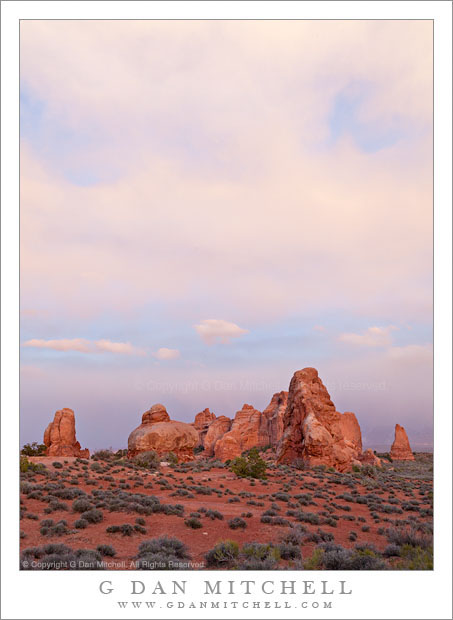
Evening clouds above sandstone towers and desert terrain, Arches National Park.
I think I can manage to coax one more photograph out of my collection of shots from my first evening in Arches National Park back in early April. To recap the story, we checked into a motel in Moab in the middle of the afternoon, and then had enough time to make a late afternoon and evening foray into Arches. We ended up in the “Windows” area just before sunset and ended our day shooting here as the sun set and then on into the evening.
I didn’t get anything of particular note that included the arches for which this spot is known – for example the North and South Windows. (I did photograph the South Window, but by this time the light wasn’t quite what I was looking for.) The wind was very strong, so I ended up behind some of the main rocky formations looking for shelter, and this provided a fairly clear view to the east just after the sun set. In this direction there was a small cluster of red sandstone formations, and as the evening sky begin to clear just a bit and the post-sunset cast a glow over the sky and the land beneath I made a few photographs in this beautiful soft light.
G Dan Mitchell is a California photographer whose subjects include the Pacific coast, redwood forests, central California oak/grasslands, the Sierra Nevada, California deserts, urban landscapes, night photography, and more. Blog | About | Flickr | Twitter | Facebook | Google+ | 500px.com | LinkedIn | Email
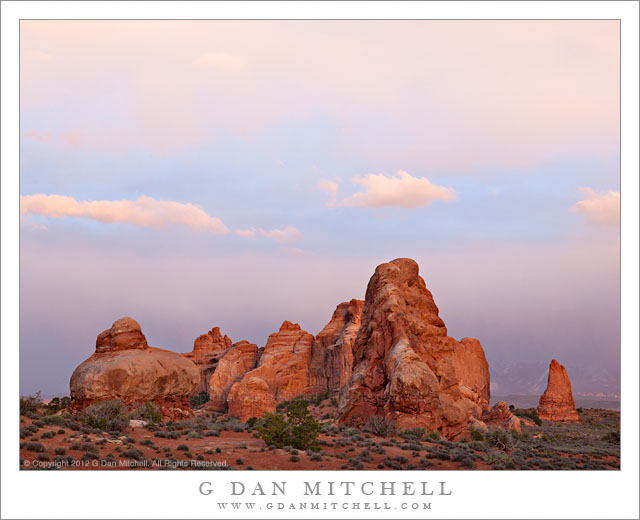
Dissipating evening clouds above sandstone formations, Arches National Park, Utah.
On our first early April evening in Arches National Park, we ended up at what the NPS map calls the “Windows Section.” This is an area of long sandstone ridges and many arches, including North and South Windows, Turret Arch and more. We really didn’t quite know where we were going, but we could tell that the day was waning and that we needed to find a spot to shoot the evening light – and this are was close and seemed to hold some potential. We drove the end of the road, quickly unloaded, and headed off to see what we could find.
I started by going back down the road a ways to photograph more open terrain to the west along with a row of sandstone features running to the north. I quickly figured out – duh! – that is was very windy! This isn’t a major problem as long as the light is good, but I knew that it was going to be a challenge as the diminishing light eventually called for longer exposures. I then wandered up toward Turret Arch and the South Window, looking for likely compositions. I made a few initial exposures before the sun dropped below the horizon, the light soon began to fade to that wonderful period just after sunset when everything can take on a sort of rich glow when the conditions are just right. Some dissipating clouds were adding to the glow and making the light and the sky more interesting… but that wind wasn’t diminishing a bit! Even with a solid tripod and head, when using a somewhat large lens and long exposures there will be issues with camera stability. This limited my range of motion a bit, as finding spots that provided some shelter from the strongest gusts became a consideration along with the usual compositional issues. With that in mind, I ended up mostly foregoing the major features here and instead turned my attention to the sky and to a cluster of sandstone formations to the east of the main arches… and that is what you see in this photograph.
G Dan Mitchell is a California photographer whose subjects include the Pacific coast, redwood forests, central California oak/grasslands, the Sierra Nevada, California deserts, urban landscapes, night photography, and more. Blog | About | Flickr | Twitter | Facebook | Google+ | 500px.com | LinkedIn | Email
Rugged canyon and plateau landscape of the White Rim area, photographed from Grand View, Canyonlands National Park.
I made this photograph on a day when we visited the “sky island” section of Canyonlands National Park, a high plateau fronted on many sides by steep cliffs and giant drop-offs. Since this was my first time in Canyonlands, I had a lot of reconnaissance to do before my planned evening shoot. We drove around sections of this part of the park, pausing at many overlooks to enjoy the view and consider the potential evening views. At one point we stopped at an overlook near the southern end of this section of the park to look and photograph.
The area in the photograph is the “white rim” area, where whitish colored rocks form a sort of tough terrace into which creeks have begun to carve canyons. The scale of the formations is tremendous, and the fact that two mighty rivers, the Colorado and the Green meet not too far from this point. This photograph was made well before the “ideal” golden hour time, but the low and slanting side-light and the rugged terrain of canyons and buttes seemed to compensate for that.
G Dan Mitchell is a California photographer whose subjects include the Pacific coast, redwood forests, central California oak/grasslands, the Sierra Nevada, California deserts, urban landscapes, night photography, and more. Blog | About | Flickr | Twitter | Facebook | Google+ | 500px.com | LinkedIn | Email
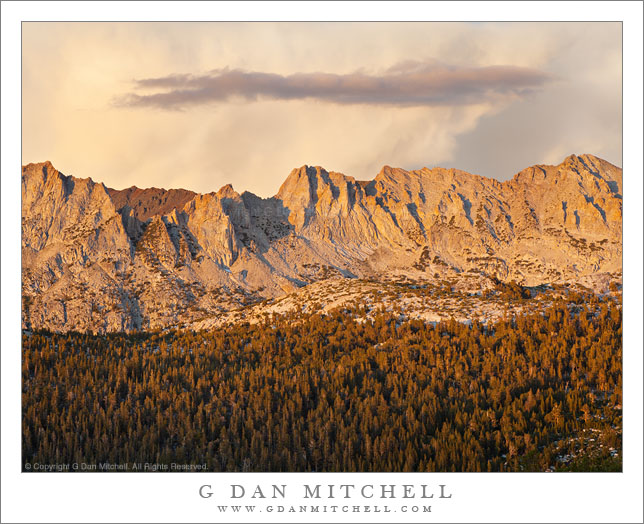
Evening thunderstorms tower beyond the ridge of Shepherd’s Crest in Yosemite National Park.
There is a bit of a serendipitous story behind this photograph. We were camped at a high lake in the Yosemite backcountry for several days. On the first day the weather was that typical Sierra blue sky weather that can sometimes go on for weeks – beautiful if you live benign weather, but perhaps less appealing to photographers. On the second day, a few small clouds appeared around noon and by evening were becoming quite nice looking above the higher peaks, so we walked up to a higher lake in the evening and did some photography there. On the third day, the little precursor clouds began to show up a bit earlier – perhaps by 11:00 a.m. or even a bit earlier. This tends to get your attention if you have spent time in the Sierra, since clouds that appear that early may have time to develop into full-fledged thunderstorms.
On the second night, one member of our party had visited another little like above our base camp and reported back that it had photo potential. Others decided to visit it early in the morning on day three, though I photographed elsewhere at that time. But when I saw these clouds I thought it might be interesting to get up to this “other little lake” in the evening. Since the route is cross-country I got directions from another member of the group – basically “head up the rocky area, keeping to the right of the bunch of willows in the creek bed, and then head up to the lake. Two members of the group, Charlie and Keith, headed up before me and I followed perhaps 15-20 minutes later.
The climb was enjoyable – while it was steep, the views just got better and better. I ascended the obvious route up the “rocky area,” saw the willows ahead, passed them on my left, and continued on. I soon realized that this was a mistake since instead of a passable route up the lake I encountered a steep rocky wall. Apparently I missed something in the instructions. I probed around a bit and finally found a reasonably safe route up some ledges, carefully marking my return route with rock duck cairns as I ascended, and finally emerged at the top of the steep section… way up the canyon from the likely location of the lake. It was spectacular, but it wasn’t the lake and Charlie and Keith were nowhere to be found.
When traveling alone I tend to be rather conservative and cautious, so I had set a turn-around time that I knew would get me back to camp before complete darkness. That time now arrived, so I back down the little system of ledges, made a few photographs of beautiful high meadows right below them, and started back down toward camp, leaving enough time to stop to make photographs on the descent.
As I passed back down below the rocky wall, the view opened up in front of me and to my right, and included within this panorama was the full length of Shepherd’s crest, with a huge thunderhead and plenty of virga just beyond the ridge. This photograph was made a few minutes before actual sunset when the angle of the light was quite low and the sunset colors were just beginning to glow.
(Basic EXIF data may be available by “mousing over” large images in posts when this page is viewed on the web. Leave a comment if you want to know more.)
Photographer and visual opportunist. Daily photos since 2005, plus articles, reviews, news, and ideas.
Manage Consent
To provide the best experiences, we use technologies like cookies to store and/or access device information. Consenting to these technologies will allow us to process data such as browsing behavior or unique IDs on this site. Not consenting or withdrawing consent, may adversely affect certain features and functions.
Functional
Always active
The technical storage or access is strictly necessary for the legitimate purpose of enabling the use of a specific service explicitly requested by the subscriber or user, or for the sole purpose of carrying out the transmission of a communication over an electronic communications network.
Preferences
The technical storage or access is necessary for the legitimate purpose of storing preferences that are not requested by the subscriber or user.
Statistics
The technical storage or access that is used exclusively for statistical purposes.The technical storage or access that is used exclusively for anonymous statistical purposes. Without a subpoena, voluntary compliance on the part of your Internet Service Provider, or additional records from a third party, information stored or retrieved for this purpose alone cannot usually be used to identify you.
Marketing
The technical storage or access is required to create user profiles to send advertising, or to track the user on a website or across several websites for similar marketing purposes.