
Tag Archives: rise

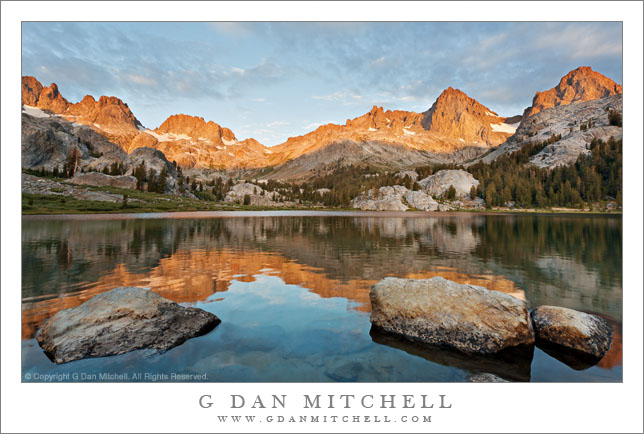
Sunrise, Ediza Lake, Minarets, and Mounts Ritter and Banner

Sunrise, Ediza Lake, Minarets, and Mounts Ritter and Banner

Sunrise, Ediza Lake, Minarets, and Mounts Ritter and Banner. Sierra Nevada, California. July 25, 2007. © Copyright 2007 G Dan Mitchell – all rights reserved.

First sunrise light on the Minarets, Mount Ritter, and Banner Peak above Ediza Lake, Sierra Nevada, California.

I made this photograph during a long and leisurely pack trip into the Minarets area of the Sierra Nevada near Mammoth Lakes. It was leisurely because I accompanied my brother and his family – and the fact that some kids were on the trip contributed to the slower hiking pace… as did the fact that both he and I wanted to make photographs.

This is a popular and accessible area of the Sierra, and also one that is a bit unusual. Typically the highest peaks of the range are found on the actual crest, but here the Sierra crest is further to the east and rather low, being right about where the Mammoth Ski Area is located. Across an intervening valley – a valley that holds Devils Postpile National Monument – loom the high and jagged peaks of the Minarets, a series of impressive spires, and the summits of Mount Ritter and Banner Peak. While in most of the Sierra the areas to the east of the highest peaks descend rapidly to the high desert, here the areas below these peaks remain very high and provide a different view of the eastern faces of the peaks.

The photograph was made very early in the morning along the shoreline of Ediza Lake on a day when clouds were already starting to build even at this early hour. Yes, there was rain later on!

G Dan Mitchell Photography
About | Flickr | Twitter | FacebookGoogle+ | 500px.com | LinkedIn | Email

Text, photographs, and other media are © Copyright G Dan Mitchell (or others when indicated) and are not in the public domain and may not be used on websites, blogs, or in other media without advance permission from G Dan Mitchell.

(Basic EXIF data may be available by “mousing over” large images in posts. Leave a comment if you want to know more.)
Sunset and Moonrise, Kuna Crest

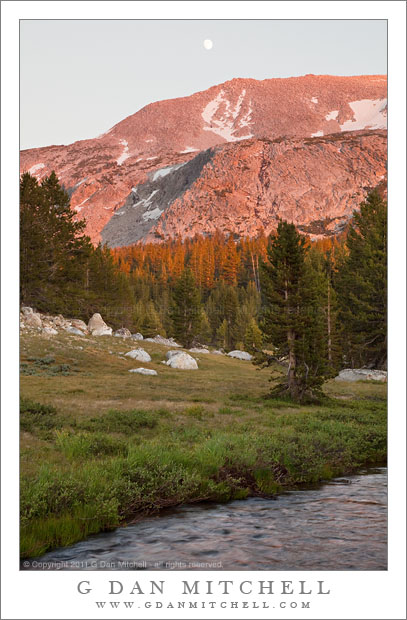
Sunset and Moonrise, Kuna Crest

Sunset and Moonrise, Kuna Crest. Yosemite National Park, California. August 10, 2010. © Copyright 2011 G Dan Mitchell – all rights reserved.

The nearly- full moon rises above the sunset light on Kuna Crest, Yosemite National Park.

Kuna Crest runs up Lyell Canyon between the Lyell and Dana forks of the Tuolumne River with the Sierra crest at one end and Mammoth Peak at the other. (Mammoth Peak is the large peak straight in front of you as you top Tioga Pass entering Yosemite National Park.) This ridge can catch great sunset light during the summer, and as I came down from the pass, heading back toward my camp at Porcupine Flat, and saw the almost full moon appearing over the shoulder of the ridge I decided to quickly stop and make a few exposures as the last light was about to leave the forest and soon after the peaks.

If you have tried photographing a scene that includes the moon in the early evening you know that the exposure is a tricky thing. The moon is lit by daylight, so it isn’t too surprising that the “correct” exposure for the moon is close to a normal daytime exposure. But that is not the right exposure for the rest of the scene, which turns out to be quite a bit darker than daylight at this time of day. In this scene things were even more complicates as the very saturated red colors on the ridge were quite “hot,” while the foreground meadow and forest was in shade and both darker and cooler in color. Basically, the dynamic range between the moon and the foreground was too large for a single exposure… so I made several.

At the time of exposure I thought that I might need as many as three component images in the final photograph – they would be one exposed for the bright ridge and sky, one exposed for the rather dark and shadowed foreground, and possibly a third that correctly exposed the moon. To be on the safe side I bracketed four exposures. When I began to work on the image I figured out that in this case I could construct a final “believable” image from two exposures if I was careful and could make some additional adjustments during post.

This is an example of a shot in which the use of a graduated neutral density filter could have been problematic, but where exposure blending could work very well. (“Exposure blending” is one term for the process of manually combining two component exposures using masked layers in Photoshop. No, it is not the same thing as HDR photography.) One of the things that would have been quite tricking using graduated neutral density filters is that the division between the brighter upper half and the darker lower half is not linear. Instead, the roughly follows the curved boundary between the lower meadow and dark trees and the still sunlit trees and the peak and sky.

G Dan Mitchell Photography
About | Flickr | Twitter | FacebookGoogle+ | 500px.com | LinkedIn | Email

Text, photographs, and other media are © Copyright G Dan Mitchell (or others when indicated) and are not in the public domain and may not be used on websites, blogs, or in other media without advance permission from G Dan Mitchell.

(Basic EXIF data may be available by “mousing over” large images in posts. Leave a comment if you want to know more.)

Dunes, Mesquite Flat, Sunrise

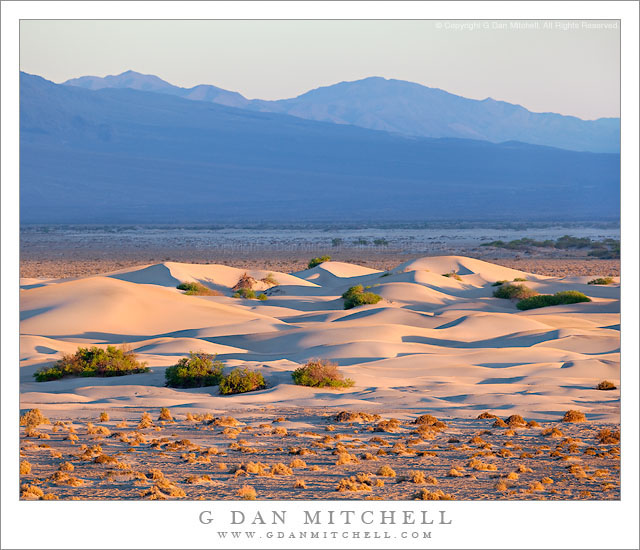
Dunes, Mesquite Flat, Sunrise
Mesquite Flat Dunes, Sunrise

Dunes, Mesquite Flat, Sunrise. Death Valley National Park, California. March 31, 2011. © Copyright G Dan Mitchell – all rights reserved.

Early morning light striking minor dunes on Mesquite Flat with Cottonwood Mountains wash and the Last Chance Range in the distance, Death Valley National Park.

These dunes are not too far from the main Mesquite Dunes near Stovepipe Wells – they are a bit further east from the better known tallest section of the dunes. The areas of lower dunes provide some very interesting shapes and textures on a smaller scale in some ways that those of the larger dunes. I photographed these with a long lens, shooting from a rise, at a point in time very shortly after the first morning light had struck the sand. The background hills, part of a very large alluvial fan at the base of the Cottonwood Mountains, were in the shadow of a cloud.

G Dan Mitchell Photography | Flickr | Twitter (follow me) | Facebook (“Like” my page) | LinkedIn | Email
Text, photographs, and other media are © Copyright G Dan Mitchell (or others when indicated) and are not in the public domain and may not be used on websites, blogs, or in other media without advance permission from G Dan Mitchell.

Ansel’s Moon

Edie Howe has posted a delightful little slide show made at this week’s Yosemite Valley event, sponsored by the Ansel Adams Gallery, that commemorated the making of the famous Ansel Adams photograph of Half Dome and the rising moon. The idea was that position of the moon and timing relative to daylight would duplicate those at the time of Adams’ original exposure. I enjoyed Edie’s sequence (nice final photograph, Edie!) and looking at some of the (pardon the awful pun) luminaries of Yosemite photography as they held forth in Ahwahnee Meadow. I’m sorry I couldn’t be there!

Perhaps ironically, the moon was hidden behind what appears to be a bit of a snow squall above Half Dome, though it appeared to be clear both before and perhaps after the historic moment! In a way I think that this might have been the most appropriate thing that could have happened. While I don’t think that trying to re-make Ansel Adam’s photograph has any more validity than trying to re-write a Mozart symphony, the event seemed like a great opportunity to: gather together on a beautiful evening in this wonderful meadow, contemplate the evening with the additional context of thoughts about Adams and his photography, meet a number of people influenced by Adams’ legacy, and focus on Adams’ photograph rather than trying to create one’s own version – since the imitative exercise turned out to be impossible!

I wish I had been there.