Tag Archives: rock

The Grandstand, Racetrack Playa

The Grandstand, Racetrack Playa

The Grandstand, Racetrack Playa. Death Valley National Park, California. March 28, 2010. © Copyright G Dan Mitchell – all rights reserved.

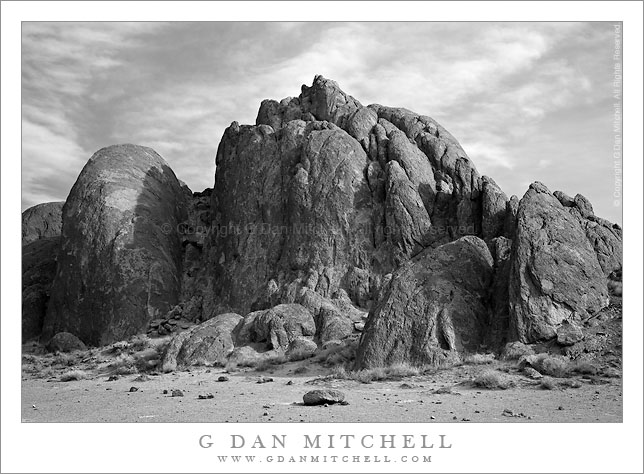
Black and white photograph of “the “Grandstand” formation standing in the middle of the Racetrack Playa, Death Valley National Park, California.

The Grandstand is a striking formation located a distance out onto the flat expanse of the Racetrack Playa, the location of the famous “moving rocks” in Death Valley National Park. The formation is located not far from where the road first reaches the playa and it is only a short walk. As I recall, it is just the tip of a large “hill” that is mostly buried beneath the very deep silt that was washed down from the surrounding mountains to form the playa. It has a shape this is vaguely “castle-like,” with several “turrets” that tower above the flat surrounding terrain and invite quite a few visitors to climb to the top. (The Grandstand is located at nearly the opposite end of the playa from the location of the largest concentration of moving rocks.)

I think that the Grandstand makes an interesting photographic subject, even though the thing most people come to see and photograph is the phenomenon of the moving rocks. I often plan to stop there and photograph in mid to late afternoon – when light on the rocks is interesting and photogenic, but before the “good light” begins further south on the playa and it is time to photograph the rocks and their tracks. It can also be a compositional element in photographs of the rocks at the south end of the playa, especially when you shoot with a long lens.

This photograph is not in the public domain and may not be used on websites, blogs, or in other media without advance permission from G Dan Mitchell.

G Dan Mitchell Photography | Twitter | Friendfeed | Facebook | Facebook Fan Page | Email

Technical Data:
Canon EOS 5D Mark II
Canon EF 24-105mm f/4 L IS USM at 55mm
ISO 200, f/11, 1/320 second

keywords: death valley, national, park, california, usa, north america, nature, scenic, travel, landscape, the, grandstand, hill, rock, boulder, formation, race, track, racetrack, playa, sky, clouds, black and white, monochrome, geology, stock, light

Moving Rock, Overcast Morning Sky – Racetrack Playa

Moving Rock, Overcast Morning Sky - Racetrack Playa

Moving Rock, Overcast Morning Sky – Racetrack Playa. Death Valley National Park, California. March 29, 2010. © Copyright G Dan Mitchell – all rights reserved.

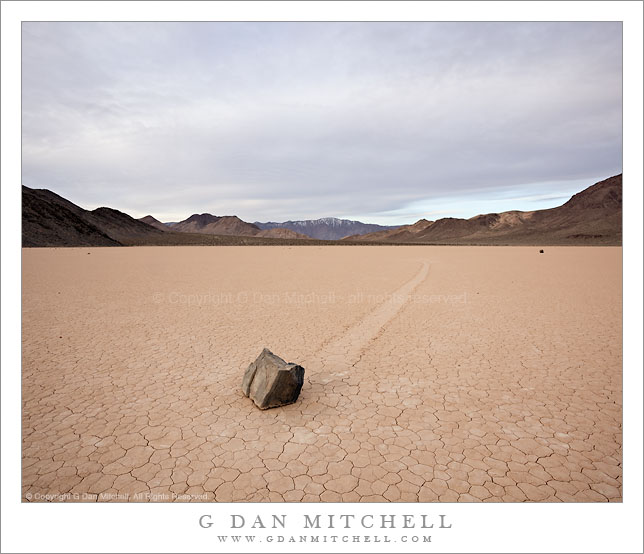
A “moving rock” beneath overcast morning skies at the Racetrack Playa, Death Valley.

First a bit of background about “the Racetrack,” the location of the famous “moving rocks” in Death Valley National Park. About 25 miles out in the desert back-country of the park on a very bad gravel road there is an isolated and desolate playa known as “the Racetrack.” (For those considering a visit, getting to the Racetrack is no trivial matter. The drive takes nearly two hours one-way and the road is awful, with some of the worst wash-board surface I’ve ever encountered. There are absolutely no services along the road or at the Racetrack – no water is available and your cell phone won’t work.) The name of the place comes, in some circuitous way, from the mysterious rocks that have clearly traveled across the playa, sometimes many hundreds of yards, and left tracks gouged into the playa surface. The most likely explanation for the phenomenon involves a combination of a periodically flooded playa, extremely high winds, and rare occasions when it is cold enough to freeze the surface of collected water, locking the rocks in place and allowing the wind to move them. I’ve never heard anything concrete about the frequency of this alignment of conditions, but as far as I know no one has ever observed the rocks actually moving, nor is there any indication that they have moved recently.

I’ve been out there three times in the past, and had great conditions for doing photography. On this visit I had plans to photograph in sunset and sunrise light and to attempt night photography of the rocks under the full moon. (I did the latter once before, but was less familiar than I am now with how to best do this with a DSLR.) Since I’ve had such good luck with weather and lighting conditions in the past, I suppose I was due for less than optimum conditions… and that is what I encountered. Shortly after arriving at the playa the sky was covered by high, thin clouds. Except for a brief moment close to sunset this made late day photography difficult. The overcast stuck around until I left then next morning, making the planned full moon night photography an impossibility, and the morning light was also challenging.

That said, I’m still glad I went. Standing in the middle of this empty playa completely alone as the day ends or begins is an amazing experience that few people get to have. And I did manage to bring back a few photographs that I think will “work.” This one was shot fairly early in the morning at what might have been around sunrise, if a sunrise had actually occurred.

This photograph is not in the public domain and may not be used on websites, blogs, or in other media without advance permission from G Dan Mitchell.

G Dan Mitchell Photography | Twitter | Friendfeed | Facebook | Facebook Fan Page | Email

Technical Data:
Canon EOS 5D Mark II
Canon EF 17-40mm f/4 L at 17mm
ISO 200, f/16, 1/8 second

keywords: moving, sliding, rock, race, track, racetrack, playa, death valley, national, park, california, usa, north america, morning, cloudy, sky, earth, cracked, dry, arid, desert, mountain, snow, covered, inyo, landscape, nature, travel, scenic, mystery, track, trail, phenomenon, lippencott, mine, road, stock

Rock Patterns, Mosaic Canyon

Rock Patterns, Mosaic Canyon

Rock Patterns, Mosaic Canyon. Death Valley National Park, California. March 27, 2009. © Copyright G Dan Mitchell – all rights reserved.

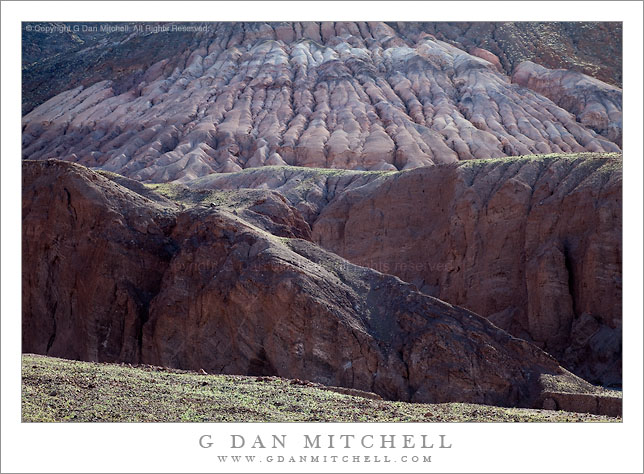
Folded and twisted rock forms in Mosaic Canyon, Death Valley National Park, California.

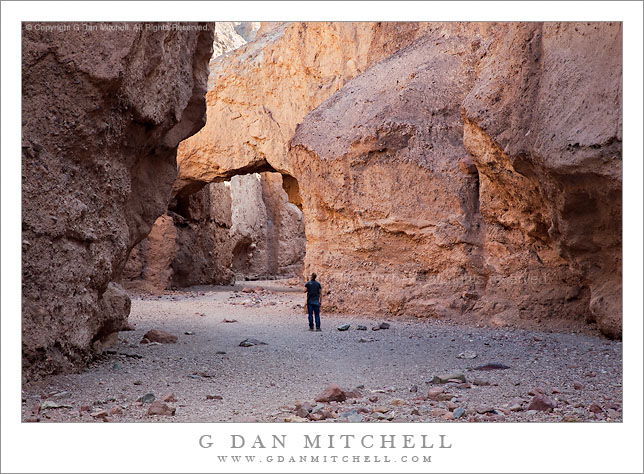
Although this formation is found very near the entrance to the canyon, on this visit I also managed to wander further up the canyon than I have in the past, discovering very different and far more open terrain that what I had seen before. Mosaic Canyon, a short drive up the hill from Stovepipe Wells, is known for its very narrow and twisty lower section, its access to higher regions of the Mount Tucki area, and the striking and unusual rock formations laid bare by erosion from water traveling down the canyon in past floods.

In the lower canyon there is a section where this beautifully banded rock runs alongside the trail. Sometimes that patterns are a bit hard to see, but this time it appeared that recent rains and the soft afternoon shaded light brought them out a bit more. This section featured ribbon-like folds in the surface of the rock that must have been created by water erosion.

This photograph is not in the public domain and may not be used on websites, blogs, or in other media without advance permission from G Dan Mitchell.

G Dan Mitchell Photography | Twitter | Friendfeed | Facebook | Facebook Fan Page | Email

Technical Data:
Canon EOS 5D Mark II
Canon EF 24-105mm f/4 L IS USM at 105mm
ISO 100, f/11, 1/8 second

keywords: death valley, national, park, california, usa, north america, scenic, travel, nature, desert, mosaic, canyon, trail, rock, pattern, fold, twist, geology, groove, curve, crack, pink, abstract, texture, nature, erosion, travel, scenic, stock

Horsetail Fall, Early Evening

Horsetail Fall, Early Evening

Horsetail Fall, Early Evening. Yosemite Valley, California. February 15, 2010. © Copyright G Dan Mitchell – all rights reserved.

The silver strand of Horsetail Fall and water reflecting on surrounding cliffs in late afternoon light, Yosemite Valley, California.

I’m thinking it is pretty nearly impossible to make a truly original photograph of Horsetail Fall – though I won’t completely rule out the possibility.

In any case, here I decided to start photographing the February spectacle a bit before the colorful sunset light showed up. At this point the beam of light on the cliff face around the fall is a bit larger, lighting the rocks to the right of the fall as well as the fall itself. During this season there has been enough precipitation and the weather had warmed enough to not only get Horsetail flowing but to also create some seepage down the face of the cliff next to the fall. As a matter of fact, the reflections from this wet rock caught my attention more strongly at first than did the fall itself. A second process was at work here as well: a stiff breeze from the west was blowing across the path of the falling water, catching it, and blowing thin clouds of spray across the buttress to the left of the fall itself.

I have posted several short articles on photographing this seasonal Yosemite Valley icon:

One of the best sources of current season information about the Horsetail Fall photography potential is photographer Michael Frye, who frequently posts general information and updates each winter.

G Dan Mitchell is a California photographer and visual opportunist whose subjects include the Pacific coast, redwood forests, central California oak/grasslands, the Sierra Nevada, California deserts, urban landscapes, night photography, and more.
Blog | About | Flickr | Twitter | FacebookGoogle+ | 500px.com | LinkedIn | Email

Text, photographs, and other media are © Copyright G Dan Mitchell (or others when indicated) and are not in the public domain and may not be used on websites, blogs, or in other media without advance permission from G Dan Mitchell.