
Tag Archives: snow

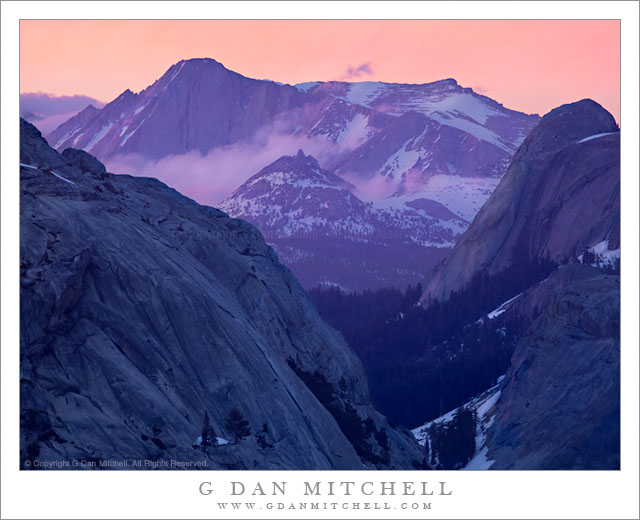
Alpenglow Clouds, Mount Conness

Alpenglow Clouds, Mount Conness

Alpenglow Clouds, Mount Conness. Yosemite National Park, California. June 18, 2011. © Copyright G Dan Mitchell – all rights reserved.

Clouds lit by alpenglow drift across the face of Mount Conness beyond the Tenaya Creek drainage, Yosemite National Park.

Earlier this week I posted another photograph of the same evening. This one was shot a bit earlier (believe it or not!) than the other photograph, as the intense and perhaps unexpected color display was just getting started. I’ll have more to write about the phenomenon in a future blog post that uses this evening as an example, but it almost seem like the sunset progressed backwards (oxymoron alert!) as it went on. It had begun with very boring and low contrast light, somewhat flattened by a haze that took on an increasingly ghastly blue-green hue as the light began to fade. Although the surroundings were spectacular on this opening day of Tioga Pass Road, the light and atmospheric conditions seemed to be conspiring to show them it their worst (literal and figurative) light.

But just at dusk a hint of pink appeared in some of the clouds ringing Mount Conness, the tall peak in the upper left. At first it was so faint that only those of us who were looking for it might have noticed, and we perhaps thought that we were simply trying to convince ourselves that something was going to happen. But the color increased, and as the more distant areas picked up better light, they shone through the foreground haze more clearly, and this haze faded in the same way that a scrim does in a theater when the front lights dim and the stage lights rise.

I find that this type of scene provides some of the most difficult technical and judgment challenges. So often the goal in an image, especially if it is going to be a print, is to try to get as much light into the scene as possible. A lot of the work in post-processing, at least for me, is done with the goal of trying to fill the image with light by means of various careful adjustments, often involving the use of masked curve layers. But here, the coloration depends upon not being overly bright – too much light either decreases the intensity of the pink and purple shadings or else sends them off into the land of the grotesque and gaudy. And the light in shadows – and there are a lot of shaded areas in this scene! – is very blue, much more so than the untrained eye would imagine when looking at the scene in person. This requires another set of tricky and subjective judgments – it would not look right to leave portions of the scene as blue “as they really were,” nor would it look right if the blue were diminished too much. But how much is right? There is no objective answer that I know of, so the goal (for example, on the large granite face of Polly Dome at the left) is to come up with a balance that seems blue enough but not too blue. A similar issue arises in these dark areas when it comes to deciding how bright is bright enough. Believe it or not, virtually nothing in this image is actually black, with the possible exception of a few very tiny areas in the lower left. The luminosity of the very dark areas had to be lifted a bit… but how much is just right? Again, a matter of personal judgment about which there is no objectively right answer.

All of that technical stuff aside, this evening provided one of the most glorious, albeit brief, displays of sublime light I have seen in the Sierra.

G Dan Mitchell Photography | Flickr | Twitter (follow me) | Facebook (“Like” my page) | LinkedIn | Email
Text, photographs, and other media are © Copyright G Dan Mitchell (or others when indicated) and are not in the public domain and may not be used on websites, blogs, or in other media without advance permission from G Dan Mitchell.
Two Trees, Morning Light, Pywiack Dome

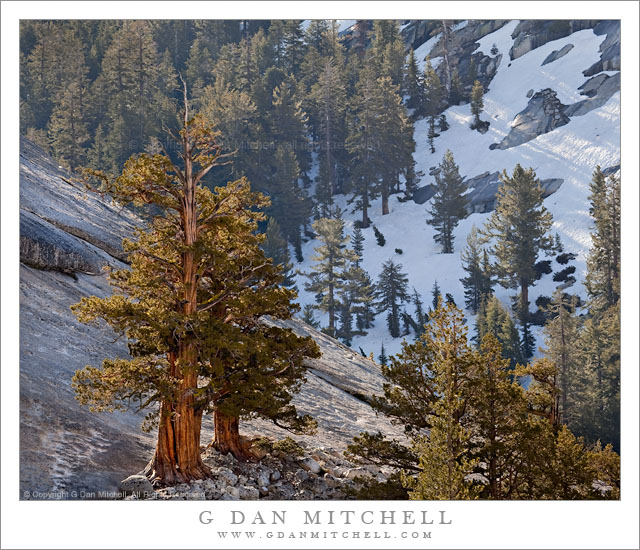
Two Trees, Morning Light, Pywiack Dome

Two Trees, Morning Light, Pywiack Dome. Yosemite National Park, California. June 19, 2011. © Copyright G Dan Mitchell – all rights reserved.

Morning sun illuminates two gnarled trees at the base of Pywiack Dome, Yosemite National Park

I should begin by acknowledging that I sort of think of these as being “Charlie’s Trees,” since I first saw them in a marvelous photograph by Charles Cramer during a visit to the Ansel Adams Gallery in Yosemite Valley. The photograph was tucked away in an inconspicuous place up high above a doorway, but it caught my eye immediately. I knew right away from the composition and the quality of the light that it was Charlie’s work.

On the morning of the day after Tioga Pass opened this year, I had gone early in the morning to a spot just below this location,  planning to photograph the high water of Tenaya Creek near where the creek from Cathedral Lakes joins and where the combined flow was flooding the meadow below Pywiack Dome. Finishing with that subject, I decided to head back up toward Tuolumne. Almost immediately as I passed by the base of Pywiack Dome, I could see that the morning sun was beginning to come around the shoulder of the dome and strike these trees and that the background of thicker forest and snow was softened a bit by haze and backlight. Very conscious of not wanting to recreate another photographer’s composition, I decided to use a long lens and let these two old and weathered trees fill the left half of the frame.

G Dan Mitchell Photography | Flickr | Twitter (follow me) | Facebook (“Like” my page) | LinkedIn | Email
Text, photographs, and other media are © Copyright G Dan Mitchell (or others when indicated) and are not in the public domain and may not be used on websites, blogs, or in other media without advance permission from G Dan Mitchell.

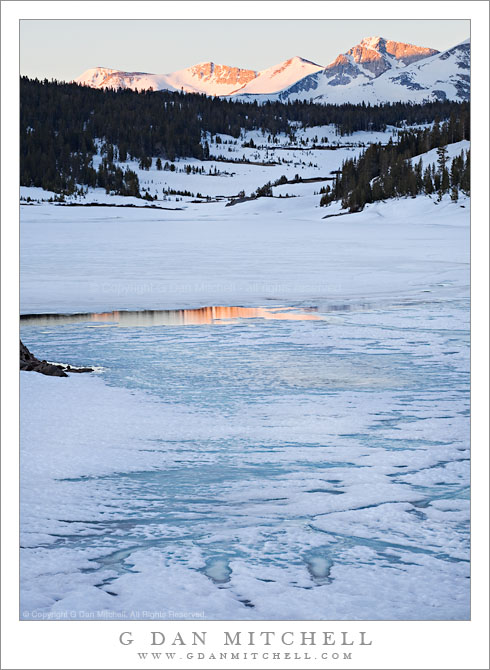
Melting Ice and Sunrise Reflection, Tioga Lake

Melting Ice and Sunrise Reflection, Tioga Lake

Melting Ice and Sunrise Reflection, Tioga Lake. Tioga Pass, California. June 19, 2011. © Copyright G Dan Mitchell – all rights reserved.

Dawn light on the peaks of Kuna Crest is reflected in a meltwater channel in the frozen surface of Tioga Lake at Tioga Pass.

On the weekend that Tioga Pass opened this year, I spent the “opening day” photographing along highway 120 in the park. That night I stayed in Aspen Camp in Lee Vining Canyon, a standby for me at almost all times of year when I photograph in the area and Tuolumne Meadows campground is not open. (That NPS campground typically opens a few weeks after the pass opens and then closes in late September.) The next morning I was up fairly early, planning to photograph more or less in the Tenaya Lake area a bit after sunrise. I drove up toward the pass and soon came to Tioga Lake, which lies next to the road just below the pass.

I had noticed the striking veined patterns formed by the melting ice the previous day but had not photographed them. When I saw them in the morning I spontaneously decided to stop and see what I could do with the subject, especially since it looked like the ice was starting to pick up a bit of color from the pre-dawn light. I quickly got out and set up and found a way to line up the melted channel in the icy surface with the peaks of the distant Kuna Crest inside the park. As the light began to strike this ridge its color reflected on the frozen lake and I made a few photographs before moving on.

G Dan Mitchell Photography | Flickr | Twitter (follow me) | Facebook (“Like” my page) | LinkedIn | Email
Text, photographs, and other media are © Copyright G Dan Mitchell (or others when indicated) and are not in the public domain and may not be used on websites, blogs, or in other media without advance permission from G Dan Mitchell.
Alpenglow, Mount Conness

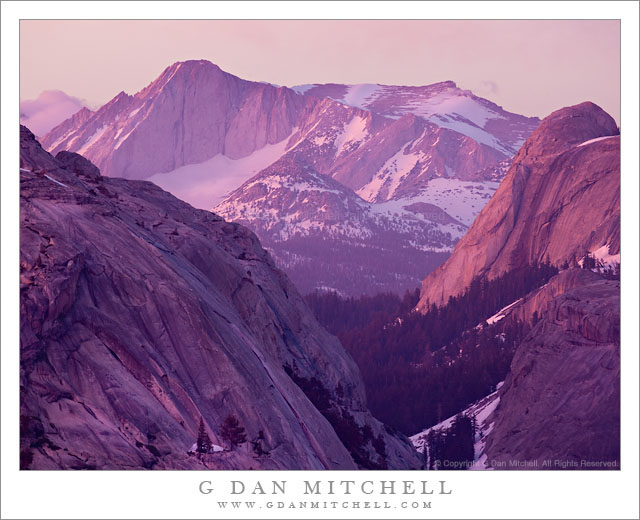
Alpenglow, Mount Conness

Alpenglow, Mount Conness. Yosemite National Park, California. June 18, 2011. © Copyright G Dan Mitchell – all rights reserved.

The last evening light illuminates domes near Tenaya Lake and the summit of Mount Conness with briilliantly colorful alpenglow, Yosemite National Park.

The tall peak at upper left is the summit of Mount Conness, one of the highest peaks in Yosemite National Park. The peak is located on the park boundary and the Sierra Nevada crest a bit north of Tioga Pass, and is visible from many places in the Tuolumne/Tioga high country. It is also a popular destination for peak baggers. The left foreground granite dome is the lower face of Polly Dome, which drops to the shoreline of Tenaya Lake. The left slope of Pywiak dome is visible in the shadows at lower right and beyond is the more brightly illuminated Medlicott dome.

I forgive you if you don’t believe the colors that you see in this photograph. I barely believe them myself, and I was (obviously!) there for the show. What happened on this evening was a near perfect example of a light phenomenon that Sierra photographers watch for and are occasionally lucky enough to experience. I have learned to see the signs that indicate that this light is possible, but also to understand that even when the conditions offer this potential that they rarely deliver.

On certain cloudy evenings in the Sierra it appears that there will be no sunset color – everything is hazy and drab and washed out. But if things play out just right, this very set of drab conditions (that induce some photographers to put away their gear too soon!) can produce some of the most striking and intense color possible if a few things fall into place just right. On this evening I had stopped for a moment at Olmsted Point, thinking to photograph ice-covered Tenaya Lake with a long lens and including the mass of Mount Conness in the distance. When I arrived there, things were about as unpromising as they could possibly be. A dull, greenish-blue haze hung in the air, overcast washed out the light, and Conness was obscured by clouds. I had actually put my gear back in the car when I looked back up and noticed that the summit of Conness had briefly poked through the clouds, accentuating its bulk and the sense that it towered over the foreground mountains. The light was still awful (I have the photos to prove it! ;-) but I thought I’d see if I could get something with the peak emerging from its shroud.

But still nothing much happened. I turned the camera to photograph some nearby trees and a blackbird that was looking for snacks. Then I noticed that there was some brighter light to the southwest and I began to consider the possibility that the cloud cover might end a bit to the west – and that is requirement #1 for the light conditions I’m describing. If the cloud deck ends to the west, as the sun reaches the horizon it may briefly break under the clouds and send brilliantly colorful light up into the clouds in the Sierra from below, creating a miles-wide light panel of the most astonishing colors. But still, it was hazy and the peaks were shrouded in clouds. But then I noticed that the clouds around Conness were beginning to drift off to the east and thin a bit. I mentioned (knock on wood!) to one of the other photographers that there was a possibility of “miracle light,” but that I wasn’t making any promises!

Then the thinning clouds began to pick up a slight pink tinge and the left side of Conness began to get some light directly from the west. Then, within a minute or so, the colors went absolutely crazy. People around me were audibly gasping as the color changed. At one point several of us spontaneously looked up to the west when we noticed the light suddenly increase out of the corners of our eyes. At the same time, the clouds almost completely dissipated from the area around the peak and because the whole sky was filled with brilliantly colorful clouds, this light began to suffuse even the depths of the canyon and slopes facing away from the sunset with this amazing light.

Never put your camera away until the last light is gone. :-)

G Dan Mitchell Photography | Flickr | Twitter (follow me) | Facebook (“Like” my page) | LinkedIn | Email
Text, photographs, and other media are © Copyright G Dan Mitchell (or others when indicated) and are not in the public domain and may not be used on websites, blogs, or in other media without advance permission from G Dan Mitchell.