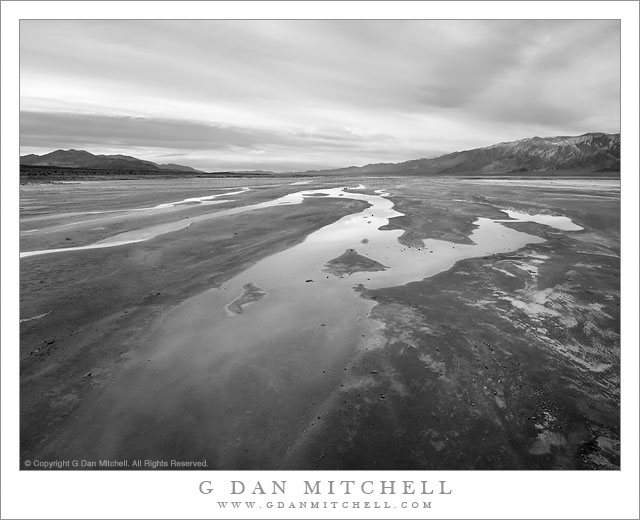
Black and white photograph of water from a salt spring reflecting cloudy morning sky above Death Valley.
Moments before I made this stark and, I think, desolate photograph of the shallow stream from a salt spring flowing slowly over the flats of Death Valley and reflecting the light from morning clouds, the Panamint Range mountains at the left side of the frame had been briefly lit by colorful sunrise light. But this light lasted only a couple minutes and shortly everything went largely gray.
The patterns of the very shallow and slowly flowing water as they spread out across the flats and reflected the light from the cloud filled sky intrigued me as soon as I arrived at this location. But before I made this photograph I had taken a different approach, positioning the camera down very low and very close to the water so that its reflective surface filled a larger portion of the frame and then lining things up to catch the first light on the Panamints and its reflection. But when that passed so quickly, it seemed like the flat and gray effect could also make an interesting photograph. When I made the exposure I wasn’t quite certain, but I think I was leaning towards a black and white rendition of the scene. Frankly, there wasn’t a lot of color to work with! The sky was mostly clouded over, though there was a hint of faded blue in a few spots. Any color in the Panamints was muted by the distance and haze. The mud is essentially gray and white (where salt has formed) and the water held less color than the sky!
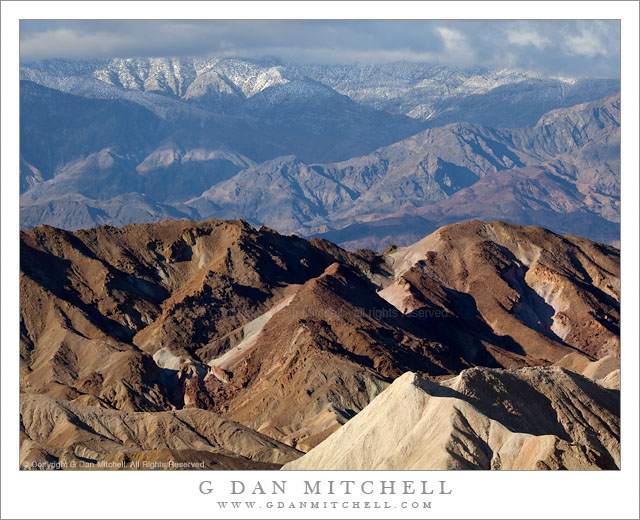
Morning light on fresh snow on the summit of the Panamint Range with Zabriskie Point Badlands in the foreground, Death Valley National Park.
After getting being frustrated by falling snow earlier in the morning when I tried to photograph dawn at Dantes View I headed back down to lower terrain. (Although I was not successful in photographing at Dantes View and, in fact, turned back before the summit in dense clouds and falling snow, it was quite an interesting visit!) I stopped along the way and made some photographs before arriving at Zabriskie Point.
At this point I no longer reflexively photograph at Zabriskie, though I will if something special or unusual is happening with the conditions. Having been frustrated in my original plans, I figured I might as well take a look around since I was there. I left the camera gear in my car and walked up the hill to the famous overlook to see what I could see. The dawn light – if there had even been any on this cloudy morning – was long gone, though a few photographers were still hanging out. As I looked about I noticed two things. First, the clouds were just beginning to thin over the Panamint range. While the summit of Telescope Peak was still socked in – it appeared to be snowing there – light was beginning to break through gaps in the clouds above the east side of the range and interesting shadows were appearing below the snow line. Second, the partially cloudy conditions were softening the light right in the Zabriskie/Gower Gulch area and the light in some of my favorite small gullies to the right of the observation area was looking somewhat interesting. (I have made a project of photographing them with a long lens.)
With no other specific plan, and two potential subjects right here, I followed one of those “laws of photography” that says shoot the thing you see now rather than continuing to wander around hoping that some other miracle crops up. (Sometimes this is great advice. Other times it is dead wrong!) I walked back down the hill to my car, grabbed my gear, and walked back up. I first spent some time photographing the nearby gullies. (I think I have a couple of interesting images of them that will appear here eventually.) But I quickly turned my attention to the interesting weather and light across the Valley, thinking about how I might photograph this wild and rugged scene without making it look like another Zabriskie Point image. I decided to use a relatively long focal length lens – which was already on the camera for shooting the gullies anyway – and try to fill the entire frame with a combination of close and far mountains and snow and clouds in the morning light.
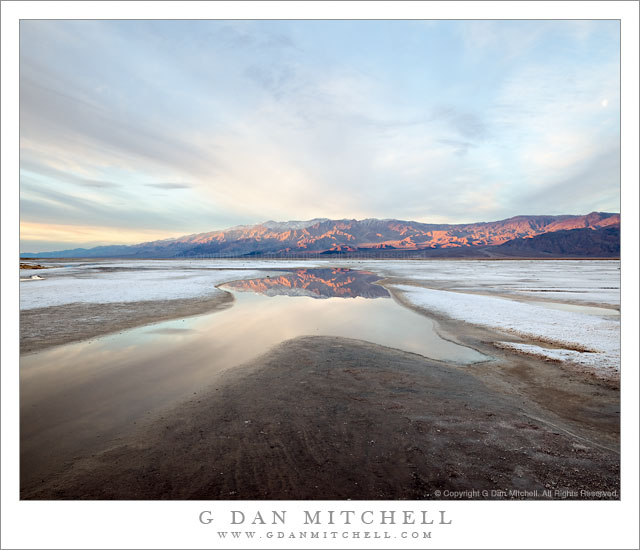
The first dawn light on the snow-dusted Panamint Range is reflected in shallow winter pools on the salt flats of Death Valley National Park.
This is yet another story of serendipity, I think, though it also does involve some advance work – which should please those who become uncomfortable with the idea that not every landscape photograph results from a slow and deliberate and well-planned process! ;-)
The general location of this scene is along a section of salt flat just below the Salt Creek turnoff from the main highway – it is the first area of obvious salt flats that you come to as you head south towards the Furnace Creek area. One one of my first photographic visits to Death Valley I recall stopping near this location along the road and trying to make a photograph pointing down the length of the Valley. It was not successful, but I’ve always been a bit intrigued by this location where the road has to curve around to the east to avoid this salt flat. A day or two earlier on this trip I had stopped along the road at almost this exact location during the “boring light” part of the day after shooting somewhere else. I had wandered – without any camera gear – down across the wash to a patch of brown salt grass and beyond to the edge of the salt flat. I had noticed a lot of things: the very alien nature of this landscape consisting of mud and caked salt and not much else, the surprising presence of some worms and larvae in this tremendously salty water, the fact that the water seemed to seep from beneath the wash, and the interesting shapes that the water created as it slowly spread along the edge of the salt flat.
Move ahead to this morning, the final one of this trip to Death Valley, and I was up well before first light. I had several ideas about what I might photograph, but had not made a firm decision yet since the weather was something of an unknown. I had a vague idea about heading north up the valley and photographing the first light on the hills along its western edge. I was keeping open the possibility that spectacular light might make it worth while to photograph Zabriskie. But I really didn’t know.
I drove to the Furnace Creek/Scotty’s Castle junction and pulled over to watch the light begin to grow. There were lots of clouds! It looked like a lighter area might evolve straight to my east, but I couldn’t quite see photographic potential in it. To the north things looked pretty bleak. There was some possibility that light could happen way to the south, but I wasn’t convinced. I decided to drive a bit south and see what might happen, and very soon I came back to this place where I had stopped earlier. The light wasn’t very promising – clouds to the east seemed likely to block the sunrise light even though there were some interesting cloud patterns overhead that were starting to become more transparent as the sky began to lighten.
Then I caught just a bit of light on some of the higher clouds above the middle level clouds and I started to wonder if the light just might make it through. I went to the back of the car and grabbed my camera with one lens already attached and mounted it on the tripod. I wasn’t sure if I’d want wide or tele for some of the possible subjects, so I grabbed two additional lenses and stuck them in a shoulder bag and headed down the wash, not really looking up too much, just heading straight towards these little areas of water that I remembered from earlier. As I got close to the edge of the flats I saw that, indeed, a band of sunrise light was coming in below the cloud deck to the east (something I have learned to watch for) and starting to light up the highest peaks of the Panamints. I knew that if this light survived long enough to make it down across the range that it was going to happen fast, so I quickly headed out onto the edge of the flats, more or less ignoring the larger scene and simply looking for an interesting reflecting pool. As I set up – working very quickly now – the first sun lit up the face of the panamints and revealed radiating cloud shapes above. I had perhaps two minutes of this light… and then the small gap along the eastern horizon must have closed up as the light disappeared and went back to gray.
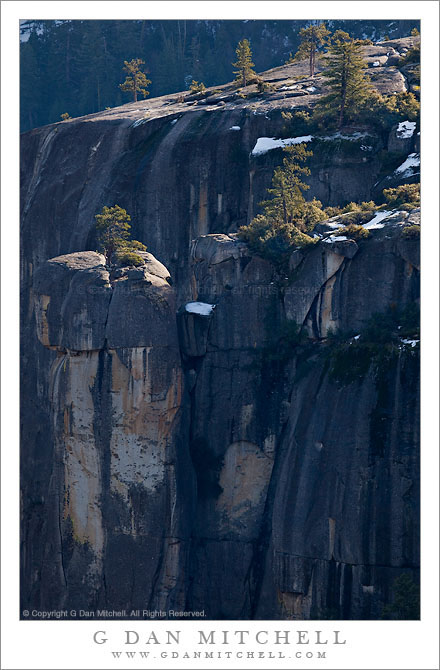
Sparse trees grow in granite slabs above steep granite cliffs in Lower Yosemite Valley.
(Note: After receiving some advice from a helpful reader – which was much appreciated! – I now know that this feature has a name. It is called “the Rostrum,” and I have retitled the photograph accordingly.)
I’ve seen these tree-topped columns and the granite slabs beyond many times when I’ve taken Crane Flat Road into the Valley. On my recent visit to Yosemite, photographing these trees in both early and late light was on my agenda, and I got myself into position to shoot them on two or three occasions.
At the right times of day – and there are at least two when this can work – the light slants across the top of the granite slabs and ledges at the top of these cliffs and catches the trees with side or back light. Below these upper slopes the vertical fluted forms of the cliffs drop nearly vertically to the Merced River canyon below. The cliffs themselves are in what I might describe as lower Yosemite Valley – think of Crane Flat Road above Cascade Creek or the area well beyond the upper end of Wawona Tunnel. There is a lot of very interesting and imposing rock in this part of the Valley, though I think it may get overlooked a bit by comparison to the truly astonishing faces and domes and peaks of the Valley proper.
Since the light changes throughout the year, and especially because the point at which the sun sets moves north as the years moves from winter to summer, I want to come back and photograph this area again a bit later in the year when I think the potential for light later in the day might improve. From my point of view, the ideal conditions might combine “golden hour” side light with shadows that reduce the detail on the forest covered slopes beyond – and without the bright snow patches that appear here. Of course, a fresh snowfall here might also be interesting…
I got a bit of a laugh out of one thing that happened when I made this photograph, though it is similar to similar situations I’ve had in the past. It is not at all unusual for lots of tourists to stop when they see a photographer with a big tripod and large lens at a pull-out along the road. I assume they think that if the photographer with the Fancy Equipment is stopping that there must be something there worth photographing. But sometime the photographer is pointing the camera in direction that must only confuse them. On this occasion I was in a spot with a classic and stunning view of distant Bridalveil Fall, and I’ll bet that many of those stopping thought they might try to duplicate my “shot of the falls.” But as they stopped and looked they may have wondered about me if they noticed that my lens was aimed at some seemingly nondescript spot perhaps 30% to the right of the fall…
Photographer and visual opportunist. Daily photos since 2005, plus articles, reviews, news, and ideas.
Manage Consent
To provide the best experiences, we use technologies like cookies to store and/or access device information. Consenting to these technologies will allow us to process data such as browsing behavior or unique IDs on this site. Not consenting or withdrawing consent, may adversely affect certain features and functions.
Functional
Always active
The technical storage or access is strictly necessary for the legitimate purpose of enabling the use of a specific service explicitly requested by the subscriber or user, or for the sole purpose of carrying out the transmission of a communication over an electronic communications network.
Preferences
The technical storage or access is necessary for the legitimate purpose of storing preferences that are not requested by the subscriber or user.
Statistics
The technical storage or access that is used exclusively for statistical purposes.The technical storage or access that is used exclusively for anonymous statistical purposes. Without a subpoena, voluntary compliance on the part of your Internet Service Provider, or additional records from a third party, information stored or retrieved for this purpose alone cannot usually be used to identify you.
Marketing
The technical storage or access is required to create user profiles to send advertising, or to track the user on a website or across several websites for similar marketing purposes.