
Tag Archives: strata

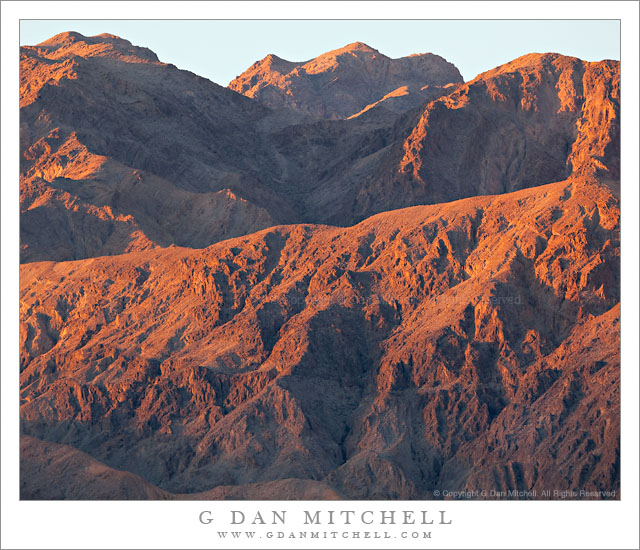
Lower Slopes of Tucki Mountain, Dawn

Lower Slopes of Tucki Mountain, Dawn

Lower Slopes of Tucki Mountain, Dawn. Death Valley National Park, California. March 31, 2011. © Copyright G Dan Mitchell – all rights reserved.

Dawn light on the faces and gullies of the lower slopes of Tucki Mountain, Death Valley National Park.

On the final morning of my recent (March, 2011) visit to Death Valley I decided to go to a spot not far from my campsite at Stovepipe Wells where I know of a bit of raised terrain that provides large-scale views of big chunks of this part of the Valley. I arrived before dawn and lugged my gear to the top of this rise with the primary plan of using a long lens to photograph across the Mesquite Dunes toward the Cottonwood Mountains at sunrise.

However, when standing in a spot like this one there are so many interesting effects of light all around that it is impossible, for me anyway, to just shoot that one thing. Far up the Valley to the north light starts to hit the highest peaks of several mountain ranges, to the east the light comes through and illuminates morning haze and layers of low hills, and to the southwest of my position the light began to reach the top of Tucki Mountain. So, between photographs of my intended subject to the west, I swung the camera though the entire 360 degrees to photograph many of these other subjects.

Tucki Mountain has fascinated me since I “discovered” it one morning while shooting on the “back side” of the Mesquite Dunes. At dawn I had been photographing the low dunes and other features on the side of the dunes that cannot be seen from the usual roadside viewpoints. As the light changed I worked my way up into the dunes a bit to photograph the shapes and textures of the sand, and I saw a composition that included this massive mountain to the south with it dark and jagged features. It was only later that I found out that it was Tucki Mountain. (If you have visited Stovepipe Wells, you have been right below the mountain.) It is a huge, sprawling peak – almost more of its own small range than a simple peak, or so it seems to me.

On this morning I first saw a big of the deep red first dawn light hitting the top of the peak and noticed lower ridges starting to pick up traces of this light. I swung that tripod head around to point this direction and decided to tightly frame some images of the overlapping ridges and valleys ascending toward the peak as the light worked its way down toward the Valley floor.

G Dan Mitchell Photography | Flickr | Twitter | Facebook | Email
Text, photographs, and other media are © Copyright G Dan Mitchell (or others when indicated) and are not in the public domain and may not be used on websites, blogs, or in other media without advance permission from G Dan Mitchell.
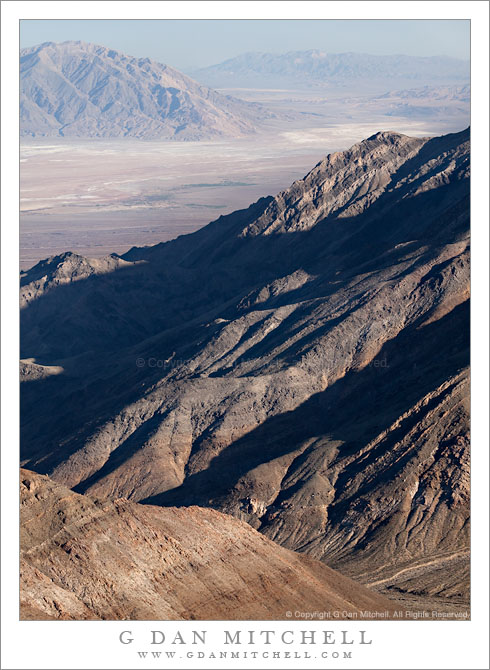
Trail Canyon, Lower Slopes of Wildrose Peak, Death Valley

Trail Canyon, Lower Slopes of Wildrose Peak, Death Valley

Trail Canyon, Lower Slopes of Wildrose Peak. Death Valley National Park, California. March 30, 2011. © Copyright G Dan Mitchell – all rights reserved.

Afternoon shadows fall across the lower slopes of Wildrose Peak above Trail Canyon and below Aguereberry Point, with Death Valley and the Black Mountains beyond.

The view from Aguereberry Point (and from this location close to the point) is spectacular and expansive, taking in everything from Death Valley itself, stretching almost 180 degrees from left to right, to the Green, Black, and other mountains beyond. To the south and north other ranges merge with the atmospheric haze. The peaks of the Panamint range lie behind, and in places where the view is clear you can look down on the rugged terrain of the east face of the Panamint Range with its rugged ridges and deep canyons dropping towards the Valley. This photograph looks roughly southeast towards the lower end of Death Valley in the area around Ashford Mill. The deep foreground canyon, the bottom of which is just visible at lower right, is Trail Canyon. I understand that a four-wheel-drive road used to come up to Aguereberry Point via that canyon, but that parts have washed out and it can no longer be driven. I think that you can hike it, but that would be one heck of a climb since the base of the canyon can’t be more than a few hundred feet above Death Valley (which is below sea level in this area) and the Point is well above 6000′. The lower slopes of Wildrose Peak rise beyond the canyon.

Surprisingly, this view presents several photographic challenges. Because of the haze that appears when such great distances are part of the scene, I chose to use a polarizing filter for this shot. Timing is important here, too. Arrive a bit too early and the light is harsh and flat. Arrive a bit too late and the foreground ridges are quickly enveloped in shadows as the sun drops behind the crest of the Panamint Range. (Yes, I have made both mistakes in the past.) Knowing this, I arrived a bit earlier than I might have usually arrive to shoot evening light and I managed to photograph the scene before that Panamint Range shadow obliterated the foreground light.

G Dan Mitchell Photography | Flickr | Twitter | Facebook | Email
Text, photographs, and other media are © Copyright G Dan Mitchell (or others when indicated) and are not in the public domain and may not be used on websites, blogs, or in other media without advance permission from G Dan Mitchell.

Erosion Patterns, Morning Light – Zabriskie Point

Erosion Patterns, Morning Light - Zabriskie Point

Erosion Patterns, Morning Light – Zabriskie Point. Death Valley National Park, California. April 30, 2010. © Copyright G Dan Mitchell – all rights reserved.

A sea of pastel erosion patterns in diffused early morning light below Zabriskie Point, Death Valley National Park, California.

Off to the left of the “classic views” from Zabriskie point is a series of hills and gullies extending back to the south-southeast which catches the early morning cross-light as the sun comes up. Depending upon the lighting conditions the color of these hills can range from white-gray, through golden, to reddish, and almost black, with bluish tones in some cases. The patterns run every which way as the gullies draining these hills ultimately head to Gower Wash and then into Death Valley. In the foreground of this scene is a solitary ridge that has the remnant of an older layer of darker stratified material.

On the morning when I made this photograph the sun had just come up over the hills to the east, but clouds in that direction were partially blocking the light which quickly changed between full dawn sun and light filtered by the clouds. At the moment I made this exposure a bit of the more direct light hit the foreground strata fragment and a few spots further away, but softer cloud-filtered light fell on many parts of the scene.

This photograph is not in the public domain and may not be used on websites, blogs, or in other media without advance permission from G Dan Mitchell.

G Dan Mitchell Photography | Twitter | Friendfeed | Facebook | Facebook Fan Page | Email

Technical Data:
Canon EOS 5D Mark II
Canon EF 100-400mm f/4.5-5.6 L IS USM at 105mm
ISO 200, f/11, 1/100 second

keywords: death, valley, national, park, california, usa, north america, spring, nature, zabriskie, point, morning, light, erosion, pattern, hill, geology, valley, crack, gully, rock, layer, strata, diagonal, landscape, scenic, travel, desert, southern, pastel, stock

Folds and Strata, Zabriskie Point

Folds and Strata, Zabriskie Point

Folds and Strata, Zabriskie Point. Death Valley National Park, California. March 29, 2010. © Copyright G Dan Mitchell – all rights reserved.

Convoluted folds topped by some stratified material at Zabraskie Point, Death Valley National Park, California.

A new hobby for me when photographing Zabriskie Point is to forego the famous panoramic views of Manley Beacon and the Panamints – well, at least sometimes – and to instead focus on smaller details of the patterns in the fantastically folded terrain. Starting about a year ago, I also became intrigued by the idea of shooting here at unusual times of the day: late morning, early afternoon, and so forth. I started doing this when a year ago I shot somewhere else at dawn and then happened to stop her much later in the morning – only to discover that some of the shapes and forms that are in shadow early in the day are actually better-lit later on.

On my late-March trip I did shoot Zabriskie at the “popular” time of dawn on one morning, but on another day I spent a good amount of time shooting here during the less classically ideal time in the middle of the afternoon. I was lucky enough to get just a bit of high thing clouds which reduced contrast just a bit, but kept the interesting shadows and illuminated ridges that appear at this time of day. When I shoot this way I go straight for a very long lens and focus on smaller details of the scene, ignoring the larger and broader landscape in favor of bits of a gully, shadowed or sunlit ridges, or a bit of strata material sitting on top of the folded material as seen here.

Rather than amp up the contrast and saturation – an easy trap to fall for in the afternoon light – I decided to keep the softer and less saturated effect that I was actually there when I made the photographs.

This photograph is not in the public domain and may not be used on websites, blogs, or in other media without advance permission from G Dan Mitchell.

G Dan Mitchell Photography | Twitter | Friendfeed | Facebook | Facebook Fan Page | Email

Technical Data:
Canon EOS 5D Mark II
Canon EF 100-400mm f/4.5-5.6 L IS USM at 250mm
ISO 100, f/16, 1/30 second

keywords: zabriskie, point, death valley, national, park, california, usa, north america, nature, landscape, geology, scenic, travel, form, formations, fold, gully, rock, strata, material, shadow, light, abstract, view, ridge, hill, manifold, overlook, desert, barren, stock