
Tag Archives: wildlife

First Bird Photographs of Fall

During the past few years I have become a big fan of photographing migratory birds in California’s Central Valley, and now that summer is over I’m anxious to get back out there and get to work on this year’s bird photographs. Actually, we made our first bird photography trip out there about a week ago, on the first weekend in November. Our main goal was to find sandhill cranes, since we knew they were here already, but we were also interested in seeing what else might have showed up.

In keeping with my new policy of posting multiple photographs in a single message when I have too many photographs waiting in the queue, this post includes five bird photographs. Enjoy!
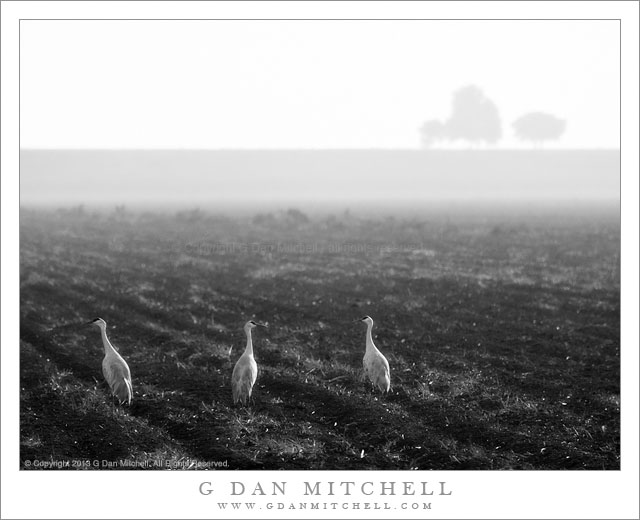
Three Cranes, Morning

Three Cranes, Morning. Central Valley, California. November 1, 2013. © Copyright 2013 G Dan Mitchell – all rights reserved.

Three sandhill cranes in a dormant field

Late in the morning, long after the morning fly out, we were poking around on some rural backroads when we found a lot of sandhill cranes in dormant fields in thinning morning fog. This group thoughtfully posed for me with a distant pair of trees on the horizon.
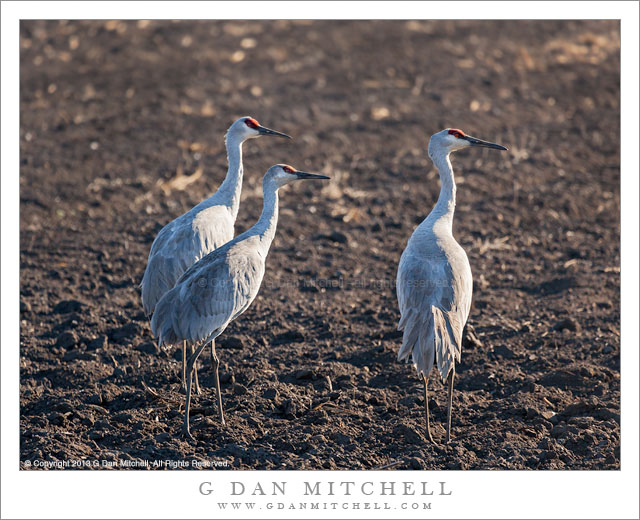
Three Sandhill Cranes

Three Sandhill Cranes. Central Valley, California. November 1, 2013. © Copyright 2013 G Dan Mitchell – all rights reserved.

Three sandhill cranes stand in a dormant Central Valley, California field

I photographed this group in much the same location as those in the previous photograph. While the cranes seem to collect in large groups near water in the evening and early morning, during the day they are often found more spread out in agricultural areas like this one.
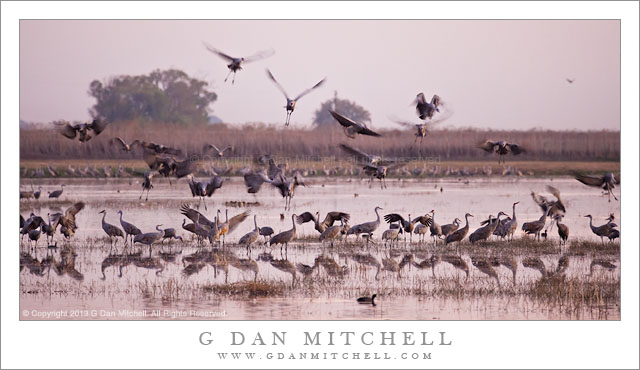
Sandhill Cranes Landing

Sandhill Cranes Landing. Central Valley, California. November 1, 2013. © Copyright 2013 G Dan Mitchell – all rights reserved.

Sandhill cranes land on a Central Valley pond during the evening fly-in

In the evening the cranes do a “fly-in” – where large numbers of them land together in areas around water. When we arrived at this small observation area an hour or so before sunset, there were many birds but no cranes. However, I’ve learned that the sandhill cranes often arrive late, frequently after sunset and sometime when it is becoming rather dark. (One of our most memorable migratory bird encounters occurred at another refuge further south in the valley. We had a great day of photographing birds, beginning very early in the morning and continuing through sunset. As the sun set the bird action began to diminish and it became quite dark. It had been a long, successful day, and we were happy to be finished with this shoot. We were just putting gear away when we began to hear a huge chorus of the easily recognized sound of sandhill cranes coming from out of sight to the southeast. A moment later the sky was filled with the birds – I’ve never seen so many cranes together since then.)

Here the birds began to arrive just a bit earlier. The first groups landed a good distance off, but soon a single large crane settled in on this dry area in front of us and began to produce very large calls, as if to say, “come on down and stop here!” Before long other birds did just that. Here the slow shutter speed allows the winds of the landing birds to blur a bit.
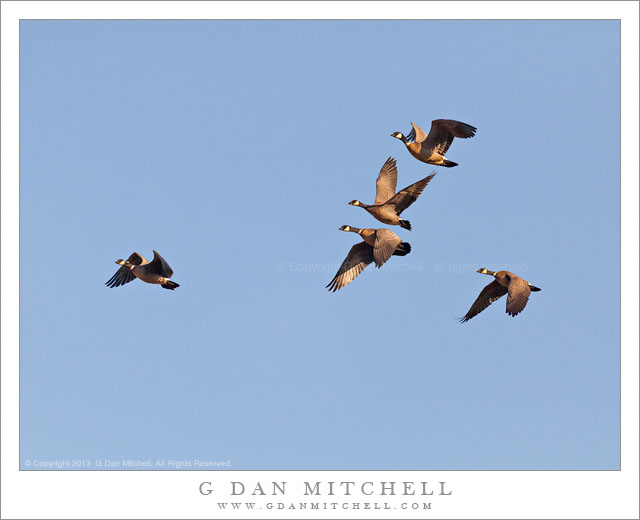
Cackling Geese in Flight

Cackling Geese in Flight. Central Valley, California. November 1, 2013. © Copyright 2013 G Dan Mitchell – all rights reserved.

A small group of cackling geese in flight against blue sky over California Central Valley agricultural lands

I have a confession to make, and it is a little embarrassing for a person who is as enthusiastic about photographing birds as I am. Basically, I’m not very good at identifying birds, or at least not good at naming them! (This is an “issue” I’ve always had, and not just with birds. I’m so familiar with certain wild plants that I can tell you exactly what they look like in the wet and dry seasons, when the flowers will appear, and when to find them… but I often cannot name them.) I’m always happy when I can photograph with someone who is better than I at this.

I’m pretty certain these are geese! (Good so far?) I used to think that geese that looked like this were Canadian geese, but when I tried to find photos of these birds online to determine what they were, I kept coming up with “cackling geese.” To make things more confusing – at least for me – I understand that the differences between some Canadian geese and some cackling geese can confuse even the experts. Judging by the size and shape of the bill, the size of the birds, and the pattern and color of feathers, I’m going with this identification until someone shows me differently!
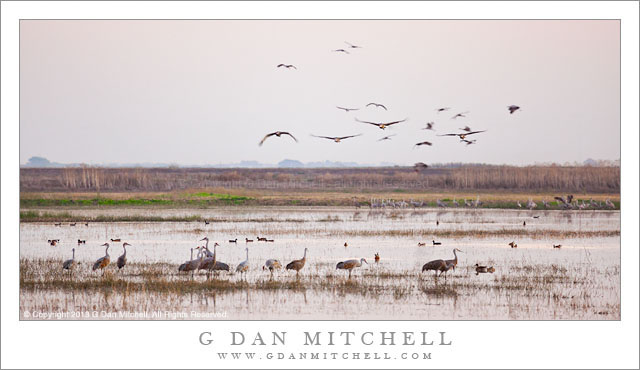
Sandhill Cranes, Evening Fly-In

Sandhill Cranes, Evening Fly-In. Central Valley, California. November 1, 2013. © Copyright 2013 G Dan Mitchell – all rights reserved.

Sandhill cranes settle in to a Central Valley pond during the evening fly-in

This is the same group seen in a photograph earlier in this post, with this photograph being made a bit earlier – clearly the case as there are fewer birds on the ground in this shot, and the color of the sky is less intense. If you look closely about a third of the way in from the left edge of the frame, you may be able to see the larger bird that landed first and was then followed by other later arrivals.


G Dan Mitchell is a California photographer and visual opportunist. His book, “California’s Fall Color: A Photographer’s Guide to Autumn in the Sierra” (Heyday Books) is available directly from him.

G Dan Mitchell: Blog | Bluesky | Mastodon | Substack Notes | Flickr | Email


All media © Copyright G Dan Mitchell and others as indicated. Any use requires advance permission from G Dan Mitchell.
Grazing Deer, Ragged Peak

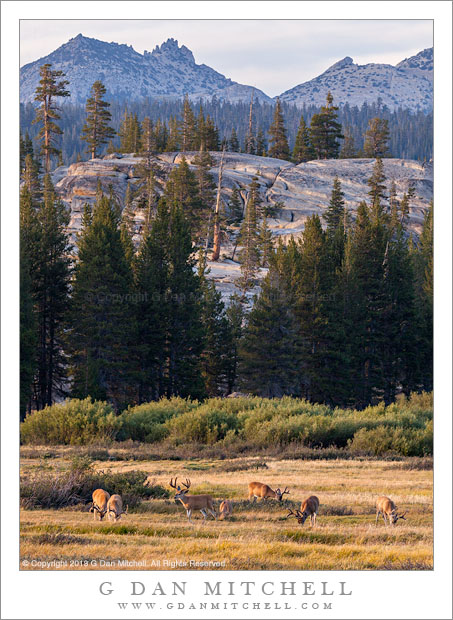
Grazing Deer, Ragged Peak

Grazing Deer, Ragged Peak. Yosemite National Park, California. August 7, 2013. © Copyright 2013 G Dan Mitchell – all rights reserved.

A group of deer graze in Tuolumne Meadows near sunset beneath the summit of distant Ragged Peak

Perhaps I’ve simply missed this in the past, but on this early August trip to the Tuolumne Meadows area I saw a herd of deer grazing in the meadow in the evening that was larger than any I have encountered before. I’ve often seen small groups of perhaps a half-dozen or so there, but this group had at least two dozen individuals on the two evenings I was there. Many were bucks with antlers, but there were also some very young and very frisky critters among them, including one who seemed to be the ringleader of periodic high-speed races back and forth across the meadow. While waiting for interesting light for photographing other subjects (and that light is just beginning to appear on the dome behind the meadow) I spent some time with the long lens photographing them.

There are, of course, quite a few ways to photograph wildlife, ranging from what amount to intimate and close-up portraits to photographs that show the animals in their landscape – with the latter verging on “landscape with animals,” a different thing than much wildlife photography. I like doing both, but here I was thinking a lot more about photographing the animals in their world. This affected my approach in a couple of perhaps obvious ways. First, while I could have gotten quite a bit closer with the long lens I was using, I hung back so that I could include more than one deer in the frame, include more of the surrounding landscape, and not intrude to closely on the deer. Second, as soon as I had clicked of a first “insurance shot” of the animals, I stopped and looked at the landscape in order to find things that I could align with the deer. In this case, I was able to move some distance to one side and get a group to line up with the low dome (which, lucky for me, got hit with a bit of soft evening sunlight at the right moment!) and the distant ridge holding Ragged Peak, an area that I know quite well from many pack trips into nearby areas.

G Dan Mitchell is a California photographer and visual opportunist whose subjects include the Pacific coast, redwood forests, central California oak/grasslands, the Sierra Nevada, California deserts, urban landscapes, night photography, and more.
Blog | About | Flickr | Twitter | FacebookGoogle+ | 500px.com | LinkedIn | Email

Text, photographs, and other media are © Copyright G Dan Mitchell (or others when indicated) and are not in the public domain and may not be used on websites, blogs, or in other media without advance permission from G Dan Mitchell.

White-Faced Ibis

White-Faced Ibis
White-Faced Ibis

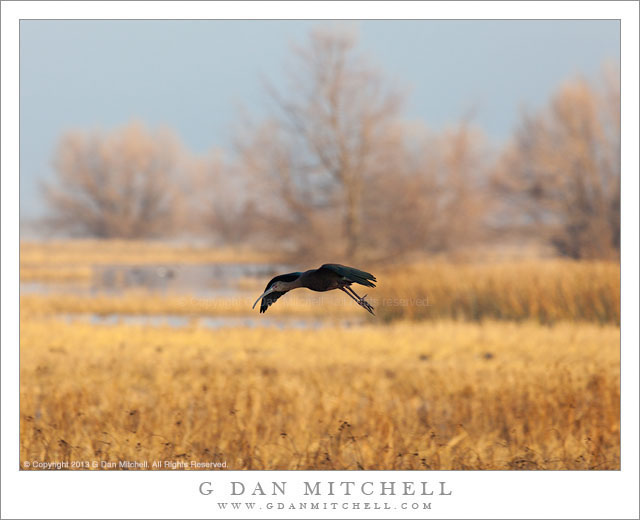
White-Faced Ibis. San Joaquin Valley, California. January 21, 2013. © Copyright 2013 G Dan Mitchell – all rights reserved.

A white-faced ibis about to land in a San Joaquin Valley marsh.

A month or two earlier I had come across a large number of white-faced ibises in this precise spot along the perimeter road around this marshland where many, many migratory birds are found this time of year. The group of them was on the ground, apparently feeding in a wet grassy area, and they were quite shy about my presence, moving back from me as I came up alongside the on the road. On the day when I made this photograph, I had not noticed any of these birds at all. In fact, I had stopped here to photograph some ducks when I happened to look up and see this single bird angling in for a landing. I swung my camera around and tracked it to its landing.

I have a few random-sounding observations about the white-faced ibis. First, unless I’m missing something, they really don’t seem to have white faces! The beak is lighter than the bird, but that’s about as close to a white face as I can can find on these birds. Second, their coloration makes them difficult to photograph effectively. They are quite dark-colored birds, though their features can have a slightly colored iridescence that seems sort of reddish to me. Because of this, if I try to enhance the shadowed areas of the very dark birds in post, this coloration can quickly start to look fake. (In fact, I’ve seen a number of photographs of these birds that attempt to make them look lighter than they are, but which instead just end up looking odd.) They do make a fine photograph in silhouette, especially when a flock of them flies overhead early or late in the day.

G Dan Mitchell is a California photographer and visual opportunist whose subjects include the Pacific coast, redwood forests, central California oak/grasslands, the Sierra Nevada, California deserts, urban landscapes, night photography, and more.
Blog | About | Flickr | Twitter | FacebookGoogle+ | 500px.com | LinkedIn | Email

Text, photographs, and other media are © Copyright G Dan Mitchell (or others when indicated) and are not in the public domain and may not be used on websites, blogs, or in other media without advance permission from G Dan Mitchell.
Egret Quartet

Egret Quartet
Egret Quartet

Egret Quartet. San Joaquin Valley, California. March 9, 2013. © Copyright 2013 G Dan Mitchell – all rights reserved.

A quartet of egrets on a foggy morning in a green late-winter pasture in California’s San Joaquin Valley.

This gang of egrets was politely waiting for me near the far corner of a wildlife refuge that I had visited on the last-winter morning, hoping to photograph (mostly) geese and cranes. The geese and cranes were a bit shy, and as I worked my way around the refuge’s perimeter road I wasn’t finding a lot of opportunities to photograph them. I could hear them, especially the sandhill cranes, but they seemed to be too far off, hidden by fog, or behind the tules. But I wasn’t in a hurry, so I took my time, stopping and watching and listening. By this later point in the season the initial astonishment at the huge numbers of birds had worn off a bit, and rather than jumping out of the car to photograph huge flocks of birds, as if they were the first and only flocks in the world, had given way to a bit more patience.

It had appeared that it would be a clear morning as I drove toward this location, but just moments before I arrived – a bit before dawn – the cool and damp air did begin to form some fog. This was fine with me, as I’d rather have a bit of interesting foggy atmosphere than have perfectly clear sky. But the fog was relatively short-lived – not like the midwinter fogs that can cover these places for days on end. By the time I finally worked my way over to this spot the sun was starting to break through and the fog was thinning. Because of their stark white color, lone egrets are often easy to spot from a good distance, and four of them clustered together were impossible to overlook. As I edged up closer to them, remaining in my vehicle so as not to spook them, they simply stood there, occasionally swinging their heads one way or another. Before I could make this photograph I first had to wait for an unruly band of red-winged blackbirds to depart, and then I waited for the four birds to move their heads in what seemed to me to be interesting directions.

G Dan Mitchell is a California photographer and visual opportunist whose subjects include the Pacific coast, redwood forests, central California oak/grasslands, the Sierra Nevada, California deserts, urban landscapes, night photography, and more.
Blog | About | Flickr | Twitter | FacebookGoogle+ | 500px.com | LinkedIn | Email

Text, photographs, and other media are © Copyright G Dan Mitchell (or others when indicated) and are not in the public domain and may not be used on websites, blogs, or in other media without advance permission from G Dan Mitchell.