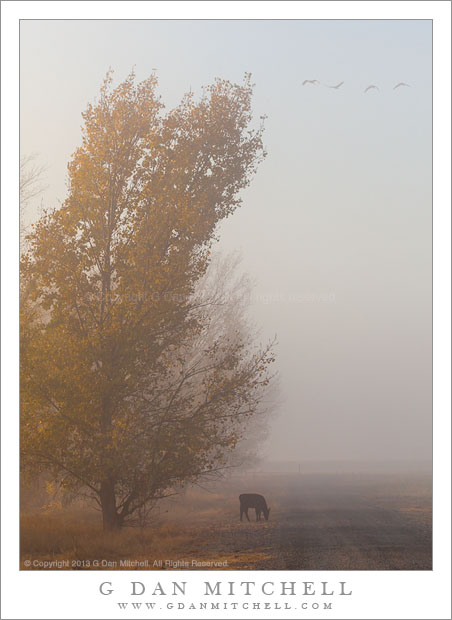
A calf grazes near a row of autumn cottonwood trees on a foggy morning and as sandhill cranes fly overhead
On this foggy morning I had begun photographing a bit earlier, just at dawn. I gradually worked my way along a gravel country road, stopping frequently – spending more time stopped than driving, actually – to photograph the foggy landscape and migratory birds. At this early hour, the sandhill cranes were my primary targets. At times, when the fog cleared a bit, it was possible to see many of them taking off for distant points as the day began. When the fog thickened, they were heard more than seen, at least until they flew close enough to momentarily appear overhead through the fog.
In a place where the road paralleled a row of cottonwood trees with golden autumn leaves I stopped to wait for the birds to fly overhead. From a distance away I had figured out that many of the cranes were headed this way as they took off, so it seemed that if I stopped and waited here quietly the birds might come to me. And they did – every few minutes another group would fly low over my position. I shared this spot with a herd of cattle, quite a few of whom found me to be the most interesting thing in their early morning world and stared quietly at me. One calf that had passed beneath a fence around the pasture was busy grazing along the lane, so I stopped and photographed it beneath the cottonwood trees as a group of sandhill cranes passed overhead.
G Dan Mitchell is a California photographer and visual opportunist whose subjects include the Pacific coast, redwood forests, central California oak/grasslands, the Sierra Nevada, California deserts, urban landscapes, night photography, and more. Blog | About | Flickr | Twitter | Facebook | Google+ | 500px.com | LinkedIn | Email
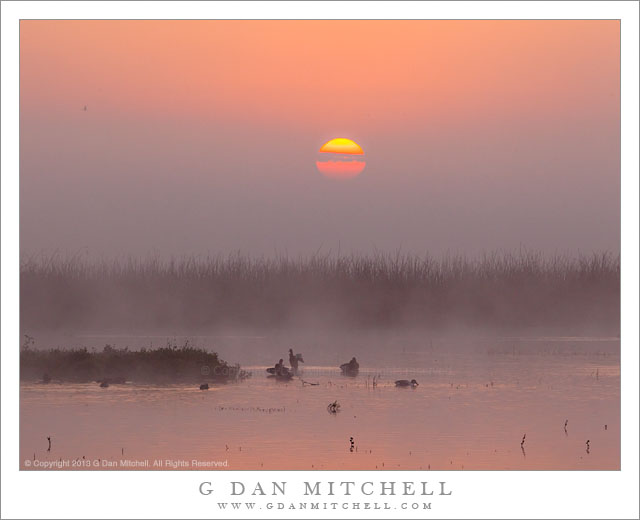
Autumn sun rises through fog about California Central Valley marshland
I wanted to photograph migratory birds at sunrise in the San Joaquin Valley, so I was on the road from the San Francisco Bay Area shortly after 4:00 AM. As I drove it seemed like it might be a perfectly clear day, but on the last few miles of my drive I hit fog – thick enough fog to slow my progress considerably. I regard this as good news when I’m photographing birds out here, as drifting fog and mist makes for interesting conditions for photography, far more than clear skies.
I arrived at my destination, and the fog was so thick that I couldn’t see the morning light beyond the general increase in ambient light levels. However, as I stopped to see what birds might be about I noticed that the sun was barely visible through the low fog and some more distant clouds. At first it was so faint that it was possible to miss it, and as the fog drifted it occasionally completely muted the light of the sun. But after a few more minutes, as the sun rose higher the fog drifted and dissipated just a bit, and the globe of the rising sun become visible through the thick atmosphere, partially blocked by a layer of mid-level clouds.
G Dan Mitchell is a California photographer and visual opportunist whose subjects include the Pacific coast, redwood forests, central California oak/grasslands, the Sierra Nevada, California deserts, urban landscapes, night photography, and more. Blog | About | Flickr | Twitter | Facebook | Google+ | 500px.com | LinkedIn | Email
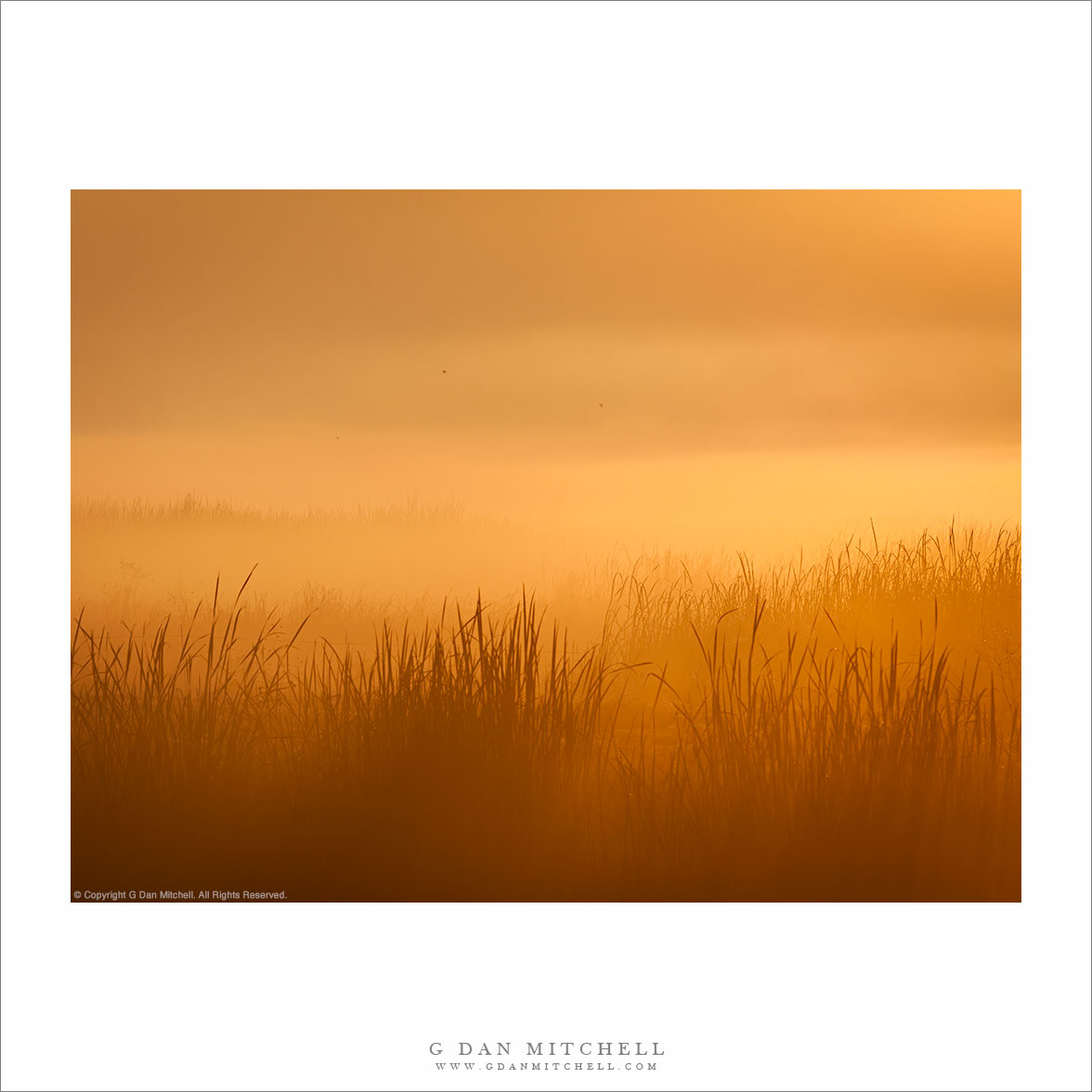
“Marsh Grasses and Fog, Dawn” — Golden dawn light illuminates autumn fog drifting above marshland grasses in California’s Central Valley.
I went to this place to photograph birds – at least that was my excuse. In the past few years I have become passionate about photographing migratory birds in the Great Central Valley of California between late fall and early spring – geese, cranes, herons, ibises, and more. Once you hear the cries of these birds as thousands of them flock together on the ground or in water or, better yet, as they fly overhead, you can become obsessed. In the fall I anticipate their return and watch for early signs. A few weeks ago we managed to find cranes further up the valley, and I knew that the geese wouldn’t be far behind – so this trip was, literally, a “wild goose chase.”
But the truth is a bit more involved. As much as I love the birds, I think that I’m at least as attracted to landscapes where they are found, and to the weather conditions of this season. You might think that a bird photographer would want clear skies and bright light, but I look forward more to fog, clouds, and mist and other kinds of interesting atmosphere. It occurs to me that the birds may partially be my excuse for visiting this landscape. I was expected that it might be clear on this morning, so I was happy (strange photographer!) when I drove into thick fog a few miles from my destination. I arrived just before dawn as the sky was somewhere in that color range between blue and purple and pink, but just barely visible though the murk. I made a few true sunrise photographs that included a barely visible sun behind fog and clouds, then moved on along a gravel road to try to locate the cranes that I could hear. As I came to a right angle turn, the fog stretched beyond the nearby grasses and straight toward the low sun in front of me, thick enough that all details in the distance disappeared (with the exception of a few barely visible birds) into a luminous glow that was almost painfully intense
Leave a comment or question using the form. (If you are reading this on the home page, click the article title to see the full article and the comment form.
During the past few years I have become a big fan of photographing migratory birds in California’s Central Valley, and now that summer is over I’m anxious to get back out there and get to work on this year’s bird photographs. Actually, we made our first bird photography trip out there about a week ago, on the first weekend in November. Our main goal was to find sandhill cranes, since we knew they were here already, but we were also interested in seeing what else might have showed up.
In keeping with my new policy of posting multiple photographs in a single message when I have too many photographs waiting in the queue, this post includes five bird photographs. Enjoy!
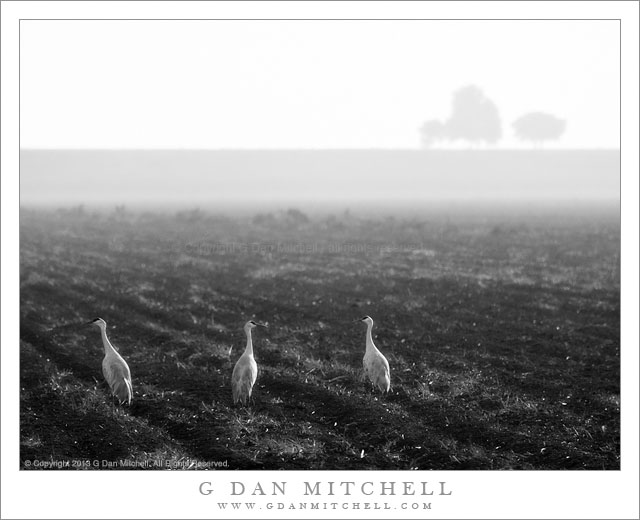
Late in the morning, long after the morning fly out, we were poking around on some rural backroads when we found a lot of sandhill cranes in dormant fields in thinning morning fog. This group thoughtfully posed for me with a distant pair of trees on the horizon.
Three sandhill cranes stand in a dormant Central Valley, California field
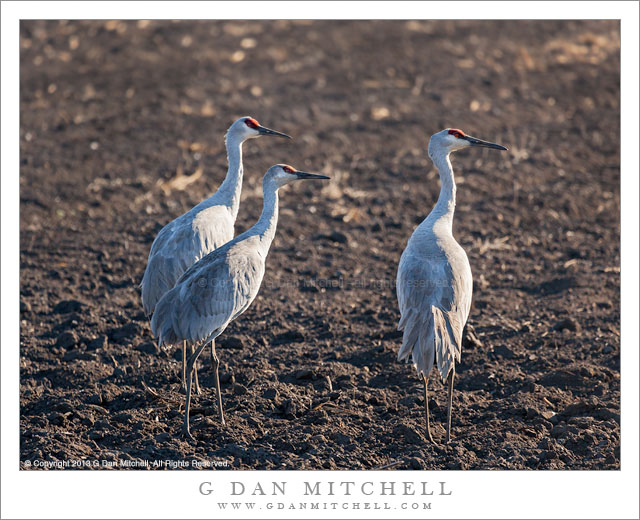
I photographed this group in much the same location as those in the previous photograph. While the cranes seem to collect in large groups near water in the evening and early morning, during the day they are often found more spread out in agricultural areas like this one.
Sandhill cranes land on a Central Valley pond during the evening fly-in
In the evening the cranes do a “fly-in” – where large numbers of them land together in areas around water. When we arrived at this small observation area an hour or so before sunset, there were many birds but no cranes. However, I’ve learned that the sandhill cranes often arrive late, frequently after sunset and sometime when it is becoming rather dark. (One of our most memorable migratory bird encounters occurred at another refuge further south in the valley. We had a great day of photographing birds, beginning very early in the morning and continuing through sunset. As the sun set the bird action began to diminish and it became quite dark. It had been a long, successful day, and we were happy to be finished with this shoot. We were just putting gear away when we began to hear a huge chorus of the easily recognized sound of sandhill cranes coming from out of sight to the southeast. A moment later the sky was filled with the birds – I’ve never seen so many cranes together since then.)
Here the birds began to arrive just a bit earlier. The first groups landed a good distance off, but soon a single large crane settled in on this dry area in front of us and began to produce very large calls, as if to say, “come on down and stop here!” Before long other birds did just that. Here the slow shutter speed allows the winds of the landing birds to blur a bit.
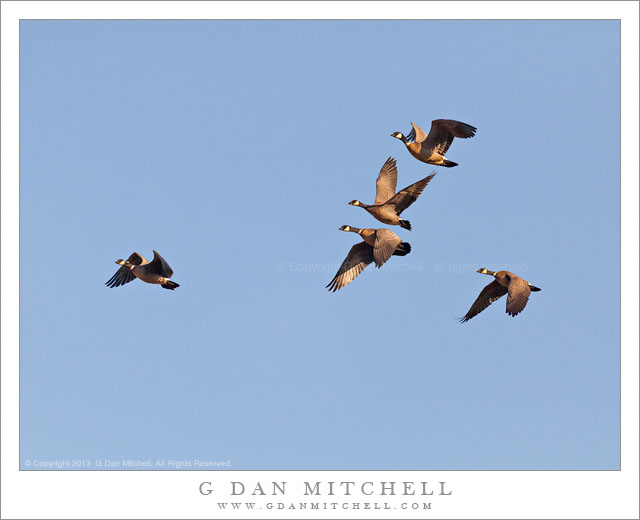
A small group of cackling geese in flight against blue sky over California Central Valley agricultural lands
I have a confession to make, and it is a little embarrassing for a person who is as enthusiastic about photographing birds as I am. Basically, I’m not very good at identifying birds, or at least not good at naming them! (This is an “issue” I’ve always had, and not just with birds. I’m so familiar with certain wild plants that I can tell you exactly what they look like in the wet and dry seasons, when the flowers will appear, and when to find them… but I often cannot name them.) I’m always happy when I can photograph with someone who is better than I at this.
I’m pretty certain these are geese! (Good so far?) I used to think that geese that looked like this were Canadian geese, but when I tried to find photos of these birds online to determine what they were, I kept coming up with “cackling geese.” To make things more confusing – at least for me – I understand that the differences between some Canadian geese and some cackling geese can confuse even the experts. Judging by the size and shape of the bill, the size of the birds, and the pattern and color of feathers, I’m going with this identification until someone shows me differently!
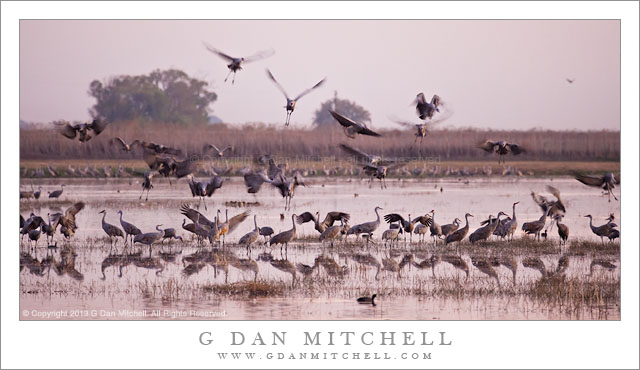
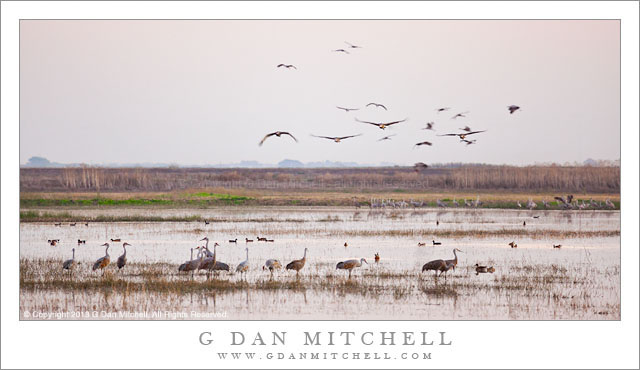
Sandhill cranes settle in to a Central Valley pond during the evening fly-in
This is the same group seen in a photograph earlier in this post, with this photograph being made a bit earlier – clearly the case as there are fewer birds on the ground in this shot, and the color of the sky is less intense. If you look closely about a third of the way in from the left edge of the frame, you may be able to see the larger bird that landed first and was then followed by other later arrivals.
G Dan Mitchell is a California photographer and visual opportunist. His book, “California’s Fall Color: A Photographer’s Guide to Autumn in the Sierra” (Heyday Books) is available directly from him.
Photographer and visual opportunist. Daily photos since 2005, plus articles, reviews, news, and ideas.
Manage Consent
To provide the best experiences, we use technologies like cookies to store and/or access device information. Consenting to these technologies will allow us to process data such as browsing behavior or unique IDs on this site. Not consenting or withdrawing consent, may adversely affect certain features and functions.
Functional
Always active
The technical storage or access is strictly necessary for the legitimate purpose of enabling the use of a specific service explicitly requested by the subscriber or user, or for the sole purpose of carrying out the transmission of a communication over an electronic communications network.
Preferences
The technical storage or access is necessary for the legitimate purpose of storing preferences that are not requested by the subscriber or user.
Statistics
The technical storage or access that is used exclusively for statistical purposes.The technical storage or access that is used exclusively for anonymous statistical purposes. Without a subpoena, voluntary compliance on the part of your Internet Service Provider, or additional records from a third party, information stored or retrieved for this purpose alone cannot usually be used to identify you.
Marketing
The technical storage or access is required to create user profiles to send advertising, or to track the user on a website or across several websites for similar marketing purposes.

 G Dan Mitchell is a California photographer and visual opportunist whose subjects include the Pacific coast, redwood forests, central California oak/grasslands, the Sierra Nevada, California deserts, urban landscapes, night photography, and more.