Images

Moving On: Fujifilm XPro2 to XT5

The XPro is dead! Long live the XPro! That’s not the main subject of this essay, but based on tea-leaf reading and my own experience with the XT5 I think that’s where we are headed. I’ll get to why I think so near the end of this article.

This article is primarily aimed at Fujifilm users (and potential users) considering the retro XPro design versus the recently released (DSLR-style) mirrorless XT5. It is partly about techie camera stuff, but it is also a story about letting go of preconceptions and adapting to something new.

Since some readers may be unfamiliar with the cameras, here’s a quick summary.

XPro2 — The XPro2 is one of three Fujifilm “XPro” bodies — originally the XPro1 , the subsequent XPro2, and the most recent XPro3. These are rangefinder-style cameras with retro appeal due to their similarity to classic rangefinder film cameras and the inclusion of full manual controls. A key feature is the hybrid viewfinder system combining an old-school optical viewfinder (OVF) and a modern electronic viewfinder (EVF). The XPro2 has a 24MP APS-C sensor, while the newer XPro3 has a 26MP sensor.

XT5 — The XT5 is the most recent (as of this writing) in Fujifilm’s series of XT cameras that combine a small DSLR-like mirrorless body with a full set of manual controls, similar to what is found on the XPro bodies. This new camera uses an updated 40MP sensor — previous models (XT1-4) used 16MP, 24MP, and most recently 26MP sensors.
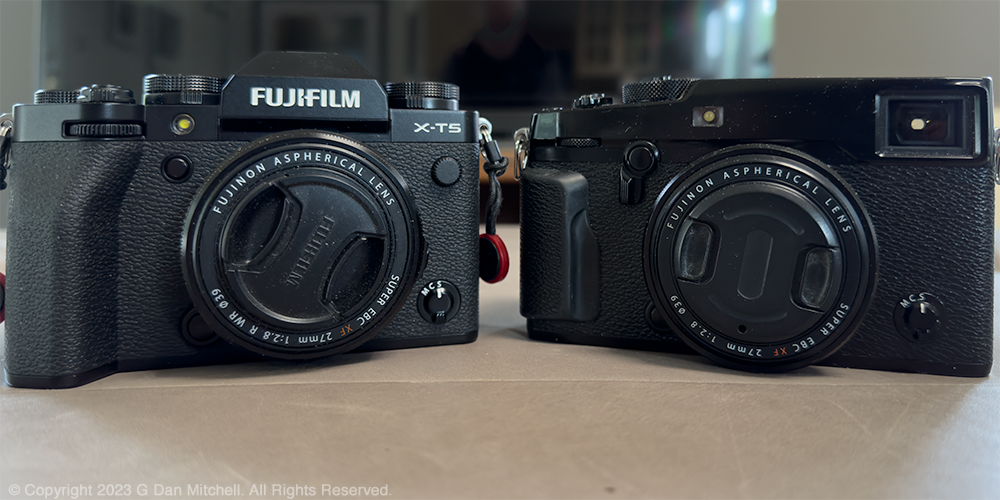
Fujifilm XT5 (l) and XPro2 (r) with Fujifilm 27mm f/2.8 lenses.

Because virtually all models in a generation of Fujifilm cameras use the same sensor, Fujfilm owners are more attentive to other functional differences between them. That is why I’ll focus on those things and say little about the sensor.

Continue reading Moving On: Fujifilm XPro2 to XT5
Sunrise, Wetlands

Sunrise, Wetlands
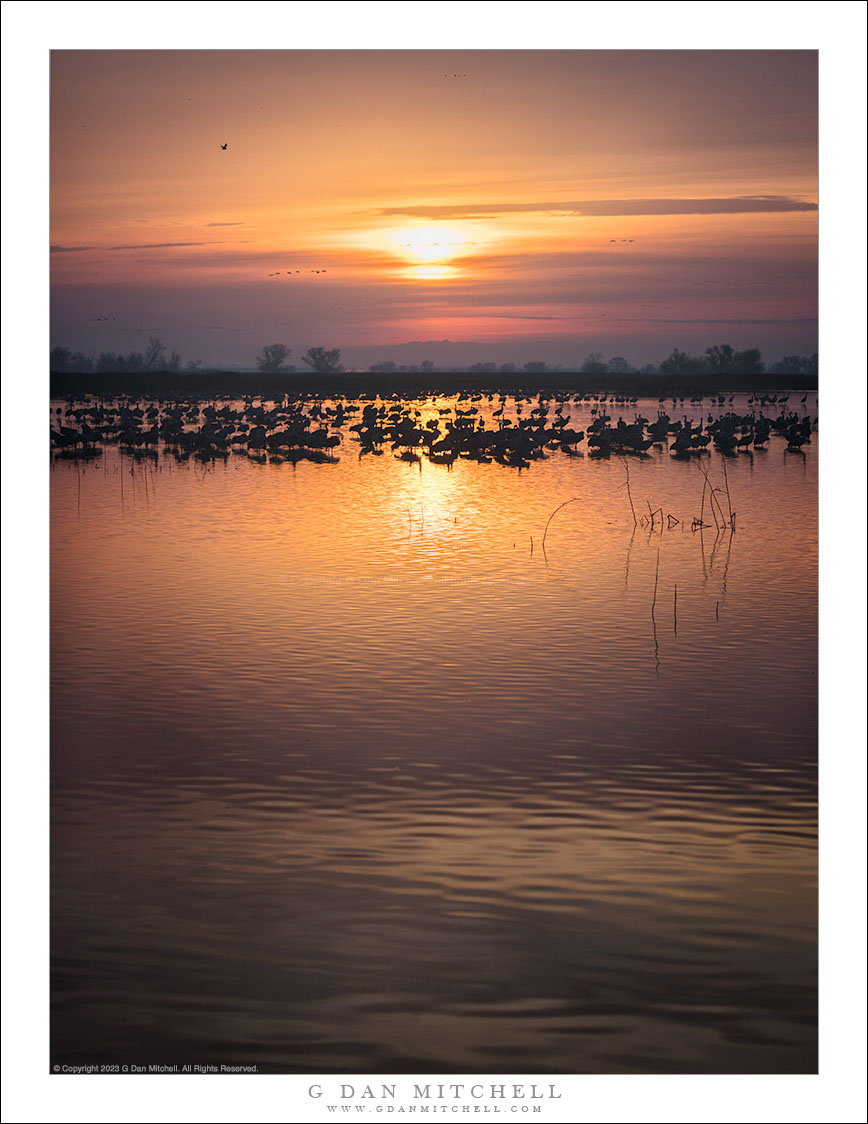
Winter sun rising through morning clouds is reflected in a Central Valley wetlands pond.

Sunrise, Wetlands. © Copyright 2023 G Dan Mitchell.

Winter sun rising through morning clouds is reflected in a Central Valley wetlands pond.

This is a photograph from the same morning that produced another sunrise photograph I recently shared — one with the sun a bit lower and cranes flying above. Usually I might be disappointed to find morning clouds above the distant Sierra Nevada, but this time they were just thick/thin enough to be an advantage. The muted the intensity of the direct sun. I made this photograph just as the sun moved above a thicker band of clouds.

The foreground expanse of water obviously reflects the sunrise light and colors, but the closest portions reflect other clouds higher in the sky and less colorful. In the middle a large group of sandhill cranes stands in the shallow water.


G Dan Mitchell is a California photographer and visual opportunist. His book, “California’s Fall Color: A Photographer’s Guide to Autumn in the Sierra” is available from Heyday Books, Amazon, and directly from G Dan Mitchell.

Blog | About | Twitter | Flickr | FacebookEmail

Links to Articles, Sales and Licensing, my Sierra Nevada Fall Color book, Contact Information.

Scroll down to leave a comment or question. (Click this post’s title first if you are viewing on the home page.)


All media © Copyright G Dan Mitchell and others as indicated. Any use requires advance permission from G Dan Mitchell.

Winter Landscape, Geese and Cranes

Winter Landscape, Geese and Cranes
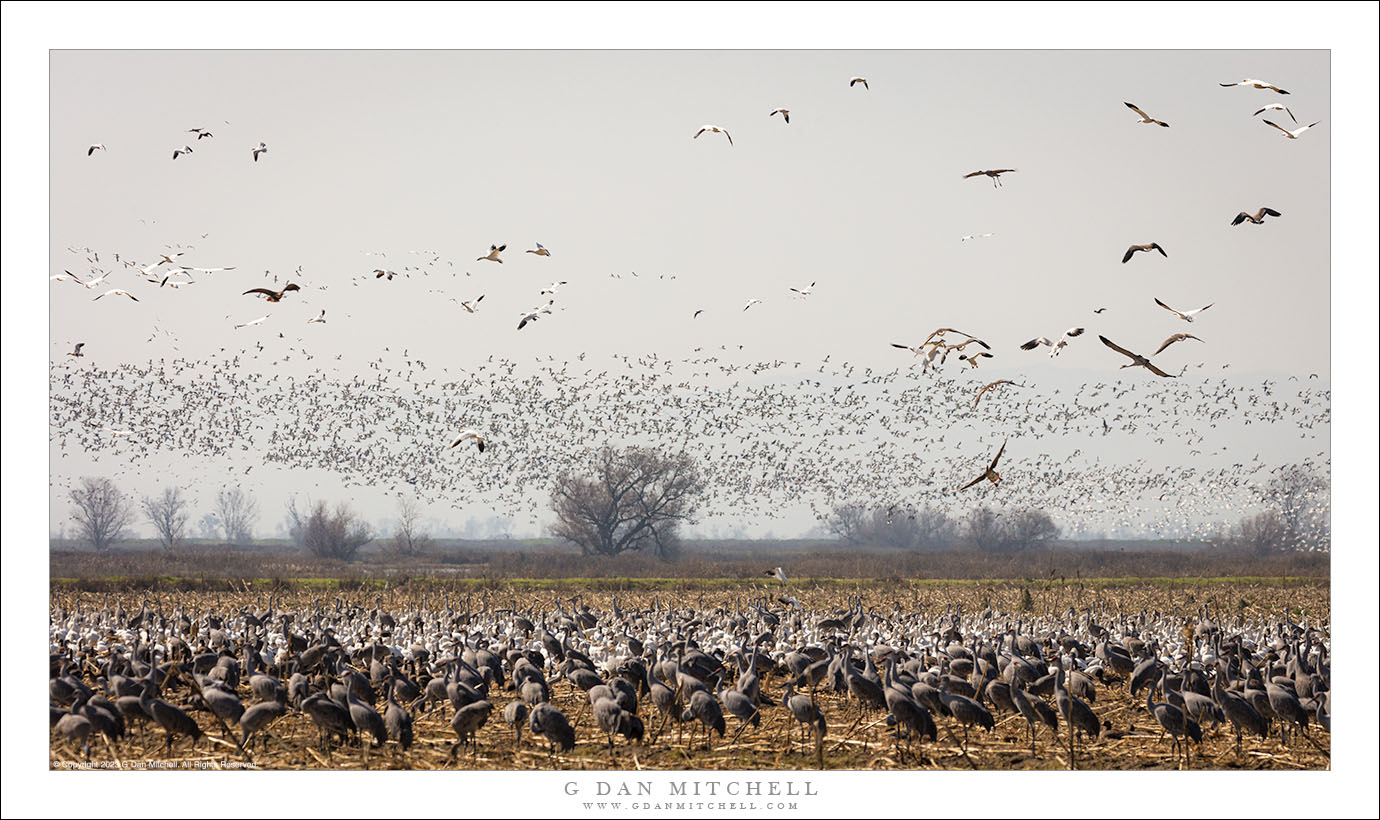
Flocks of sandhill cranes and various geese in the winter landscape of California’s Central Valley.

Winter Landscape, Geese and Cranes. © Copyright 2023 G Dan Mitchell.

Flocks of sandhill cranes and various geese in the winter landscape of California’s Central Valley.

While I anticipate eagerly the start of the migratory bird “season” in California every fall, the most exciting time to see and photograph the spectacle is in weeks before the geese depart. By this point, it seems the birds are well fed and — from my subjective perspective — getting restless about their imminent departure. During the day I often find huge mixed flocks collected together and very active.

The primary activity seems to be feeding — which makes sense, given the monumental migration they will soon undertake. But they also seem to have a hair-trigger response to anything that concerns them — a raptor flying nearby, a coyote on the prowl, an airplane passing overhead. And when this happens they take off in huge groups, spiral around for a few minutes, land, and regroup. In this photograph a flock of geese is beginning one of these brief aerial forays.


G Dan Mitchell is a California photographer and visual opportunist. His book, “California’s Fall Color: A Photographer’s Guide to Autumn in the Sierra” is available from Heyday Books, Amazon, and directly from G Dan Mitchell.

Blog | About | Twitter | Flickr | FacebookEmail

Links to Articles, Sales and Licensing, my Sierra Nevada Fall Color book, Contact Information.

Scroll down to leave a comment or question. (Click this post’s title first if you are viewing on the home page.)


All media © Copyright G Dan Mitchell and others as indicated. Any use requires advance permission from G Dan Mitchell.

Geese in Motion

Geese in Motion
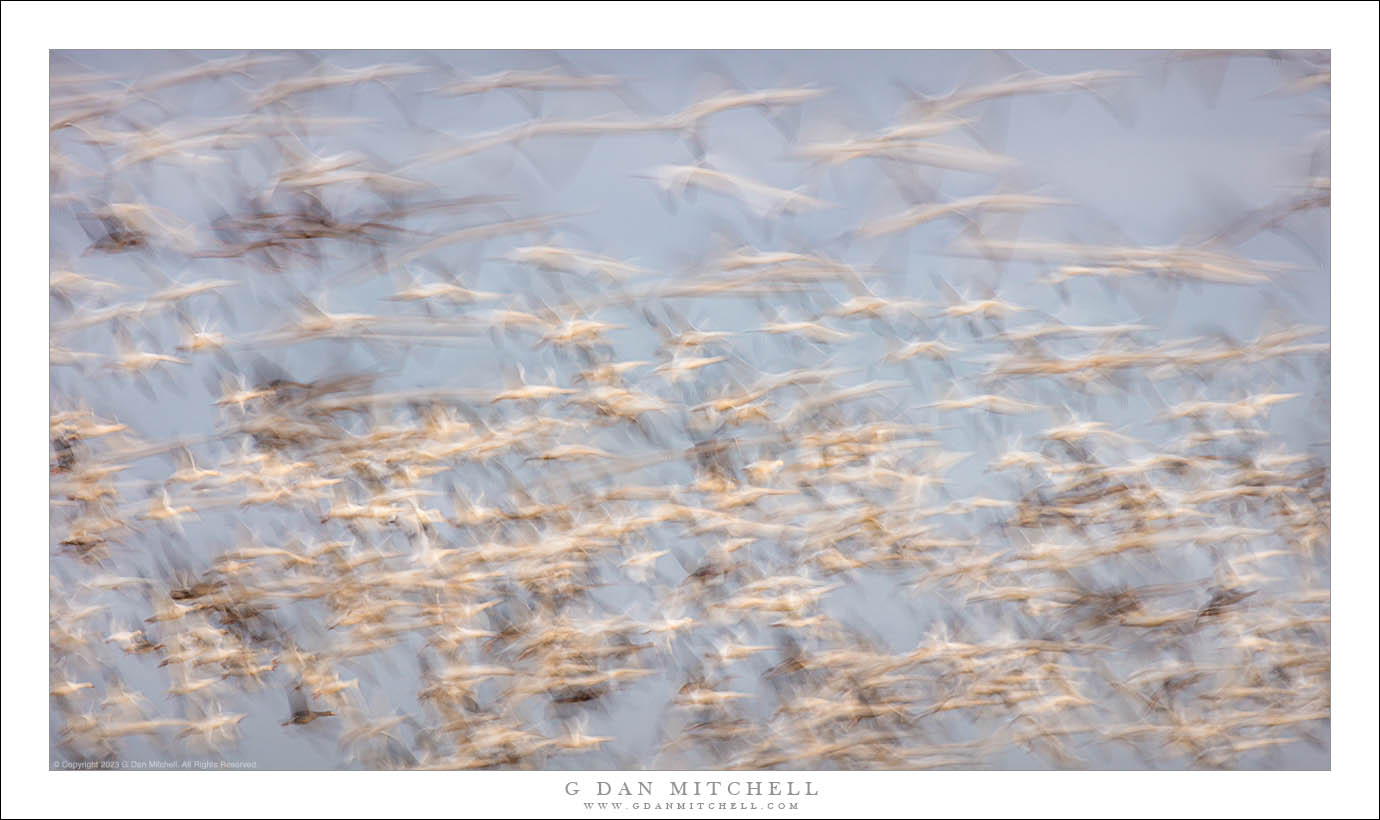
Long exposure photograph of an airborne flock of migratory geese.

Geese in Motion. © Copyright 2023 G Dan Mitchell.

Long exposure photograph of an airborne flock of migratory geese.

A day of my wildlife photography typically begins and ends in darkness — I arrive and set up before sunrise and “don’t pack until it’s black.” During the earliest and latest times there’s often barely enough to light to make photographs, especially with the long lenses that I favor for this subject. In the early morning I often just crank up the ISO and do the best I can. But in the evening I frequently go the opposite direction in my final shots of the day — lowering the ISO and intentionally working with rather long exposures that allow the birds’ motion to blur.

Given the popularity of sharp pictures of birds — something that I often aspire to, as well — this might seem counterintuitive. But it occurred to me some years ago that the mass of blurred motion actually better evokes the wild seeming-chaos of these mass flights. They are not so much about any particular bird as they are about the half-seen motion of the group.


G Dan Mitchell is a California photographer and visual opportunist. His book, “California’s Fall Color: A Photographer’s Guide to Autumn in the Sierra” is available from Heyday Books, Amazon, and directly from G Dan Mitchell.

Blog | About | Twitter | Flickr | FacebookEmail

Links to Articles, Sales and Licensing, my Sierra Nevada Fall Color book, Contact Information.

Scroll down to leave a comment or question. (Click this post’s title first if you are viewing on the home page.)


All media © Copyright G Dan Mitchell and others as indicated. Any use requires advance permission from G Dan Mitchell.