
Images

Winter Trees and Grass

Winter Trees and Grass
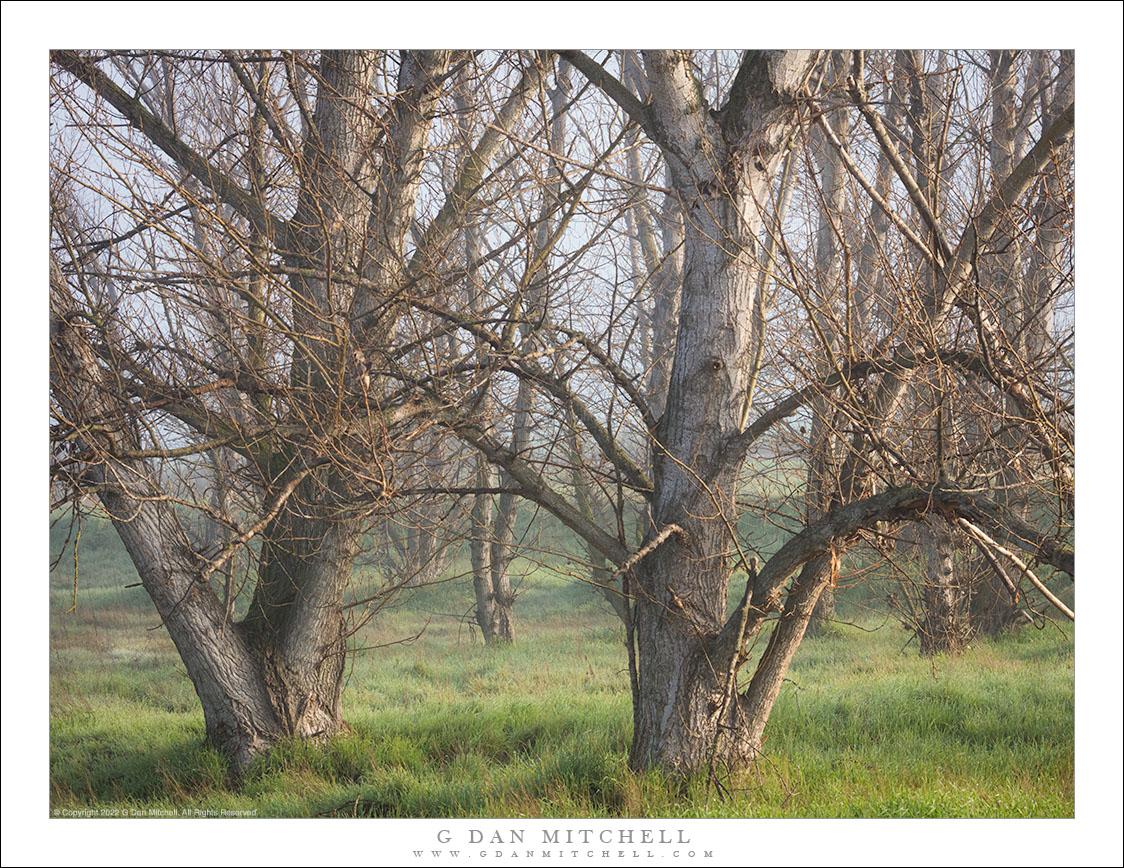
Winter grass beneath a thicket of dormant trees on a foggy morning in the Central Valley.

Winter Trees and Grass. © Copyright 2022 G Dan Mitchell – all rights reserved.

Winter grass beneath a thicket of dormant trees on a foggy morning in the Central Valley.

This photograph comes from a particular moment of transition on a winter tule fog day in California’s Central Valley, the point when the nearly impenetrable gray blanket of the fog begins to thin, the view opens a bit, and the light becomes warmer and slightly directional. A half hour earlier this scene would have been almost devoid of color, and many of the trees would have been nearly obscured by fog. (An hour later the scene might be overly bright and harshly lit.)

This spot holds several things that characterize the the Valley at this time of year: the fog-to-sunlight transition, of course, but also the dormant trees along the edge of farmland and the very green newly sprouted winter grass. That grass is a distinctly California thing that often surprises visitors from colder climates, where the seasonal cycle is almost reversed. A spot like this will be dry and brown in summer and fall, but winter rains trigger our”impossible green” season as the plants respond to the moisture.


G Dan Mitchell is a California photographer and visual opportunist. His book, “California’s Fall Color: A Photographer’s Guide to Autumn in the Sierra” is available from Heyday Books, Amazon, and directly from G Dan Mitchell.

Blog | About | Flickr | FacebookEmail

Links to Articles, Sales and Licensing, my Sierra Nevada Fall Color book, Contact Information.

Scroll down to leave a comment or question. (Click this post’s title first if you are viewing on the home page.)


All media © Copyright G Dan Mitchell and others as indicated. Any use requires advance permission from G Dan Mitchell.
Creosote, Shadowed Dunes

Creosote, Shadowed Dunes
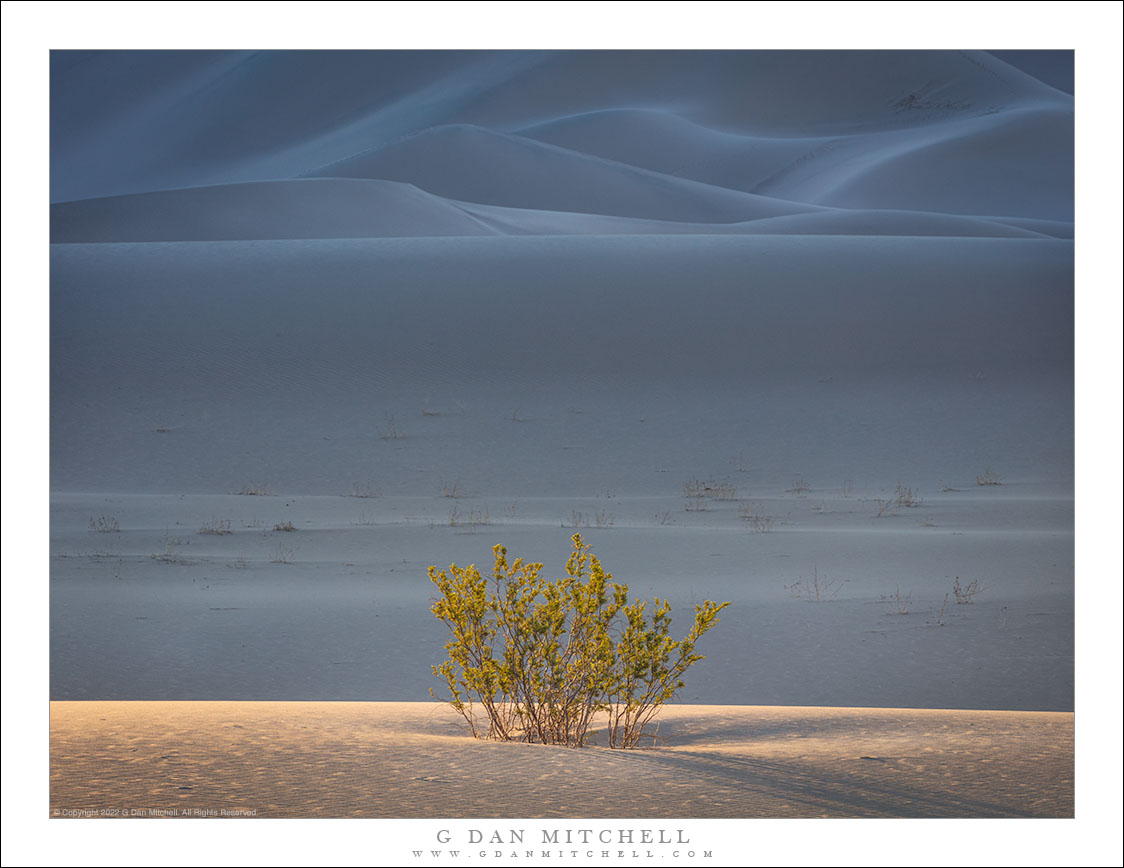
Creosote plant in sunlight, backed by shadowed sand dunes.

Creosote, Shadowed Dunes. © Copyright 2022 G Dan Mitchell – all rights reserved.

Creosote plant in sunlight, backed by shadowed sand dunes.

Sand dune landscapes provide all sorts of surprises. After seeing many photographs of impressive blowing sand and dust storms, you might think that is the norm — but most of the time the dunes are quiet and still. In the daytime there often doesn’t seem to be a lot going on in a visual sense. But go there at the earliest and latest moments of the day, and the light changes so quickly that it is almost impossible to keep up. Here there was only a brief moment when the soft light fell on the dune and the creosote plant and left the further dunes in soft, cool-toned light.

It is common to think of landscape photography as a slow and deliberate process. In fact, at times and with certain subjects it can be, and the photographer may have a lot of time to look and contemplate. But in this edge-of-day light things happen so quickly that photography can become a kind of action sport. The light does something “over there” for a brief moment, but when I look up something new is happening elsewhere. I turn my attention, quickly make a photograph or two, and right away some new combination of form and light emerges. And this whole dynamic show itself only lasts for a short time between midday bright (and often harsh) light and darkness.


G Dan Mitchell is a California photographer and visual opportunist. His book, “California’s Fall Color: A Photographer’s Guide to Autumn in the Sierra” is available from Heyday Books, Amazon, and directly from G Dan Mitchell.

Blog | About | Flickr | FacebookEmail

Links to Articles, Sales and Licensing, my Sierra Nevada Fall Color book, Contact Information.

Scroll down to leave a comment or question. (Click this post’s title first if you are viewing on the home page.)


All media © Copyright G Dan Mitchell and others as indicated. Any use requires advance permission from G Dan Mitchell.
Winter Light, San Luis Reservoir

Winter Light, San Luis Reservoir
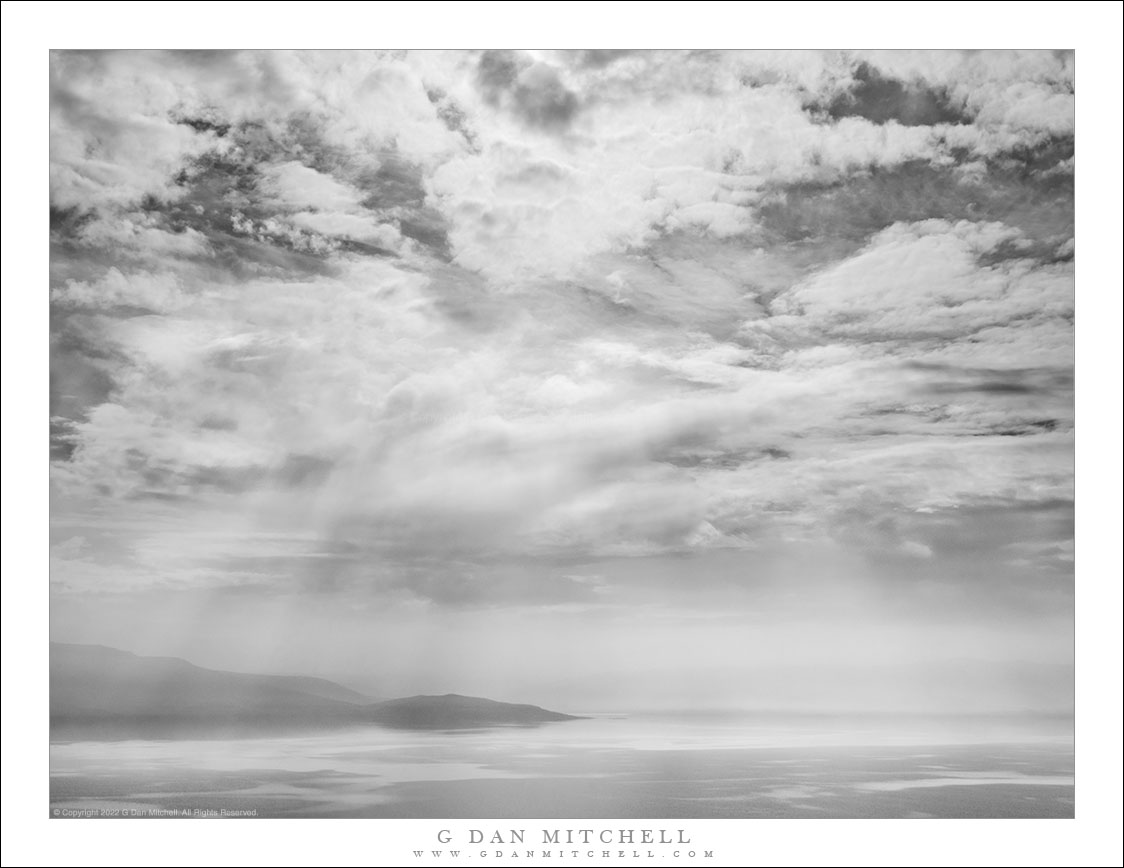
High clouds, fog, and brilliant light on a winter day over San Luis Reservoir, California.

Winter Light, San Luis Reservoir. © Copyright 2022 G Dan Mitchell – all rights reserved.

High clouds, fog, and brilliant light on a winter day over San Luis Reservoir, California.

Because it lies between the southern San Francisco Bay Area and California’s Great Central Valley — and on the route to many interesting places ranging from the Sierra to Southern California and Death Valley — I have driven past the San Luis Reservoir probably hundreds of times over the years. (I’m old enough to barely recall the area before there was a reservoir, from trips when I was a young child.) Being just another part of the system to transport water in the state, I hardly think of it as one of California’s great scenic wonders.

But in the right conditions and the right light, it becomes difficult to ignore it as a landscape subject. The reservoir is huge and it is surrounded on three sides by mountains. Because of the expansive scale, light can reflect off its surface in ways that mimic what I sometimes see along the Pacific Ocean coast. It also picks up the winter atmosphere, with its fogs and mists, from the Central Valley. And because the road runs more or less along its northern shore, all of this is frequently backlit, as in this photograph that I made in the middle of the day while returning from the Central Valley.


G Dan Mitchell is a California photographer and visual opportunist. His book, “California’s Fall Color: A Photographer’s Guide to Autumn in the Sierra” is available from Heyday Books, Amazon, and directly from G Dan Mitchell.

Blog | About | Flickr | FacebookEmail

Links to Articles, Sales and Licensing, my Sierra Nevada Fall Color book, Contact Information.

Scroll down to leave a comment or question. (Click this post’s title first if you are viewing on the home page.)


All media © Copyright G Dan Mitchell and others as indicated. Any use requires advance permission from G Dan Mitchell.
Interrupted Dune

Interrupted Dune
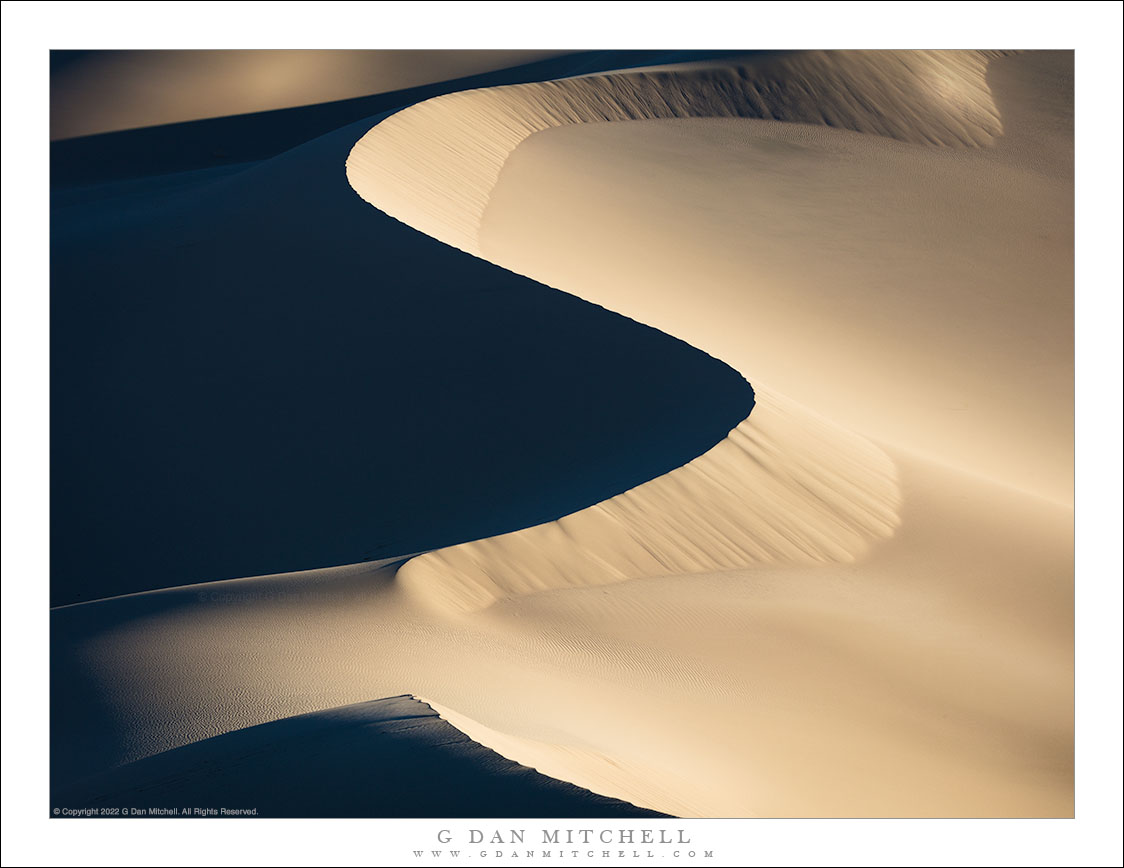
Interrupted curve of sand at a Death Valley dune.

Interrupted Dune. © Copyright 2022 G Dan Mitchell – all rights reserved.

Interrupted curve of sand at a Death Valley dune.

Sand dunes seem to have very distinct personalities, at least from what I’ve observed in Death Valley National Park and nearby areas. Perhaps counterintuitively, their forms are much more stable than we might imagine, and the changes are mostly superficial. Their unique qualities come from their orientation to the surrounding landscape, how the light strikes them, their tendency (necessarily quite high!) to be in windy areas, the materials that form the sand, the amount of plant life in and around them, and small but persistent features that they hold — peaks, ridges, valleys, twists and turns, hollows, and more.

This was my first visit to the dunes in this photograph. Based on their orientation and the distance to and height of nearby mountains, I had some idea of what the light might be like before I set foot on them. But until I got there I had no idea of the smaller features that could be revealed by changing light. I photographed this beautiful curving pattern in the morning, shortly after the sunlight arrived over the top of a nearby ridge and slanted across the dunes to create the yin-yang pattern of light and shadow along a curve that was surprisingly broken near its lower end.


G Dan Mitchell is a California photographer and visual opportunist. His book, “California’s Fall Color: A Photographer’s Guide to Autumn in the Sierra” is available from Heyday Books, Amazon, and directly from G Dan Mitchell.

Blog | About | Flickr | FacebookEmail

Links to Articles, Sales and Licensing, my Sierra Nevada Fall Color book, Contact Information.

Scroll down to leave a comment or question. (Click this post’s title first if you are viewing on the home page.)


All media © Copyright G Dan Mitchell and others as indicated. Any use requires advance permission from G Dan Mitchell.