G Dan Mitchell, photographer and visual opportunist focusing on the Pacific coast, the Sierra Nevada, redwood forests, California oak/grasslands, California deserts, urban landscapes, night photography and more. Posting daily photographs since 2005, along with articles, reviews, news, and ideas.
Photographer Mark Citret is presenting a free public talk on his work at De Anza College in mid-November. I invite San Francisco Bay Area photographers and photography fans to join me in attending!
Wednesday, November 16
7:00 p.m. – 9:00 p.m.
Room A-11
De Anza College
Cupertino
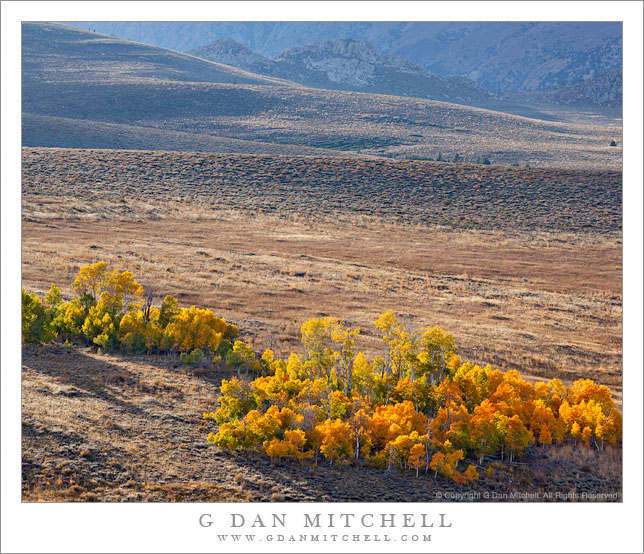
Late afternoon sun backlights the brilliant fall colors of aspen groves along the eastern slope of the Sierra Nevada near Conway Summit.
This is one of what is likely to be a series of very gaudy and colorful photographs of autumn aspen color, much of it photographed at Conway Summit along highway 395 just north of Lee Vining and Mono Lake. Keep your sunglasses handy!
If you happen to arrive at the Conway Summit area at the right point in the fall color season, you can be treated to an astonishingly large and brilliant show of aspen color. (It isn’t a sure bet though. Some years it is not nearly as spectacular. ) This year the trees seemed to turn quite suddenly. A week earlier there had been a lot of very green trees at this elevation along the east side of the Sierra, and many of us expected that the most striking colors would not come until as much as a week later. But nature wasn’t listening, and one week after I had seen so much green, the aspens all along the eastern escarpment of the range were turning golden and many other shade, frequently all the way down to the level of Owens Valley.
After shooting in the early morning out in Owens Vally and then hiking up to Parsons Lake in the middle of the day, I finally made my way up north to Conway Summit just before what I regard as the ideal time to photograph aspen color here, namely during the last hour or so before the sun drops below the peaks of the Sierra to the west. During this period the trees are back- and side-lit in very dramatic ways. While shooting almost directly into the sun can be tricky, the backlit trees really light up. At first I was a bit concerned when I arrived since clouds over the crest threatened to end the light show early, and they actually did interfere at times. But they also broke up the light a bit and provided a combination of ever-changing light and shadow patterns. One moment the light would strike one area and I would shoot in that direction. A moment later that light was gone, but shortly it would appear in another spot – and I’d swivel the camera around and work that subject for a moment.
This little pair of groves is one that I’ve watched and photographed for several years. I like the way that it stands apart from the much larger main groves and has the plain grass and sagebrush covered hills as background. I made a series of exposures of this subject, and in this one the light crossing from left to right not only struck the colorful trees but also lit up some of the gentle ridges of the slopes beyond.
G Dan Mitchell is a California photographer and visual opportunist. His book, “California’s Fall Color: A Photographer’s Guide to Autumn in the Sierra” is available from Heyday Books and Amazon.
“Sierra Wave Clouds Above Owens Valley, Dawn”— Sierra wave clouds building at dawn are reflected in the waters of an Owens Valley lake.
On this morning I was up well before dawn – I checked out of my motel in Bishop, California and was on the road while it was still dark, with a semi-plan of photographing aspen trees around dawn up in the northern portion of the June Lakes Loop. As I headed north out of Bishop and through Round Valley, the very first light arrived and I saw the dim outlines of Sierra wave clouds forming over and just east of the crest. Now, this was an interesting development!
As I continued north and the light increased, the clouds began to interest me more than the possibility of photographing more aspens – I could do that later, but such clouds are unpredictable and transitory. I could see that subtle color was beginning to appear along the edges of the clouds even though it was not yet sunrise, and I decided that I needed to find some landscape feature – almost any would do! – that could serve as a foil to these clouds so that I could photograph them as they began to pick up sunrise color.
A week earlier I had photographed at some small lakes out in Owens Valley, and it occurred to me that if I could get there in time that they might reflect the clouds nicely, though I was a bit concerned about how the lake and the mountains and the clouds would actually align. But not having any better ideas and having very little time, I decided to make the lake my goal and without much further thought took the turnoff, parked my car near the largest lake, grabbed my gear, and headed across the sage brush landscape to the shore of the lake. My initial thought that I might be able to include the Sierra range in the image with the clouds clearly wasn’t going to work due to their relative positions, so I circled a bit further around the shore of the lake and instead composed a scene that excluded all but the tiniest bit of the peaks of the Sierra.
(Basic EXIF data may be available by “mousing over” large images in posts when this page is viewed on the web. Leave a comment if you want to know more.)
Aspen trees in peak color at Conway Summit along highway 395 in the eastern Sierra Nevada.
I isolated this small bit of near-psychedelic color from the extensive aspen groves at Conway Summit, along highway 395 just north of Lee Vining and Mono Lake along the eastern edge of the Sierra Nevada range. When I visited the grove this past weekend the colors seemed to be essentially at their peak with alternating rows of red, orange, gold, and even a few lime green trees marching up the slopes toward the Dunderberg area high above.
If you hit it at the right moment, the aspen color at this location is second to none, and a bonus for many is that it is so accessible, being right alongside the highway. Brilliant colors can occur on both sides of the summit, but those on the north side seem to me to be more varied, and it is a bit easier and safer to find a place to stop alongside the road.
The lighting during my visit was “interesting” – which often means good but with some challenges. From my point of view, the best light at Conway Summit, at least when it comes to photographing aspen color, occurs fairly late in the afternoon when the sun gets low in the sky and can backlight the groves of trees. However, because of the backdrop of Sierra Nevada peaks the interval of good light can be short – and it is distinctly before actual sunset. The “interesting” element during this visit was that clouds were building over the crest. This produces some spectacular sky conditions at times, but it also cast shadows across the trees that dulled the colors and lowered contrast. Now a bit of this can be a good thing, and too much backlight can be a bit difficult to handle. By scoping out perhaps three of four possible compositions from my position, I could wait until the “good light” hit one or another of them, swing the camera around in that direction, and work quickly while the light lasted. For this detail shot of a colorful section of the aspen groves just below my position I had what can perhaps be the very best light for such subjects – a bit of directional light from behind filtered through clouds.
(Basic EXIF data may be available by “mousing over” large images in posts when this page is viewed on the web. Leave a comment if you want to know more.)
Photographer and visual opportunist. Daily photos since 2005, plus articles, reviews, news, and ideas.
Manage Consent
To provide the best experiences, we use technologies like cookies to store and/or access device information. Consenting to these technologies will allow us to process data such as browsing behavior or unique IDs on this site. Not consenting or withdrawing consent, may adversely affect certain features and functions.
Functional
Always active
The technical storage or access is strictly necessary for the legitimate purpose of enabling the use of a specific service explicitly requested by the subscriber or user, or for the sole purpose of carrying out the transmission of a communication over an electronic communications network.
Preferences
The technical storage or access is necessary for the legitimate purpose of storing preferences that are not requested by the subscriber or user.
Statistics
The technical storage or access that is used exclusively for statistical purposes.The technical storage or access that is used exclusively for anonymous statistical purposes. Without a subpoena, voluntary compliance on the part of your Internet Service Provider, or additional records from a third party, information stored or retrieved for this purpose alone cannot usually be used to identify you.
Marketing
The technical storage or access is required to create user profiles to send advertising, or to track the user on a website or across several websites for similar marketing purposes.