
Love Window, China Camp

Love Window, China Camp

Love Window, China Camp. China Camp, California. January 6, 2013. © Copyright 2013 G Dan Mitchell – all rights reserved.

Opaque window and door of a weathered wooden building at China Camp, California

There are any number of places with name “China Camp” (or similar variations), but this one is located along the shores of the northern San Francisco Bay. I’m not an expert on the history of the place by any means, but I understand that the village was established by immigrants from China in the 1800s and was, over a century ago, a thriving village of several hundred people who focused on harvesting shrimp. Today it is part of a California State park and can be a very quiet and peaceful place.

I visited for the first time this winter, along with a number of other photographers who went there as part of a “photo walk.” After photographing some nearby landscape subjects I walked over to the remaining buildings from the old village and spent some time poking around the area looking for photographs. While I think of this as a sort of ghost town, unlike some other such places in California, this one includes some modern improvements and restoration and even some museum facilities. I was intrigued by some windows and doors on the exterior of this wooden building, including this four-pane window on which someone had inscribed the word “love.”

G Dan Mitchell is a California photographer and visual opportunist whose subjects include the Pacific coast, redwood forests, central California oak/grasslands, the Sierra Nevada, California deserts, urban landscapes, night photography, and more.
Blog | About | Flickr | Twitter | FacebookGoogle+ | 500px.com | LinkedIn | Email

Text, photographs, and other media are © Copyright G Dan Mitchell (or others when indicated) and are not in the public domain and may not be used on websites, blogs, or in other media without advance permission from G Dan Mitchell.
Stairway and Broken Windows

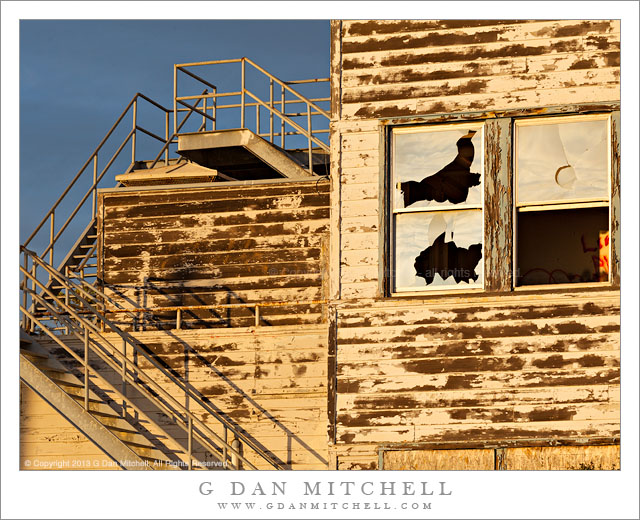
Stairway and Broken Windows

Stairway and Broken Windows. Near Vallejo, California. March 16, 2013. © Copyright 2013 G Dan Mitchell – all rights reserved.

Exterior staircase, broken windows, and peeling paint on the wooden side panels of an abandoned building near Vallejo, California

I had joined up with a group of night photographers that I often shoot with on this evening, and we were sitting around in the late afternoon hours sharing pizza when someone made the radical suggestion of going out to shoot before darkness arrived! In the past, this has been just about the only group of photographers I’ve ever met who would stay inside during a San Francisco Bay area golden hour and sunset period, anxious for the light to go away so that shooting could begin! But on this evening, the radical concept of shooting in the daylight must have seemed so innovative that quite a few of us headed out to find either landscape-style shots over the San Francisco Bay or else abandoned and dilapidated industrial subjects nearby. I opted for the latter, and hoping to cover a bit more ground before dark, rather than walking nearby I drove, trying to figure out where I wanted to be in the fading light.

I ended up near this lonely, abandoned and partially destroyed building that has been left to vandals, who seem to be doing their best to accelerate the natural destructive forces that eventually take such buildings. Many windows are broken, there is spray paint in many places, and the exterior of the building is tremendously weathered and worn. Just a few minutes before sunset I made a series of exposures of this building, using a long lens to isolate smaller sections of the building. The sunset light turned the otherwise-dull building a much more intense shade of brown/yellow, and the brighter sky and clouds over San Francisco Bay are reflected in the broken windows. Soon after I finished shooting, the sun set, and I headed back to where my nocturnal friends awaited, and we headed out to photograph in the night.

G Dan Mitchell is a California photographer and visual opportunist whose subjects include the Pacific coast, redwood forests, central California oak/grasslands, the Sierra Nevada, California deserts, urban landscapes, night photography, and more.
Blog | About | Flickr | Twitter | FacebookGoogle+ | 500px.com | LinkedIn | Email

Text, photographs, and other media are © Copyright G Dan Mitchell (or others when indicated) and are not in the public domain and may not be used on websites, blogs, or in other media without advance permission from G Dan Mitchell.
Geese in Dusk Light

Geese in Dusk Light
Geese in Dusk Light

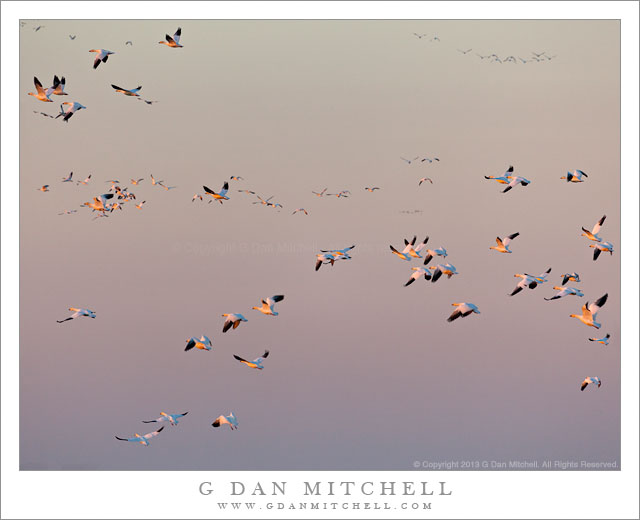
Geese in Dusk Light. San Joaquin Valley, California. January 1, 2013. © Copyright 2013 G Dan Mitchell – all rights reserved.

Geese take off into the dusk sky above marshes, San Joaquin Valley, California

Yes. More geese. I photographed these on my New Year’s Day visit to the San Joaquin Valley with a group of fellow photographers and other folks with an artistic bent. We were out there to join the migratory birds in greeting the first sunrise of 2013. Joining us were many Ross’s geese, a heron or two, some egrets, thousands of geese, one flock of white pelicans, quite a large contingent of cranes, the odd coyote, and many others. We arrived early, photographed all morning, broke for a movie in a nearby town during the middle of the day, and returned to photograph until dark.

It is an interesting though challenging atmosphere on this day, one of those days that isn’t remarkable for extremes of weather or light – thick fog, brilliant sunrise light, etc. Instead, it was sort of gray in the morning with light fog and mostly very subtle colors at dawn. It never fully cleared, but near sunset the sky turned interesting colors of pink and purple and there was a last-minute bit of colorful light, as seen on the birds in this photograph. They had been settled in on a pond, but as the day ended they took off on the evening “fly out” to some other place. The lifted off in groups ranging from a few birds to a few hundred at a time and then mostly headed north or northwest. In this photo there is a close group that has just taken flight but beyond there are several other groups at varying distance that had left moments earlier. The result, as often seems to be the case with geese, is a sort of organized chaos. There are various ways to try to photograph this, but here I was trying to find instantaneous composition in which the various groups of birds aligned themselves, both within their groups and among the separate groups, in interesting ways.

G Dan Mitchell is a California photographer and visual opportunist whose subjects include the Pacific coast, redwood forests, central California oak/grasslands, the Sierra Nevada, California deserts, urban landscapes, night photography, and more.
Blog | About | Flickr | Twitter | FacebookGoogle+ | 500px.com | LinkedIn | Email

Text, photographs, and other media are © Copyright G Dan Mitchell (or others when indicated) and are not in the public domain and may not be used on websites, blogs, or in other media without advance permission from G Dan Mitchell.

Fujifilm X-E1: From DSLR to Mirrorless

(March 2014: Fujifilm has continued to update the X-trans cameras since I acquired my X-E1 in the spring of 2013. While this article refers specifically to that model—since updated to the similar but improved X-E2—the experiences recounted here should still be relevant to others looking at the Fujifilm system. For broader and updated coverage also see Taking Stock of the Fujifilm X-E1, X-E2, X-T1 Mirrorless Cameras, and check out links to the Fujifilm line of cameras at lenses at the end of this article.)

Recently I have read a lot of good things about some of the new “rangefinder-style” (a useful though not completely accurate description) or “mirrorless” cameras from Fujifilm. As a result I acquired the Fujifilm X-E1 with a few lenses, and I have now had the chance to start using it a bit. I thought I would share some initial thoughts and impressions now, with more thorough reports later on as I use the camera and lenses more.

Background

I am primarily a confirmed full-frame DSLR photographer – I rely on the versatility of these cameras, their speed, the availability of a wide variety of lenses and other accessories, and especially on the excellent image quality that they can produce. However, one downside of this equipment is that it is most certainly not small nor light, especially once you add some (or all!) of the lenses I like to use.

While much of my photography requires what the full frame DSLR system provides, sometimes I have wished for high-quality but smaller and lighter equipment – for example when doing certain kinds of street photography, for certain types of travel, or when I just want to have a camera with me when I’m out and about. I have used a few of the smaller high end point & shoot style cameras ranging from the Canon S95 back to the old Canon Pro One, and I have looked at quite a few others.

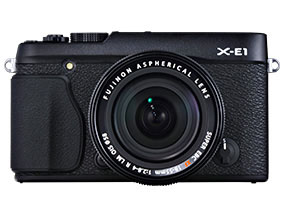
I have heard enthusiastic reports on various cameras, including a number of the four-thirds cameras, but I decided that I did not want to consider a camera with a sensor smaller than APS-C, the size of the “cropped sensor” DSLRs. For my intended use, that level of quality – in terms of resolution, useful range of apertures, low-light performance, etc. – will work quite well. Recently several mirrorless cameras with such sensors have been introduced, and they all have their attractions. What led me to settle on the Fujifilm cameras was the combination of an expanding selection of excellent lenses, their somewhat “retro” design that provides hardware knobs and buttons to control settings, and encouraging reports on image quality.Fujifilm X-E1 Mirrorless Camera

I considered the more expensive Fujifilm X-Pro-1, with its hybrid optical-electronic viewfinder, but decided that for my intended use the electronic viewfinder (EVF) of the X-E1 would likely work. (As I read reports from other users, quite a few reported that they used the optical viewfinder option of the Pro-1 less than they expected.) I did not consider the reportedly-excellent X100 since I want interchangeable lenses.

Initial Impressions

What follows is highly subjective, and some of my initial reactions will likely need revision after I adapt to the camera. Speaking of “adapting,” some of this is perhaps based as much on my familiarity and comfort with my Canon DSLRs as on the nature of the X-E1 itself. I have used my Canon EOS 5D II so much that its operation is very much second-nature for me at this point. I rarely have to think about how to do something on that camera, since the “how” has become more or less instinctive. I’m far from that point with the X-E1, but that is to be expected.  Continue reading Fujifilm X-E1: From DSLR to Mirrorless

Photographer and visual opportunist. Daily photos since 2005, plus articles, reviews, news, and ideas.