
Thinking About Yosemite’s Horsetail Fall

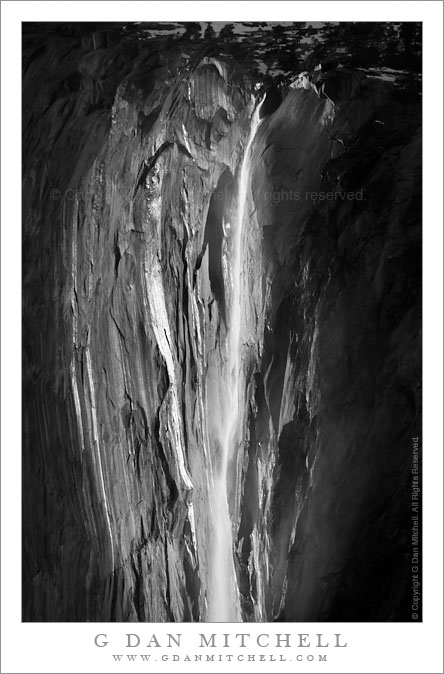
Horsetail Fall
Horsetail Fall

Horsetail Fall. Yosemite National Park, California. February 15, 2010. © Copyright 2010 G Dan Mitchell – all rights reserved. *

UPDATE: As of 2020 I am no longer posting annual updates concerning this subject — and I am editing older posts on the subject in light of the need to be more responsible about not encouraging the onslaught. I also no longer recommend going to the Valley to see it. Unfortunately, too much exposure (yes, I played a part in it, unfortunately) has led to absurd crowds, traffic jams, littering, destruction of areas in the Valley where too many people go to see it… and the park has increasingly — and appropriately — cracked down. Parking options have been eliminated, at least one viewing location has been closed. Good news! The rest of Yosemite Valley is still there and often exceptionally beautiful at this time of year.

The silver strand of Horsetail Fall and water reflecting on surrounding cliffs in late afternoon light, Yosemite Valley.

This being February, it seems that Horsetail Fall has again (and more every year) become a hot topic. Horsetail Fall, sometimes referred to as the “Natural Firefall” has been popularized to an absurd and, frankly, dangerous level on social media and in the press. To be honest, I now recommend that you not go.

The conjunction of elements required to produce the most spectacular Horsetail Fall “event” is complex. First, it depends on the geological coincidences of the placement of the fall in a spot hight on the face of El Capitan that receives a narrow beam of sunset light during two brief periods each year. Second, the fall must be running – in roughly the middle of winter. The area supplying water to the fall is high enough to be snow-covered in a typical winter, but low enough that snow can melt and start the fall flowing even in the cold season – but this is not a sure thing. Essentially, there must be snow and then some warmth to melt it, or else some significant warm rain. Third, a series of meteorological events must play out just right. Obviously, the upper face of El Capitan must be clear of clouds. (Yosemite Valley fog and clouds ringing the cliffs are rather common in the winter season.) The sky west of the Valley must also be clear all the way to the horizon since the best color occurs just before the sun hits the horizon.

Most often the requirements do not align. Many of us can tell stories of light getting better and better, leading toward a brilliant finale… and then the “lights going out” just at the peak of color as the sun dropped behind clouds far to the west.

Hundreds and hundreds Thousands of photographers now show up to try to photograph the thing. I’ve done it in the past, though I’m no longer interested these days – partly because of the absurd crowds and partly because I’m often busy photographing other interesting things!

My best memory of photographing Horsetail was years ago when the park service was doing major road work on Northside Drive, the road along that side of the Valley. The road was completely closed as were the cross-valley roads that travel between Southside and Northside Drives. It had snowed and there was perhaps a foot or more of snow along this section of the Valley floor. I wanted to photograph the fall from a location on the north side of the Valley, so my only option was to put on lots of warm clothes, load up a pack of camera and other gear, and walk across the Valley in the snow. I arrived long before sunset, so I first walked west to El Capitan Meadow where I photographed in rare quiet and solitude on this car-free and carefree late afternoon. Later, I quietly walked back along the road to my shooting location and found perhaps three or four other people there. This quiet, peaceful, and relatively uncrowded experience became my touchstone for photographing Horsetail.

If you go today, there is no way that your experience will be even close, unfortunately.

In recent years, as more people have acquired digital cameras and become more serious about their photography and as the renown of the fall has increased, the crowds have also increased to the point that they have become unmanageable and are damaging the park. As I revise this article in 2020, the problem has become so acute that the park service has wisely put severe restrictions on access — there is no stopping allowed along large sections of nearby Valley roads and one of the popular locations has been completely closed due to damage to forest, meadows, and the river.

* Note: In a wonderful video about Horsetail Fall, Ansel Adams’ son Michael Adams speaks eloquently about his father’s early photographs of the phenomenon. I was intrigued by his comment that Ansel might not have photographed the fall the way we do now because he couldn’t – since he worked with black and white photography. Thinking of this, and being full of myself today, I thought that I’d post a black and white photograph of Horsetail Fall! :-)

G Dan Mitchell is a California photographer whose subjects include the Pacific coast, redwood forests, central California oak/grasslands, the Sierra Nevada, California deserts, urban landscapes, night photography, and more.
Blog | About | Flickr | Twitter | FacebookGoogle+ | 500px.com | LinkedIn | Email

Text, photographs, and other media are © Copyright G Dan Mitchell (or others when indicated) and are not in the public domain and may not be used on websites, blogs, or in other media without advance permission from G Dan Mitchell.

Trees, Pond, and Birds in Twilight Sky

Trees, Pond, and Birds in Twilight Sky - Migratory birds fly through twilight skies above trees and ponds at the Merced National Wildlife Refuge.
Migratory birds fly through twilight skies above trees and ponds at the Merced National Wildlife Refuge.

Trees, Pond, and Birds in Twilight Sky. Merced National Wildlife Refuge, California. February 4, 2012. © Copyright 2012 G Dan Mitchell – all rights reserved.

Migratory birds fly through twilight skies above trees and ponds at the Merced National Wildlife Refuge.

On an early February Saturday evening, four of us converged on the Merced National Wildlife Refuge from far-flung locations – two from the San Francisco Bay Area and two from the Sierra Foothills – to photograph the evening fly-in of migratory birds. We arrived well before the golden light of evening and had plenty of time to get settled in and find birds and other things to photograph. The first “target” was a large, no make that huge, flock of geese that were in a pond of the far side of the road around the refuge. We photographed these birds, both in the water and as groups of them took off and flow (sometimes) over our position.

As the evening wore on the bird “action” began to slow down. Some of us wandered off to shoot other subject including the interesting trees and brush along the levees that separate the ponds. I can’t speak for the others, but I had decided that “the show was over,” and that we had probably seen as many of the large migratory birds as we would see that night. You can’t completely predict where and when they’ll show, so one has to be a bit philosophical about this. Then, without warning, we began to hear the calls of large numbers of birds from the south and moments later flock after flock began to fly right over us and then circle above the pond in front of us in huge groups. There was a bit of light still, and I managed a few photographs in this beautiful but marginal light before we pretty much stopped photographing and simply marveled at the spectacle.

G Dan Mitchell is a California photographer whose subjects include the Pacific coast, redwood forests, central California oak/grasslands, the Sierra Nevada, California deserts, urban landscapes, night photography, and more.
Blog | About | Flickr | Twitter | FacebookGoogle+ | 500px.com | LinkedIn | Email

Text, photographs, and other media are © Copyright G Dan Mitchell (or others when indicated) and are not in the public domain and may not be used on websites, blogs, or in other media without advance permission from G Dan Mitchell.

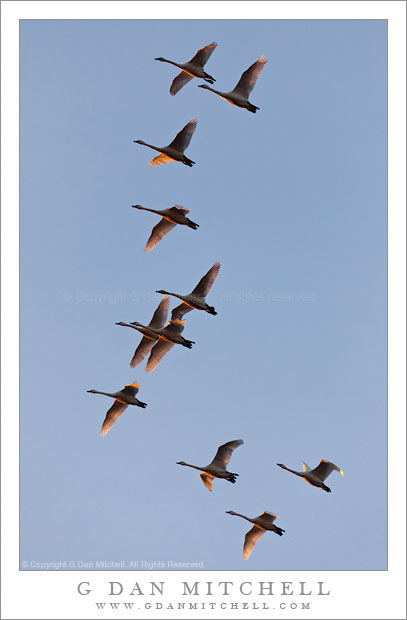
Tundra Swans, Dawn

Tundra Swans, Dawn - Tundra swans in dawn light above the Central Valley of California.
Tundra swans in dawn light above the Central Valley of California.

Tundra Swans, Dawn. Central Valley, California. January 28, 2012. © Copyright 2012 G Dan Mitchell – all rights reserved.

Tundra swans in dawn light above the Central Valley of California.

This is the second photograph of this particular group of tundra swans that flew low over our position near the end of Woodbridge Road in the California Central Valley near the end of January. With all the challenges of photographing flying birds in limited light and with long lenses, it is no wonder that one gets a less than 100% success rate with these photographs. But every so often all the pieces fall into place and you end up with something that is not another slightly out-of-focus, slightly mis-aimed, over- or under-exposed photograph of the silhouettes of bird undersides. Seriously. ;-)

This group came over at a relatively low level, though not so low than individual birds would fill the viewfinder. By default, I usually begin with the camera in “landscape” (horizontal) mode for this sort of subject, but because these birds were almost directly overhead and lined up “vertically” rather than strung out in a line, I decided to quickly shift the camera to “portrait” (vertical) orientation after one initial exposure as they approached. Now the trick was to try to keep my eye on one bird that needed to be under the AF point, while simultaneously remaining aware of the entire flock so that I could keep them within the boundary of the frame and try to catch them at a point when they were not blocking one another. The fact that I got the beautiful morning light coming from below was partially due to being there good and early, and possibly due to the birds thoughtfully positioning themselves to allow this. Thank you, tundra swans!

G Dan Mitchell is a California photographer whose subjects include the Pacific coast, redwood forests, central California oak/grasslands, the Sierra Nevada, California deserts, urban landscapes, night photography, and more.
Blog | About | Flickr | Twitter | FacebookGoogle+ | 500px.com | LinkedIn | Email

Text, photographs, and other media are © Copyright G Dan Mitchell (or others when indicated) and are not in the public domain and may not be used on websites, blogs, or in other media without advance permission from G Dan Mitchell.

Happy Birthday, Ansel!

Today is the 110th anniversary of the birth of Ansel Adams. It hardly seems necessary to make the case for his impact on photography and photographers, and should it be necessary there are many others who are better equipped than I to make that case. But I can’t let the date go by without writing something.

Arriving in California and the San Francisco Bay Area at the age of four, having a father who was an enthusiastic photographer,  and living here during the last half of the 20th Century and into the 21st, it is no surprise that my literal view of the world has been affected by Adams’ way of seeing it. Unlike a number of people in my “circle” who knew him and worked with him and can tell their own real Ansel Stories, I was not fortunate enough to have any substantial direct contact with the man. (Although I was very interested in photography from a young age and I knew people who ended up working with him, where Adams zigged left towards photography, as a young man I zagged right toward music.) The closest I came was when my father dragged me and perhaps one or more of my brothers to the local community college to hear a lecture by some photographer. We assembled in a small, dingy classroom and some old, bearded guy talked about photography. Yes, that bearded guy. While I have a visual memory of seeing Adams there, I’m embarrassed to admit that I don’t recall a single thing that he said.

Today, it is popular in some circles to overlook the visual power of his best photographs, to regard him as being “merely a landscape photographer,” to overlook the tremendous number of photographers affected directly and indirectly by him, to misrepresent him as some sort of pure “realist,” to point out that not every photograph he made was “perfect,” and even to regard his work as something of an anachronism.

However, Adams’ way of seeing (along with that of others such as Weston) strongly affected my visual orientation to the world, in ways that I didn’t comprehend when I was young. I distinctly recall the first time that I was more or less turned loose in Yosemite with a “real camera” (something with bellows, as I recall) by my family, I went off and happily made black and white photographs of cliffs and waterfalls… and one specific photograph of North Dome framed by trees that surprised me by managing to evoke (though probably only for me) something like the feeling that Adams’ photographs evoked. At the time I don’t think I had a clue of the vein I was tapping into, but I now look back and realize that I must have baffled my parents when, at junior high school age,  I became obsessed by making photographs of rusty fence gates and oak trees in empty fields and tide pools at Point Lobos. The powerful and direct images that Adams created  started me dreaming about the imagined high country of the Sierra, and by my mid-teens I had managed to finagle my way into accompanying friends on my first backpacking trip.

Yes, I took a camera.

G Dan Mitchell is a California photographer whose subjects include the Pacific coast, redwood forests, central California oak/grasslands, the Sierra Nevada, California deserts, urban landscapes, night photography, and more.
Blog | About | Flickr | Twitter | FacebookGoogle+ | 500px.com | LinkedIn | Email

Text, photographs, and other media are © Copyright G Dan Mitchell (or others when indicated) and are not in the public domain and may not be used on websites, blogs, or in other media without advance permission from G Dan Mitchell.

Photographer and visual opportunist. Daily photos since 2005, plus articles, reviews, news, and ideas.