
What Happened to My Death Valley Guide?

During the past year or two I had written the majority of an extensive guide to photographing in Death Valley National Park and some of the surrounding areas, and shared it at this web site. It was chock-full of the names of places and descriptions of how to get to them and specific suggestions regarding how they might be photographed – along with a few disclaimers and warnings about dangers including focusing too much on bagging photographs of icons, endangering certain fragile things in the park, and so forth.

I recently took this guide down, with the intention of writing a new one that I hope will be more useful to those who are looking for a bit of a deeper understanding of the place and how it might be photographed, perhaps at the expense of providing that quick list of where to go and how to get there.

Every so often friends remind me that there are ethical risks in sharing too much detailed information in the wrong forums, and recently one friend mentioned this relative to a post about a particular area I had photographed that is easily accessible but not yet overrun. As result I began the process of going through some previous posts and editing descriptions to offer details only when it seemed important in the context of the photograph. Then I started thinking a bit more about the content of the my existing guide to photographing the park. Even though I had worked to “sanitize” the descriptions in the old guide – removing many of the references to exact spots and so forth – and of including exhortations to protect the place, I began to think that I was not necessarily doing photographers a big favor by offering a guide that was primarily organized along the lines of “places to go,” and which might encourage people to go “bag a shot” of these places rather than looking a bit deeper.

Some may ask, “Why not tell people the best places?”

  • Plenty of other people have already written guides to the places. In the end, I probably don’t really have a lot to add to this pool of information. If you want to know the names of icons and where to find them you can certainly find this information elsewhere.
  • While many of us begin by thinking that the goal is to photograph the “famous places” – and, frankly, that is not a bad way to start – eventually I realized that it was the process of discovering my own orientation to the park that brought greater pleasure and rewards. I don’t want to encourage others to miss out on that experience.
  • Some of the places are wonderful largely because of their remoteness and solitude. In fact, the immense solitude of Death Valley is one of the most powerful and rare things it has to offer, and there are still many places and times to find this. I don’t want to accelerate the loss of this valuable commodity.
  • While many areas of the park might seem too rugged to be damaged much by our passage, there are fragile things here that cannot withstand the presence of too many people – and there are plenty of examples of things that have already been damaged. While it isn’t my goal to keep people away from the park, I certainly don’t want to accelerate the degradation of these resources by unnecessarily encouraging more people to go to these places.

So, I’m offering this post as both an explanation of where the old Death Valley guide went, and as a promise to get to work on the document that will replace it. My plan is to speak in more general terms about what it means to photograph in the park and about how to approach it as a photographic subject – and to do so in a way that may offer something useful to all who want to seek out the rewards that come from developing a deeper relationship with this land.

G Dan Mitchell is a California photographer whose subjects include the Pacific coast, redwood forests, central California oak/grasslands, the Sierra Nevada, California deserts, urban landscapes, night photography, and more.
Blog | About | Flickr | Twitter | FacebookGoogle+ | 500px.com | LinkedIn | Email

Text, photographs, and other media are © Copyright G Dan Mitchell (or others when indicated) and are not in the public domain and may not be used on websites, blogs, or in other media without advance permission from G Dan Mitchell.
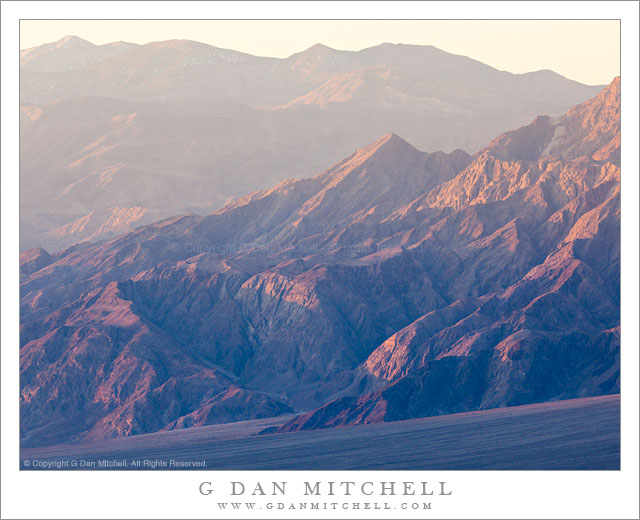
First Light, Base of Tucki Mountain and the Panamint Range

First Light, Base of Tucki Mountain and the Panamint Range - First morning light on the rugged landscape of the base of Tucki Mountain and the Panamint Range, Death Valley National Park, California
First morning light on the rugged landscape of the base of Tucki Mountain and the Panamint Range, Death Valley National Park, California

First Light, Base of Tucki Mountain and the Panamint Range. Death Valley National Park, California. January 3, 2012. © Copyright 2012 G Dan Mitchell – all rights reserved.

First morning light on the rugged landscape of the base of Tucki Mountain and the Panamint Range, Death Valley National Park, California

This photograph was made from a location a ways up from the bottom of Death Valley, from which I could look directly across at the lower slopes of gigantic Tucki Mountain as the first morning light worked its way down toward the lower ridges and the huge alluvial fan at the base of the mountain. At the moment I made the exposure the light was just beginning to fill this slanting area below the rugged mountains, and the light was softened by morning haze.

Tucki Mountain is a huge peak that almost seems to me to be large enough to count as its own minor mountain range. It rises above Stovepipe Wells, and extends a great distance east, south, and west of there. It is laced with deep canyons and its lower slopes are heavily eroded to reveal tilting and twisting strata. Another large valley lies on beyond the foreground spur ridge in this photograph, and beyond that the Panamint Range rises to its crest at 11,000+’ Telescope Peak.

G Dan Mitchell is a California photographer whose subjects include the Pacific coast, redwood forests, central California oak/grasslands, the Sierra Nevada, California deserts, urban landscapes, night photography, and more.
Blog | About | Flickr | Twitter | FacebookGoogle+ | 500px.com | LinkedIn | Email

Text, photographs, and other media are © Copyright G Dan Mitchell (or others when indicated) and are not in the public domain and may not be used on websites, blogs, or in other media without advance permission from G Dan Mitchell.
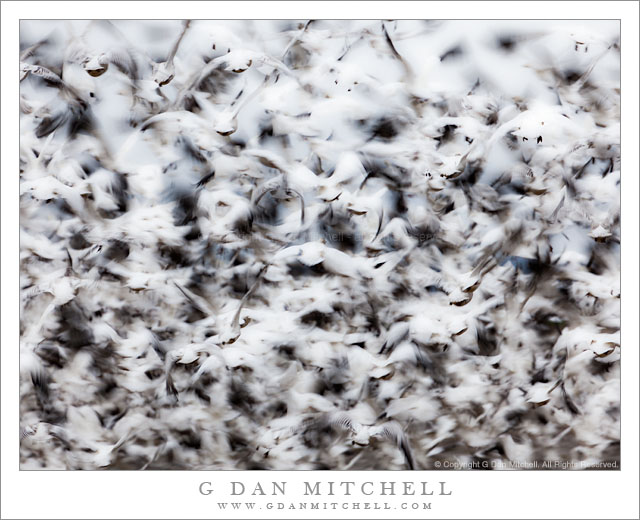
Snow Goose Maelstrom

Snow Goose Maelstrom - A swirling mass of snow geese taking flight above Skagit Valley, Washington.
A swirling mass of snow geese taking flight above Skagit Valley, Washington.

Snow Goose Maelstrom. Skagit Valley, Washington. February 19, 2012. © Copyright 2012 G Dan Mitchell – all rights reserved.

A swirling mass of snow geese taking flight above Skagit Valley, Washington.

(You may need to look at this one for a moment in order to understand what is going on.) I photographed these birds in what I believe Washingtonians might refer to as the “Lower Skagit River Valley” area of Washington. I visited the Seattle Area in mid-February, and managed to get one full day to drive up to Skagit Valley and look for the famous birds that are found there: snow geese, trumpeter swans, bald eagles, and more. I arrived there just before dawn on a cloudy and drizzly morning. Not really knowing the area, at first I wasn’t exactly certain where to look. I started just outside of the town of Conway, where fresh green fields occasionally held groups of trumpeter swans, though they all turned out to be a bit too far away for effective photography. Soon I decided to continue on the road out of Conway, driving in the general direction of Laconner and Anacortes. About half way between Conway and Anacortes, the road crosses a large bridge over the river through a forested area. Just before this bridge, I found my geese! As I approached I caught (thrilling) sight of airborne birds heading toward and landing in a field, so I pulled over and began photographing them. There were many thousands of snow geese, mixed in with some trumpeter swans and a few odd ducks.

As I have photographed the migratory birds this season, mostly in California’s Central Valley, one of the ideas that I got in my head was to photograph the massive flocks as they take off, using longer shutter speeds to create some motion blur and long focal lengths to compress the flocks. So, after making a few photographs at more normal and reliable shutter speeds, I switched to an unusually low shutter speed for a hand held 400mm lens and prepared for the inevitable lift off of the flock. I didn’t have to wait long. As the flock, with its edge barely more than 50 feet away from me, lifted off all at once, I used the long lens to crop closely and tracked the flock as it rose and expanded. While the initial impression of the resulting photograph might be “lots of blurry stuff!,” a closer look begins to reveal some detail and order in the madness, and individual birds can be isolated from the background blur. For the interpretation I had in mind, additional work was needed in the post-processing phase, including some work to control the blur and find edges, and some overall adjustments to dynamic range and color.

G Dan Mitchell is a California photographer whose subjects include the Pacific coast, redwood forests, central California oak/grasslands, the Sierra Nevada, California deserts, urban landscapes, night photography, and more.
Blog | About | Flickr | Twitter | FacebookGoogle+ | 500px.com | LinkedIn | Email

Text, photographs, and other media are © Copyright G Dan Mitchell (or others when indicated) and are not in the public domain and may not be used on websites, blogs, or in other media without advance permission from G Dan Mitchell.

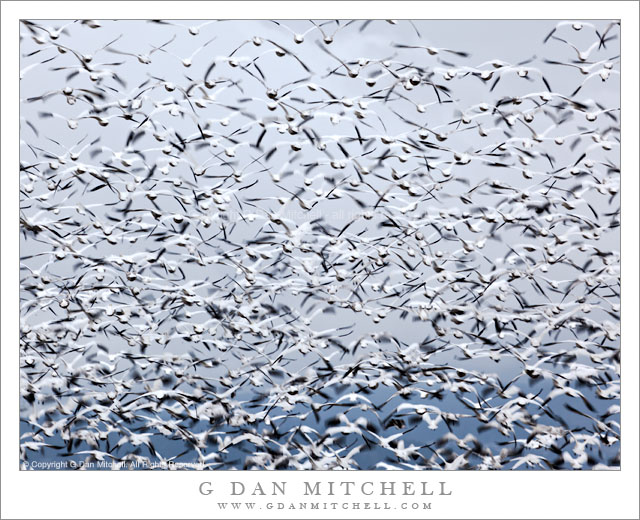
Snow Geese in Motion

Snow Geese in Motion - A subtle abstraction of motion-blurred snow geese in the sky over Skagit Valley, Washington.
A subtle abstraction of motion-blurred snow geese in the sky over Skagit Valley, Washington.

Snow Geese in Motion. Skagit Valley, Washington. February 19, 2012. © Copyright 2012 G Dan Mitchell – all rights reserved.

A subtle abstraction of motion-blurred snow geese in the sky over Skagit Valley, Washington.

In the second half of February I had the opportunity to spend four days in the Pacific Northwest, in and around the Seattle area. It seemed that there were two wildlife events taking place – both involving birds. The one that was getting the most attention was the snowy owls up in, if I understood correctly, the Vancouver, BC area. For a variety of reasons that subject was not going to be on my itinerary for this trip. The other was the trumpeter swans and snow geese that were settling in the lower Skagit Valley, roughly between Conley and Laconner. I did manage to spend the better part of an entire day there photographing these birds, along with a few others including bald eagles.

I arrived in the area very early, at just about the time of what would have been sunrise had it not been raining lightly. As I drove out of Conley I began to see the trumpeter swans here and there on the bright green winter fields. But despite some serious wandering about on rural side roads, I was not able to get close enough to them to make photographs. So I moved on, soon coming to a closed produce market alongside the road near fields and just before the road crossed the nearby river on a bridge through the woods. Here, at a curve in the road, I spotted many thousands of snow geese just across a drainage ditch and not far from the roadway. I pulled over and set up and watched as even more birds began to arrive, until the largest flock of geese that I have even seen was assembled in this empty field. Then, for some reason I could not discern, the entire group of thousands and thousands of geese spontaneously and en masse rose up into the air. Fortunately, I had been thinking about this possibility and an idea I had to photograph them with a long lens and at slow shutter speeds, and I was already at the right shutter speed and had the long lens on the camera. It was mostly a matter of aiming straight into the thickest part of the flock and trying to keep some eye on the background patterns as the geese rose into the air. I took this photograph from the set since it was almost entirely filled with geese and used it as a starting point to do a bit of additional post-processing to produce the interpretation of the photograph that you see here.

G Dan Mitchell is a California photographer whose subjects include the Pacific coast, redwood forests, central California oak/grasslands, the Sierra Nevada, California deserts, urban landscapes, night photography, and more.
Blog | About | Flickr | Twitter | FacebookGoogle+ | 500px.com | LinkedIn | Email

Text, photographs, and other media are © Copyright G Dan Mitchell (or others when indicated) and are not in the public domain and may not be used on websites, blogs, or in other media without advance permission from G Dan Mitchell.

Photographer and visual opportunist. Daily photos since 2005, plus articles, reviews, news, and ideas.