
Tag Archives: 2

Experiment #2: What do you see?

In this experiment I invite you to view a sequence of six jpg files that include different versions of the same original photograph.

  1. All six images seen at the link began as the same original source file – a RAW file from a high quality full frame camera.
  2. Three versions of this file were created, with each altered in a particular way I won’t yet reveal in advance – let’s call them versions #1, #2, and #3.
  3. Each of the three versions was then duplicated – in other words two identical copies of version #1 were created, two identical copies of version #2 were created, and two identical copies of version #3 were created.
  4. The six files were randomly assigned slightly different file names so that in the end we have File A, File B, File C, File D, File E, and File F.
  5. The six images were then sequenced into a “slide show” version that automatically switches between them, but which also allows the viewer to select them individually.

The Experiment

After you view the linked files in your web browser as presented at the linked page I would like you to consider three questions:

  1. By viewing the files in your web browser as presented here are you able to perceive any visual differences between the files aside from the letters A-F indicating the different images?
  2. If you do perceive differences among them, to what would you attribute the visual difference?
  3. By viewing them in your web browser as presented, can you identify the pairs of identical images?

Click on this link to view the sequence of six presentations of the photograph. The sequence should open in a new window/tab when you click the link. Return here to report your results by adding a comment to this post. (Note: The link was briefly broken – apologies to those who got the missing page error. The problem should now be resolved. Direct URL: https://gdanmitchell.com/images/Experiment2/index.html )

Caveats and Warnings

  • I do not make any claims that this is a scientifically constructed experiment – let’s call it an informal investigation of a potentially interesting question.
  • If you view the comments of other participants before offering your own response you may be influenced by what they write. Therefore in the spirit of the experiment you should decide on your results before posting your response and before viewing the comment page – and resist the temptation to change your results after reading what others say.
  • The whole point of this exercise is to consider what you see when you look at these image in your web browser. If you want to participate, please limit your consideration of the images to viewing them in your browser on the linked page.
  • Feel free to look at the images as many times as you want or to switch among them manually. (You might want to mention the extent of your careful viewing in your comment.)
  • I’ll stipulate that if you download the files and carefully investigate them that you will possibly find differences whether you can see them or not. But don’t – this isn’t the point here. If you can’t resist doing this please keep your discoveries to yourself until the end. (I’ll also point out that I could do things in the files that might mislead you… ;-)
  • You are welcome to hold positive or negative opinions about the aesthetic quality of the photograph, but please keep those out of your response to this experiment.
  • I am not saying in advance what the difference are nor am I making any assumptions ahead of time about what the results will be. It is best if you do the same and keep an open mind.
  • I plan to reveal everything about the experiment in a day or two.

(This is the second in a series of visual experiments that I invite you to try. You can see the previous Experiment #1 and the followup post about the results.)


G Dan Mitchell is a California photographer and visual opportunist. His book, “California’s Fall Color: A Photographer’s Guide to Autumn in the Sierra” (Heyday Books) is available directly from him.

G Dan Mitchell: Blog | Bluesky | Mastodon | Substack Notes | Flickr | Email


All media © Copyright G Dan Mitchell and others as indicated. Any use requires advance permission from G Dan Mitchell.
Eastern Sierra Aspen Color Reports Starting (9/24/09)

If you are really trying to follow the evolution of eastern Sierra fall color – most aspens – your best bet is to find some of the primary sources yourself and start following them. However, I’m going to continue to post a few here from time to time – and before long I should be able to start posting some of my own reports.

  • Inge Fernau posted an extensive description of her one-day marathon trip to Bishop Creek, including some photographs that will help those who know the areas already extrapolate a bit. Inge’s site is always worth a visit, and few post more thoroughly on the aspens.
  • The calphoto site is typically a great source of current information about the fall color in the eastern Sierra… but this season there doesn’t seem to be much info there yet. I’m hopeful that this many change in the next few days.
  • The Eastern Sierra Fall Color group at Flickr has a lot of information, both in the form of text and in images that will give you some answers to the “where?” and “when?” questions.
  • Greg Boyer’s One Horse Studio site is featuring frequent updates including one from the middle of the current week that sounds somewhat optimistic.

Remember a few things about finding and shooting aspens:

  • Conditions can vary a lot as you travel north/south and low/high. If you hear a poor report about one spot, you cannot necessarily extrapolate that to the whole range. Be prepared to move if your “perfect spot” isn’t in condition.
  • How you shoot the trees matters a lot. Sometimes a grove that seems to be almost green will appear to be quite yellow/gold if you go around to the other side for some backlight.
  • Time of day matters a lot #1. It is really tough to shoot them effectively in harsh, midday sun on a cloudless day. Early and late are often better, and shooting on the sun/shade boundary is often very interesting – though you’ll have to be prepared and work quickly.
  • Time of day matters a lot #2. A spot that is flat and boring in the morning may shine in the evening, and vice versa.
  • Time of day matters a lot #3. Shooting in shady conditions is sometimes very effective. You can get past the problems with black shadows and blown highlights and get a very wonderful soft effect – though you’ll likely have to do some color balancing in post.
  • If you show up and there is a crowd in the spot you were heading towards – yes, it happens! – look around. There is often something slightly different nearby and shooting something other than “the obvious thing” often leads to more interesting shots. (One morning I arrived at North Lake intending to do the iconic “across the lake towards Piute Peak” shot only to find a few dozen photographers lined up tripod to tripod in “the spot.” I went a few hundred yards away… and came back with one of my very favorite aspen photos.
  • Think small. Big groves are spectacular, but sometimes one perfect leaf can make a better photograph.
  • Think beyond the trees. Part of the experience includes other trees, rocks, moving or still water, clouds, grass, etc.

Happy aspen hunting!

UPDATE: 9:00 p.m. – Sierra Impressions points out that there is a probability of a change in the weather pattern next week – in the direction of true fall-like weather. That could mean cooler temperatures (a possible hard freeze is mentioned), perhaps wind, and (outside chance) some precipitation. It is always good to keep an eye on this stuff, for a whole bunch or reasons:

  • light snow can create some really wonderful photographic opportunities, but
  • it can also temporarily close passes, and
  • challenge your adaptability to and knowledge of more challenging conditions.
  • wind can quickly bring down some aspen leaves. (One morning I arrived before dawn at North Lake to find beautiful leaves. A squall swept in and it blew and snowed lightly for about an hour. At the end of that hour the large grove across the lake had lost half of its leaves!)

Besides following the official weather service reports – I like to read the “weather discussion” pages for more details – it also can be fun and informative to follow the Mammoth Dweeb Report. Not only does this site include some interesting local information and a lot of background stuff, but you can have fun following the speculation about longer term patterns.


G Dan Mitchell is a California photographer and visual opportunist. His book, “California’s Fall Color: A Photographer’s Guide to Autumn in the Sierra” (Heyday Books) is available directly from him.

G Dan Mitchell: Blog | Bluesky | Mastodon | Substack Notes | Flickr | Email


All media © Copyright G Dan Mitchell and others as indicated. Any use requires advance permission from G Dan Mitchell.

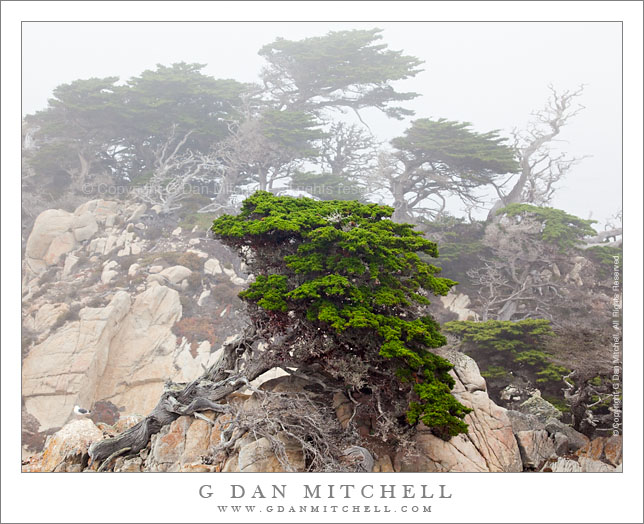
Cypress Trees in Fog #2

Cypress Trees in Fog #2

Cypress Trees in Fog #2. Point Lobos State Reserve, California. August 21, 2009. © Copyright G Dan Mitchell – all rights reserved.

Cypress trees and rocks in fog, Point Lobos State Reserve, California.

Once I finally admitted that the sun was not going to come out before sunset – which would have been obvious to anyone who did not arrive at Point Lobos with my incorrect preconceptions about the day’s weather – I set about making photographs of subjects that were made more interesting by the fog.

This tree is one that I’ve walked past many times while shooting along the northwest portion of the park just to the “right” of the Punta de los Lobos Marinos and in an area of trails along the bluffs and through Monterey Pine groves. Usually the scene right here is pretty complicated, with many trees, lots of rocks and so forth – but on this evening the fog simplified things, fading all parts of the scene except for this one closer tree growing on top of the rocks.

This photograph is not in the public domain. It may not be used on websites, blogs, or in any other media without explicit advance permission from G Dan Mitchell.

Web: G Dan Mitchell Photography
Twitter: http://twitter.com/gdanmitchell
Friendfeed: http://friendfeed.com/gdanmitchell
Facebook: http://www.facebook.com/gdanmitchell

keywords: monterey, cypress, tree, fog, mist, cloud, pinnacle, point, hill, cliff, rock, bluff, shore, seascape, pacific, ocean, peninsula, california, usa, carmel, sea, rugged, point, lobos, state, reserve, park, landscape, nature, travel, scenic, stock, stump, snag, water, foam

Quick Note: ‘Live View’ post updated

Earlier today I updated my post about the “live view” feature on the Canon EOS 5D Mark II, and added a couple additional reasons why the feature is so useful. See the post here: Why I Like ‘Live View’ on my Canon EOS 5D Mark II.


G Dan Mitchell is a California photographer and visual opportunist. His book, “California’s Fall Color: A Photographer’s Guide to Autumn in the Sierra” (Heyday Books) is available directly from him.

G Dan Mitchell: Blog | Bluesky | Mastodon | Substack Notes | Flickr | Email


All media © Copyright G Dan Mitchell and others as indicated. Any use requires advance permission from G Dan Mitchell.