
Tag Archives: amargosa

Titus Canyon Road

Titus Canyon Road
Titus Canyon Road

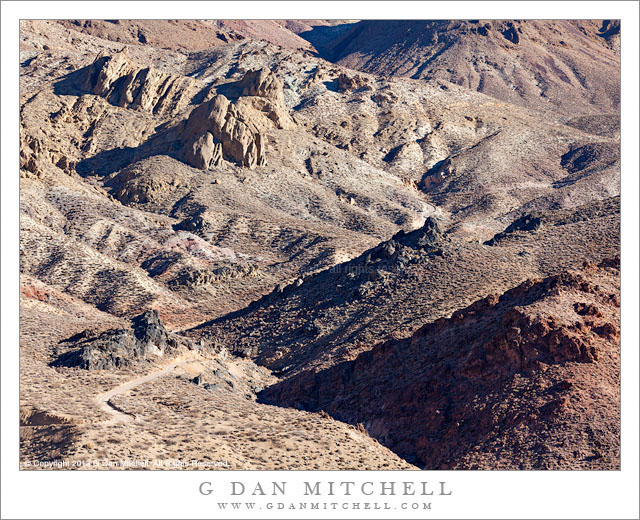
Titus Canyon Road. Death Valley National Park, California. December 11, 2013. © Copyright 2014 G Dan Mitchell – all rights reserved.

Titus Canyon Road descents into upper Titanothere Canyon before climbing to Red Pass

Early December is a fine time to be in Death Valley National Park, and I managed to spend five days there this past December. The weather is cooler this time of year – in fact, temperatures dropped into the upper twenties in the Valley during my visit and well down into the teens in some of the upper elevations that I visited during the pre-dawn hours. Although seasoned Death Valley visitors prefer to visit during the cooler months, things seem much quieter than a few months later in the spring. In fact, I almost had the entire Stovepipe Wells campground to myself on my first night!

The relative solitude extended to this day, on which I drove over the Amargosa Range via Titus Canyon Road, the rough back-country one-way route between the Amargosa Valley and Death Valley itself. I know this route fairly well, having been over it a number of times. I always start in the morning, and this trip was no exception – I was well out on to the route when the sun came up. Often I just take a few hours for the trip, stopping at a few key locations. But recently I have thought more about how I might photograph some of these places that I used to simply drive through, and on this visit I slowed way down and devoted almost the entire day to this area. The location in this photograph is an example of the sort of area that I might have just passed through in the past. Here the road traverses the upper reaches of a very large canyon that eventually spills out into Death Valley far below. The location from which I made the photograph marks the high point on the route, and I always stop there – but on some previous visits I have just regarded the terrain as being empty. It isn’t, and I’m learning to see it more clearly. Here the gravel road drops down from the previous ridge, winding through the rough and dry landscape to the bottom of the canyon and its dry stream bed before climbing steeply up to my camera position.

G Dan Mitchell is a California photographer and visual opportunist whose subjects include the Pacific coast, redwood forests, central California oak/grasslands, the Sierra Nevada, California deserts, urban landscapes, night photography, and more.
Blog | About | Flickr | Twitter | FacebookGoogle+ | 500px.com | LinkedIn | Email

Text, photographs, and other media are © Copyright G Dan Mitchell (or others when indicated) and are not in the public domain and may not be used on websites, blogs, or in other media without advance permission from G Dan Mitchell.
Desert Mountains and Valley

Desert Mountains and Valley

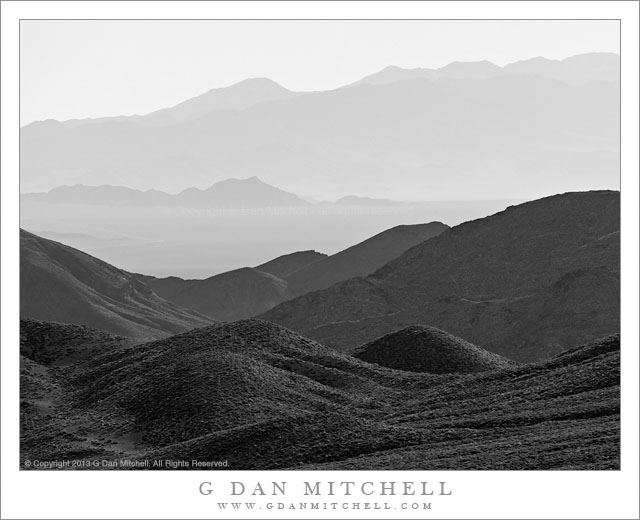
Desert Mountains and Valley. Death Valley National Park. December 11, 2013. © Copyright 2014 G Dan Mitchell – all rights reserved.

Receding desert mountains about the Amargosa Valley, Death Valley National Park

At first look, the general scene here might not have appeared to offer too many photographic opportunities. Although it was still somewhat early in the morning, it was well past the “first light” phase that can make almost any subject look beautiful. There was a great deal of atmospheric haze, and it almost obscured the far mountain ranges. And, as seen in the lower portion of this photograph, while the location is in high and rugged mountains, it is an extremely spare landscape with few plants and only the subtlest of colors from the high desert sage and similar plants.

But, for me, several things were going on here. First, I like haze! Second, a few years ago, after many years of photographing in the Death Valley landscape, I began to look beyond the familiar and more obvious beauties of sunrise and sunset light in dramatic locations in the Valley, and to try to figure out how to photograph more subtle and complex beauties that I encountered at other times and in other locations. I had found myself most often driving through locations like this one, on my way to other places that I presumed would be more interesting. Yet, even though I wasn’t photographing this sort of place, I was having pleasant experiences in them and developing an affinity for them. On one trip it hit me that if I liked being here, there must be some what to make photographs that somehow expressed what it was in these apparently barren places that made me like them. So I stopped here for some time, in a place that might seem like many other places along this route, and I looked around.

G Dan Mitchell is a California photographer and visual opportunist whose subjects include the Pacific coast, redwood forests, central California oak/grasslands, the Sierra Nevada, California deserts, urban landscapes, night photography, and more.
Blog | About | Flickr | Twitter | FacebookGoogle+ | 500px.com | LinkedIn | Email

Text, photographs, and other media are © Copyright G Dan Mitchell (or others when indicated) and are not in the public domain and may not be used on websites, blogs, or in other media without advance permission from G Dan Mitchell.
Abandoned Buildings, Leadfield

Abandoned Buildings, Leadfield

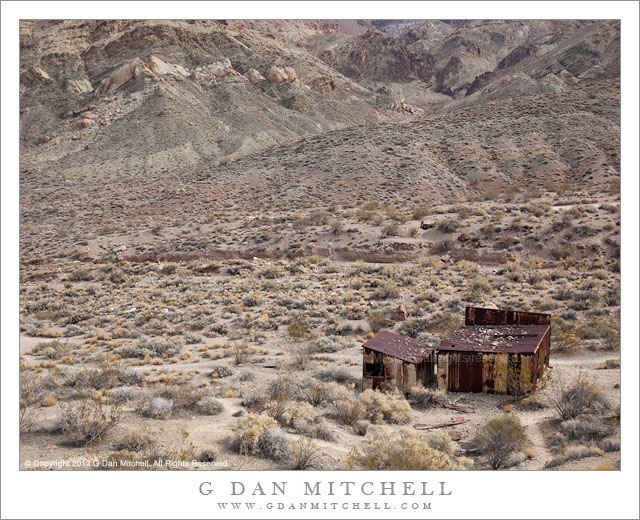
Abandoned Buildings, Leadfield. Death Valley National Park, California. April 6, 2013. © Copyright 2013 G Dan Mitchell – all rights reserved.

Abandoned buildings at the site of the Leadfield mines, Death Valley National Park

In a way there is really nothing that special about Leadfield. It is one of many, many abandoned outposts and mining sites found all over California and, for that matter, all over the West. These sites remain, though precariously in some cases, as a reminder of a number of things: history that is not all that distant, the people who must have been willing to come to such places and attempt to scratch out a living by mining, the human capacities for misleading others and for falling victim to those who would mislead, and the temporal nature of things that might seem permanent at the time.

I’m no historian, but I can share a few facts about this particular spot. In the 1920s the town – with some semi-permanent buildings and reportedly many tents – came into existence and died again in the span of less than a single year. Although the reports of ore in the area and situation that might allow it to be successfully mined were wild exaggerations or downright lies, a road was built into this rugged area, work was started on a mill, and today there is still plenty of evidence of mines all around the area. I made this photograph from the tailings pile at the entrance to what I think may be the main mine shaft, looking out over the site in what I imagine might be the direction that a person working that mine might have looked. I wonder it these people took as much notice as I did of the tiny and inconsequential appearance of the human landscape against the vast and rugged natural landscape beyond?

G Dan Mitchell is a California photographer and visual opportunist whose subjects include the Pacific coast, redwood forests, central California oak/grasslands, the Sierra Nevada, California deserts, urban landscapes, night photography, and more.
Blog | About | Flickr | Twitter | FacebookGoogle+ | 500px.com | LinkedIn | Email

Text, photographs, and other media are © Copyright G Dan Mitchell (or others when indicated) and are not in the public domain and may not be used on websites, blogs, or in other media without advance permission from G Dan Mitchell.

High Country Desert Canyon

High Country Desert Canyon

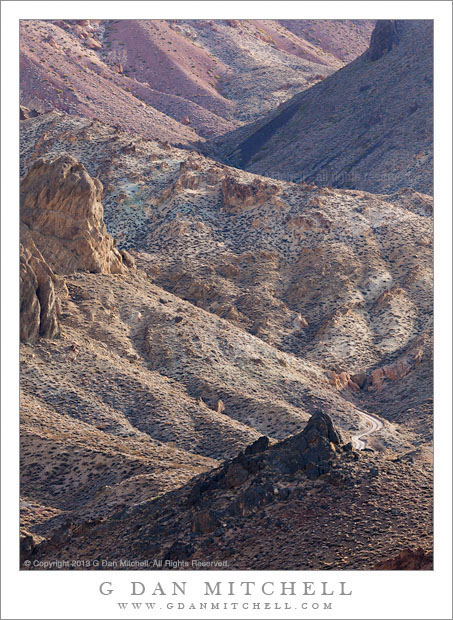
High Country Desert Canyon. Death Valley National Park, California. April 6, 2013. © Copyright 2013 G Dan Mitchell – all rights reserved.

A back-country gravel road twists through the upper reaches of a colorful mountain canyon, Death Valley National Park

The gravel back-country road might be hard to spot in this photograph, but if you look closely near the lower right you may see it twisting around a bend before crossing the canyon behind the rocky prominence at the bottom of the frame. The road begins in desert sagebrush country, then rises to cross the Amargosa Range before descending, sometimes precipitously, down toward the main Death Valley.

Some things about photographing this subject are easy and obvious, but others are a bit challenging and require some attention and then some resistance to trying to turn the scene into something it isn’t. What is easy about this subject? I am endlessly fascinated by winding canyons with overlapping ridges that descend toward the bottom of the canyon, creating a back and forth weave of form. Here the canyon winds from right (at the top) to left to right to left to right to left and, finally, back to the left. And the colors and textures are remarkable, ranging from the very dark rocks at the bottom, through the much lighter slopes right above to the rather reddish rock in the far, upper portion of the canyon. What is hard about it? In many ways, it is easy to pass right through such an area and overlook what it offers, since there really is not single, central, and iconic “thing” to focus the attention. Instead, I almost have to remind myself to slow down, to stop, and to just look… and finally the way to photograph such subjects begins to reveal itself. In addition, because the color palette of this land is so subtle, including mostly pastel shades that subtly contrast with one another, it is important, I think, to resist the ever-present temptation to hype it up into something it isn’t.

G Dan Mitchell is a California photographer and visual opportunist whose subjects include the Pacific coast, redwood forests, central California oak/grasslands, the Sierra Nevada, California deserts, urban landscapes, night photography, and more.
Blog | About | Flickr | Twitter | FacebookGoogle+ | 500px.com | LinkedIn | Email

Text, photographs, and other media are © Copyright G Dan Mitchell (or others when indicated) and are not in the public domain and may not be used on websites, blogs, or in other media without advance permission from G Dan Mitchell.