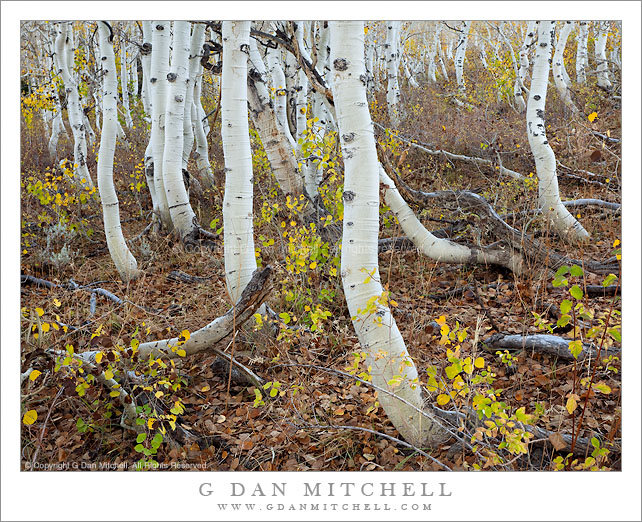
A dense grove of aspens along Dunderberg Road in the eastern Sierra Nevada.
If you passed by this grove along the rough, gravel Dunderberg Road you might not even think to stop – in many ways it seems a lot like many other aspen groves along in this part of the Sierra and along this road. However, I once stopped in this spot the first time I drove this road and for some reason the location has become one of those that draws me back. This time I arrived very late in the afternoon, just as the sun was slipping behind Dunderberg Peak to the west, leaving the trees in shaded early evening light. This section of the grove is remarkable for the thickness of the trees – you might not guess from the photo, but trees are not all that tall. It also is more open than some groves of this size and it isn’t quite as cluttered with non-aspen plants that sometimes make it difficult to find a composition.
This photograph is not in the public domain and may not be used on websites, blogs, or in other media without advance permission from G Dan Mitchell.
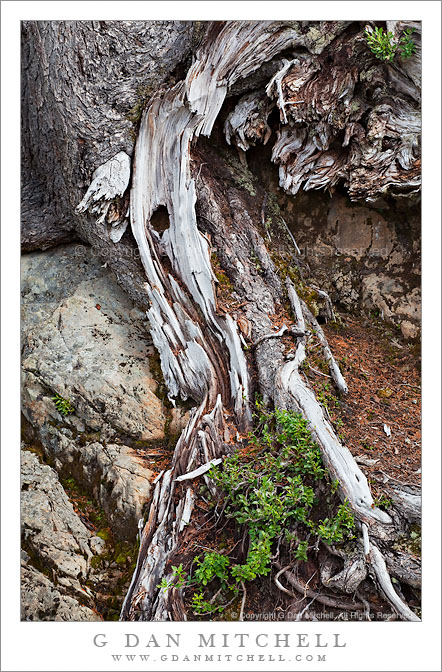
Weathered tree roots stretch across boulders at Mt. Baker-Snoqualmie National Forest, Washington.
I made this photograph at our first stop after we arrived at the Mt. Baker-Snoqualmie National Forest. (Technically, that isn’t quite true, since we had earlier stopped at the “ranger station” to ask some questions, but this was the first “real” stop for photography.) The road into this area twists and turns as it ascends toward and then past a ski area, and here we couldn’t help but pull over at a hairpin curve that provided a panoramic overlook to the valley below and the ridges to the east (?) of our position. Although the original reason for stopping was this dramatic view, I soon found nearby “intimate landscapes” to also be very interesting. While I often hike and climb long distances to find my photographs… for this one the tripod was on asphalt and the subject right next to the road.
On a technical note, for this photograph I used a lens that I’m increasingly fond of for photographing subjects like this one, the Canon EF 70-200mm f/4 L USM (link to B&H). I find it useful to be able to put a bit of distance between myself and subjects in which the entire image may include only a few square feet, and the ability to fine tune the composition with the zoom is very useful. Although I didn’t do it in this photography, working with a slightly longer focal length also lets me have the option of isolating the subject against an out of focus background. I have the non-IS version of the lens – because that was the only version available back when I got mine – though I would almost certainly get the IS version if I were to replace it.
This photograph is not in the public domain and may not be used on websites, blogs, or in other media without advance permission from G Dan Mitchell.
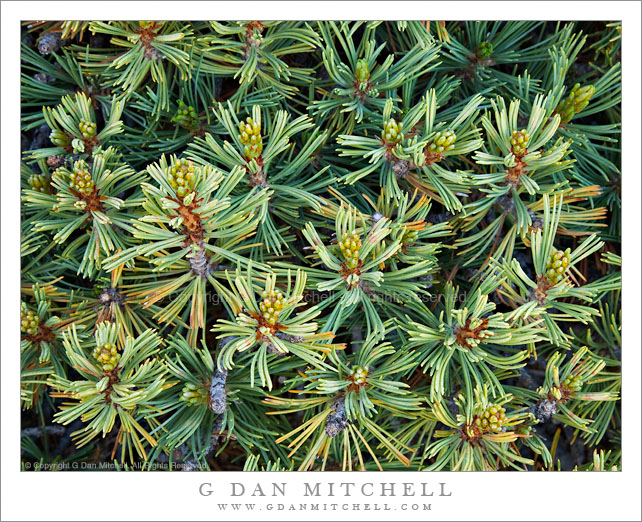
Detail of dense growth of a white bark pine tree in the high country near Tioga Pass, Yosemite National Park.
I photographed this dense growth of white bark pine in a high meadow not far from Tioga Pass, after venturing out into (and around, given the wet conditions!) this area very early in the morning. Although it isn’t apparent in this very close-up photograph, this was a rather unique tree. It had grown up around a large boulder and taken on the boulder’s shape since the branches followed the outline of the boulder almost exactly – it almost looked like the boulder was covered with a “tree blanket.”
This photograph is not in the public domain and may not be used on websites, blogs, or in other media without advance permission from G Dan Mitchell.
A wide panoramic view of morning light in a dense redwood grove at Muir Woods National Monument, California.
Up next in the stitched panorama parade… a photograph make in the vicinity of Bohemian Grove at Muir Woods National Monument in the Golden Gate National Recreation Area, California. This grove is high on the list of popular places in the central and well-known section of the park, and the loop trail that many visitors hike travels right through it.
There are, it seems to me, a huge number of ways to photograph these very tall trees. Interesting effects of light filtering down from above are often a possibility. There are lots of small subjects that can be shot close up. But their sheer height is often difficult to capture. You can shoot straight up, but that creates some issues. You can (and I have) shoot in vertical format to try to include the vertical size. You can try to shoot from further back, but then the scale of the trees diminishes – plus it is very hard to get a clear line of site on these trees from any distance… unless, perhaps, you are at the edge of an area that has been logged.
So, I’ve been thinking about shooting very wide panoramas of groves of parallel vertical forms of the massive trunks. I think that this has two effects that work for me. First, when you stand before these trees and look around you mostly are seeing just the lower sections of the trees – so for me this depiction is true to the experience of being in the forest. Second, the fact that you cannot see the full height of the trees doesn’t mean that you aren’t aware of it! Focusing on these massive trunks might cause you to project the rest of the trees and the great height that isn’t included within the frame. (This isn’t the first time I’ve done this, and I’m certainly not the first person to do it.)
By the way, because the image is stitched from multiple high-resolution full-frame images, it has the potential to be printed very large at some point.
Photographer and visual opportunist. Daily photos since 2005, plus articles, reviews, news, and ideas.
Manage Consent
To provide the best experiences, we use technologies like cookies to store and/or access device information. Consenting to these technologies will allow us to process data such as browsing behavior or unique IDs on this site. Not consenting or withdrawing consent, may adversely affect certain features and functions.
Functional
Always active
The technical storage or access is strictly necessary for the legitimate purpose of enabling the use of a specific service explicitly requested by the subscriber or user, or for the sole purpose of carrying out the transmission of a communication over an electronic communications network.
Preferences
The technical storage or access is necessary for the legitimate purpose of storing preferences that are not requested by the subscriber or user.
Statistics
The technical storage or access that is used exclusively for statistical purposes.The technical storage or access that is used exclusively for anonymous statistical purposes. Without a subpoena, voluntary compliance on the part of your Internet Service Provider, or additional records from a third party, information stored or retrieved for this purpose alone cannot usually be used to identify you.
Marketing
The technical storage or access is required to create user profiles to send advertising, or to track the user on a website or across several websites for similar marketing purposes.