
Tag Archives: dawn

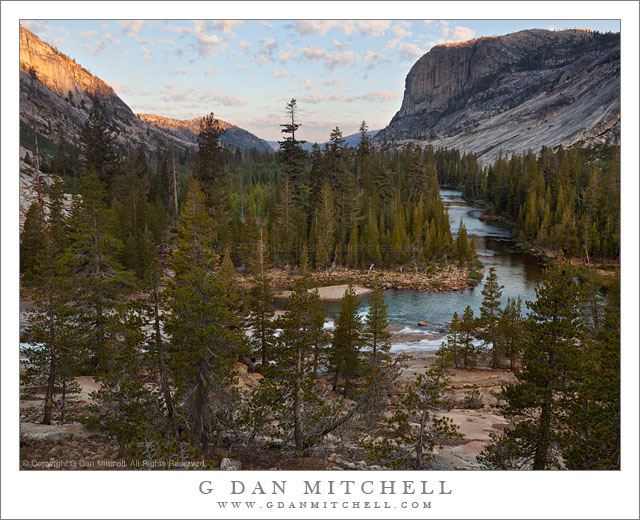
Tuolumne River Below Glen Aulin, Morning

Tuolumne River Below Glen Aulin, Morning

Tuolumne River Below Glen Aulin, Morning. Yosemite National Park, California. September 16,2011. © Copyright 2011 G Dan Mitchell – all rights reserved.

Early light on morning clouds above the Tuolumne River Canyon below Glen Aulin, Yosemite National Park.

This is the same bend in the Tuolumne River, located below Glen Aulin and before the river descends toward Waterwheel Falls and eventually the abomination of Hetch Hetchy Reservoir, that was shown in a photograph of late afternoon light that I posted here a few days ago. This time it was early morning. We had been up well before sunrise and had wandered off in various directions to find early morning photographic subjects. My main goals were the cascading water along the edge of this section of the river (a bit of which is visible in the lower portion of the frame) and a granite bowl to the right of this view. As I came over the rise above this area before descending I saw the beautiful sparse clods to the west, probably extending to the edge of the Sierra and still with pastel colors from dawn light.

A technical observation about this photograph. This scene presented a technical challenge in the form of an extremely wide dynamic range between the bright and red-saturated first direct sunlight on the ridge at upper left and the much darker areas of forest in shade along the river and in the foreground. With a digital exposure, in a scene like this one, the primary rule for me is “don’t blow out the highlights.” If I had overexposed the sky the clouds would have turned into pure white, texture-free blotches and that bit of early sun on the rocks would have lost detail and taken on a very strange coloration. However, an exposure that protects the highlights in a scene like this one can leave the shadows nearly black. While it is possible to “fix” that a bit in post, the result is not necessarily very good when the dynamic range is very large. One “traditional” solution would have been to use a graduated neutral density filter (or “GND”) that blocked some of the brightest areas at the top of the frame while not affecting the lower 2/3 or so. But I don’t use them, and in this case the result would not have been totally wonderful since the same filtering that would reduce sky brightness would also make the large granite dome at the right end up nearly black at the top.

So instead of filtering at the time of exposure, I decided that I would use the roughly comparable, but more flexible, “exposure blending” techniques in post. With that in mind I made several photographs at different exposures – some at shorter shutter speeds to avoid the blown out highlights and others at increasingly slower shutter speeds to reveal the shadow detail that my eyes could see but which the camera otherwise could not. During the post-production phase, I selected two of the exposures, one that was as bright as possible but without blowing out the sky and sunlight, and the other two stops lighter to reveal that shadow detail in a way that seemed consistent with what I recall the scene actually looked like. The two source images were carefully adjusted during raw conversion and their two layers carefully aligned. With the darker image (the one with the “good” sky) on the top, I began to “paint” out the mask to reveal the details of the foreground forest, river, and rocks. (In answer to the expected question, this is not the same as HDR. That is a more or less automated process that works in a different way. Exposure blending is typically a manual process that relies a great deal on the photographers judgment and recall of the actual scene.)

G Dan Mitchell is a California photographer whose subjects include the Pacific coast, redwood forests, central California oak/grasslands, the Sierra Nevada, California deserts, urban landscapes, night photography, and more.
Blog | About | Flickr | Twitter | Facebook | Google+ | 500px.com | LinkedIn | Email

Text, photographs, and other media are © Copyright G Dan Mitchell (or others when indicated) and are not in the public domain and may not be used on websites, blogs, or in other media without advance permission from G Dan Mitchell.

First Light on Zabriskie Point Hills

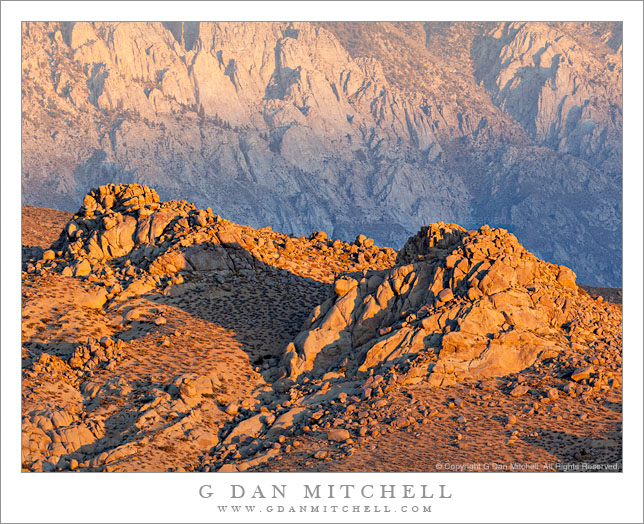
First Light on Zabriskie Point Hills

First Light on Zabriskie Point Hills. Death Valley National Park, California. April 3, 2009. © Copyright 2009 G Dan Mitchell – all rights reserved.

The first morning light touches hills at Zabriskie Point with ridges of the Panamint Range visible in the distance, Death Valley National Park, California.

When I visit Death Valley – typically, at least once each year – I usually try to seek out some of the less iconic scenes. However, I still do visit the icons, too. And Zabriskie Point at dawn may be the best known and perhaps the most photographed “icon” in the park. When I do go to Zabriskie it is usually for one of two reasons. First, if the light or conditions are truly special, I’ll be there with everyone else when the sun comes up! Second, I have a vague project to try to photograph aspects of Zabriskie that are different from the icon views across Gower Gulch or of Manley Beacon. This photographs sort of fits into that second category.

Those who have photographed here more than once become acquainted with the way that the morning light typically unfolds at Zabriskie. The pre-dawn light begins to softly light the entire scene, and before long the very first dawn light strikes the highest ridges of the Panamint Range on the opposite side of the Valley to the west. This light works its way down the face of that range, gradually illuminating the ridges and valleys of the range and spreading horizontally. It then begins to hit the Valley floor and works its way east and closer to Zabriskie and the rest of the ranges along the east side of the Valley. Although the closest hills are in shadow, one can almost sense the beams of light over head that are reaching into the Valley and sense that the angle of this light is gradually working down toward the closest ridges. Then the first light appears on the higher features around Zabriskie Point, at first soft but quickly increasing in intensity.

This photograph was made at this moment when that firs light arrives. The subject is a darker and rugged ridge that rises between the usual vantage points and the backdrop of the distant Panamint range, which in this photograph is somewhat obscured by the hazy atmosphere on a day when giant dust storms were just beginning to develop further north in the Valley.

G Dan Mitchell is a California photographer whose subjects include the Pacific coast, redwood forests, central California oak/grasslands, the Sierra Nevada, California deserts, urban landscapes, night photography, and more.
Blog | About | Flickr | Twitter | Facebook | Google+ | 500px.com | LinkedIn | Email

Text, photographs, and other media are © Copyright G Dan Mitchell (or others when indicated) and are not in the public domain and may not be used on websites, blogs, or in other media without advance permission from G Dan Mitchell.
Mount Humphreys and the Sierra Crest, Dawn

Mount Humphreys and the Sierra Crest, Dawn

Mount Humphreys and the Sierra Crest, Dawn. Near Bishop, California. October 15, 2011. © Copyright 2011 G Dan Mitchell – all rights reserved.

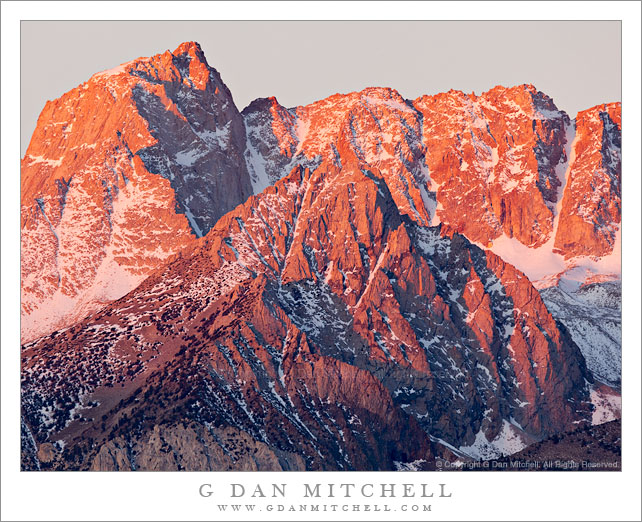
Dawn light falls on the snow-dusted summit of Mount Humphreys and the Sierra Crest above Bishop, California.

On this morning I paused along highway 168 on my way to photograph fall aspen color in the Bishop Creek Canyon area to photograph the first light on the Buttermilk Range and along the section of the Sierra crest near Mt. Humphreys and Center Peak. My main reason for stopping here was to photograph the Buttermilks, the rocky hills along the giant “fan” rising from Bishop toward the base of the escarpment of the eastern Sierra. The plan was to find a good vantage point, put a long lens on the camera, and then pick out various features of the range as the edge of the first light hit them.

With that in mind, I was set up here before dawn and standing around in the cold morning air waiting for the light to arrive. Obviously, before the dawn light can get down to the elevation of the Buttermilks it must first hit the peaks of the crest, and who can resist that kind of light? The very first light that just touched the tip of Mount Humphreys, near the right side of the frame, was almost too intense in comparison to the shadowed lower slopes, so I continued to wait until the light, still very saturated with color, illuminated the full upper faces of the crest and began to light up the lower peaks to the east.

G Dan Mitchell is a California photographer whose subjects include the Pacific coast, redwood forests, central California oak/grasslands, the Sierra Nevada, California deserts, urban landscapes, night photography, and more.
Blog | About | Flickr | Twitter | Facebook | Google+ | 500px.com | LinkedIn | Email

Text, photographs, and other media are © Copyright G Dan Mitchell (or others when indicated) and are not in the public domain and may not be used on websites, blogs, or in other media without advance permission from G Dan Mitchell.

Buttermilk Range, Morning

Buttermilk Range, Morning

Buttermilk Range, Morning. Near Bishop, California. October 15, 2011. © Copyright 2011 G Dan Mitchell – all rights reserved.

Early morning light strikes a ridge in the Buttermilk Range, with the eastern escarpment of the Sierra Nevada in the background.

While in the eastern Sierra last week to photograph aspen color again, I detoured away from the trees at sunrise one morning to photograph the first light striking these hills in the Buttermilk Range above Bishop, California, with a steep section of the Sierra’s east escarpment beyond. The light in this area is often spectacular in the early morning, but it can be especially so when there are some clouds in the sky as was the case on this morning. While it was almost completely clear to the west over the Sierra crest, the sky to the east held some broken clouds which cast alternating patterns of light and shadow across the landscape. Here, while the light on the foreground rocky ridge was very intense and saturated, some haze muted the more distant ridge and the shadow from those clouds slightly obscured the lower slopes.

The Buttermilks are yet another example of the range to subjects to be found in the eastern Sierra. Sometimes I head to these mountains with a plan of shooting a particular subject or even a particular place, but this doesn’t always work out. The weather may change or my schedule may change. Fortunately, if the original subject doesn’t work, there are almost always other choices! This small range tucked up against the Sierra above Bishop – like many other similar places along the “east side” – contains a wealth of photographic subjects to explore.

G Dan Mitchell Photography
About | Flickr | Twitter | Facebook | Google+ | 500px.com | LinkedIn | Email

Text, photographs, and other media are © Copyright G Dan Mitchell (or others when indicated) and are not in the public domain and may not be used on websites, blogs, or in other media without advance permission from G Dan Mitchell.

(Basic EXIF data may be available by “mousing over” large images in posts when this page is viewed on the web. Leave a comment if you want to know more.)