Tag Archives: eroded

Cedar Breaks

Cedar Breaks
“Cedar Breaks” — Eroded sandstone strata at Cedar Breaks National Monument.

Cedar Breaks seems to me a bit of an odd spot. It sits on the edge of a high ridge in Utah just south of the Brian Head ski area. While it is spectacular, it is small, and and out of the way, and I think that it gets a bit lost by comparison to the other iconic parks of the state. In fact, it wasn’t a primary destination for us either — it was near a convenient place to spend a few nights on our way between California and points east of here.

But what it lacks in size and fame, it makes up for in spectacular features. A gigantic west-facing gash cuts into the summit of a high plateau. (The difference between that gentle plateau and this feature is remarkable.) Rather than the gigantic solid masses of sandstone found in places like Zion, Capitol Reef, and Arches, here the terrain is softer and the strata seem thinner, giving it a very different character.


Leave a comment or question using the form. (Click the title to see the full article and to comment if you are viewing it on the home page.)

G Dan Mitchell is a California photographer and visual opportunist. His book, “California’s Fall Color: A Photographer’s Guide to Autumn in the Sierra” (Heyday Books) is available directly from him. Blog | Bluesky | Mastodon | Substack Notes | Flickr | Email

All media © Copyright G Dan Mitchell and others.
Desert Gully

Desert Gully, Death Valley
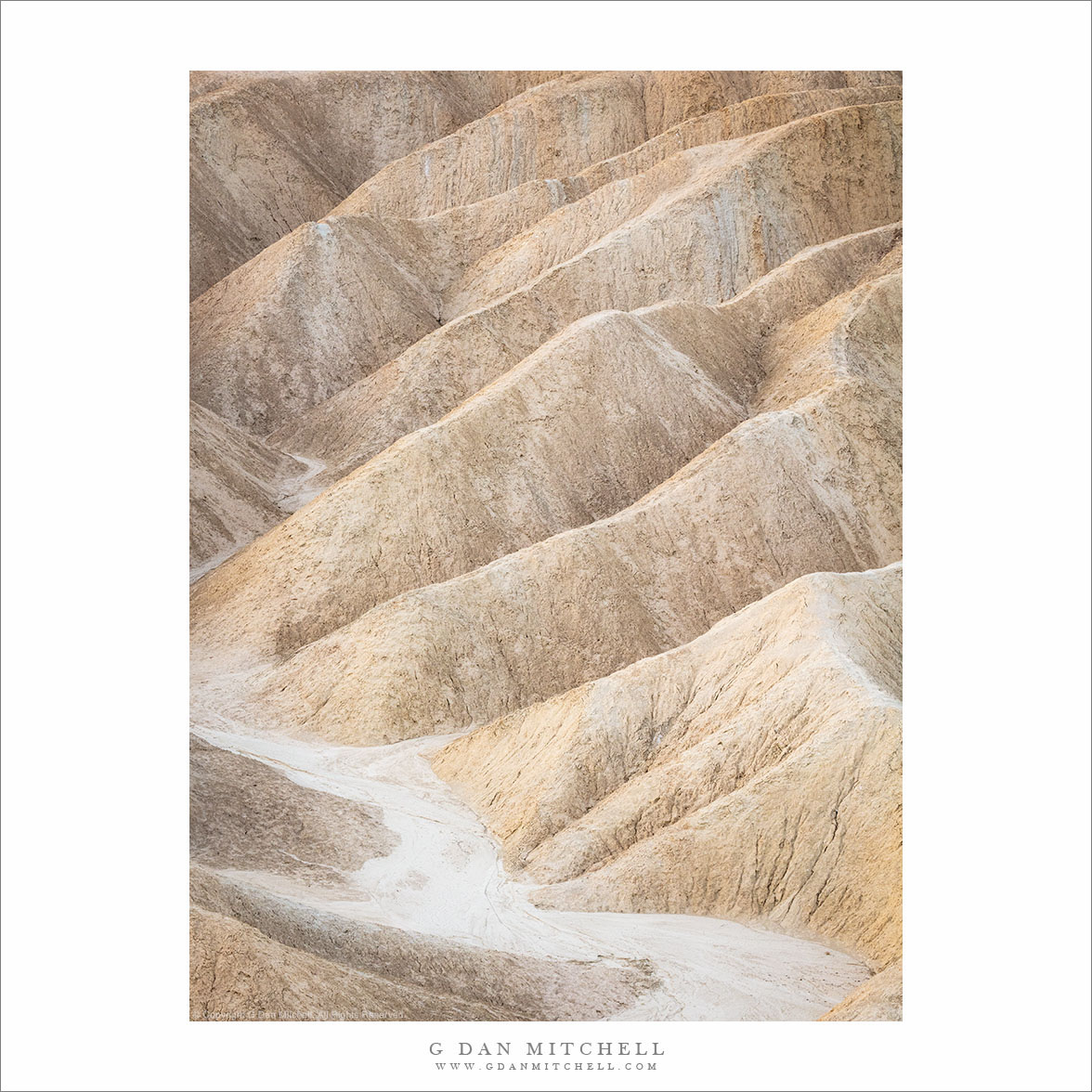
“Desert Gully” — Eroded formations and a desert gully, Death Valley.

The desert landscape of Death Valley National Park seems fairly static. Yes, we see dust storms blow things around a little, but even the shapes of the dunes remain fairly constant over time. The mountains and the playas look much as they did when I first saw them 25 years ago. But the reality is that this is a very dynamic landscape, and it is constantly being built up and torn down. This photograph is an obvious example of the latter process.

This light material was laid down millennia ago in the distant prehistoric past, long before people were here — and before there were even “people” at all. Over vast stretches of time the material was transformed — squashed, bent, tilted. Eventually a combination of uplift and erosion exposed it, and other processes kicked in. Here, those processes — including flowing water — have eroded and continue to erode the layers, producing this maze of small gullies and the fine silt seen at the bottom of the photo.

G Dan Mitchell is a California photographer and visual opportunist. His book, “California’s Fall Color: A Photographer’s Guide to Autumn in the Sierra” (Heyday Books) is available directly from him. Blog | Bluesky | Mastodon | Substack Notes | Flickr | Email

Join the discussion — you are welcome to leave a comment or question. (Comments are moderated and may not appear immediately.)

This site uses Akismet to reduce spam. Learn how your comment data is processed.

(All media © Copyright G Dan Mitchell and others.)

Fractal Landscape

Fractal Landscape, Death Valley National Park
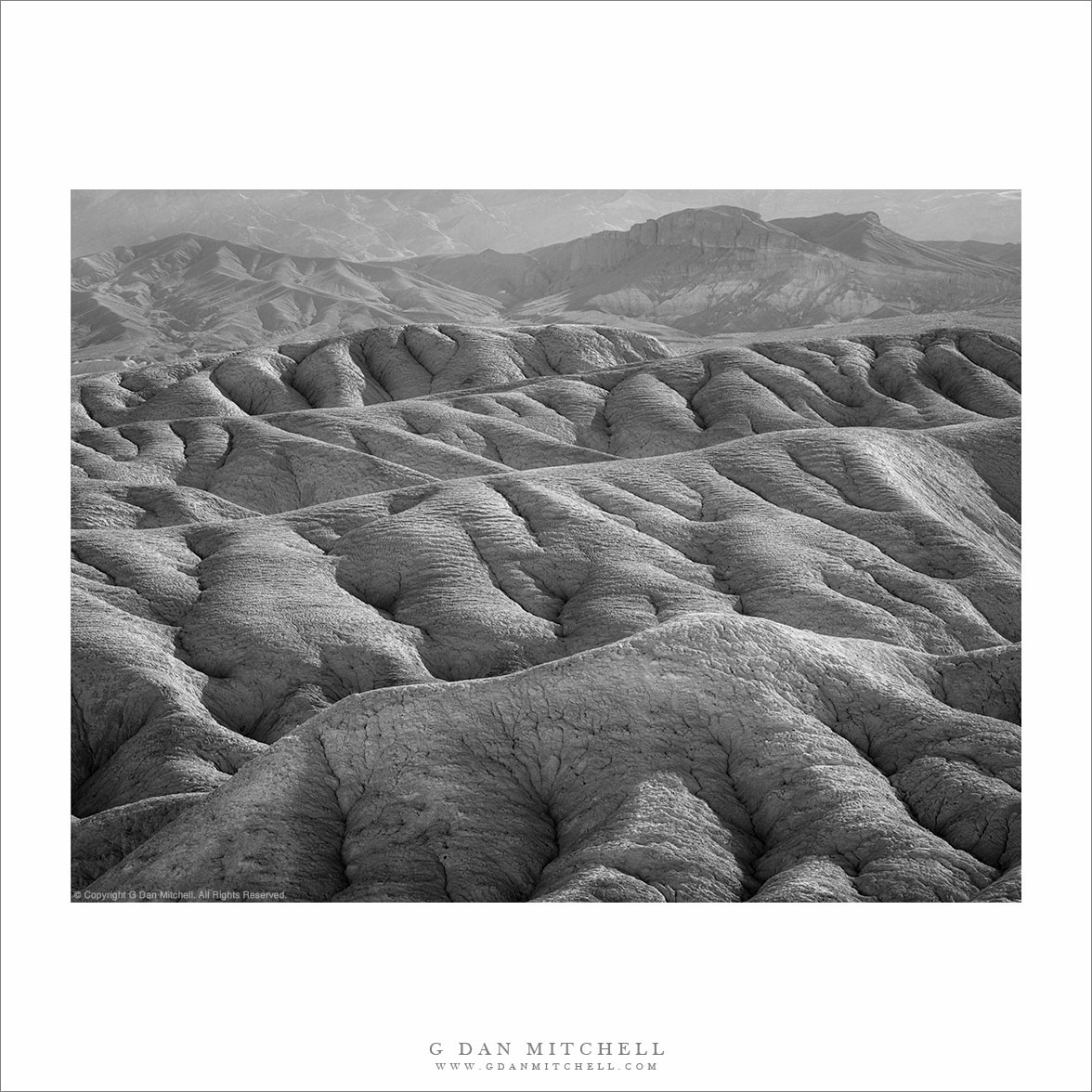
“Fractal Landscape” — A Death Valley landscape of layers of eroded ridges.

This view has intrigued me for years. At one popular Death Valley National Park location, one comes upon it quickly and often briefly. Because it is the coda of visits to this area that has many other attractions, it is easy to overlook it. It is harder to photograph than it seems that it should be — there are some compositional challenges, and unless the light is right the scene can have very low contrast and tricky colors.

The variety of pattens and details in the scene is remarkable. The first four ridges are low and consist of soft, easily eroded material. The more distant ridge is far away, across an intervening valley, and its details are almost always muted by haze. The foreground formations are deeply eroded and cut by gullies — which might seem like an odd thing at first when you consider that you are in an extremely hot and arid desert.


G Dan Mitchell is a California photographer and visual opportunist. His book, “California’s Fall Color: A Photographer’s Guide to Autumn in the Sierra” (Heyday Books) is available directly from him.

G Dan Mitchell: Blog | Bluesky | Mastodon | Substack Notes | Flickr | Email


All media © Copyright G Dan Mitchell and others as indicated. Any use requires advance permission from G Dan Mitchell.

Dunes and Desert Hills

Dunes and Desert Hills, Death Valley
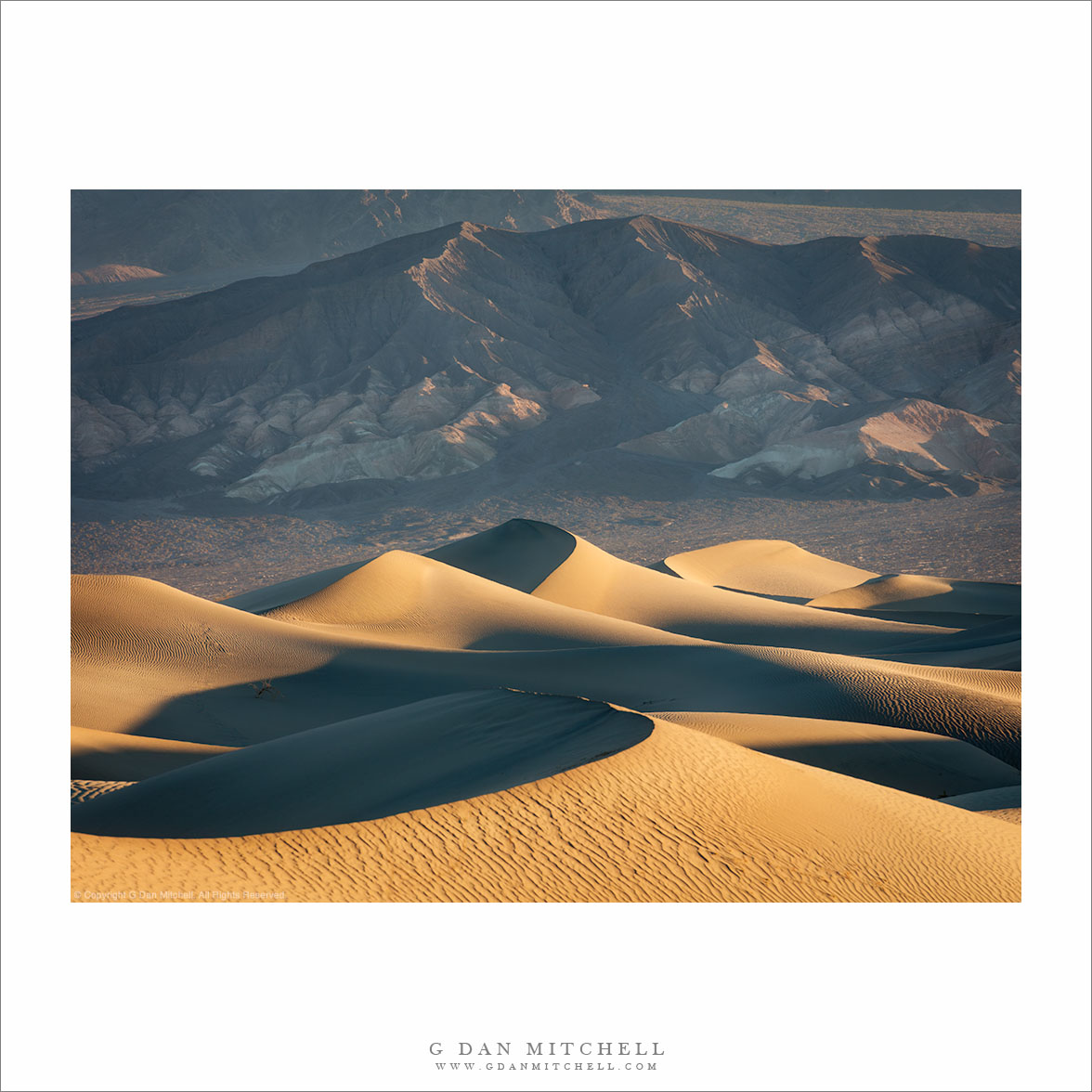
“Dunes and Desert Hills” — Early morning light on sand dunes and eroded desert hills, Death Valley.

Sand dunes were the primary attraction when I first visited Death Valley a couple of decades ago. They are visual icons of the place, and any new visitor would want to see them. For me, a person whose wilderness experience had been almost exclusively focused on the High Sierra, the dunes were exotic and new. Over time I discovered that there is a much more to this place, and the dunes are no longer at the top of my list of Death Valley destinations. Yet, I can’t let a trip go by without at least a brief visit.

This time my hour of dune photography was a prelude to other activities. I got up in darkness so that I could in position a half hour before sunrise. There is no denying that morning light in the dunes can be spectacular. After all these years, I’m still caught off guard by how quickly the dunes go from pre-dawn soft shadows to morning light and by the short period of extremely saturated colors right around sunrise. I photographed for perhaps 45 minutes, then hiked back to my car and headed to my real target for the day.


G Dan Mitchell is a California photographer and visual opportunist. His book, “California’s Fall Color: A Photographer’s Guide to Autumn in the Sierra” (Heyday Books) is available directly from him.

G Dan Mitchell: Blog | Bluesky | Mastodon | Substack Notes | Flickr | Email


All media © Copyright G Dan Mitchell and others as indicated. Any use requires advance permission from G Dan Mitchell.