
Tag Archives: face

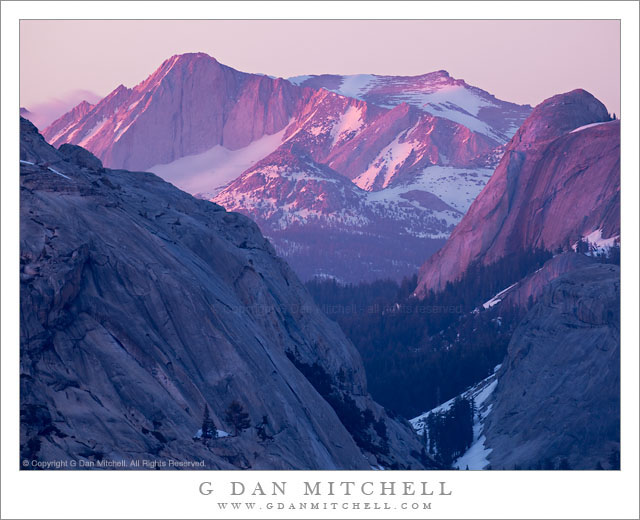
Alpenglow, Mount Conness

Alpenglow, Mount Conness

Alpenglow, Mount Conness. Yosemite National Park, California. June 18, 2011. © Copyright G Dan Mitchell – all rights reserved.

The last evening light illuminates domes near Tenaya Lake and the summit of Mount Conness with briilliantly colorful alpenglow, Yosemite National Park.

The tall peak at upper left is the summit of Mount Conness, one of the highest peaks in Yosemite National Park. The peak is located on the park boundary and the Sierra Nevada crest a bit north of Tioga Pass, and is visible from many places in the Tuolumne/Tioga high country. It is also a popular destination for peak baggers. The left foreground granite dome is the lower face of Polly Dome, which drops to the shoreline of Tenaya Lake. The left slope of Pywiak dome is visible in the shadows at lower right and beyond is the more brightly illuminated Medlicott dome.

I forgive you if you don’t believe the colors that you see in this photograph. I barely believe them myself, and I was (obviously!) there for the show. What happened on this evening was a near perfect example of a light phenomenon that Sierra photographers watch for and are occasionally lucky enough to experience. I have learned to see the signs that indicate that this light is possible, but also to understand that even when the conditions offer this potential that they rarely deliver.

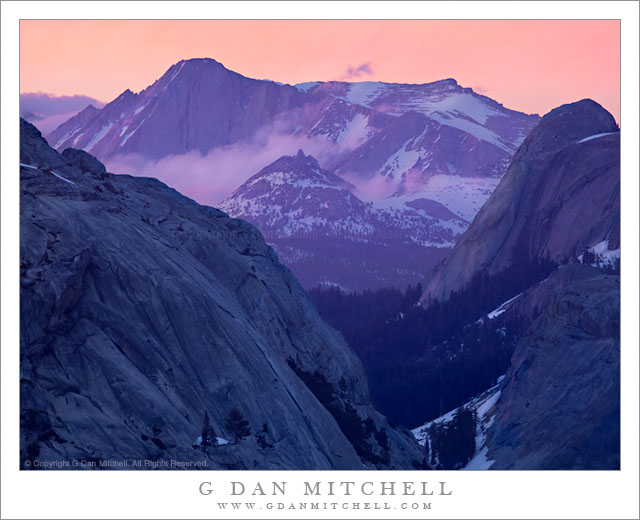
On certain cloudy evenings in the Sierra it appears that there will be no sunset color – everything is hazy and drab and washed out. But if things play out just right, this very set of drab conditions (that induce some photographers to put away their gear too soon!) can produce some of the most striking and intense color possible if a few things fall into place just right. On this evening I had stopped for a moment at Olmsted Point, thinking to photograph ice-covered Tenaya Lake with a long lens and including the mass of Mount Conness in the distance. When I arrived there, things were about as unpromising as they could possibly be. A dull, greenish-blue haze hung in the air, overcast washed out the light, and Conness was obscured by clouds. I had actually put my gear back in the car when I looked back up and noticed that the summit of Conness had briefly poked through the clouds, accentuating its bulk and the sense that it towered over the foreground mountains. The light was still awful (I have the photos to prove it! ;-) but I thought I’d see if I could get something with the peak emerging from its shroud.

But still nothing much happened. I turned the camera to photograph some nearby trees and a blackbird that was looking for snacks. Then I noticed that there was some brighter light to the southwest and I began to consider the possibility that the cloud cover might end a bit to the west – and that is requirement #1 for the light conditions I’m describing. If the cloud deck ends to the west, as the sun reaches the horizon it may briefly break under the clouds and send brilliantly colorful light up into the clouds in the Sierra from below, creating a miles-wide light panel of the most astonishing colors. But still, it was hazy and the peaks were shrouded in clouds. But then I noticed that the clouds around Conness were beginning to drift off to the east and thin a bit. I mentioned (knock on wood!) to one of the other photographers that there was a possibility of “miracle light,” but that I wasn’t making any promises!

Then the thinning clouds began to pick up a slight pink tinge and the left side of Conness began to get some light directly from the west. Then, within a minute or so, the colors went absolutely crazy. People around me were audibly gasping as the color changed. At one point several of us spontaneously looked up to the west when we noticed the light suddenly increase out of the corners of our eyes. At the same time, the clouds almost completely dissipated from the area around the peak and because the whole sky was filled with brilliantly colorful clouds, this light began to suffuse even the depths of the canyon and slopes facing away from the sunset with this amazing light.

Never put your camera away until the last light is gone. :-)

G Dan Mitchell Photography | Flickr | Twitter (follow me) | Facebook (“Like” my page) | LinkedIn | Email
Text, photographs, and other media are © Copyright G Dan Mitchell (or others when indicated) and are not in the public domain and may not be used on websites, blogs, or in other media without advance permission from G Dan Mitchell.
Oak, Laurel, and Granite

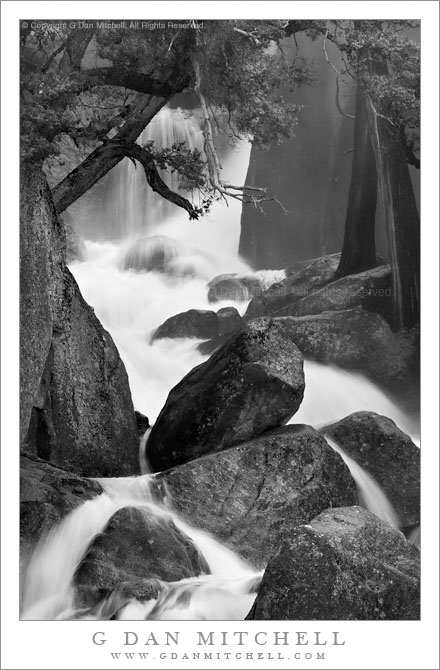
Oak, Laurel, and Granite

Oak, Laurel, and Granite. Yosemite Valley, California. May 7, 2011. © Copyright G Dan Mitchell – all rights reserved.

An oak tree and a laurel tree grow next to a granite face along the north side of Yosemite Valley, California.

I have visited this small, gnarled oak tree before. It grows right at the base of a granite face along the north side of Yosemite Valley, seems to face a pretty rugged life living beneath the shadow of the cliff and among fallen boulders. When I visited in early May the tree was just starting to get its new growth of leaves, though the laurel tree right next to it was already quite green.

The last time I photographed this tree it was autumn, and the leaves were also colorful then. It seems a bit odd that the leaves of this oak take on similar yellow and red colors at both the start and end of their season. (Though they do go more toward brown than yellow in the fall.)

The light was interesting on this day, which had started out clear. As the day wore on a weak Pacific weather front approached, and by evening things were pretty well socked in. But here, at perhaps 4:00 or 4:30, if I recall correctly, the incoming clouds were thing and broken enough to just soften the light without turning it completely gray.

G Dan Mitchell Photography | Flickr | Twitter (follow me) | Facebook (“Like” my page) | LinkedIn | Email
Text, photographs, and other media are © Copyright G Dan Mitchell (or others when indicated) and are not in the public domain and may not be used on websites, blogs, or in other media without advance permission from G Dan Mitchell.
Young Tree and Granite Wall

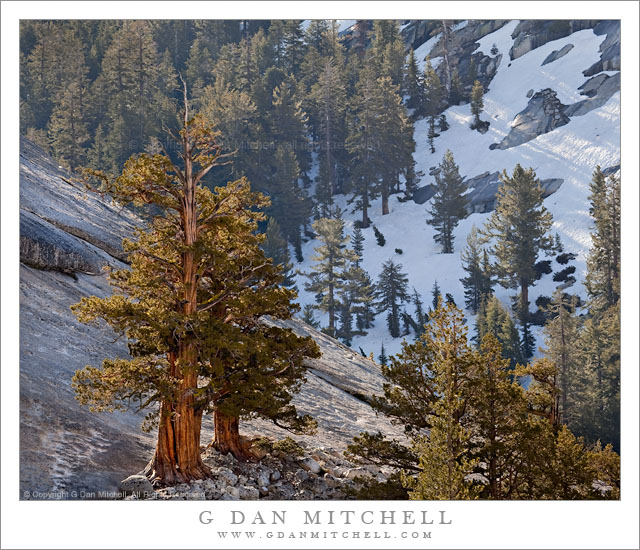
Young Tree and Granite Wall

Young Tree and Granite Wall. Yosemite Valley, California. May 7, 2011. © Copyright G Dan Mitchell – all rights reserved.

A young tree grows against a granite wall along the north side of Yosemite Valley.

This tree (and its nearby oak partner) and I have become good friends over the past few years. I first photographed it in the fall some years back, though the oak made a better shot at that time given its fall color leaves. But every time I walk along a certain area under the cliffs on the north side of Yosemite Valley I check in here to see what the light is doing.

During the first weekend of May I was in the Valley for photography and to visit the reception for Michael Frye’s exhibit at the Ansel Adams Galley. After spending an enjoyable hour and a half or so viewing Michael’s prints and meeting and talking with a wonderful group of photographers and photography enthusiasts at the Gallery I left to go wander a bit and make some photographs. When I came to this spot, clouds were starting to appear in the late afternoon sky above the Valley. This is a kind of ideal light since these conditions soften but don’t completely destroy the sunlight, and diffused light gets down into the forest and fills out the shadows.

I love the texture of these huge blocks of flat granite, covered with lichen. I like the visual quality of this rock, but I also like the physical quality of it; this probably dates back to a time some years ago when I was a rock climber for a few years. So while the tree seems like the main subject here, the rock surface is for me just as important.

G Dan Mitchell Photography | Flickr | Twitter (follow me) | Facebook (“Like” my page) | LinkedIn | Email
Text, photographs, and other media are © Copyright G Dan Mitchell (or others when indicated) and are not in the public domain and may not be used on websites, blogs, or in other media without advance permission from G Dan Mitchell.

Post-Sunset Glow, Amargosa Range

Post-Sunset Glow, Amargosa Range

Post-Sunset Glow, Amargosa Range. Death Valley National Park, California. March 29, 2011. © Copyright G Dan Mitchell – all rights reserved.

Post-sunset light from bright red clouds casts a reddish glow on the Amargosa Range, Death Valley Buttes, and the Kit Fox Hills.

I think this might be the second in what I could call the “impossible color” series from my late-March trip to Death Valley. (The previous image was a photograph of a wash/alluvial fan at the base of Tucki Mountain, photographed on the same evening.) The lurid and unreal colors are not the result of post-processing gone horribly wrong – the light was actually this color for a short period. The sun had already gone down behind the Cottonwood Mountains to the west of my shooting location in the middle of Death Valley not far from Stovepipe Wells. It had been an interesting sunset with the usual increase in warm colors and some attractive clouds in the sky.

What happened next was something that is probably familiar to those who have done a lot of landscape photography, though they recognize that it is not something that you can quite predict. After the sun had set and dusk was coming on, some final light from far to the west, where the sun had probably already dropped just below the horizon, began to strike high clouds above Death Valley. (I could sort of see this coming, since I had noticed increasing color in the sky further to the east.) As this happened, these clouds began to glow with an intense red color that was mixed with the normal bluish tones of dusk light and surface features took on this purple/red glow for just a brief moment before the light faded.

(Those who look very carefully may notice that the sky above and to the east of the mountains is a lot bluer than the mountains themselves. The color had already left the sky to the east, and at this point was coming from the sky directly overhead and to my west.)

I’m still trying to sort out the complex geology of this area and the ways that features are named. The larger range containing these peaks is called the Amargosa Range, though it encompasses many smaller named sub-ranges – I think these might be part of the Grapevine Mountains, roughly in the neighborhood of Thimble and Corkscrew Peaks. A dark peak in front of the main range at the very far right may be part of Death Valley Buttes, and the banded foreground hills are sometimes called the “Kit Fox Hills.”

G Dan Mitchell Photography | Flickr | Twitter | Facebook |
LinkedIn | Email
Text, photographs, and other media are © Copyright G Dan Mitchell (or others when indicated) and are not in the public domain and may not be used on websites, blogs, or in other media without advance permission from G Dan Mitchell.