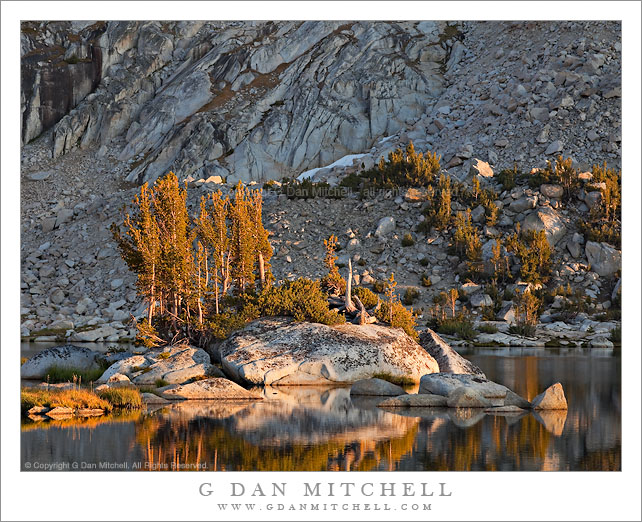
Sunset light illuminates trees on a rocky peninsula, reflected in the surface of alpine Upper Young Lake, Yosemite National Park, California.
This is one more and perhaps the last in the sequence of photographs made on a mid-September evening at Upper Young Lake. I mentioned in a previous post that I had walked up here from my campsite to photograph in the beautiful evening light, and after wandering about and making a few other photographs I finally decided to focus my efforts on this scene featuring tree-covered rocks at the end of a small, curving peninsula. I began shooting just as the “golden hour” time began, and continued until the light was quite dim… and I had to start heading back down what passes for a trail to my camp at a lower lake. This photograph was made at a point at which the light had really begun to warm up as the sun dropped toward the horizon, but before the very last (and very red) light.
A comment on why I have posted several photographs (four by now?) of more or less this same scene rather than selecting “the best” one… I’ve previously written about my reasons for posting daily photographs at the blog, which include practice and encouraging me to regularly take photographs all the way through at least an initial post-processing workflow. The latter gives me a better opportunity to get to know the different images, both as I work on them and I I consider them after posting. So, frankly, I don’t necessarily have a clear favorite at this point.
This photograph is not in the public domain and may not be used on websites, blogs, or in other media without advance permission from G Dan Mitchell.
Morning light on the shoreline forest at Lower Young Lake.
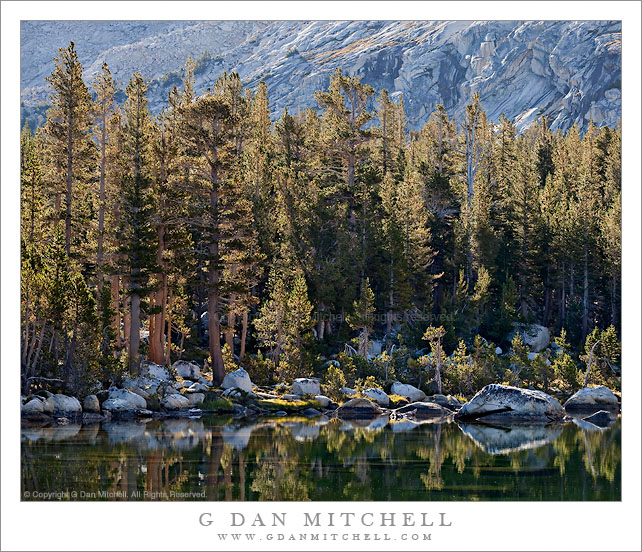
After finally managing to convince myself to get out of my warm sleeping bag and bivy sack oh-so -early on this cold, late-summer morning, I grabbed my tripod, camera, and lenses and headed down to the shoreline of this lake. (That’s right – no breakfast. My routine is generally to simply get up and start shooting. I might work for as long as a few hours before the light is no longer what I want, at which point I make my way back to my camp to fix coffee and breakfast.) Although I know this lake pretty well at this point, there are always new things to discover when I look closely, and the conditions are never the same twice. Although I’ve walked past this little bit of shoreline forest many times – the trail goes right through here – this is probably the first time I’ve photographed this spot. I’m often intrigued by backlit trees – for the long shadows, the color of light coming through leaves and branches, and the darker and mysterious quality of the trunks – and several other things also caught my attention here. There was still a bit of late-season green in the small plants down close to the ground, and I liked the obstructed view of the lake surface, the far shore, and the rocky slopes above.
This type of scene and lighting poses some challenges, the most obvious being the wide dynamic range. There are very bright specular highlights reflecting from the needles of the trees and the bright areas of the tree trunks can also be very bright. In this scene there was an additional source of “bright” where the rocks above the far shoreline were directly lit by sunlight. The trick is to not blow out all of those highlights – though a bit of “blow out” on tiny specular highlights can be OK – while still retaining some detail on the shaded side of the trees. Often I resort to exposure bracketing (making two or three different exposures to be blended in post) and, in fact, I did approach this scene that way. However, by shooting RAW and working carefully in post I was able to control the highlights and bring back some of the subtle shadow details.
This photograph is not in the public domain and may not be used on websites, blogs, or in other media without advance permission from G Dan Mitchell.
Early evening light on a tree-covered rocky peninsula at Upper Young Lake, Yosemite National Park, California.
I’ve visited these lakes almost annually for a number of years, since I first visited one autumn on a long day hike from the Tuolumne Meadows area. Many people visit the lower lake on day hikes, quite a few others backpack to the area and visit all three, and climbers on their way to Mount Conness also pass through the area. My plan was to stay several days so that I could do a lot of photography in the area. The upper lake provides a beautiful sub-alpine scene, surrounded by relatively level meadows with small hills interspersed with rocky rises and groves of trees. Because the area is open to the west there can be stunning evening light here… and that I precisely why I went to the lake on this evening.
I was camped at the lower lake, where I had photographed in the morning. After I finished up my morning photography I spent a good part of the late morning and early afternoon eating a post-shoot late breakfast, more or less hanging out, reading, doing a few camp chores, and finally having a very early dinner at about 3:00 – the plan is to eat the big meal of the day early, go off and do photography as the evening light approaches, and then return to camp after dark and have something to eat before climbing into the sleeping bag.
The route that I prefer to use to get to the upper lake is not really exactly a trail. Anticipating that I’d be returning from the upper lake via this route in near or actual darkness, as I climbed it I made sure to remember a series of landmarks that I could use to find my way back. At various junctures on the route – as I would do on any similar route – I stopped to look backwards and fix in my mind certain obvious route cues that I could follow on the way back: stay above the thicker trees, stay in the middle of the bench, cross the low rise while heading straight toward a certain distant ridge, begin the descent at the two groves of trees next to the lake, and so on. I was so focused on this that when I reached my final landmark at the upper lake I barely looked around – I arrived at the final grove and immediately turned right to walk the short distance to the lakeshore and look for compositions. At about this point I recalled that I also had planned to check out camping possibilities for a future visit, so I looked back up at the grove I had just left.
I saw a tent and two people and tripods – all of which I had completely overlooked at first, so fixated was I on my “route.” I walked back up to say “hi” when I noticed that one of the two photographers looked quite familiar. I approached and said, “You bear a striking resemblance to John Sexton” – which made a lot of sense in that he was John Sexton. (If you don’t know who he is… you should. Follow the link to his web site and perhaps do a bit of searching to find out more.) I have, of course, known of John’s wonderful photography for some time and I had most recently been to a lecture at the opening of a show of his work in Carmel earlier this summer. The other photographer was Anne Larsen.
The wilderness is always full of surprises, but meeting John and Anne in the Yosemite back-country was one of the most pleasant in recent memory. We spoke for a while until the light began to become more interesting, but at various times during the evening we again ran into one another and talked about this and that. The next morning I met them once again as we were heading back to the trail head. (I felt a bit guilty about my “tiny” 15 pound load of photography equipment – they were each carrying close to 30 pounds of film gear!)
The photograph is of a tree-covered rocky rise at the end of a narrow curving peninsula that forms a small lagoon near the outlet of the lake. My initial thought had been to photograph a small tree near the edge of the lake – one that I have photographed in the past – but John correctly pointed out that it would be in shadow at the time of best light, so I decided to focus on this subject instead.
This photograph is not in the public domain and may not be used on websites, blogs, or in other media without advance permission from G Dan Mitchell.
Ridgetop trees and boulders along the trail catch the afternoon light at Artist Point, Mt. Baker-Snoqualmie National Forest, Washington.
I had been admiring this steep, rugged, and distant ridge all afternoon, starting with our first shooting location down lower on the mountain. As we hiked up the Artist Point trail, we took a detour to the right and I noticed this low rocky ridge covered with trees and the ridge in the distance. At first I couldn’t quite see a shot and I looked elsewhere, but soon I came back to this spot and thought that something with the foreground rocks and trees along with the clouds and more distant ridge might be interesting – but as soon as I saw this a large cloud floated over and blocked the sun from my position, leaving the nearby trees and rocks in shade!
Sometimes when this happens it makes more sense to move on and look for a photograph that works with the conditions you have, but other times it can be worth waiting. It is hard to know for sure which is right, but I decided to set up and sit tight, waiting to see if the light would improve. The light shining around the edge of the cloud was tantalizingly close, but the cloud was stubborn about moving. At one point the light increased a bit for perhaps 15-20 seconds, but then quickly went away. I continued to wait. Finally, the light began to gradually increase, and I got about one minute or less of sun before the cloud again blocked the light – but this was long enough to make a few exposures of this scene.
I have a favor to ask of anyone who is familiar with this area – help in identifying the trees and, even more, help in identifying/naming the distant ridge and the peaks that sit on it. I’m not great at plant identification, but I’m really out of my league in the Cascades. One person walking by as I made the shot seemed to think that the trees are mountain hemlock – but I’d be grateful if anyone can confirm this… or set me straight. Although I was impressed with the peaks on the ridge in the distance in this photograph… I do not have any Washington topographical maps or guide books, so I’m completely in the dark about what to call this ridge or the peaks. Here, too, I would be grateful if anyone can help me identify the ridge, the peaks, and any other important features in the photograph.
Update: A Facebook reader shared information about the peaks on the distant ridge in this photograph…
Alan Majchrowicz writes: “From left to right, Tomyhoi Peak, Canadian and American Border Peaks, Larrabee Mountain. Nice photo Dan, hope I can break away this week and spend some time up there!”
This photograph is not in the public domain and may not be used on websites, blogs, or in other media without advance permission from G Dan Mitchell.