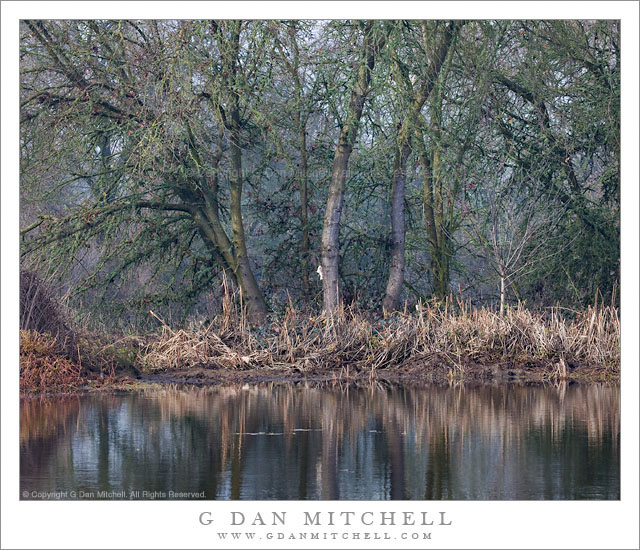
Weak sunlight breaks through Central Valley tule fog to illuminate trees and brush growing on a levee near the Cosumnes River.
This morning started out with extremely dense Central Valley tule fog – at first so thick that I more or less gave up photographing. But eventually, as usually happens, the upper layers of the fog began to thin, and some light began to filter down through the fog. By late in the morning the fog was thinning enough that very pale sunlight began to show through and softly light the dense vegetation on this levee along the edges of the Cosumnes River. This is an incredibly rich environment in the winter, especially with all of the water from winter rains and the nearby river, and the vegetation grows very thick here.
A bird wades in a flooded Central Valley winter field in front of a receding line of power poles and some farm buildings on a levee.
This is (yet another!) photograph of the flooded fields along a country road near the Cosumnes River in California’s Central Valley. I was shooting almost directly into the sun through remaining fog and haze near the middle of a winter day. The building sits on a levee between the fields and the bird was kind enough to pose for me while I made the photograph.
Given one of the subjects subject that I’ve been discussing at the blog during the past few days, it seems reasonable to point out that this image involved significant work during the post-processing phase – what we used to refer to as “the darkroom,” but which we now refer to as “photoshop.” I used a variety of techniques to push this image towards what I had in mind – a very high key interpretation that I hope evokes the sensation of looking into a backlit hazy atmosphere that is so bright that you can barely look at it. (In fact, it was very much like this when I made the photograph – as you can see it required a 1/1000 second exposure at f/8 and ISO 100. That’s bright!) In general I brought the overall brightness up to nearly pure white in the lightest portions of the image, and I employed some other techniques to lower the amount of contrast in the sky yet keep the building, the poles, and the levee fairly dark. Although all of this was accomplished in the “digital darkroom,” all of the processes are equivalent to those that might have been applied by photographers working in the traditional darkroom.
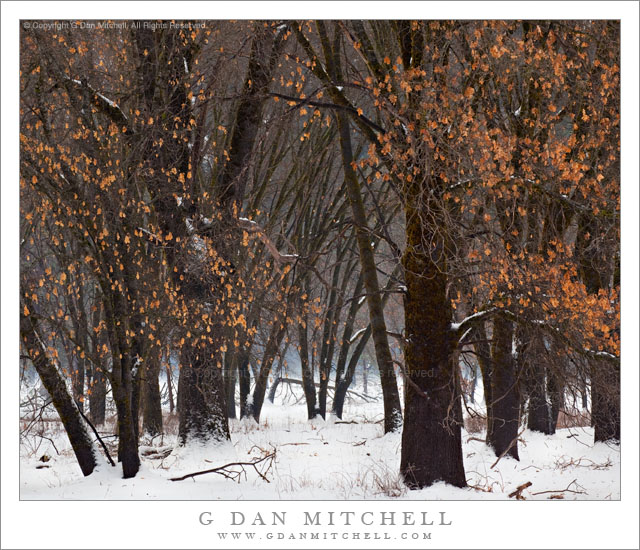
Black oak trees with a few remaining autumn leaves in foggy and snow-covered El Capitan Meadow, Yosemite Valley.
I’m always fascinated by the trees in El Capitan Meadow – it doesn’t matter whether it is spring when the meadow is green and the trees are getting new leaves, summer when the meadow is filled with people watching climbers overhead on El Capitan, fall when the grasses turn golden and the leaves change to fall colors, or winter when the meadow may be snow-covered. Sometimes I tell myself that I’m just going to drive past on my way to another destination, but I almost always end up stopping for a least a brief look around – and I frequently end up making a few photographs.
That was the case on this mid-January day, when I drove through on my way to make photographs up on Crane Flat Road. As I passed by the meadow I noticed that low fog was floating above the snow, so I pulled over to look at the scene more closely. I was somewhat surprised to see how many leaves were still hanging on the oak trees so late in the season, and I decided to try to find a photograph that would include them, along with the snow and a bit of the fog and the dark shapes of the tree trunks.
Photographing Horsetail Fall has increasingly become “the thing to do” in Yosemite Valley for quite a few photographers this time of year. Horsetail is a seasonal waterfall that drops from near the eastern end of El Capitan in Yosemite Valley, and for a few weeks each winter may catch the setting sun to produce quite a visual show when the conditions are just right. I’m not going to offer a how-to for photographing Horsetail – good ones are available elsewhere, and as beautiful as the sight can be, I have a sort of “been there, done that” attitude towards it at this point.
Which is not to say that I won’t point my camera that direction if I find myself in the area! I did so for a few minutes last weekend, even though it was well before the time when the sunset show begins, and even though it was the middle of the afternoon. I happened to be photographing something else below the fall and after I finished I looked up and noticed that the flow of water over Horsetail was as strong as I’ve seen it. I had a long lens on the camera, so I pointed it up and made a few photographs.
Here is the odd thing… In the photographs made with this telephoto lens I can clearly see that a long climbing rope ascends from the right to the first ledge that the water hits, crosses the ledge, and continues its ascent to the left of the fall. It appears to be a fixed rope that someone left in place, and I can only wonder about possible explanations. Did someone have to leave it behind earlier in the season? Did someone leave it with the intention of coming back and traversing through the fall?
If it does remain much longer, there may be some disappointed photographers who find a glowing rope draped across their photographs of the fall this season…
Photographer and visual opportunist. Daily photos since 2005, plus articles, reviews, news, and ideas.
Manage Consent
To provide the best experiences, we use technologies like cookies to store and/or access device information. Consenting to these technologies will allow us to process data such as browsing behavior or unique IDs on this site. Not consenting or withdrawing consent, may adversely affect certain features and functions.
Functional
Always active
The technical storage or access is strictly necessary for the legitimate purpose of enabling the use of a specific service explicitly requested by the subscriber or user, or for the sole purpose of carrying out the transmission of a communication over an electronic communications network.
Preferences
The technical storage or access is necessary for the legitimate purpose of storing preferences that are not requested by the subscriber or user.
Statistics
The technical storage or access that is used exclusively for statistical purposes.The technical storage or access that is used exclusively for anonymous statistical purposes. Without a subpoena, voluntary compliance on the part of your Internet Service Provider, or additional records from a third party, information stored or retrieved for this purpose alone cannot usually be used to identify you.
Marketing
The technical storage or access is required to create user profiles to send advertising, or to track the user on a website or across several websites for similar marketing purposes.