
Tag Archives: morning

Redwing Blackbird, Fog

Redwing Blackbird, Fog

Redwing Blackbird, Fog. Calero Hills, California. April 18, 2009. © Copyright 2009 G Dan Mitchell – all rights reserved.

A redwing blackbird rests on a branch on a foggy early spring morning at Calero County Park, California.

Although this photograph was made in April, it evokes the Central and Northern California winter for me. This is a time when tule fogs are common – the inland valley fogs, which are different from the coastal fog of warmer months – and when the number of birds and other wildlife seems to increase, perhaps because fewer people are out and about than in the summer.

This photograph was made at a small pond that is not too far from where I live. It is near the start of a trail that I have hiked many times, a trail that eventually rises through grass and oak covered hills to low ridges that catch the morning sun. The small ponds is only perhaps five minutes from the start of this trail, and it is a place where I can often find local and not-so-local wildlife if I arrive early and approach quietly.

G Dan Mitchell is a California photographer whose subjects include the Pacific coast, redwood forests, central California oak/grasslands, the Sierra Nevada, California deserts, urban landscapes, night photography, and more.
Blog | About | Flickr | Twitter | FacebookGoogle+ | 500px.com | LinkedIn | Email

Text, photographs, and other media are © Copyright G Dan Mitchell (or others when indicated) and are not in the public domain and may not be used on websites, blogs, or in other media without advance permission from G Dan Mitchell.
Tuolumne River Below Glen Aulin, Morning

Tuolumne River Below Glen Aulin, Morning

Tuolumne River Below Glen Aulin, Morning. Yosemite National Park, California. September 16,2011. © Copyright 2011 G Dan Mitchell – all rights reserved.

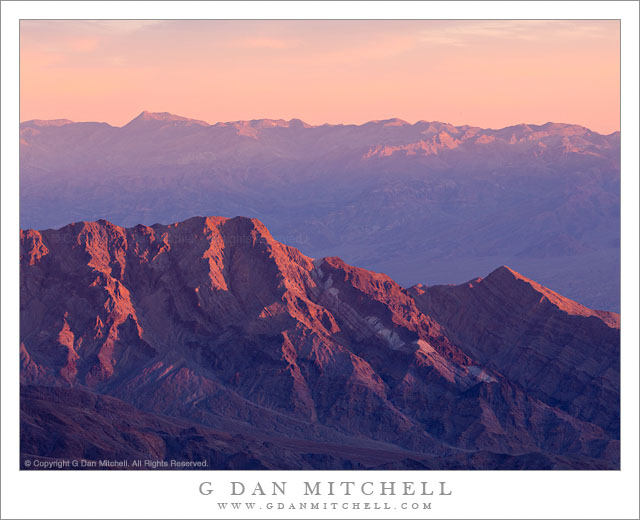
Early light on morning clouds above the Tuolumne River Canyon below Glen Aulin, Yosemite National Park.

This is the same bend in the Tuolumne River, located below Glen Aulin and before the river descends toward Waterwheel Falls and eventually the abomination of Hetch Hetchy Reservoir, that was shown in a photograph of late afternoon light that I posted here a few days ago. This time it was early morning. We had been up well before sunrise and had wandered off in various directions to find early morning photographic subjects. My main goals were the cascading water along the edge of this section of the river (a bit of which is visible in the lower portion of the frame) and a granite bowl to the right of this view. As I came over the rise above this area before descending I saw the beautiful sparse clods to the west, probably extending to the edge of the Sierra and still with pastel colors from dawn light.

A technical observation about this photograph. This scene presented a technical challenge in the form of an extremely wide dynamic range between the bright and red-saturated first direct sunlight on the ridge at upper left and the much darker areas of forest in shade along the river and in the foreground. With a digital exposure, in a scene like this one, the primary rule for me is “don’t blow out the highlights.” If I had overexposed the sky the clouds would have turned into pure white, texture-free blotches and that bit of early sun on the rocks would have lost detail and taken on a very strange coloration. However, an exposure that protects the highlights in a scene like this one can leave the shadows nearly black. While it is possible to “fix” that a bit in post, the result is not necessarily very good when the dynamic range is very large. One “traditional” solution would have been to use a graduated neutral density filter (or “GND”) that blocked some of the brightest areas at the top of the frame while not affecting the lower 2/3 or so. But I don’t use them, and in this case the result would not have been totally wonderful since the same filtering that would reduce sky brightness would also make the large granite dome at the right end up nearly black at the top.

So instead of filtering at the time of exposure, I decided that I would use the roughly comparable, but more flexible, “exposure blending” techniques in post. With that in mind I made several photographs at different exposures – some at shorter shutter speeds to avoid the blown out highlights and others at increasingly slower shutter speeds to reveal the shadow detail that my eyes could see but which the camera otherwise could not. During the post-production phase, I selected two of the exposures, one that was as bright as possible but without blowing out the sky and sunlight, and the other two stops lighter to reveal that shadow detail in a way that seemed consistent with what I recall the scene actually looked like. The two source images were carefully adjusted during raw conversion and their two layers carefully aligned. With the darker image (the one with the “good” sky) on the top, I began to “paint” out the mask to reveal the details of the foreground forest, river, and rocks. (In answer to the expected question, this is not the same as HDR. That is a more or less automated process that works in a different way. Exposure blending is typically a manual process that relies a great deal on the photographers judgment and recall of the actual scene.)

G Dan Mitchell is a California photographer whose subjects include the Pacific coast, redwood forests, central California oak/grasslands, the Sierra Nevada, California deserts, urban landscapes, night photography, and more.
Blog | About | Flickr | Twitter | FacebookGoogle+ | 500px.com | LinkedIn | Email

Text, photographs, and other media are © Copyright G Dan Mitchell (or others when indicated) and are not in the public domain and may not be used on websites, blogs, or in other media without advance permission from G Dan Mitchell.
Detail, Red Cathedral

Detail, Red Cathedral
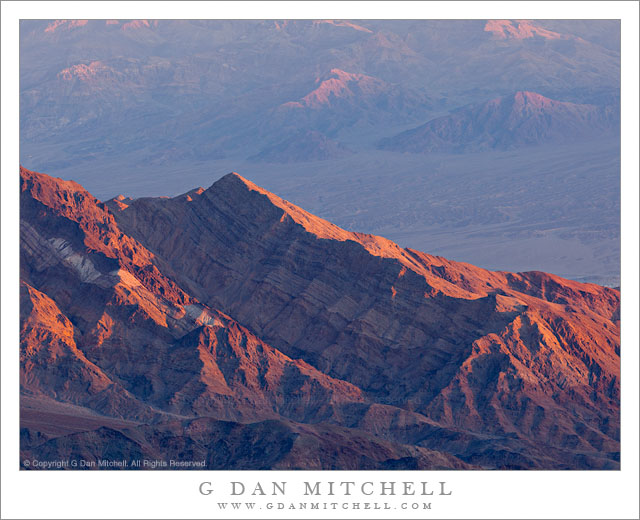
“Detail, Red Cathedral” — The eroded and fluted face of the Red Cathedral, Zabriski Point, Death Valley National Park.

I have recently posted other photographs made in the area of Zabriskie Point in Death Valley, including one other of this feature sometimes known as the Red Cathedral. It stands to the right of the more famous and recognizable parts of the Zabriskie Point Landscape where, for example, Manley Beacon is one of the most well-known visual icons in the park.

This detail photograph was made using a long lens very shortly after the first morning light had arrived on this feature. In my experience, getting good light on Red Cathedral can be a tricky thing. Parts of it face away from the sun and towards Death Valley and because its face is deeply fluted it can be tricky avoiding blocked shadows. But increasing exposure too much creates problems with saturated colors on the brightest strata that cut through its face. If you shoot it in the morning, light somewhat softened by some high clouds can be helpful, and that is what I had on this morning – the sun light is direct, but it is also filtered a bit by passing through broken clouds to the east.


Leave a comment or question using the form. (If you are reading this on the home page, click the article title to see the full article and the comment form.

G Dan Mitchell is a California photographer and visual opportunist. His book, “California’s Fall Color: A Photographer’s Guide to Autumn in the Sierra” (Heyday Books) is available directly from him. Blog | Bluesky | Mastodon | Substack Notes | Flickr | Email

All media © Copyright G Dan Mitchell and others.

Morning Light, Zabriskie Point, Detail

Morning Light, Zabriskie Point, Detail

Morning Light, Zabriskie Point, Detail. Death Valley National Park, California. April 2, 2009. © Copyright 2009. G Dan Mitchell – all rights reserved.

Detail of eroded gullies and hills at the edge of Gower Gulch in morning light, Zabriskie Point, Death Valley National Park.

This photograph focuses on a small section of the contorted and folded geological shapes along the edges of Gower Gulch at Zabriskie Point in Death Valley National Park. These details fascinate me, not only for the amazing variety of forms that they present but also because they change continuously as the light changes. Here they are illuminated by fairly stark light from early morning sun light that has just appeared as the sun rose above the hills to the east. The contrasts between the brightly lit tops of the small hills and the deeply shadowed gullies is clear, but if you look closely you may be able to see that the shadows are lit, as well, by the light reflected into them from the obscured sunlit faces of the gullies that are not visible from this position.

When I return to Zabriskie, I may take a few moments to make photographs of momentary soft light as the first sun strikes Manley Beacon, but I have become much more interested in photographing these small details of the scene. I usually work with a very long lens, and continue to shoot long after the “golden hour” sunrise light has gone since some of the small subjects are better lit by higher light.

G Dan Mitchell is a California photographer whose subjects include the Pacific coast, redwood forests, central California oak/grasslands, the Sierra Nevada, California deserts, urban landscapes, night photography, and more.
Blog | About | Flickr | Twitter | Facebook | Google+ | 500px.com | LinkedIn | Email

Text, photographs, and other media are © Copyright G Dan Mitchell (or others when indicated) and are not in the public domain and may not be used on websites, blogs, or in other media without advance permission from G Dan Mitchell.