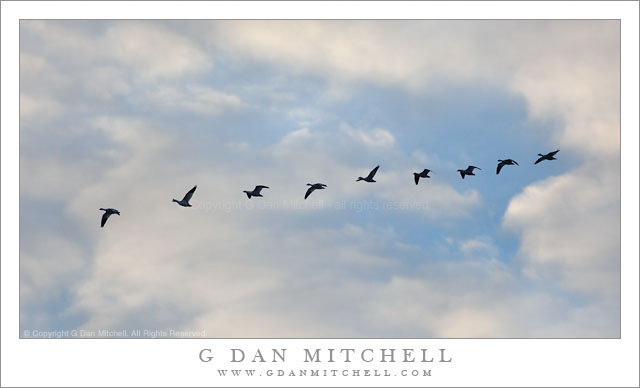
A flock of snow geese against the partly cloudy winter sky above the Merced National Wildlife Reserve, California.
Yes, yet another in the series of photographs of migratory birds above the Merced National Wildlife Reserve made on a winter evening in February. While I missed the “fly in” (though saw it happening a ways north of my position) I did watch hundreds and hundreds of birds of all types pass overhead. Every time I would start to wonder “where are the birds?” or worry about whether I would miss the fly in, another flock would appear and traverse the sky above me.
It was my good fortune – certainly little careful planning was involved! – to be out here during a brief evening window of interesting light and sky as a storm cleared. In fact, as I drove towards the Refuge I at first thought that some of the larger clouds to the west might block the evening light or even bring a bit of rain. However, as sunset approached the clouds continued to thin and I ended up with a beautiful sky full of broken clouds that were gently illuminated as the day ended.
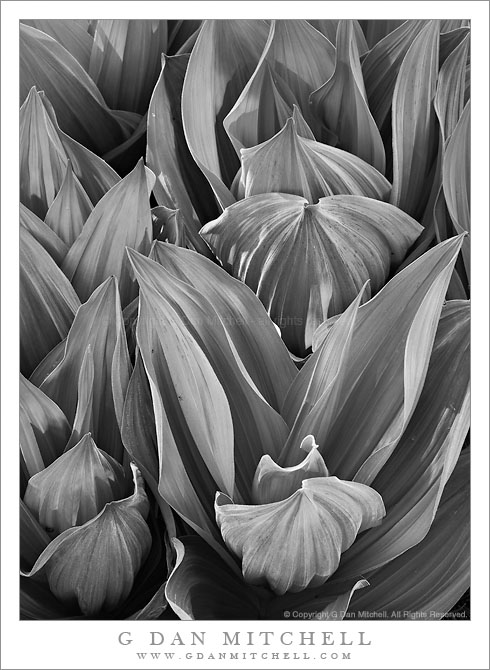
High Sierra corn lilies grow profusely near a waterlogged meadow in the high country of Yosemite National Park.
I had spotted this little meadow area on my way to photograph earlier in the morning at Tenaya Lake, so on my return I decided to wander down into this wet, meadowy area where a small creek flows in the early summer season. As I walked up the stream I came upon large and lush stands of corn lily plants in a boggy area where the stream turned and twisted through a flat area.
I have long been a fan of these plants. I’m fascinated by them at every phase of their annual life cycle, from the time when they first poke up from ground newly free of snow, through this phase when they grow thick and wildly green, to the first hints of brown at the tips of the leaves (which always seem to come a bit too early), to the time in late August when they begin to turn brown and yellow and hint at the coming fall, to the dry stalks that fall over in late September and October.
It is somewhat hard to give up the beautiful green color when you photograph the plants at the peak of growth, as these were when I photographed them at the end of June. However, I like the way that black and white abstracts the curving and sweeping shapes of the plants. (And I always think of John Sexton’s wonderful corn lily photograph when I work with this subject!)
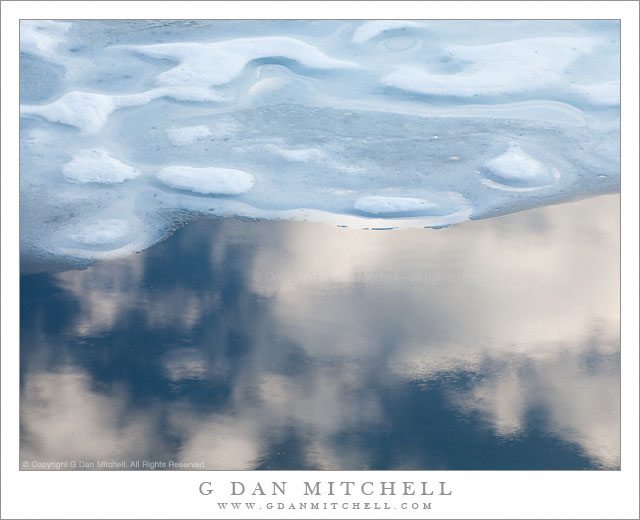
Clouds in blue sky are reflected in the surface of Gaylor Lake next to melting winter ice.
This photograph is very similar to another I made on this late June evening in 2010 when a small group of us hiked over a ridge near Tioga Pass to find a snow covered valley and this lake that was still almost completely covered with ice. The deep blue water near the edge of the melting ice along the shoreline reflected evening clouds passing overhead, and there were quite a few possible compositions combining the clouds, blue sky, curving edge of the ice and the interesting formations where the ice surface was melting. I made quite a few photographs – some up close like this one and others taking in the larger landscape. As I was recently reviewing raw files from 2010, I ended up spending quite a bit of time with this set of images!
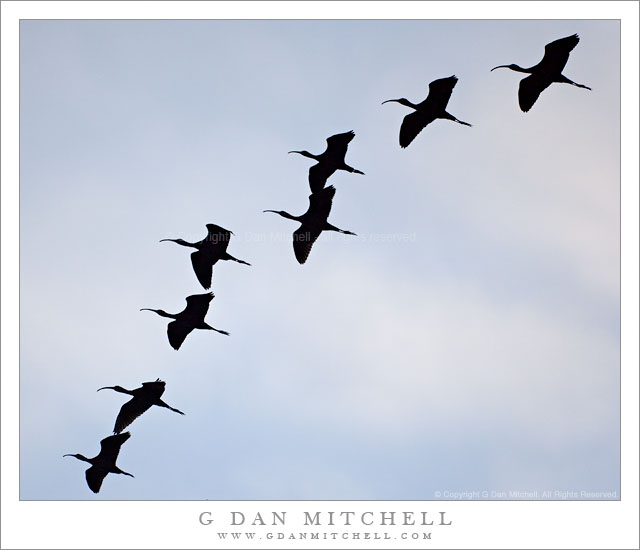
A flock of white-faced ibises is silhouetted against evening blue sky and clouds above the Merced National Wildlife Refuge.
On this winter evening I visited, for the first time, the Merced National Wildlife Reserve on a detour I took while returning home from a few days photographing in Death Valley. This winter I have (finally!) started to become aware of the amazing annual influx of migratory birds in California’s Central Valley and I managed to get out there a couple of times to view and photograph the magnificent flocks of birds. Being new at this, I have been working at figuring out just how to photograph this subject, and I’ve come up with a few approaches that seem to work, though I have a lot to learn. In this case, I had figured out that if I just picked a spot and waited that eventually flocks would fly over my position, and that I would have a chance of photographing them against the evening sky and clouds. Being almost completely ignorant when it comes to identifying these birds – but no less impressed with them because of this – I had virtually no idea what I was photographing in the moment when I tracked the birds and made the exposures. In fact, it wasn’t until later that I noticed the wonderful curved bills of these birds and then found out from my friend Tom Clifton (who does know how to identify these critters) what they were.
As the birds approach I work to synchronize my camera motion with the speed and direction of their flight. I try to keep them in the frame, and preferably in the frame in a way that might create an interesting composition. And while I do that I try to keep some attention on the background against which they fly and some small remaining bit of my attention on the technical matter of keeping at least one of them under an autofocus point in the camera’s viewfinder. As a flock approaches, things seem to start out fairly slowly and it may seem like the birds are taking a long time to arrive. But as they get closer – especially when shooting with a 400mm focal length and double-especially when they are as close as this flock – the action speeds up, and as they pass overhead it is all I can do to keep them centered in the viewfinder as I let the camera’s burst mode do its job at the right moment.
There are things about the experience that the camera cannot capture. The cold and damp of a Central Valley winter evening might be evoked by the right sort of landscape photograph, but not by a photograph like this one – yet this is an integral part of the experience. Even more than that, the sound of these birds, alone or in huge groups, sticks in my mind as much or more than the visual image. If you have been there and heard it, perhaps a photograph may cause you to recall it.