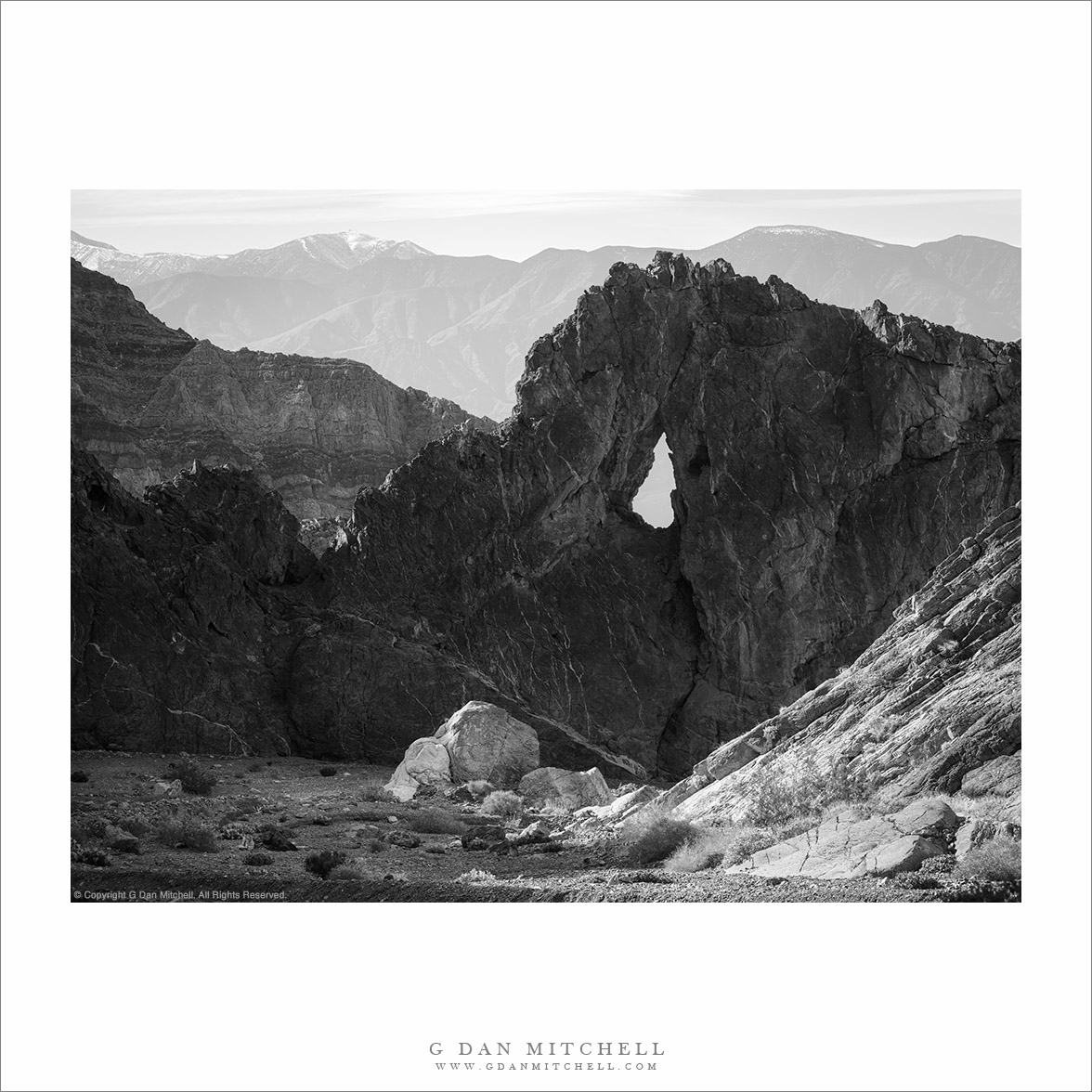
“Window Formation, Desert Mountains” — Desert mountains beyond a teardrop-shaped window in a rock wall, Death Valley.
Death Valley National Park is full of popular and famous attractions that are quite accessible — Mesquite Dunes, Badwater, Zabriskie Point, to name a few. But there’s far more to this immense park than the popular spots. There are equally worthy things to see everywhere, including in some rather remote locations. This is one of those sights, and the odds are that you would be alone here if you were to visit.
The feature is an impressive tear-drop shaped “window” in a wall of rock that stands on the inside of a sharp bend in the canyon. Beyond, further canyon walls rise above the wash, and in the far distance we see the highest peaks of the Panamint Range, including 11,000’+ Telescope Peak.
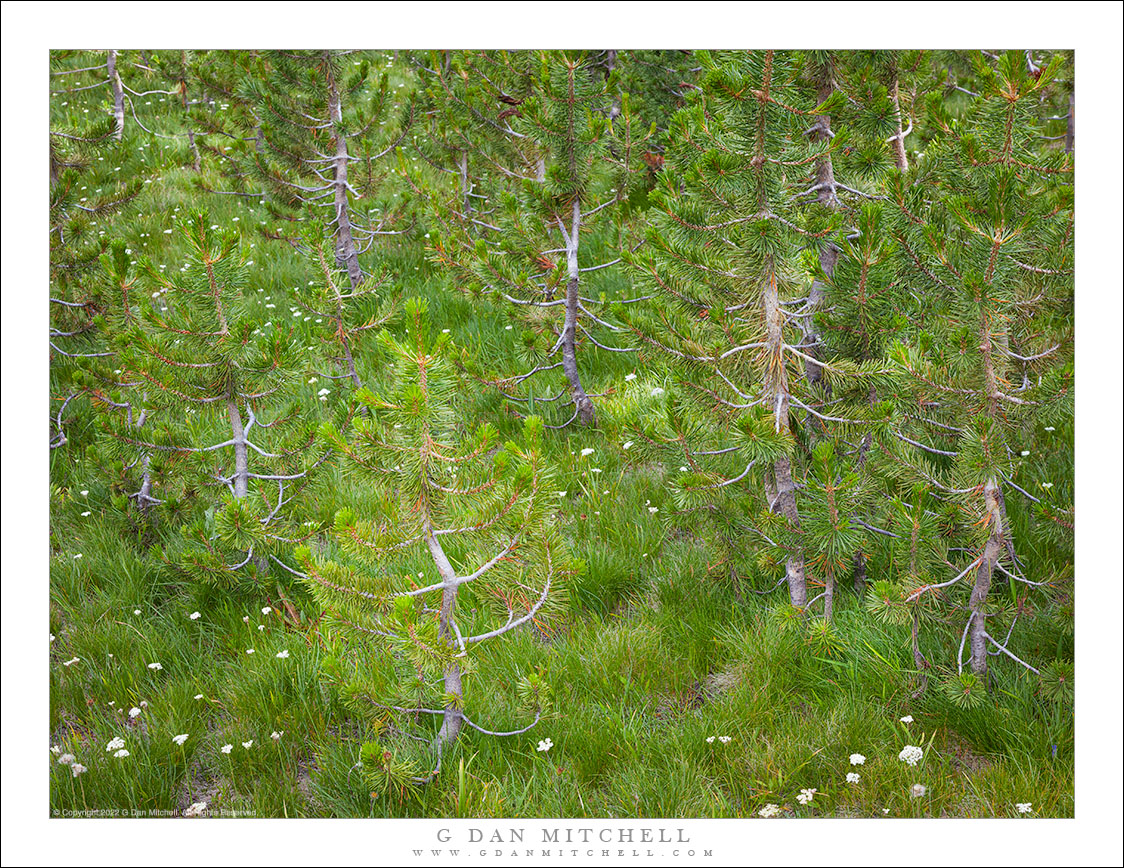
Lodgepole pines growing at the edge of the meadow at Tioga Pass
While I often prefer to minimize the content of photographs when possible — some of my favorites qualify as minimalist images — I also have a weakness for trying to make photographs out of extremely dense subjects. (If you know a bit about “minimalism,” you may recognize that filling space with details can also be a characteristic.) Sometimes the pure density and complexity of the scene is enough, though at other times the challenge is in finding a viable composition among so much detail.
This little “baby forest” vignette is from high in the subalpine zone in the Yosemite Sierra, in the young forest near the edge of a meadow, a place where new trees can gain a foothold out of the literal shadows of the more established trees. Particularly in the early season — late spring and the start of summer — spots like this can be lush and full of new greenery and wildflowers.
G Dan Mitchell is a California photographer and visual opportunist. His book, “California’s Fall Color: A Photographer’s Guide to Autumn in the Sierra” is available from Heyday Books, Amazon, and directly from G Dan Mitchell.
“Autumn Leaves, Sand” — Autumn oak and box elder leaves lie on the pink sand in the bottom of a wash, Zion National Park
The thing that most often first catches my attention in the bottom of slot canyons, such as this small one in the Zion National Park high country, is the way that they twist between closely spaced vertical walls. There is virtually nothing quite like this in our experience. But the thing I notice first is not necessarily the thing I remember most. I often wonder how others might regard my photographs, since I know that they cannot share the full context of the images that I know from being in these places. (I’ve often said that we, as the photographers, are perhaps the least able to see our own work objectively, since we cannot easily put aside these non-photographic things that are no longer present in the purely visual medium within which we work.) When I think of these canyons I think of the sound, often deadened by the sand and perhaps by vegetation, and of the feeling of the air, which always different from the feeling of the air outside the canyon – most often cooler when the “outside” air is warm but also warmer when the canyon provides shelter from cool-season winds. And it those canyons with water flowing through them, there is the constant, though often gentle sound of water flowing and trickling.
I also usually end up slowing down and looking at many small things that might not first be seen – the leftover pattern of water than may have flowed through weeks or months earlier, place where the sand has been marked by the passage of a small animal or by grass moving across its surface in the breeze, the mixture of rocks that must have come from distant places, plants growing in odd cracks in the rock, patterns in the rock walls, the passage from one rock layer to another, and more. On this fall day it had been windy and lots of autumn “stuff” was littering the canyon floor, which here was pink sandstone sand, further colored by the glowing light reflected from the red rock canyon walls.
Leave a comment or question using the form. (If you are reading this on the home page, click the article title to see the full article and the comment form.
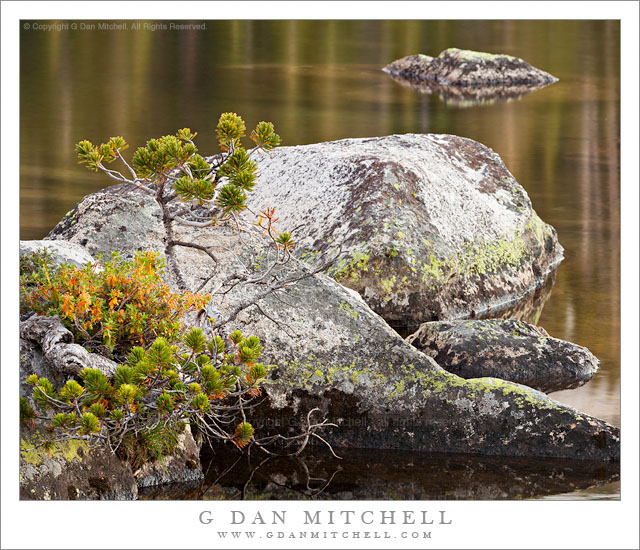
A small tree grows in a shoreline rock garden along a Sierra Nevada lake in the back-country of Yosemite National Park.
I’m posting this one because a person who posted here a week or two ago on a similar photograph asked whether I had made any photographs that included a bit more of the surface of the lake and its reflections of the forest in the distance. In fact, I had one more, and this is it.
I made this photograph and the other one in soft light at the edge of the day when no direct sunlight was in the scene at all. While this can flatten the light a bit, it also tends to fill in that shadow areas and create a less harsh sort of light. In also contributed to the interesting reflected and diffused forms of the forest along the far bank of the lake, whose vertical forms cross the horizontal forms of underwater rocks along the bottom of the lake bed.
G Dan Mitchell is a California photographer whose subjects include the Pacific coast, redwood forests, central California oak/grasslands, the Sierra Nevada, California deserts, urban landscapes, night photography, and more. Blog | About | Flickr | Twitter | Facebook | Google+ | 500px.com | LinkedIn | Email
Photographer and visual opportunist. Daily photos since 2005, plus articles, reviews, news, and ideas.
Manage Consent
To provide the best experiences, we use technologies like cookies to store and/or access device information. Consenting to these technologies will allow us to process data such as browsing behavior or unique IDs on this site. Not consenting or withdrawing consent, may adversely affect certain features and functions.
Functional
Always active
The technical storage or access is strictly necessary for the legitimate purpose of enabling the use of a specific service explicitly requested by the subscriber or user, or for the sole purpose of carrying out the transmission of a communication over an electronic communications network.
Preferences
The technical storage or access is necessary for the legitimate purpose of storing preferences that are not requested by the subscriber or user.
Statistics
The technical storage or access that is used exclusively for statistical purposes.The technical storage or access that is used exclusively for anonymous statistical purposes. Without a subpoena, voluntary compliance on the part of your Internet Service Provider, or additional records from a third party, information stored or retrieved for this purpose alone cannot usually be used to identify you.
Marketing
The technical storage or access is required to create user profiles to send advertising, or to track the user on a website or across several websites for similar marketing purposes.