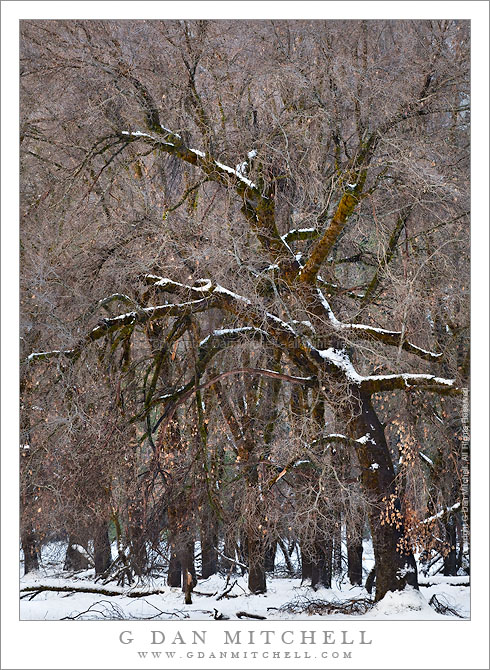
Snow dusts winter oak trees in El Capitan Meadow, Yosemite Valley.
A thick-trunk mature black oak fringed with snow stands in front of a grove of smaller oaks in El Capitan Meadow, Yosemite Valley. The small branches in the upper part of the tree are so thick that they almost create a cloud-like effect in this light, as the low angle winter sun leaves the Valley floor in shadow. A few leaves still remain on the lower branches of the tree.
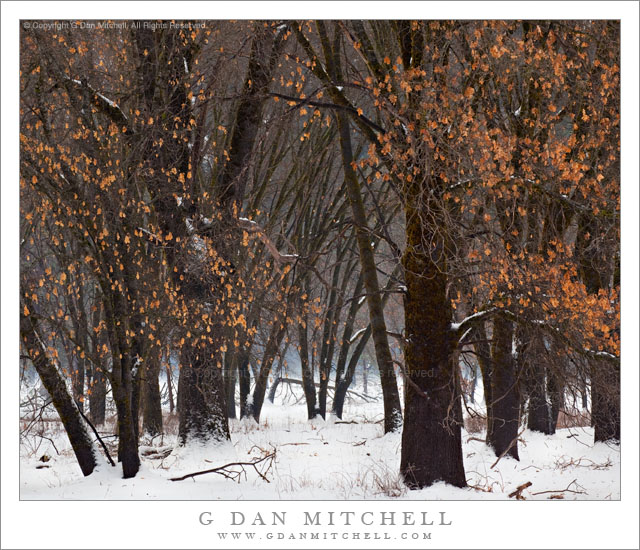
Black oak trees with a few remaining autumn leaves in foggy and snow-covered El Capitan Meadow, Yosemite Valley.
I’m always fascinated by the trees in El Capitan Meadow – it doesn’t matter whether it is spring when the meadow is green and the trees are getting new leaves, summer when the meadow is filled with people watching climbers overhead on El Capitan, fall when the grasses turn golden and the leaves change to fall colors, or winter when the meadow may be snow-covered. Sometimes I tell myself that I’m just going to drive past on my way to another destination, but I almost always end up stopping for a least a brief look around – and I frequently end up making a few photographs.
That was the case on this mid-January day, when I drove through on my way to make photographs up on Crane Flat Road. As I passed by the meadow I noticed that low fog was floating above the snow, so I pulled over to look at the scene more closely. I was somewhat surprised to see how many leaves were still hanging on the oak trees so late in the season, and I decided to try to find a photograph that would include them, along with the snow and a bit of the fog and the dark shapes of the tree trunks.
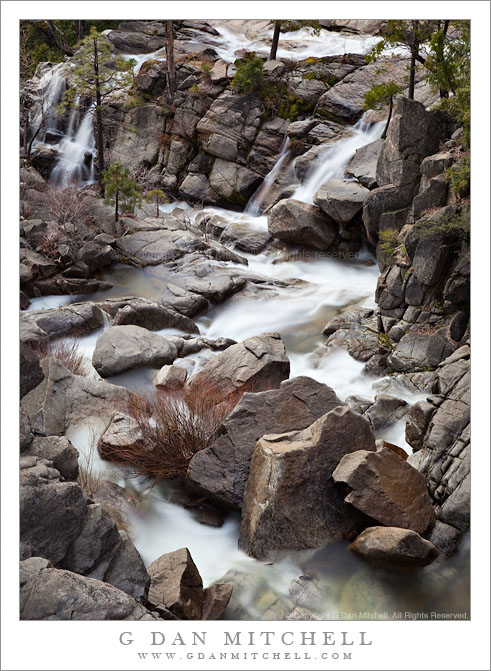
Long exposure in evening light of the boulder-strewn confluence of Cascade and Tamarack Creeks, Yosemite National Park.
Right below the bridge along the Crane Flat Road (often described as highway 120) route into Yosemite Valley, two wildly cascading creeks join together before their final descent to the bottom of the canyon where they join with the Merced River. Cascade Creek is probably the better known of the two since some spectacular sections of its descent are clearly visible right above the roadway. Tamarack Creek is easier to miss since you have to look carefully into the trees if you try to spot it from your car, or else get out of the car and look more closely. In the photograph, Cascade Creek flows away from the bottom of the frame, and Tamarack joins from the right in the upper portion of the frame.
I’ve always paid more attention to the section of Cascade Creek that is above the bridge. However, after recently having several opportunities to carefully (and admiringly) view Charlie Cramer’s stunning print of his “Cascade Creek, Spring, Yosemite”, I decided that I really needed to look off the other side of this bridge! (Charlie, I found your rocks. First, I’m even more impressed now that I realize how obscure and out of the way the subject of your photograph is. Second, how the heck did you position the camera over the side of the bridge to make that photograph!?) With that in mind, I visited this spot several times on this weekend trip to Yosemite and tried photographing it in different types of light.
This photograph is not in the public domain and may not be used on websites, blogs, or in other media without advance permission from G Dan Mitchell.
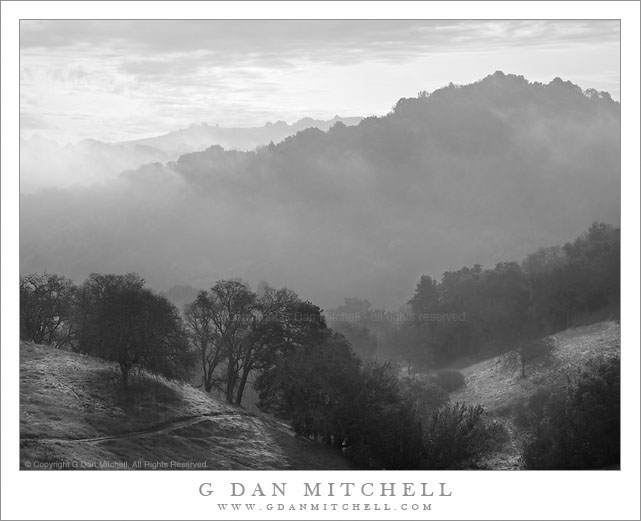
Morning winter fog clears from the oak forest and grassland of the Calero Hills, California.
This is a sort of scene that seems to me to be a prototypical California view. Almost anywhere you go west of the Sierra and away from either the redwoods or deserts, you won’t be too far from places like this that feature grassland, oak trees, and some sort of vertical relief in the landscape. This area happens to be a short drive from where I live. It is merely a local county park and not a place that most would regard as special. However, because it is so close, I have been able to spend a great deal of time here in all seasons, at all times of the day, and in all sorts of weather conditions. Eventually I found that there is an almost unending supply of potential photographic subjects even in this spot that would certainly not impress most people as being exceptional.
I made this photograph back near the beginning of 2010, and shortly after that a posted an early version here. That version was in a slightly wider format and it was in color. As part of my year-end review of all of my raw files from 2010, I saw this image again in its original form… and this time I saw it a bit differently, in black and white and with a more “traditional” 4:5 ratio format. Contrary to what I though originally, I now think that the narrower format does a more effective job of juxtaposing the stacked angles of close, middle and far ridges, and it also let me eliminate some stuff along the margins that now seems distracting to me.
To the extent that this version of the image works, I think it illustrates something that I’ve heard others say and which resonates with my own experience, namely that it is sometimes easier to “see” what is in a photograph when you get a bit more distance from the act of “capturing” it.
This photograph is not in the public domain and may not be used on websites, blogs, or in other media without advance permission from G Dan Mitchell.
Photographer and visual opportunist. Daily photos since 2005, plus articles, reviews, news, and ideas.
Manage Consent
To provide the best experiences, we use technologies like cookies to store and/or access device information. Consenting to these technologies will allow us to process data such as browsing behavior or unique IDs on this site. Not consenting or withdrawing consent, may adversely affect certain features and functions.
Functional
Always active
The technical storage or access is strictly necessary for the legitimate purpose of enabling the use of a specific service explicitly requested by the subscriber or user, or for the sole purpose of carrying out the transmission of a communication over an electronic communications network.
Preferences
The technical storage or access is necessary for the legitimate purpose of storing preferences that are not requested by the subscriber or user.
Statistics
The technical storage or access that is used exclusively for statistical purposes.The technical storage or access that is used exclusively for anonymous statistical purposes. Without a subpoena, voluntary compliance on the part of your Internet Service Provider, or additional records from a third party, information stored or retrieved for this purpose alone cannot usually be used to identify you.
Marketing
The technical storage or access is required to create user profiles to send advertising, or to track the user on a website or across several websites for similar marketing purposes.