
Tag Archives: peak

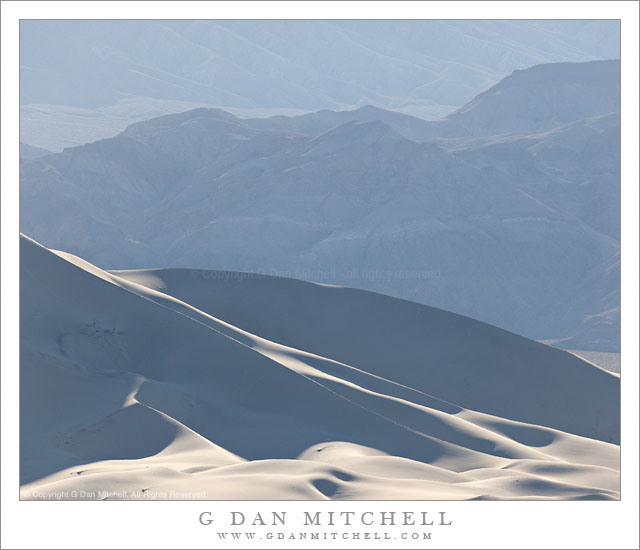
Eureka Dunes and Last Chance Range, Morning

Eureka Dunes and Last Chance Range, Morning - Morning light on the Eureka Dunes and the hills of the Last Chance Range, Death Valley National Park.
Morning light on the Eureka Dunes and the hills of the Last Chance Range, Death Valley National Park.

Eureka Dunes and Last Chance Range, Morning. Death Valley National Park, California. January 6, 2012. © Copyright 2012 G Dan Mitchell – all rights reserved.

Morning light on the Eureka Dunes and the hills of the Last Chance Range, Death Valley National Park.

While I love – who doesn’t? – the golden hour light on the desert dunes and hills and valleys, I also like to seek out the subtler and more “atmospheric” effects that are often frequently seen in this terrain. I had spent the (very cold!) night alone out here in Eureka Valley. I woke up fairly early, though with the sun having to rise past the ridge of the Last Chance Range, the light did not come early. I soon packed up my camp – which largely meant rearranging stuff in my vehicle – and before long started the drive out toward Lone Pine and my trip back home over Tioga Pass.

But first I planned to stop just a ways away from the camping area so that I could use a long lens to photograph the dunes against the background of the higher surrounding peaks. By the time I did this it was after 9:00 a.m. and the early morning golden hour light was long gone, replaced by the soft and hazy bluish light that is more typical during daylight hours. However, the sun was still low enough to glance across the dunes at a fairly low angle and to backlight the dunes and the mountains behind them. The idea here was to juxtapose some of the different textures, lines, curves, and angles of this landscape – the curving forms of the dunes near the bottom of the frame, the sharply delineated sunlit ridges of the upper dunes, the faint view of jagged and stratified rocks in the low peaks beyond them, the further ridge inclining the opposite direction from the dunes, and the much fainter texture of the huge valley in the distance.

G Dan Mitchell is a California photographer whose subjects include the Pacific coast, redwood forests, central California oak/grasslands, the Sierra Nevada, California deserts, urban landscapes, night photography, and more.
Blog | About | Flickr | Twitter | FacebookGoogle+ | 500px.com | LinkedIn | Email

Text, photographs, and other media are © Copyright G Dan Mitchell (or others when indicated) and are not in the public domain and may not be used on websites, blogs, or in other media without advance permission from G Dan Mitchell.
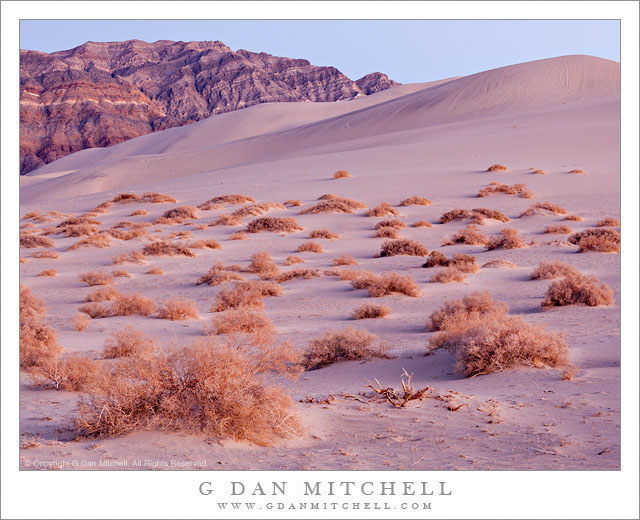
Eureka Valley Dunes, Dusk

Eureka Valley Dunes, Dusk - Pink dusk light on the Eureka Valley Sand Dunes, Death Valley National Park.
Pink dusk light on the Eureka Valley Sand Dunes, Death Valley National Park.

Eureka Valley Dunes, Dusk. Death Valley National Park, California. January 5, 2012. © Copyright 2012 G Dan Mitchell – all rights reserved.

Pink dusk light on the Eureka Valley Sand Dunes, Death Valley National Park.

On the second-to-last day of my January visit to Death Valley, I decided that it would make sense to exit the park to the north by way of miles of gravel roads heading into the northern portion of the park then out via more gravel and then some paved roads to Big Pine the next day, setting me up to return home over snow-free (in January!) Tioga Pass. After shooting early in the morning I headed back to my camp – at Stovepipe Wells at that time – had some breakfast, took down my camp, and packed. By the time I fueled up my car and headed north, I was a bit behind my planned schedule, but I figured that I might still make it to Eureka Valley in time to shoot in some late afternoon light.

A few hours later, after a drive including over 40 miles of gravel, I finally arrived at the site of these monumental dunes. At nearly 700 feet tall, they are supposedly the tallest dunes in the United States – or is it in North America? Eureka Vally is a lonely place, being a long drive on rough roads from any direction and almost completely without the civilized services found in some other areas of the park. When I got there, a family that had visited was just leaving, and there was one other photographer shooting high up on the dunes. I knew that I didn’t have enough time to try that, so I grabbed my gear and hiked over to one side of the dunes where their lower slopes begin to merge with the flat surface of the valley and where the last sun would hit the dunes. I shot there for a while and after the sun dropped below the ridges to the west I went looking for subjects that might benefit from the post-sunset soft and pink light. Very close to my “campsite” (which was in the back of my vehicle that night!) I saw these plants leading up toward the summit of the dunes and the higher stratified peaks beyond, and I made a few photographs in the rose-colored late light.

G Dan Mitchell is a California photographer whose subjects include the Pacific coast, redwood forests, central California oak/grasslands, the Sierra Nevada, California deserts, urban landscapes, night photography, and more.
Blog | About | Flickr | Twitter | FacebookGoogle+ | 500px.com | LinkedIn | Email

Text, photographs, and other media are © Copyright G Dan Mitchell (or others when indicated) and are not in the public domain and may not be used on websites, blogs, or in other media without advance permission from G Dan Mitchell.
Cook Bank Ruins, Rhyolite

Cook Bank Ruins, Rhyolite - The ruins of the Cook Bank in the ghost town of Rhyolite, Nevada, with barren desert hills under a pre-sunrise sky.
The ruins of the Cook Bank in the ghost town of Rhyolite, Nevada, with barren desert hills under a pre-sunrise sky.

Cook Bank Ruins, Rhyolite. Rhyolite, Nevada. January 3, 2012. © Copyright 2012 G Dan Mitchell – all rights reserved.

The ruins of the Cook Bank in the ghost town of Rhyolite, Nevada, with barren desert hills under a pre-sunrise sky.

This was the closest to the winter solstice that I’ve visited Rhyolite, so I shouldn’t have been surprised by several things. First, the sun came up not only later, but also a bit further south along the horizon – and the light that would usually strike these ruins at sunrise was blocked for a while by a large hill that sits next to the town. Second, it was cold! Third, no one else was there at sunrise! This is a bit unusual since in the Death Valley high season (which arrives a bit later in the year), Rhyolite can be a pretty popular place… for a ghost town… in the middle of the desert… in Nevada. :-)

Because I have photographed here several times before and for the reasons mentioned above, I took a bit of a different approach to photographing the place this time. The winter light, some high clouds, and the different point along the horizon of the sun rise meant that the light was quite different from what I’ve occasionally had to work with in the past. At first I was a bit disappointed to realize that the direct dawn light was not going to strike the old Cook Bank and other nearby buildings. But when some clouds to the east obscured the direct light and high, thin overhead clouds begin to pick up color and fill in the shadows, I saw that other interesting lighting was going to make up for it. At the moment that I made this photograph, those clouds to the east (right) of my position beautifully softened what might otherwise have been some stark and harsh light on the pinnacles beyond the town. They also created an unusual and beautiful quality of light for a few moments – a reddish-pink quality from the light reflected from the clouds but with a few soft quality.

I decided to shoot from a distance with a long lens so as to control the position of the ruins against the background hills, and the longer focal length makes these hills more prominent than they would be if I shot the building with a shorter focal length from a closer position. This also allowed me to more carefully eliminate some distracting elements that invariably appear at old sites like this. (The first times I visited, access to most of the ruins was quite unimpeded. Now fences have been erected around some of them. Part of me regrets the loss of access, but the greater part of me understands that this will allow these buildings to be around longer so that more people will get to see them. I stayed behind the fences.) If you look around on the web a bit, you can find some wonderful old photographs of this town when it was a bustling place with thousands of residents, and when the Cook Bank was a very impressive and modern-for-the-time building.

G Dan Mitchell is a California photographer whose subjects include the Pacific coast, redwood forests, central California oak/grasslands, the Sierra Nevada, California deserts, urban landscapes, night photography, and more.
Blog | About | Flickr | Twitter | FacebookGoogle+ | 500px.com | LinkedIn | Email

Text, photographs, and other media are © Copyright G Dan Mitchell (or others when indicated) and are not in the public domain and may not be used on websites, blogs, or in other media without advance permission from G Dan Mitchell.

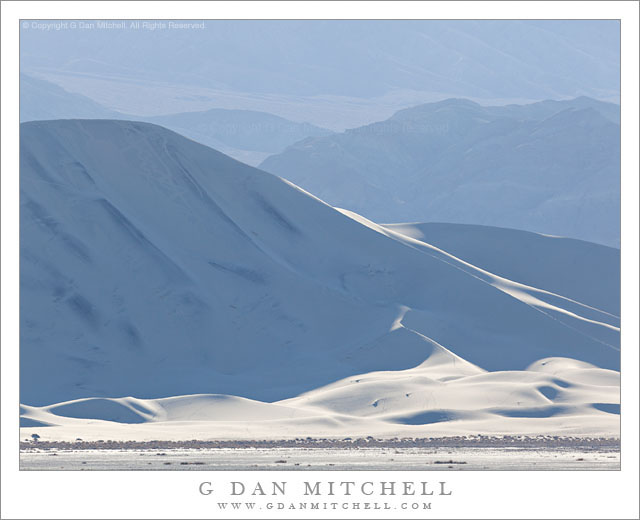
Dunes, Eureka Valley, Morning

Dunes, Eureka Valley, Morning - Morning light and haze at the Eureka Valley Dunes, Death Valley National Park, California.
Morning light and haze at the Eureka Valley Dunes, Death Valley National Park, California.

Dunes, Eureka Valley, Morning. Death Valley National Park, California. January 6. 2012. © Copyright 2012 G Dan Mitchell – all rights reserved.

Morning light and haze at the Eureka Valley Dunes, Death Valley National Park, California.

This seems like a typical desert scene, right? Hot, arid, a bit of summer haze… It may look that way, but it was 28 degrees when I made this photograph!

At the tail end of my early January photography visit to Death Valley National Park I went north from the Ubehebe Crater area on the long gravel route up to the remote Eureka Valley Dunes, which are described as the tallest dunes in the United States, being nearly 700 feet tall. I decided to visit here at the end of my trip for several reasons – first, believe it or not, I had not been to this major feature in the park before. Second, because the trans-Sierra passes were still open in the strange weather year, by going out the north end of the park I figured I could shorten my drive back to the Bay Area a bit.

I arrived the night before, just in time to shoot a little bit as the last light came and went. Then I spent a very cold night “camping” in the back of my car. I was up reasonably early, but it was so cold that it was very hard to get out of the sleeping bag. Finally I did so, and I put on all my warm clothes and marched around the camping area trying to warm up a bit. Finally, after the morning sun topped the tall ridge to the east, the light arrived and my world began to warm up a bit. Eventually I packed up and started my trip back out to civilization. But first I wanted to stop a ways out in the valley and do some long shots back towards the dunes. This is one of those photographs, made from a ways down the road using a long lens.

Somewhat surprisingly, when I finally got back in my car a bit after 9:00 a.m. and long after the sun arrived, I finally thought to check the outside temperature on my car’s thermometer. At about 9:15, out in the valley, and in the sun… the temperature had finally risen… to 28 degrees!

G Dan Mitchell is a California photographer whose subjects include the Pacific coast, redwood forests, central California oak/grasslands, the Sierra Nevada, California deserts, urban landscapes, night photography, and more.
Blog | About | Flickr | Twitter | FacebookGoogle+ | 500px.com | LinkedIn | Email

Text, photographs, and other media are © Copyright G Dan Mitchell (or others when indicated) and are not in the public domain and may not be used on websites, blogs, or in other media without advance permission from G Dan Mitchell.